The Best Anonymous Feedback Collection Tool: A 2026 Guide to Employee Intelligence
By Humae · 31 August 2026
using employee feedback for performance reviews
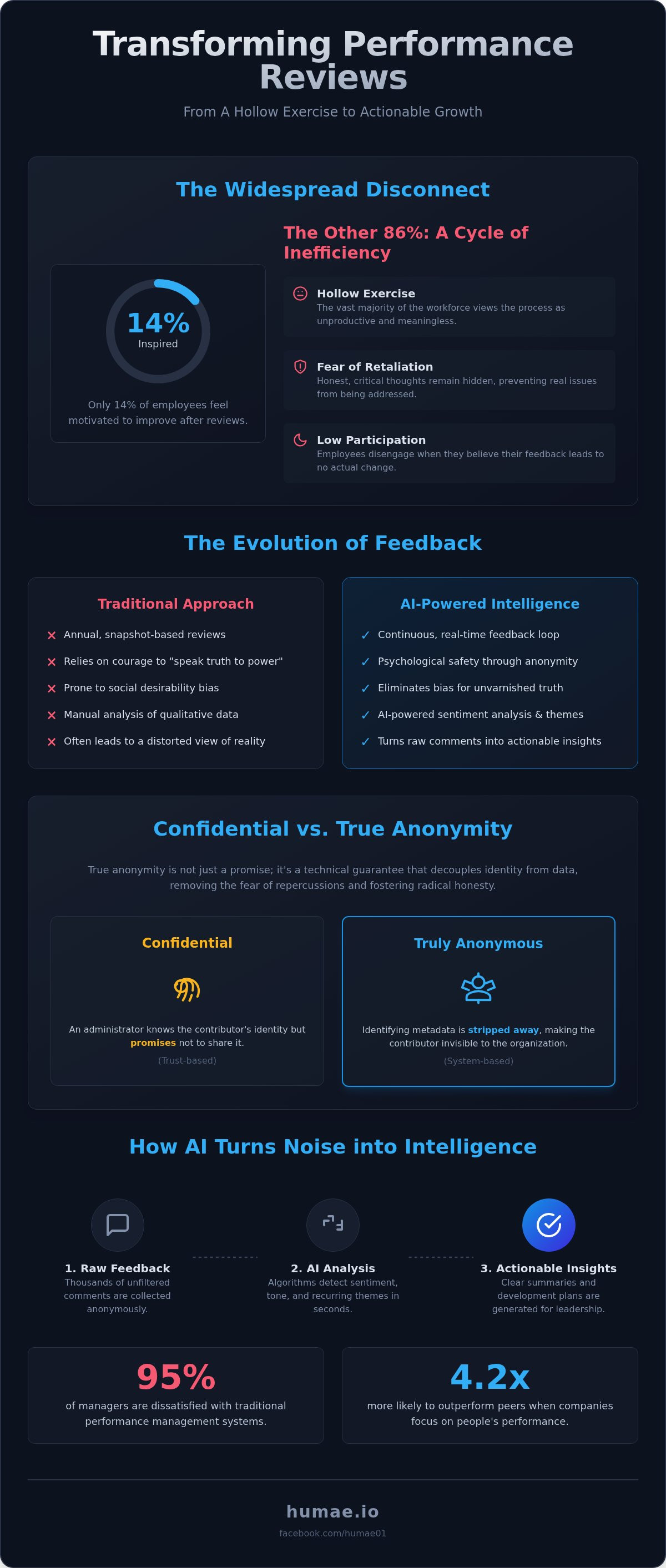
Only 14% of employees feel inspired to improve after their performance reviews, which means the vast majority of your workforce likely views the process as a hollow exercise. This disconnect often stems from the difficulty of using employee feedback for performance reviews in a way that feels safe and productive. You probably recognize the pattern: participation rates are low, and when people do speak up, the fear of retaliation keeps their most honest, critical thoughts hidden. It's exhausting to sort through qualitative comments that never seem to lead to actual organizational change.
We agree that feedback should be a catalyst for growth, not a source of anxiety. This guide reveals how to transform raw input into actionable growth using the next generation of AI-driven feedback tools. You will discover how modern platforms turn unfiltered comments into clear sentiment summaries and actionable development plans. We are moving beyond simple surveys to a future where performance intelligence and real-time OKR tracking create a clear path from raw feedback to measurable success.
Humae | humae.io | Facebook | Back to Home
Key Takeaways
- Learn how metadata stripping and advanced encryption create the psychological safety required for honest and high-quality employee participation.
- Discover the most effective methods for using employee feedback for performance reviews by replacing manual data analysis with AI-powered sentiment summaries.
- Identify the critical features of next-generation tools that bridge the gap between raw qualitative comments and measurable organizational growth.
- Understand how to integrate anonymous insights directly into your OKR tracking to ensure feedback leads to real-time performance improvements.
- Master the art of crafting empathetic, non-leading questions that yield actionable data while protecting the human element of your workplace culture.
What is an Anonymous Feedback Collection Tool and Why Does it Matter?
An anonymous feedback collection tool is a specialized software layer designed to strip away identifying metadata, such as IP addresses, timestamps, and browser signatures. It ensures that the contributor remains invisible to the organization. This goes beyond a simple survey. It creates a digital vault where the focus shifts from who said it to what was said. High-quality performance intelligence features allow this data to be processed without ever compromising the individual's identity.
Many organizations confuse confidential feedback with anonymous feedback. In confidential systems, an administrator knows the identity but promises not to share it. In truly anonymous systems, the data is technically decoupled from the user. For leaders focused on using employee feedback for performance reviews, this distinction is vital. True anonymity removes the fear of repercussions, allowing for a level of honesty that confidential systems often fail to reach.
Traditional open-door policies are well-intentioned but often functionally broken. They rely on the employee having the courage to speak truth to power. Without a digital safety net, most people choose silence over potential conflict. A dedicated tool provides the psychological safety required for a modern, healthy workplace to thrive.
The Psychology of Unfiltered Input
Anonymity is the most effective way to eliminate social desirability bias. This is the tendency for employees to answer questions in a way that will be viewed favorably by their managers. When you remove the name, you remove the filter. This leads to a high-performance company culture where problems are solved because they're actually acknowledged. Deepening your employee engagement strategies requires this level of raw, unvarnished truth.
Anonymity as a Trust Builder
It sounds counterintuitive, but keeping names private actually increases organizational transparency. Modern teams move away from top-down management toward collaborative intelligence. In this model, every voice contributes to the whole. By implementing 360-degree feedback through protected channels, leaders can spot early signs of burnout or turnover before they escalate into resignations. Using employee feedback for performance reviews becomes a proactive strategy rather than a reactive post-mortem. It allows managers to act as partners in growth, fueled by insights that employees would never share in a face-to-face meeting.
Humae | humae.io | Facebook | Back to Home
Using Employee Feedback for Performance Reviews: The Shift to AI Intelligence
The traditional annual review is dying. According to the PerformYard 2025 State of Performance Management Report, 95% of managers are dissatisfied with their current systems. Relying on a once-a-year snapshot creates a distorted view of workplace reality. The shift toward using employee feedback for performance reviews on a continuous basis allows for real-time course correction. However, the biggest challenge isn't collecting data; it's processing it. Human HR teams can't manually sort through thousands of comments without losing the context or introducing bias.
AI-powered sentiment analysis solves the qualitative data overload problem. Machine learning algorithms now identify recurring themes across thousands of comments in seconds. These tools detect subtle shifts in tone and sentiment that a human eye might overlook. Modern analytics dashboards give HR leaders a bird's-eye view of organizational health, turning raw noise into actionable intelligence. Effective leaders use this feedback to drive performance by acting on insights while the context is still fresh and relevant. Companies that focus on their people's performance are 4.2 times more likely to outperform their peers according to McKinsey and Company.
Moving Beyond Quantitative Scores
Quantitative metrics like eNPS scores provide a high-level pulse but lack the necessary depth for growth. They tell you that something is wrong, but they don't explain why. True performance intelligence relies on the voice of the employee found in qualitative responses. AI now categorizes these open-ended comments into distinct buckets: growth opportunities, operational friction, and cultural alignment. This ensures that when you're using employee feedback for performance reviews, you're looking at a nuanced narrative rather than just a spreadsheet of numbers.
Continuous vs. Pulse Feedback
The 2026 workforce demands speed and responsiveness. Research from Speakwise shows that 65% of employees desire more feedback than they currently receive. Low-friction pulse surveys integrated into your daily workforce management infrastructure meet this need without causing survey fatigue. You can set up automated triggers that alert managers when sentiment shifts in a specific department. This proactive approach prevents small issues from becoming systemic failures. If you're ready to evolve, exploring modern performance intelligence platforms can help bridge the gap between raw data and human potential.
Humae | humae.io | Facebook | Back to Home
Key Features to Look for in a Feedback Collection Tool
Selecting a platform isn't just about the interface. It's about the technical infrastructure that protects your people. When using employee feedback for performance reviews, the integrity of your data depends entirely on the security of the collection method. If employees suspect that their identity can be traced, they will revert to safe, generic answers. You need a tool that balances deep intelligence with uncompromising privacy protocols.
Processing qualitative data shouldn't be a manual chore for HR. The best tools offer automated summaries that highlight key themes instantly. Instead of reading 500 comments about "communication," AI identifies that the friction actually stems from "unclear project ownership." This level of detail is essential for using employee feedback for performance reviews that result in genuine behavioral change rather than just checked boxes.
Verifying True Anonymity
Go beyond a simple promise of privacy. You must verify the technical standards that keep your team safe. Look for IP masking and browser fingerprint protection to prevent any back-end tracking. A critical feature is the minimum response threshold. This ensures that managers can't deduce identities in small teams by blocking data visualization until a specific number of responses is reached. Review the Humae features list to see how modern security standards protect the respondent while delivering high-value insights.
Actionable Analytics Dashboards
Visualizing data is key to maintaining organizational health. A robust dashboard should provide sentiment trends to see if morale is rising or falling over months, not just days. Heatmaps are particularly effective for identifying organizational friction points across different segments. You should be able to filter data by department or tenure without ever compromising the individual's privacy. This allows you to move from guessing about culture to knowing exactly where to apply resources.
Finally, consider how the tool connects to your broader HRMS. A feedback tool shouldn't live in a silo. It must integrate with your OKR tracking and performance intelligence systems to be truly effective. If the interface is clunky, participation will drop. Choose a platform that feels like a natural, empathetic extension of your team's daily workflow.
Humae | humae.io | Facebook | Back to Home
How to Optimise Performance Reviews Using Employee Feedback
Transformation begins with a clear promise. If your team doesn't understand why they're being asked for input, they'll treat the process as a chore. Success starts by communicating the "why" and the technical privacy guarantees behind your tool. Using employee feedback for performance reviews requires a high level of transparency about how the data is handled. Once trust is established, you must ask the right questions. Avoid leading language that nudges employees toward a specific answer. Instead, use empathetic prompts that encourage deep reflection rather than quick, one-word responses.
A common fear among leaders is that anonymity might invite toxicity. This is where modern performance intelligence shines. AI moderation filters out aggressive language or personal attacks while preserving the core sentiment of the critique. This ensures the feedback remains constructive. By addressing this objection early, you create a safe space where radical honesty can coexist with professional respect. Integrating this stream into your regular management cycle turns performance reviews from a dreaded event into a continuous growth conversation.
Crafting High-Response Survey Questions
Open-ended questions are the engine of qualitative insight. Instead of asking "Are you happy with your manager?", try "What is one specific hurdle your manager could remove to help you succeed?" This shifts the focus from personality to productivity. You should also balance structured ratings with unstructured comments to get both the "what" and the "why." To avoid survey fatigue, keep pulse surveys short and vary the frequency based on your team's current workload. Strategic timing ensures that you capture data when it's most relevant.
The Close the Loop Framework
Silence is the fastest way to kill employee trust. If people share their thoughts and see no change, they'll stop participating. Closing the loop means sharing aggregated, anonymous results with the whole team and outlining specific planned actions. This is a critical part of modern performance management. When employees see their input reflected in organizational changes, they feel a sense of ownership over the culture. Negative feedback shouldn't be feared; it should be used as the foundation for collaborative problem-solving sessions that drive the company forward.
Ready to see how AI-driven insights can transform your team's culture? Explore the Humae platform to start building a more transparent, high-performing organization today.
Humae | humae.io | Facebook | Back to Home
Why Humae is the Future of Performance Intelligence
Most HR platforms are digital filing cabinets that store data without ever understanding it. Humae changes this by treating feedback as a living stream of intelligence. By using employee feedback for performance reviews within a centralized HRMS, you eliminate the fragmentation that plagues most organizations. Our platform doesn't just collect comments; it integrates sentiment analysis directly into your performance intelligence workflow. This ensures that every piece of anonymous input contributes to a clearer picture of individual and team growth.
The real power of Humae lies in its ability to connect qualitative insights to quantitative goals. We bridge the gap between how people feel and what they achieve by linking feedback to OKR tracking. When you see a dip in sentiment alongside a missed key result, you gain the context needed to fix the root cause. This centralized infrastructure covers everything from hiring and onboarding to continuous feedback, providing a single source of truth for your entire workforce management strategy.
Intelligence Over Information
Managers don't have time to read through hundreds of survey responses every month. Humae’s AI does the heavy lifting by summarizing key takeaways into digestible reports. You save hours of manual analysis while gaining deeper insights into your team's needs. Beyond simple summaries, our predictive analytics identify retention risks early by spotting subtle shifts in engagement patterns. You can see how it works to understand how our real-time dashboards empower leaders to act immediately rather than waiting for the next quarterly review.
Scaling Culture with Technology
Whether you're a fast growing startup or a global enterprise, your culture depends on trust. Humae provides the flexible tools needed to scale that trust as you grow. We believe technology should never replace human empathy; it should amplify it. By using employee feedback for performance reviews in a way that feels safe and productive, you bridge the gap between digital efficiency and human connection. Our mission is to help you build a smarter, more connected workplace where every employee feels heard and every leader feels equipped to support them.
Build a culture of radical honesty and measurable growth. Start your journey with Humae today and transform your raw data into a high-performance roadmap.
Humae | humae.io | Facebook | Back to Home
Transform Your Organizational Intelligence
The shift from annual evaluations to continuous, AI-driven insights isn't just a trend; it's a necessity for any high-performing team. We've explored how technical anonymity creates the psychological safety needed for radical honesty. By using employee feedback for performance reviews that are backed by real data, you move beyond guesswork and start making decisions that actually improve culture. It's about turning silent frustrations into actionable growth strategies that resonate with your entire workforce.
Humae offers a global workforce management infrastructure designed for this modern reality. Our platform combines AI-powered sentiment analysis with integrated OKR tracking to ensure every voice leads to a measurable result. This centralized approach means you can manage hiring, onboarding, and feedback all in one place without losing the human touch. You don't have to choose between digital efficiency and deep empathy. Start Building a High-Trust Culture with Humae and see how performance intelligence can redefine your success. Your team is ready to be heard. Give them the platform they deserve.
Humae | humae.io | Facebook | Back to Home
Frequently Asked Questions
Is an anonymous feedback collection tool truly anonymous?
True anonymity depends on technical infrastructure like IP masking and metadata stripping. Humae ensures that respondent identities are decoupled from their contributions. This technical safeguard prevents any back-end tracking; creating a secure environment where employees feel safe sharing unvarnished truths. By decoupling the user from the data, organizations can focus on the message rather than the messenger, which is the foundation of high-quality organizational intelligence.
How do I prevent toxicity in anonymous employee surveys?
Toxicity is prevented through AI-powered moderation and structured survey design. Modern tools use natural language processing to flag aggressive or personal attacks before they reach managers. This doesn't censor the feedback; instead, it preserves the core sentiment while filtering out harmful language. By setting clear expectations and using empathetic prompts, you encourage constructive criticism. This balanced approach ensures that using employee feedback for performance reviews remains a professional and productive exercise.
What is the best frequency for collecting anonymous feedback?
The best frequency depends on your team's pace, but weekly or bi-weekly pulse surveys are generally most effective. Research indicates that 43% of highly engaged employees receive feedback at least once a week. Frequent, low-friction check-ins prevent survey fatigue and allow for real-time adjustments. This cadence ensures that insights are fresh and relevant, making it easier to integrate findings into your regular workforce management cycle without overwhelming your staff.
Can managers see who sent specific feedback in Humae?
Managers cannot see the identity of respondents in Humae. The platform is built on a technical architecture that prioritizes psychological safety by stripping all identifying metadata. Even administrators are restricted by minimum response thresholds; these block data visualization for small groups to prevent deductive identification. This commitment to privacy is why teams trust Humae to facilitate honest communication, ensuring that the feedback provided is genuine and actionable.
How does AI sentiment analysis work for employee feedback?
AI sentiment analysis uses machine learning to categorize qualitative text into emotional buckets like positive, neutral, or negative. It identifies recurring themes and shifts in tone across thousands of comments in seconds. This allows leaders to spot organizational friction points that human analysis might miss. Instead of manually reading every entry, you get automated summaries that highlight the most critical areas for growth, turning raw noise into actionable performance intelligence.
Should I share anonymous feedback results with the whole team?
Sharing aggregated results is essential for building trust and closing the loop. When employees see that their input is acknowledged and leads to specific actions, participation rates increase. You don't need to share every comment, but summarizing the key themes and planned improvements demonstrates accountability. This transparency proves that the organization values the voice of the employee, turning a simple survey into a collaborative roadmap for cultural success.
What is the difference between a pulse survey and a continuous feedback tool?
A pulse survey is a specific, periodic snapshot of sentiment, while a continuous feedback tool is an always-on infrastructure. Pulse surveys are great for tracking trends over time, but continuous tools allow employees to provide input whenever a situation arises. Humae integrates both into a centralized HRMS, combining regular check-ins with real-time OKR tracking. This ensures that using employee feedback for performance reviews is based on a complete narrative rather than isolated data points.