Structured Interview Feedback Software: The 2026 Buyer’s Guide
By Humae · 18 May 2026
structured interview feedback software
What if your most critical business decisions are being made based on a gut feeling that changes with every cup of coffee? It's a frustrating reality for many teams where inconsistent notes and manual documentation lead to recruiter burnout and, ultimately, poor culture fits. Standardizing your evaluation process isn't just about being organized; it's about building a defensible, high-performing organization. Utilizing modern structured interview feedback software allows you to eliminate hiring bias and streamline candidate evaluation with the latest in structured interview intelligence.
We understand that you want a faster time-to-hire without sacrificing the human connection that makes your company unique. This 2026 buyer's guide will show you how to achieve a higher quality of hire and standardized evaluations across every department. We'll dive into the essential features of interview intelligence, the impact of the August 2026 EU AI Act enforcement, and how to ensure your feedback loops sync perfectly with your existing ATS and performance intelligence tools.
Humae: Empowering modern organizations through innovative technology and human-centric design.
Key Takeaways
- Replace inconsistent, "gut feeling" notes with digital scorecards to ensure every hiring decision is objective and defensible.
- Discover how AI sentiment analysis and dynamic rubrics help your team identify soft skill alignment with precision.
- Understand why integrating structured interview feedback software into your core HRMS is essential for maintaining data continuity from hire to retire.
- Follow a five-step implementation plan to audit your current workflow and standardize evaluations across all departments.
- Explore how platforms like Humae connect interview intelligence with performance data and OKRs to create a high-performing culture.
Humae: Empowering modern organizations through innovative technology and human-centric design.
What is Structured Interview Feedback Software?
At its core, structured interview feedback software is a specialized category of HR technology designed to standardize how companies evaluate candidates. It replaces the unreliable "gut feeling" approach with data-driven rubrics and AI analysis. Instead of relying on an interviewer's memory or scattered, inconsistent notes, these platforms ensure every candidate is measured against the same criteria using a structured interview framework. This isn't just about digitizing a messy process; it's about transforming subjective conversations into objective, actionable data points that lead to better hires.
The evolution of this technology has been rapid. We've moved far beyond manual scribbling on legal pads or typing notes into a generic document. Today's tools offer digital scorecards and AI-driven sentiment analysis that can detect subtle cues in candidate responses. In 2026, the industry has shifted from simple recording to "Interview Intelligence." This means the software doesn't just store what was said; it interprets it through the lens of your company's unique needs. This shift is critical for building a robust workforce management infrastructure, where hiring data directly informs your long-term talent strategy and organizational health.
The Science of Structure: Reducing Cognitive Bias
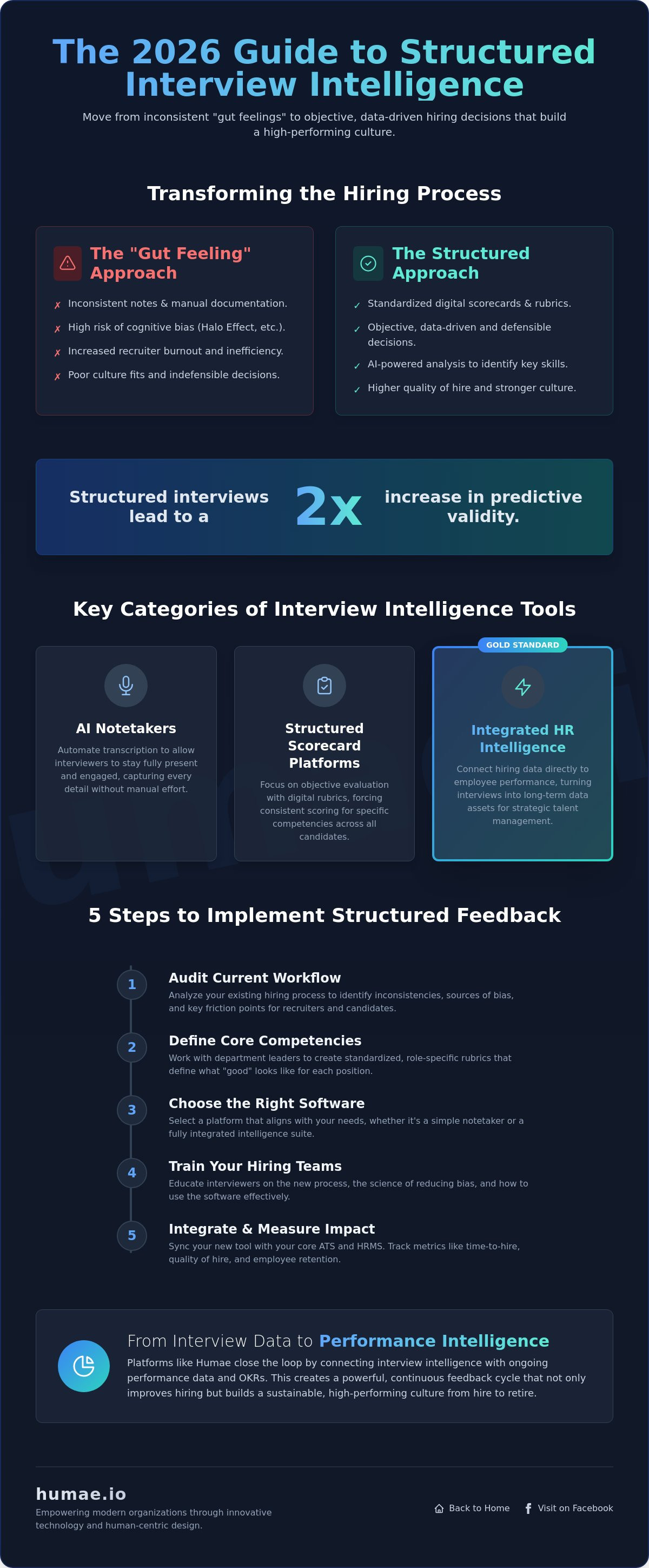
Human brains are wired for shortcuts, but in hiring, these shortcuts are dangerous. The "halo effect," where one positive trait outshines all others, and "confirmation bias" frequently ruin unstructured interviews. We've all seen it: a candidate goes to the same university as the manager, and suddenly the interview turns into a casual chat instead of a rigorous evaluation. Research shows that using standardized questions and scoring leads to a 2x increase in predictive validity compared to traditional methods. By removing the guesswork, structured interview feedback software creates a level playing field. It ensures that every candidate gets the same opportunity to shine, regardless of the interviewer's personal preferences or unconscious biases.
Key Categories of Interview Feedback Tools
Not all tools are created equal. Your choice depends on your organization's specific friction points. You'll generally find three main categories in the 2026 market:
- AI Notetakers: These tools automate the transcription process. They allow interviewers to stay fully present and engaged with the candidate instead of looking down at a screen to type.
- Structured Scorecard Platforms: These focus on the evaluation itself. They use digital rubrics that force interviewers to provide objective scores for specific competencies immediately after the call.
- Integrated HR Intelligence: This is the gold standard. These platforms connect hiring data directly to employee performance and analytics. It turns a one-time interview into a long-term data asset that helps you understand why your best people succeed.
Humae: Empowering modern organizations through innovative technology and human-centric design.
Core Features of Modern Interview Intelligence Platforms
Modern structured interview feedback software has evolved far beyond the simple video recording tools of the past. It's no longer enough to just capture a conversation; you need to extract meaningful, objective data from it. Today's platforms act as a layer of intelligence that sits between the conversation and the final hiring decision. By using dynamic rubrics, teams can move away from one-size-fits-all checklists. These customizable scoring systems adapt to specific job roles, ensuring that a Senior Developer is evaluated on different technical and leadership competencies than a Junior Marketing Associate. This precision ensures that "good" isn't a vague vibe but a measurable set of skills.
Structure doesn't just benefit the hiring team. It also creates a positive candidate experience by providing a clear, fair, and professional environment. When candidates see a consistent process, they feel more confident that they're being judged on their merits rather than a manager's personal preference. AI-powered sentiment analysis takes this further by detecting candidate enthusiasm and soft skill alignment. It analyzes tone and engagement levels to provide a deeper layer of insight that manual notes often miss. To keep everyone aligned, real-time calibration features help the hiring panel stay on the same page during the debrief, eliminating the common problem of "score drift" between different interviewers.
Data silos are the enemy of efficiency. The most effective structured interview feedback software offers seamless ATS and HRMS sync. This ensures that the insights gathered during the interview don't vanish once the "hire" button is clicked. Instead, that data flows directly into the employee's permanent record, informing their future growth and development within the company. If you're looking to unify your hiring and performance data, exploring an integrated solution like Humae can bridge the gap between initial evaluation and long-term success.
AI-Driven Transcription vs. Manual Scorecards
Hiring managers shouldn't be stenographers. AI-driven transcription removes the admin burden, allowing interviewers to stay fully engaged with the candidate. These systems don't just transcribe; they automatically identify key themes and competency evidence. This allows the human interviewer to focus on intuition and cultural alignment while the AI handles the heavy lifting of documentation. It's a partnership that balances automation with the human touch needed for final decisions.
Analytics Dashboards for Hiring Teams
You can't improve what you don't measure. High-quality platforms provide analytics dashboards that track interviewer "harshness" or "leniency" metrics. This helps identify if certain managers are consistently scoring too high or too low, allowing for better training. More importantly, these dashboards can measure the correlation between interview scores and 90-day retention, helping you identify exactly where the bottlenecks in your talent pipeline exist.
Humae: Empowering modern organizations through innovative technology and human-centric design.
Standalone Interview Tools vs. Integrated HRMS Solutions
Choosing between a specialized point solution and an all-in-one platform is a pivotal decision for talent teams in 2026. Standalone tools often offer flashy, niche features, but they frequently create the "Silo Problem." This is where vital candidate data is trapped in an app that doesn't talk to the rest of your tech stack. When your structured interview feedback software lives in isolation, the rich insights gathered during the hiring process rarely make it to the manager who actually leads the new hire. This data loss isn't just an administrative headache; it's a missed opportunity to build a cohesive employee journey from the very first interaction.
Integrated platforms like Humae solve this by ensuring the hiring story continues seamlessly into the performance phase. Instead of managing subscription fatigue across dozens of vendors, you gain a unified ecosystem. This is why modern HRIS systems are rapidly absorbing interview intelligence features. It's more efficient, it's more cost-effective, and it keeps your data clean and actionable. You don't have to worry about syncing records or losing context during a handoff between departments. Everything stays in one place, ready to be used.
The Long-Term Value of Integrated Feedback
Imagine using specific interview feedback to set a new hire's first-quarter OKRs. When your software is integrated, you can identify exactly where a candidate excelled and where they might need support during their initial months. This isn't just hiring; it's performance intelligence starting on day one. You're creating a single data thread that follows a person from their first application to their first promotion. This transition from "Candidate" to "High-Performer" becomes visible and measurable, allowing for truly personalized development plans that drive long-term retention.
Security and Compliance Considerations
Storing sensitive interview recordings and evaluations requires more than just a login. In 2026, GDPR and SOC 2 compliance are non-negotiable for any organization. Standalone tools might struggle to maintain these rigorous standards across multiple complex integrations. An integrated HRMS provides a centralized, secure vault for all employee data, including the records generated by your structured interview feedback software. It ensures candidate privacy while maintaining a searchable, defensible database of feedback. Owning your data in a secure, unified environment is the only way to manage a modern workforce effectively without risking costly compliance failures.
Humae: Empowering modern organizations through innovative technology and human-centric design.
5 Steps to Implementing Structured Feedback Software
Implementing structured interview feedback software isn't just a technical upgrade; it's a cultural shift toward objectivity. The first step is an honest audit of your current process. Look for the moments where "gut feeling" takes over, like the informal hallway chats after an interview or the vague "not a culture fit" comments in your inbox. These are the gaps where bias thrives. By identifying these friction points, you can pinpoint exactly where your new system needs to provide the most support.
Once you've mapped the leaks, define core competencies and standardized rubrics for every department. This ensures that every interviewer is looking for the same qualities in a candidate. Next, select a software partner that aligns with your existing tech stack and offers the right features for your team's specific needs. Don't just look for a tool; look for a partner that understands the balance between data and human connection. After selection, train your hiring managers. They need to understand how to use rubrics effectively without losing the "human touch" that makes an interview engaging. Finally, monitor your results. Use "Quality of Hire" metrics to iterate on your rubrics and ensure the system is actually delivering better candidates.
Ready to transform your hiring process into a data-driven engine? Explore how Humae can help you build a more objective and efficient talent pipeline.
Building Effective Interview Rubrics
Creating a rubric requires distinguishing between behavioral and technical competency scoring. While technical scores measure "can they do the job," behavioral scores predict "how they will do the job." Use "anchored" scales to provide clarity. For example, a 5/5 score shouldn't just mean "great"; it should correspond to a specific, observable action or answer defined in your structured interview feedback software. For new teams, calibration meetings are essential to ensure everyone interprets these anchors the same way, preventing "score inflation" or "harshness bias."
Change Management: Getting Buy-In
The biggest hurdle is often the "it takes too much time" objection from busy managers. Address this by demonstrating the long-term value of defensible data. Show them how a structured process prevents the nightmare of a bad hire or a promotion dispute. You can even gamify the feedback process by highlighting teams with the highest completion rates or the most accurate predictive scores. When managers see that structure actually saves them time and stress in the long run, the resistance fades away, replaced by a commitment to better hiring.
Humae: Empowering modern organizations through innovative technology and human-centric design.
Humae: Turning Interview Data into Performance Intelligence
Hiring doesn't end when a contract is signed. It's the beginning of a long-term relationship that requires continuous nurturing. Humae transforms the way you use structured interview feedback software by embedding it directly into a total workforce management ecosystem. Instead of treating candidate evaluations as static files, we turn them into dynamic intelligence. This data flows through our platform; it ensures that the insights you gathered during the hiring process drive success throughout the employee's entire tenure.
The real magic happens when you connect these initial insights to real-time OKR tracking. If an interviewer noted a candidate's exceptional problem-solving skills, that evidence should inform their first performance targets. Modern leaders choose Humae because we prioritize an experience-based approach to HR. We don't just provide tools; we provide a vision for organizational growth. This integration allows companies to reach the kind of efficiency reported by industry leaders. Ready to see how it works?
From Applicant to Employee Directory
Transitioning a new hire into your employee directory shouldn't feel like starting from scratch. Humae ensures a seamless handoff by moving interview notes and scores into the permanent employee record. We use AI sentiment analysis to flag potential early-stage turnover risks based on interview engagement patterns. This allows managers to intervene early with supportive coaching. It's about creating a culture of continuous feedback that truly starts before Day 1. By centralizing this data, you avoid the fragmentation that leads to poor culture fits and wasted resources.
A Visionary Partner for Modern Teams
We're committed to combining high-tech AI with deep human empathy. Our platform is built for the speed of 2026 business, where efficiency is mandatory but the human factor is paramount. With the EU AI Act's high-risk classification for recruitment tools now in full effect, we provide the transparency and human oversight needed for total compliance. Humae brings a high level of performance intelligence to your team, allowing you to focus on what matters most: your people. Join the community of innovators on our Facebook page to stay ahead of the curve.
Humae: Empowering modern organizations through innovative technology and human-centric design.
Building Your Future-Ready Hiring Engine
Building a high-performing team in 2026 requires more than just intuition. It demands a shift toward objectivity and data-driven decision-making. By adopting structured interview feedback software, you're not just improving your hiring process; you're laying the foundation for long-term organizational success. The best tools don't just capture data; they integrate it into the entire employee lifecycle. You've seen how removing cognitive bias leads to better culture fits and how integrated platforms eliminate the silo problem that plagues traditional HR tech.
The future of work is about connecting the dots between an initial conversation and a high-performer's success. It's time to move past fragmented systems and embrace a unified approach that values both technical precision and human empathy. With a modern, intuitive interface designed for the speed of today's business, you can turn every interview into a strategic advantage. Experience the power of AI-driven performance intelligence and integrated OKR tracking in one place. Let's build a culture where everyone has the chance to thrive.
Streamline your hiring with Humae’s AI-powered platform
Humae: Empowering modern organizations through innovative technology and human-centric design.
Common Questions About Interview Intelligence
What is the difference between an ATS and structured interview feedback software?
An ATS manages the logistics of the applicant pipeline, while structured interview feedback software focuses on the quality and consistency of the evaluation itself. While an ATS tracks where a candidate is in the process, feedback software ensures every applicant is judged against the same competencies using standardized rubrics. Modern platforms often combine these functions to prevent data silos and ensure a smooth transition from candidate to employee.
Does structured feedback really reduce hiring bias?
Yes, it forces interviewers to score candidates on pre-defined criteria rather than vague impressions or "gut feelings." This method neutralizes the halo effect and confirmation bias by requiring evidence-based ratings for specific skills. Standardizing the questions ensures every applicant faces a level playing field, which directly leads to more objective and defensible hiring decisions across all departments.
How does AI help in the interview feedback process?
AI automates the heavy lifting of transcription and sentiment analysis so interviewers can stay fully present during the conversation. It identifies key competency evidence within a discussion and summarizes responses against your specific rubrics. This allows hiring teams to focus on high-level decision-making instead of getting bogged down in manual documentation and administrative note-taking.
Is structured interview software difficult for hiring managers to learn?
Most modern platforms are designed with an intuitive interface that requires minimal training for busy teams. The software guides managers through the process with clear prompts and anchored scales that define what a top score looks like. By simplifying the feedback loop, it actually reduces the cognitive load on managers, making it easier for them to provide high-quality input quickly.
Can I integrate interview feedback tools with my existing HRMS?
Yes, and choosing an integrated solution is often more effective than using standalone tools. Native integration with your HRMS ensures that structured interview feedback software data flows directly into the employee's permanent record. This connectivity allows for a seamless transition from the hiring stage to performance tracking, OKRs, and long-term workforce management without losing vital context.
What are the legal benefits of using structured interview feedback?
It provides a clear, documented audit trail that protects your organization during hiring or promotion disputes. With the August 2026 EU AI Act enforcement, having transparent and human-oversight-driven feedback is critical for staying compliant with high-risk AI regulations. Standardized records prove that your decisions were based on merit and specific job requirements rather than subjective or discriminatory factors.
How do I measure the ROI of interview intelligence software?
Is my candidate data safe in an AI-powered HR platform?
Leading platforms prioritize security through strict GDPR compliance and SOC 2 certification. Your data is encrypted and stored in secure environments that give your organization full ownership and control. Always ensure your provider meets the high-risk AI standards required by 2026 regulations to maintain candidate privacy and ensure the integrity of your hiring data.
Humae: Empowering modern organizations through innovative technology and human-centric design.