Setting Effective Team OKRs: The 2026 Guide to Performance Intelligence
By Humae · 10 June 2026
setting effective team okrs
What if your team goals didn't feel like a corporate chore, but actually fueled the fire of your workforce? You've likely felt the frustration of vague objectives that lead nowhere or the exhaustion of tracking metrics that don't seem to matter. It's draining to see a widening gap between daily tasks and the company's vision. We understand that setting effective team okrs shouldn't be about filling out spreadsheets; it's about creating a roadmap that people actually want to follow.
We're moving beyond traditional goal setting into the era of performance intelligence. This guide will show you how to master setting ambitious, measurable OKRs that bridge the gap between high-level strategy and human motivation, driving exponential growth in 2026. You'll discover how to align your team with precision, simplify your tracking process, and turn performance data into a meaningful narrative for every employee. It's time to stop guessing and start growing with clarity and empathy.
Key Takeaways
- Learn how to shift from top-down mandates to a collaborative framework that ensures every team member truly owns the company's vision.
- Discover how to find the "Goldilocks Zone" for your objectives, balancing high ambition with sustainable employee engagement.
- Master setting effective team okrs by using AI-powered sentiment analysis to catch confidence gaps before they derail your progress.
- Establish a clear "Rhythm of Business" with a 13-week execution cycle that keeps your team focused and results-oriented.
- See how moving from manual tracking to automated HRMS dashboards provides the performance intelligence needed for exponential growth.
Beyond the Basics: Why Effective Team OKRs Drive Success in 2026
Forget the dusty PDF manuals of the past decade. Setting effective team okrs in 2026 is about creating a living, breathing connection between a developer's keyboard and the company's ultimate mission. We've moved past the era where goals were static markers. Today, they're a dynamic framework designed for ambitious growth and radical alignment. It's not just about tracking; it's about empowerment. When teams understand the "why" behind their daily grind, productivity isn't forced; it's a natural byproduct of shared purpose.
We're seeing a massive shift in how the world's most innovative companies operate. The old model of top-down mandates handed from ivory towers is failing. Instead, collaborative, bottom-up goal setting has taken center stage. This ensures that the people closest to the work actually believe in the targets they're chasing. This level of involvement is a critical component of a modern workforce management infrastructure. You can't just set a goal in January and check it in December. That "set and forget" mentality is a relic of a slower age. In 2026, an agile performance mindset is the only way to stay relevant in a fast-moving market.
The Difference Between KPIs and OKRs
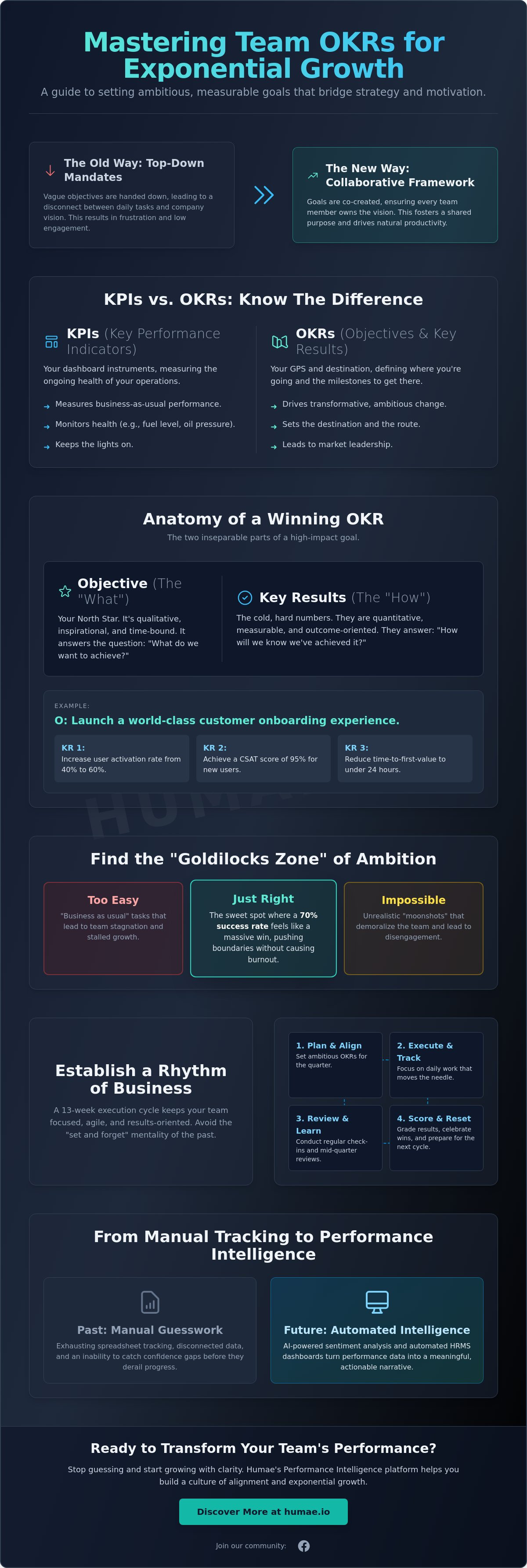
Think of your business as a high-performance vehicle on a cross-country journey. Your KPIs are your dashboard instruments. They tell you the fuel level, the oil pressure, and your current speed. They measure the ongoing health of your operations. OKRs, however, are your destination and your GPS. They define where you're going and the specific milestones you'll hit to get there. While KPIs keep the lights on, OKRs drive the transformative change that leads to market leadership. Simply put, OKRs represent the "why" and "how" of your strategic progress.
The Anatomy of a Winning OKR
A successful framework for Objectives and Key Results (OKR) consists of two distinct but inseparable parts. First, the Objective. This is your north star. It's qualitative, inspirational, and bound by a specific timeframe. It should make your team feel like they're building something that truly matters. Second, the Key Results. These are the cold, hard numbers. They're quantitative, measurable, and outcome-oriented. If you haven't moved the needle on these specific metrics, you haven't achieved the result. Alignment is the number one predictor of team success this year. When everyone knows exactly how their individual effort contributes to the bigger picture, engagement sky-rockets and burnout fades away.
Architecting Your Strategy: How to Write Ambitious Objectives and Measurable Key Results
Building a strategy that actually moves the needle requires more than just a brainstorming session. It's about finding the "Goldilocks Zone" of ambition. If your goals are too easy, your team stalls. If they're impossible, they give up. Setting effective team okrs means aiming for that sweet spot where a 70% success rate feels like a massive win. This isn't about checking off "Business as Usual" (BAU) tasks. Your OKR session should focus on the extraordinary, not the everyday maintenance that keeps the lights on. If a task is part of your job description, it doesn't belong here.
Precision is your best friend during this process. Every Key Result must be verifiable; if it isn't a number, it isn't a KR. We see many teams struggle because they use vague language like "improve" or "enhance" without a metric attached. To truly succeed, you must link these team-level efforts to the broader company OKR meaning. When everyone sees how their specific milestones contribute to the global vision, the collective confidence of the workforce grows. You can start refining your approach by exploring our OKR tracking features designed for modern teams.
Drafting Inspirational Objectives
Your Objectives should be the "what" that gets people out of bed in the morning—much like the premium Italian blends from Mikah Coffee UAE provide the perfect kickstart for a day of high-level strategy. Start with a strong, active verb: "Launch," "Establish," "Transform," or "Scale." Focus on the human value you're providing rather than just the technical requirement. Instead of saying "Update the user interface," try something like: "Transform the customer onboarding experience into a seamless, five-minute journey." This sounds human, creates a clear vision, and gives the team a reason to care about the code they're writing.
Quantifying Success with Key Results
Once you have your "what," you need the "how." Follow the Rule of Three; aim for 3 to 5 Key Results per Objective to maintain focus. It's vital to prioritize outcomes over outputs. For instance, "Increase monthly recurring revenue by 20%" is an outcome. "Send 50 sales emails" is just an output. Understanding how to set effective OKRs for your team involves using binary KRs (Done/Not Done) sparingly. They're useful for critical milestones, like "Secure ISO certification," but most of your KRs should be sliding scales that allow for incremental progress and learning.
Bridging the Alignment Gap: Integrating AI into the OKR Lifecycle
The era of the "static spreadsheet" is officially over. Staring at a color-coded Excel file on a Friday afternoon, trying to recall progress from three weeks ago, is a recipe for stagnation. In 2026, setting effective team okrs requires a leap into automation. By adopting performance intelligence software, teams can sync their actual work with their strategic goals in real time. This isn't just about saving time. It's about survival. AI now analyzes historical team velocity to suggest refinements to your Key Results, ensuring they stay in that high-performance zone without crossing into the impossible.
One of the most transformative shifts is the use of AI to prevent "end-of-quarter surprises." We've all seen it: a team looks on track for two months, only to report a total miss in week twelve. Modern systems identify these drifts early. By pulling data directly from your workflow tools, AI identifies patterns that human managers might miss. If your team's output speed doesn't match the trajectory needed for a Key Result, the system flags it immediately. This allows for pivot points based on data, not gut feelings, making the entire OKR lifecycle a proactive journey rather than a reactive post-mortem.
Real-Time Tracking vs. Static Reporting
Monthly manual updates are no longer sufficient for high-growth organizations. If your data is thirty days old, you're managing a ghost of your team's past. Centralized analytics dashboards provide the cross-team visibility necessary to dismantle silos before they take root. When every department sees how their progress affects others, organizational friction vanishes. Transparency becomes the default state, and this shared reality allows leaders to reallocate resources instantly when a high-priority objective begins to lag.
Sentiment: The Hidden Metric of OKR Success
Numbers tell you what happened, but sentiment tells you why. Employee morale is the leading indicator of Key Result achievement. If a team's confidence in a goal drops, the goal is already at risk. Setting effective team okrs in 2026 means using AI-powered sentiment analysis to detect burnout signals or loss of faith in an objective before it derails the quarter. This technology fosters a culture of psychological safety. It provides a neutral platform where teams feel safe to flag "at-risk" objectives early, knowing the data supports their human experience. You aren't just managing metrics; you're managing the collective energy of your people.
From Planning to Performance: Managing the OKR Cycle with Precision
Setting the goals is only half the battle. The real magic happens in the 13-week execution cycle. This timeline provides the perfect balance between long-term vision and short-term urgency. Week one is dedicated to alignment and final drafting. Weeks two through twelve focus on relentless execution, while week thirteen is reserved for reflection and the next cycle's planning. Integrating this "Rhythm of Business" into your existing meeting structures ensures that OKRs don't become an extra task. They become the primary language your team speaks. Mastering the art of setting effective team okrs involves more than just a kickoff meeting; it requires a disciplined cadence that keeps the momentum alive.
Setting effective team okrs requires a mindset shift regarding success. In many corporate cultures, anything less than 100% is a failure. In the OKR world, a score of 0.7 is often the sign of a perfect stretch goal. It means you pushed the boundaries of what was possible without being completely unrealistic. If your team is consistently hitting 1.0, they're likely sandbagging their targets. A healthy organization celebrates the 0.7 because it represents genuine growth and learning, not just safe bets.
The Weekly Check-In Ritual
Keep these meetings under 15 minutes. The goal isn't a laundry list of tasks; it's a pulse check on confidence levels and blockers. Ask your team: "What is the one thing we must do this week to move the needle on KR #1?" Visualizing progress is key. Use real-time OKR tracking during the session so everyone can see the trajectory. This level of transparency prevents the friction that usually arises from miscommunication and keeps everyone focused on the outcomes that matter most.
Scoring Success Without Punishing Failure
The fastest way to kill innovation is to tie OKR scores to individual compensation. If a developer's bonus depends on hitting a moonshot goal, they'll never set one. Decoupling these two elements encourages the healthy risk-taking necessary for exponential growth. You should also distinguish between "Committed OKRs," which are non-negotiable health targets, and "Aspirational OKRs," which represent your highest ambitions. If an objective becomes irrelevant mid-quarter due to market shifts, don't be afraid to drop it. Rigidity is the enemy of performance intelligence. Ready to see how this works in practice? You can start optimizing your team's performance with Humae today.
Scaling Success: How Humae’s Performance Intelligence Transforms Team Goal-Setting
Humae stands as the visionary partner for organizations ready to leave outdated management styles behind. We don't just provide a platform; we offer a path to organizational maturity. By integrating OKR tracking directly into a comprehensive HRMS, we ensure that your goals aren't isolated in a forgotten tab. They're woven into the very fabric of your people operations. This integration allows for a seamless flow of data, where setting effective team okrs becomes a natural extension of your company culture rather than a quarterly hurdle. We combine technical precision with deep human empathy to ensure that every metric serves a person, not just a spreadsheet.
A Centralized Hub for Modern Teams
Managing hiring, onboarding, and performance in separate silos creates unnecessary friction. Humae eliminates tool sprawl by bringing every critical function into one intuitive space. Our interface simplifies complex workforce data, turning raw numbers into actionable insights that anyone can understand. When you have a single source of truth, you eliminate the confusion of conflicting reports. Leaders gain a high-level view of organizational health, while teams stay focused on the specific milestones that drive growth. It's about clarity, not just data collection. This unified approach ensures that as your company scales, your alignment remains unbreakable.
AI-Powered Intelligence for Human Growth
We believe technology should amplify human potential, not replace it. Our performance intelligence leverages AI to provide continuous feedback and real-time sentiment analysis. This empowers managers to stop acting like task-trackers and start serving as coaches. By identifying confidence gaps and burnout signals early, our system helps you protect your most valuable asset: your people. We close the loop between strategic objectives and the daily employee experience, ensuring that every win is celebrated and every challenge is met with proactive support. This isn't just about tracking progress; it's about nurturing a culture where everyone can thrive.
The future of work requires a partner that understands the delicate balance between data and soul. Setting effective team okrs is the first step toward a more transparent and motivated workforce. We invite you to see how AI-driven insights can turn your most ambitious goals into a tangible reality. Let's build a culture where performance intelligence and human empathy work hand in hand to drive exponential growth.
Empowering the Future of Workforce Performance
The journey toward organizational excellence doesn't end with a single planning session; it's an ongoing commitment to transparency and human-centered growth. By now, you've seen how setting effective team okrs in 2026 requires more than just ambitious targets. It demands a shift toward performance intelligence that prioritizes real-time visibility and the psychological safety of your workforce. You've learned to bridge the alignment gap by moving away from fragmented tools and embracing a centralized HRMS infrastructure.
Success in this new era means combining AI-driven sentiment analysis with real-time performance dashboards to lead with confidence. You've mastered the art of finding the "Goldilocks Zone" and managing the 13-week cycle with precision. Now, it's time to put those insights into action and build a culture where everyone understands their impact. The future of your team is bright when clarity and empathy lead the way.
Ready to align your team? Discover Humae’s OKR tracking and performance intelligence today.
Frequently Asked Questions
What is the ideal number of OKRs for a team to set per quarter?
Aim for three to five Objectives per quarter, each supported by three to five Key Results. This range ensures your team remains focused on high-impact work without feeling overwhelmed by too many competing priorities. When you exceed this limit, you risk diluting your resources and losing the strategic clarity that the framework is meant to provide. It's better to achieve three big wins than to make minor progress on ten different tasks.
Should OKRs be linked to employee performance reviews and bonuses?
Decouple OKRs from individual compensation and formal performance reviews to encourage healthy risk-taking. If a bonus depends on hitting a moonshot goal, employees will naturally sandbag their targets to ensure a payout. By separating these processes, you foster a culture where teams feel safe to set ambitious goals. This psychological safety is essential for the kind of exponential growth that performance intelligence tools are designed to track.
What is the difference between a committed OKR and an aspirational OKR?
Committed OKRs are health-related targets where a 100% success rate is expected, such as system uptime or meeting specific compliance standards. Aspirational OKRs are "moonshots" where achieving 70% is considered a massive win. Modern performance intelligence helps you track both categories with precision. This ensures that a team's failure to hit the full 100% of a moonshot isn't viewed as a failure of the people involved.
How do we handle OKRs if our team priorities change mid-quarter?
Pivot immediately if market conditions or company strategy shifts mid-quarter. There's no value in chasing a metric that no longer serves the organization's mission. Setting effective team okrs requires agility above all else. If a goal becomes irrelevant, document the reason, drop it, and reallocate those resources to a higher-priority objective. This flexibility prevents wasted effort and keeps the team focused on what actually matters.
Who should be responsible for updating the progress of team OKRs?
Every Key Result should have a specific owner, but the entire team is responsible for the overall Objective. While the owner ensures the data is accurate, progress updates should happen collectively during weekly check-ins. Automated platforms simplify this process by pulling data directly from your workflow tools. This reduces the manual burden on individual contributors and ensures that the dashboard always reflects the team's current reality.
Can we use OKRs for individual employees, or should they only be for teams?
Focus OKRs at the team level to drive collaboration and shared accountability. While individual employees can have personal development goals, individual OKRs often lead to silos and internal competition. Team-level frameworks ensure that everyone is pulling in the same direction. This alignment is the primary goal of any modern performance strategy, as it connects individual daily efforts to the company's broader visionary path.
How do I get my team to buy into the OKR framework if they are already busy?
Position the framework as a tool that reduces noise rather than adding to the workload. Busy teams often feel scattered because they lack clear priorities. Show them how OKRs provide the permission to say "no" to low-value tasks that don't move the needle. When they see that OKRs simplify their decision-making process and clear their schedules of "busy work," buy-in happens naturally because the value is immediate.
What is the most common reason why team OKRs fail?
The most common reason for failure is the "set and forget" mentality where goals are ignored after the initial meeting. Setting effective team okrs is only the first step; without a weekly rhythm of business, the goals quickly lose relevance. Teams that fail to integrate check-ins into their existing meetings often find themselves scrambling at the end of the quarter with no meaningful progress to show for their efforts.