Remote Workforce Management Software: The 2026 Guide to Global Team Operations
By Humae · 29 July 2026
remote workforce management software
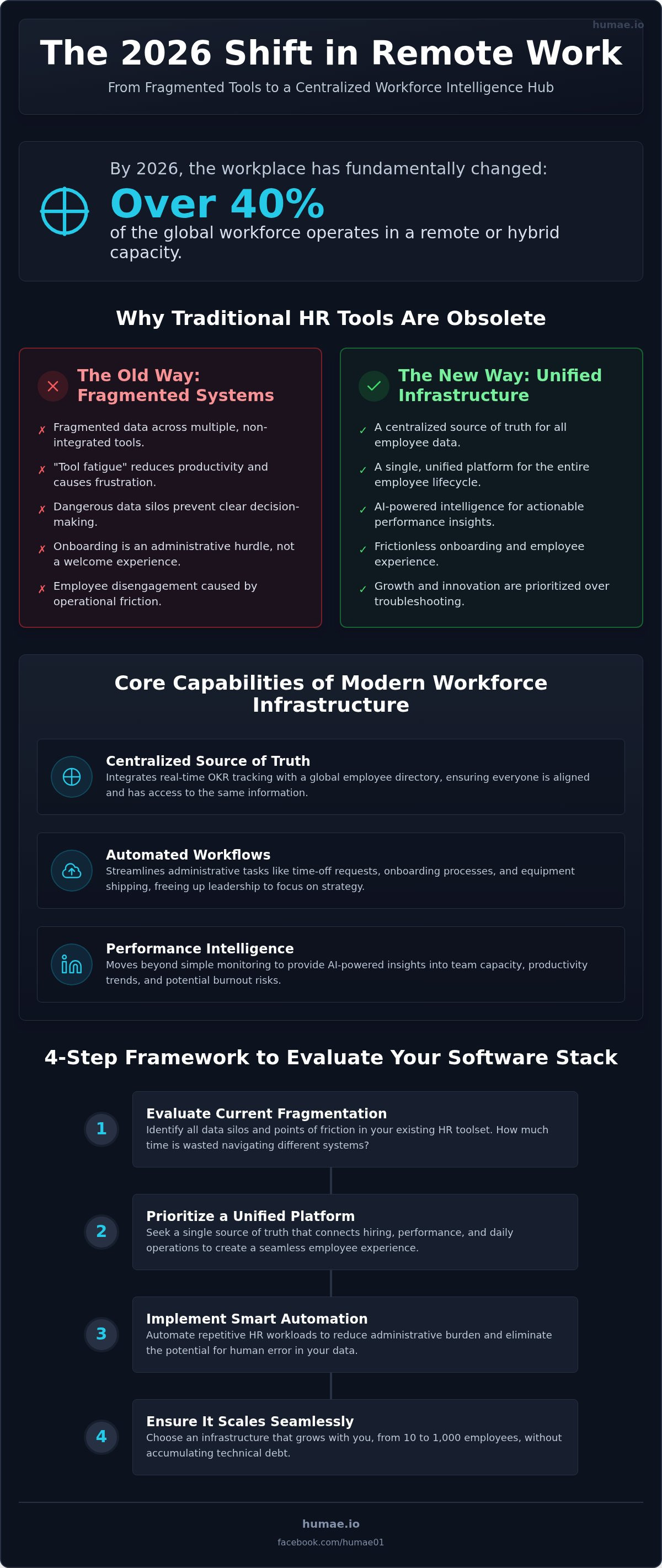
What if your remote team's biggest hurdle isn't distance, but a lack of centralized intelligence? As of 2026, over 40% of the global workforce operates in a remote or hybrid capacity, yet many leaders are still struggling to find the right remote workforce management software to unify their fragmented data. You've likely felt the frustration of trying to track OKRs or gauge employee sentiment when your people are spread across the globe. It's difficult to maintain a cultural pulse when you're fighting with tools that don't talk to each other. We know you need more than a digital punch card; you need a way to support your people effectively.
This guide will show you how to leverage modern workforce infrastructure to build a high-performance team driven by AI. You'll learn how to establish a centralized source of truth for all employee data, providing clear, actionable insights into productivity and well-being. We'll preview the tools necessary to simplify onboarding and time-off management, allowing you to scale your operations while keeping human connection at the heart of your business.
Key Takeaways
- Discover why 2026 demands a transition from simple monitoring to a comprehensive workforce management infrastructure.
- Identify the essential features that transform administrative HR tools into strategic growth drivers for your team.
- Solve the engagement gap by using remote workforce management software to gain AI-powered performance intelligence.
- Apply a four-step framework to evaluate your software stack and ensure it scales seamlessly as you grow.
- Build a centralized source of truth by integrating real-time OKR tracking with your global employee directory.
What Is Remote Workforce Management Software in 2026?
Managing a team in 2026 means operating without physical borders. In this environment, remote workforce management software has evolved into the essential digital backbone of every successful distributed organization. It's no longer just about tracking hours or seeing who's "green" on a chat app. Instead, it represents a comprehensive workforce management infrastructure that connects every aspect of the employee lifecycle, from the first interview to long-term career development. This technology provides the structural support needed to maintain high performance across multiple time zones.
The traditional concept of Workforce management (WFM) has shifted from simple administrative oversight to a strategic advantage. Modern platforms provide a centralized source of truth, ensuring that every team member has access to the same data and cultural values. To understand the broader context of these changes, you can explore our detailed guide on What is Workforce Management? to see how HR infrastructure has been redefined for the modern age.
The Evolution of Work Infrastructure
Startups today realize that "office-first" software models are obsolete. If your tools assume everyone is in the same building, your operations will eventually break. The shift toward asynchronous work requires real-time data accessibility and total transparency. 2026 technology prioritizes the employee experience by removing friction from daily tasks. It's about empowering people to do their best work without being tethered to a specific desk or rigid schedule. This evolution moves us away from micromanagement toward a model of trust and intelligence.
Why Traditional HR Tools Fail Remote Teams
Traditional HR systems were built for stability, not speed. Most legacy platforms are fragmented, forcing you to juggle separate tools for hiring, time off, and performance reviews. This creates dangerous data silos and leads to "tool fatigue," where employees spend more time navigating logins than delivering results. When your systems don't talk to each other, onboarding feels like an administrative hurdle rather than a warm welcome. This friction directly causes employee disengagement. You need a unified platform that integrates your employee directory with real-time OKR tracking and performance intelligence. A single source of truth ensures that growth isn't stunted by technical debt, allowing your team to focus on innovation rather than troubleshooting their HR stack.
Core Capabilities of Modern Workforce Infrastructure
Success in a distributed team isn't about watching people work. It's about giving them the tools to succeed autonomously. Modern remote workforce management software must bridge the gap between back-office administration and front-line growth. In 2026, the best platforms prioritize synergy, ensuring that every administrative task actually fuels your team's strategic objectives. Automation plays a central role here, handling repetitive HR workloads so your leadership can focus on scaling from 10 to 1,000 employees without losing their cultural essence.
Leading platforms now offer a suite of integrated tools designed for high-impact results:
- Automated Workflows: Streamlining everything from time-off requests to equipment shipping.
- Integrated Analytics: Providing a clear view of team capacity and burnout risks.
- Unified Infrastructure: Connecting hiring, performance, and day-to-day operations in one place.
Centralized Employee Directory and Onboarding
Connection is the biggest challenge when you don't have a physical water cooler. A user-friendly Employee Directory serves as more than just a contact list; it's a social map of your organization. By automating the onboarding workflow, you ensure that every global hire receives the same high-quality experience, regardless of their location. This automation guarantees data accuracy across your entire workforce management infrastructure, preventing the errors that typically plague fragmented systems. You can explore our centralized directory features to see how we foster these vital connections.
Real-Time OKR Tracking and Goal Alignment
Objectives and Key Results (OKRs) are the lifeblood of remote team alignment. Without them, people often feel busy but lack a sense of direction. Integrating OKR tracking directly into your HRMS allows everyone to see how their daily tasks contribute to the company's mission. This shift moves your organization away from outdated annual reviews toward continuous, goal-based performance management. It creates a culture of transparency where achievements are recognized in real-time, keeping morale high and turnover low. When goals are visible and measurable, your team stays focused on what truly moves the needle.
Solving the Engagement Gap with Performance Intelligence
Distance often leads to a "culture tax" where employees feel isolated and disconnected from the collective mission. The biggest challenge isn't just managing tasks; it's maintaining a vibrant culture across thousands of miles. This is where remote workforce management software transcends basic administration to become a tool for human connection. By shifting from intrusive monitoring to what we call "Performance Intelligence," organizations can drive growth without sacrificing trust. This approach moves beyond the "what" of work to understand the "how" and "why" behind team dynamics.
Performance Intelligence uses data to understand team health in real time. Instead of counting keystrokes or tracking application usage, it focuses on outcomes and well-being. This data-driven approach replaces the urge to micromanage with actionable insights that empower leaders to support their teams more effectively. For a deeper dive into these methods, check out our Employee Engagement Strategies guide, which explores how to build a resilient remote culture.
AI-Powered Sentiment Analysis
Managing a team you can't see requires a new kind of "sixth sense." AI sentiment analysis provides this by evaluating communication patterns and feedback to detect signs of burnout or disengagement before they lead to turnover. It offers managers a real-time "pulse" of their organization. If a department's sentiment drops, leaders can intervene with empathy and support rather than just demanding more output. This intelligence fosters a culture where employees feel seen and valued as individuals, not just as remote resources. It's about being proactive rather than reactive to your team's needs.
Integrated Time Off and Absence Management
Operational efficiency and employee well-being are two sides of the same coin. Fragmented systems make requesting time off a chore, especially when navigating global time zones. A unified platform simplifies this process, making approvals instant and transparent. When everyone has visibility into team availability, project planning becomes realistic rather than aspirational. This transparency prevents the accidental overworking of individuals and ensures that project deadlines are met without causing stress.
- Burnout Prevention: Seeing who hasn't taken a break lately allows for proactive wellness checks and mandatory rest periods.
- Seamless Planning: Automated visibility ensures that deadlines don't clash with regional holidays or personal leaves across different countries.
- Long-Term Retention: Transparent and fair leave policies are a top priority for 2026 talent, directly impacting how long they stay with your company.
A Strategic Framework for Choosing Your Software Stack
Selecting the right remote workforce management software isn't just a technical decision; it's a commitment to your team's future. You aren't just buying a tool for today. You're building an infrastructure that must support your growth from a tight-knit group of 10 to a global force of 1,000. In 2026, the stakes for data privacy and security have never been higher. SOC2 compliance isn't optional anymore; it's the baseline for protecting your most valuable asset: your people's data. You can Discover Humae Features to see how we prioritize these critical standards.
Use this four-step checklist to evaluate any potential platform:
- Verify Scalability: Ensure the pricing and architecture support rapid expansion without requiring a total system overhaul.
- Audit Security: Look for SOC2 Type II certification and robust data encryption as non-negotiable requirements.
- Test Integrations: Confirm the software syncs seamlessly with your existing communication and project management tools.
- Assess UX: Run a pilot program to see if employees can navigate the system without a 50-page manual.
Integration Capabilities and API Ecosystem
Your HRMS shouldn't exist on an island. If your workforce management infrastructure doesn't talk to your daily communication tools, you're creating friction. Locked data in proprietary, non-integrated systems leads to manual entry errors and delayed decision-making. Before committing, audit your current tech stack. Look for open APIs that allow for custom connections. A truly modern platform acts as a hub, pulling data from project management tools to give a complete picture of team health. If you want to see how we handle these connections, explore our integration-ready platform today.
User Experience and Employee Adoption
The best software in the world is useless if your team refuses to use it. We call this the "Intuition Test." If an employee needs a manual to request time off or update an OKR, the software has failed. Reducing friction is essential for encouraging consistent participation in feedback loops and goal tracking. A distributed workforce relies on mobile-first design. Your team should be able to check their directory or submit a pulse survey from their phone while waiting for coffee. High adoption rates are the only way to ensure your performance intelligence data remains accurate and useful.
Optimizing Global Growth with Humae
Scaling a global team requires more than just a collection of digital tools; it requires a unified vision powered by the right infrastructure. Humae stands as the definitive solution for modern, performance-driven teams that want to move beyond the limitations of legacy systems. We've combined essential HR infrastructure with sophisticated AI intelligence to help you lead with empathy and precision. This approach isn't just about managing people; it's about empowering them to reach their full potential. As the premier remote workforce management software for 2026, Humae provides the clarity you need to transform your operations from a series of tasks into a cohesive growth engine.
Our platform was designed for the visionary partner who understands that technology should support, not replace, human connection. By centralizing your data and automating routine processes, you create space for the strategic work that actually moves your company forward. We've eliminated the noise so you can focus on the signal, providing a clear path to organizational excellence in a distributed world.
All-in-One Infrastructure for Modern Leaders
Modern leaders deserve an all-in-one infrastructure that respects their time and energy. Our platform brings hiring, onboarding, and directory management into a single, intuitive interface. The Humae HRMS serves as the core of your business, eliminating the friction and security risks caused by juggling multiple, disconnected SaaS subscriptions. When your Applicant Tracking System shares a language with your performance reviews, you gain a holistic view of your talent that was previously impossible. This integration ensures that every new hire is set up for success from day one, fostering an immediate sense of belonging regardless of their physical location.
Actionable Analytics for Strategic Decision Making
Strategic decision-making shouldn't be based on guesswork or incomplete data. The Humae dashboard provides actionable analytics that help you identify high-performers and future leaders with objective clarity. By turning raw workforce data into a strategic advantage, you can make informed choices about promotions, resource allocation, and team restructuring. The future of AI-driven HR lies in predictive insights. Our platform helps you anticipate needs, whether it's identifying a potential burnout risk before it happens or automating routine approval workflows to keep projects moving. We invite you to see the platform in action and discover how Humae works to revolutionize your people operations and drive long-term success.
Build the Future of Your Global Team
The landscape of work has permanently shifted toward a borderless model where traditional tools no longer suffice. You've seen how modern remote workforce management software must act as a unified infrastructure rather than a collection of separate apps. By focusing on performance intelligence and centralized operations, you can bridge the distance gap and build a culture rooted in trust and clarity. It's about moving from simple monitoring to genuine organizational intelligence that supports every person in your company.
Humae provides the exact framework needed to scale your business with confidence. With our AI-powered performance intelligence, centralized global directory, and integrated OKR tracking, you can turn raw data into a strategic growth advantage. It's time to move past fragmented systems and embrace a platform built for the future of global operations. Start optimizing your remote team with Humae today and experience the difference a human-centered approach makes. We're ready to help you thrive in this exciting new era of work.
Frequently Asked Questions
What is remote workforce management software exactly?
Remote workforce management software is the operational backbone for companies with distributed teams. It integrates hiring, onboarding, and performance management into one centralized platform. This ensures that every employee stays connected to the organization's goals and culture regardless of their physical location.
How does remote management software improve employee productivity?
It boosts productivity by eliminating "tool fatigue" and administrative silos. When employees have a single source of truth for their tasks and goals, they can work more autonomously. This streamlined approach allows teams to focus on innovation rather than troubleshooting fragmented HR processes.
Can remote management software help with employee engagement?
Engagement improves when people feel seen and supported. These platforms facilitate continuous feedback and real-time recognition, which are essential for maintaining a strong company culture at a distance. Managers can use performance intelligence to celebrate wins and address challenges before they escalate.
Is it possible to manage OKRs within an HRMS platform?
Managing OKRs within your HRMS is not only possible but highly recommended for 2026 teams. Integrating goal tracking with employee records creates a direct link between daily effort and strategic success. It ensures that everyone is pulling in the same direction without the need for constant, manual check-ins.
How do I ensure data privacy when using remote workforce software?
You ensure privacy by choosing software that adheres to global security standards like SOC2. Look for platforms that offer end-to-end encryption and transparent data handling policies. Protecting your team's personal information is critical for building long-term trust in a digital work environment.
What is the difference between workforce management and simple time tracking?
Time tracking is just one small feature of a much larger system. Workforce management encompasses the entire employee lifecycle, from talent acquisition to performance intelligence. It provides the strategic insights needed to grow a business, whereas simple time tracking merely counts seconds.
Does remote management software work for small startups?
Startups gain a competitive edge by implementing these tools early. Having a centralized directory and automated onboarding from the start makes scaling much smoother. It builds a culture of transparency and efficiency that attracts top-tier global talent even before you hit your first 100 employees.
How does AI sentiment analysis work in an HR context?
AI sentiment analysis uses natural language processing to understand the emotional tone of feedback and internal communications. It provides managers with a real-time pulse of team health. This allows leaders to detect early signs of burnout and offer empathetic support when it actually matters most.