People Analytics Dashboard: The 2026 Guide to Data-Driven Workforce Growth
By Humae · 14 September 2026
people analytics dashboard
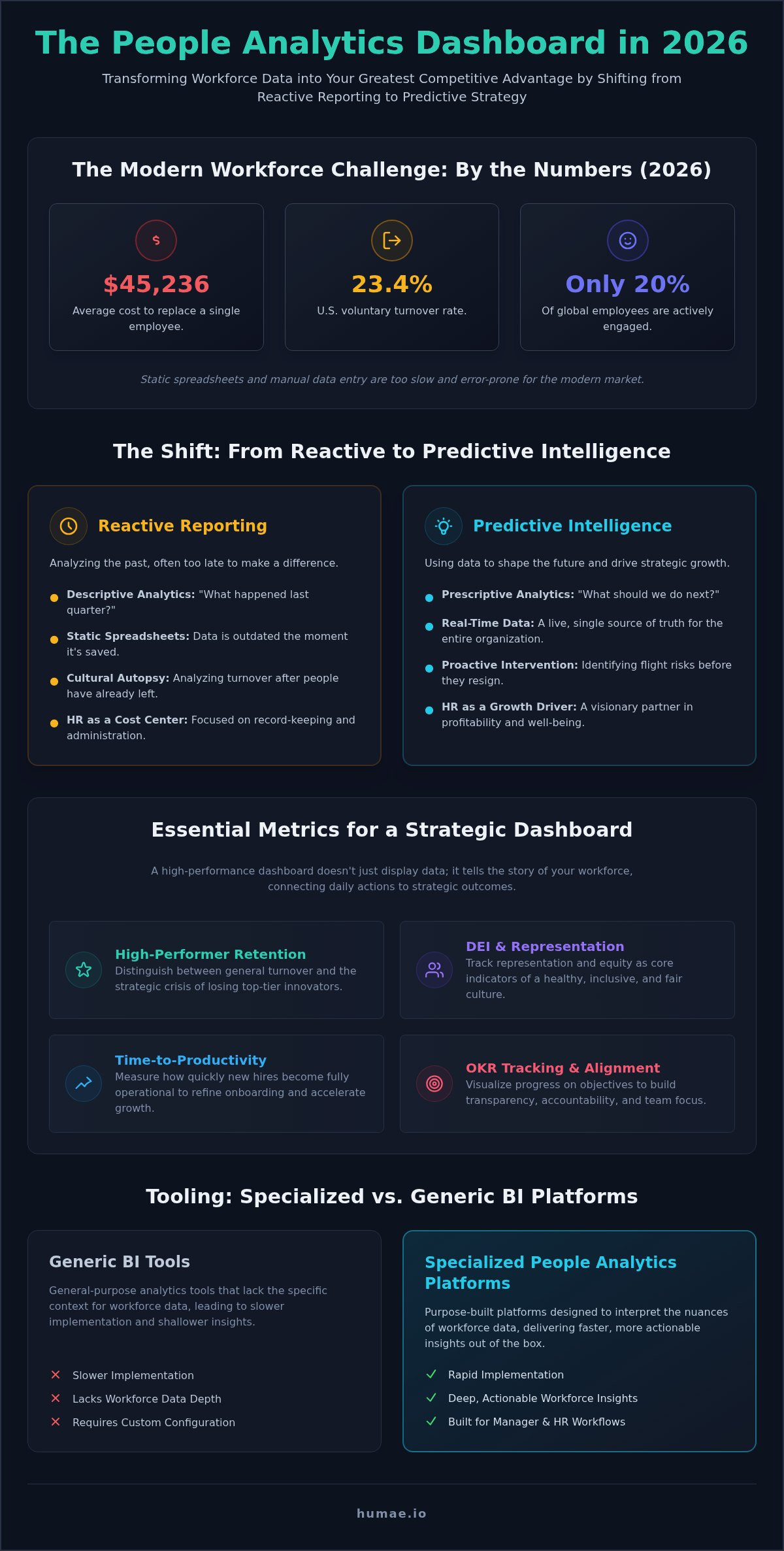
In 2026, the average cost to replace a single employee has surged to $45,236. You likely feel the weight of this figure every time a top performer exits, especially when the signals were there all along. It's exhausting to manage data scattered across disconnected tools or to spend your limited time building manual reports that still fail to prove ROI to leadership. You deserve a clearer, real-time view of your organization's heartbeat through a sophisticated people analytics dashboard.
This guide shows you how to move past static spreadsheets to build a strategy rooted in clarity. You'll learn how to transform raw workforce data into actionable intelligence that drives employee performance and strengthens organizational health. We will explore how to establish a single source of truth, leverage predictive insights for talent retention, and ensure every employee OKR aligns perfectly with your company goals. Let's turn your data into your greatest competitive advantage.
Humae | Visit Website | Back to Home | Facebook
Key Takeaways
- Learn how modern HR shifts from describing the past to predicting future talent needs using prescriptive insights.
- Identify the critical retention and sentiment metrics that transform your people analytics dashboard into a strategic growth engine.
- Understand why specialized platforms outperform generic BI tools in both implementation speed and workforce data depth.
- Discover how to design role-specific interfaces that encourage managers to take immediate action on emerging workforce trends.
- Master the alignment of employee performance and organizational goals through real-time OKR tracking and centralized infrastructure.
Humae | Visit Website | Back to Home | Facebook
Defining the People Analytics Dashboard in 2026
A people analytics dashboard is no longer just a collection of colorful bar charts. In 2026, it serves as a centralized visual interface that aggregates complex data points into a single, cohesive view of organizational health. While traditional HR focused on record-keeping, modern leaders use these platforms to drive growth. To understand the foundation of this field, you can look at the People analytics definition, which highlights how data application has evolved from simple reporting to a strategic business function. Digital intelligence doesn't replace the human touch; it empowers it by removing the guesswork from management.
The most significant evolution is the shift from descriptive to prescriptive analytics. Descriptive data tells you what happened last month; prescriptive data tells you what to do next. AI now processes the heavy lifting of workforce management infrastructure, identifying patterns that humans might miss. Instead of just seeing a high turnover rate, your dashboard suggests specific interventions to stabilize your culture. This transition allows HR teams to stop being reactive and start acting as visionary partners in the boardroom.
Relying on static spreadsheets is the biggest risk to your 2026 talent strategy. Manual data entry is slow, prone to error, and outdated the moment you hit save. In a world where global employee engagement has fallen to 20 percent, you can't afford to wait for a quarterly report to realize your team is struggling. Real-time data is the only way to keep pace with the modern market.
The Core Purpose of People Intelligence
True people intelligence moves beyond basic headcounts. It measures organizational velocity, which is the speed and efficiency with which your teams achieve their goals. Dashboards facilitate transparent communication by providing a shared reality for leadership and employees alike. When everyone sees the same metrics, trust grows. While some tools focus purely on the numbers, a visionary approach recognizes that every data point represents a human experience. For a deeper look at how these systems fit into your company's foundation, explore our guide on What is Workforce Management? to see the bigger picture of modern HR infrastructure.
Predictive vs. Reactive Reporting
Reactive reporting is a recipe for missed growth targets. If you only analyze turnover after people leave, you're performing an autopsy on your culture. Predictive models change the game by identifying flight risks before they resign. By analyzing patterns in sentiment and performance intelligence, you can intervene when it actually matters. Real-time insights allow you to pivot quickly, ensuring your talent strategy stays as agile as the market demands. Choosing a specialized people analytics dashboard turns HR from a cost center into a primary driver of profitability and employee well-being.
Humae | Visit Website | Back to Home | Facebook
Essential Metrics for Your People Intelligence Infrastructure
Metrics are the language of organizational growth. A high-performance people analytics dashboard doesn't just display data; it interprets the story of your workforce. In 2026, the U.S. voluntary turnover rate has climbed to 23.4 percent. Seeing this number is one thing. Understanding it is another. You must segment turnover by department and, more importantly, by high-performers. Losing a low-contributor is a management shift; losing a top-tier innovator is a strategic crisis. Your dashboard should highlight these distinctions instantly.
Beyond retention, your infrastructure must track DEI metrics and time-to-productivity. Representation and equity are now core indicators of a healthy culture. Meanwhile, monitoring how long it takes a new hire to become fully operational helps you refine your onboarding process. If your time-to-productivity is lagging, your growth is too. These data points allow you to build a more inclusive, efficient environment where everyone has the tools to succeed.
Integrating OKRs into the Dashboard
OKR tracking is the heartbeat of modern performance intelligence. It connects individual daily efforts to the company's ultimate success. By visualizing the "red, yellow, green" status of objectives, you provide teams with immediate clarity on where to focus their energy. This level of transparency builds trust and accountability across the entire organization. To master this framework, you can read our OKR Meaning and Guide for a definitive look at objectives and key results in 2026.
AI-Powered Sentiment Analysis
With global employee engagement hitting a low of 20 percent, standard surveys aren't enough. You need to decode the subtext. AI-powered sentiment analysis processes feedback from check-ins and pulse surveys to identify cultural bottlenecks. This technology spots trends in frustration or enthusiasm that manual reviews often miss. It allows you to address issues like burnout or lack of recognition before they impact your bottom line. Balancing this depth with strict data privacy ensures your team feels heard, not watched. It's about using digital intelligence to foster deeper human connections.
Building this infrastructure is about choosing the right partner to help you see the human behind the data. If you are looking to streamline these insights, you can explore our performance intelligence tools to start building a more resilient culture today.
Humae | Visit Website | Back to Home | Facebook
Commercial BI vs. Specialized People Analytics Platforms
Choosing between a generic business intelligence tool and a dedicated platform is a pivotal moment for any HR leader. You might already have licenses for enterprise BI software, but these tools weren't built with the nuances of human behavior in mind. They treat people like inventory units. A specialized people analytics dashboard understands that workforce data requires specific context, like tenure curves and cultural sentiment. Building these models from scratch in a generic tool often leads to months of custom development and high consultant fees.
Implementation speed is where the difference becomes undeniable. While a custom-built BI project might take half a year to launch, specialized platforms are often operational in a fraction of that time. There's also the question of data integrity. HR-specific platforms are designed to handle sensitive employee information with granular permission levels. You don't want to risk exposing private salary data or performance reviews because of a configuration error in a general-purpose tool. Total cost of ownership isn't just about the monthly license; it's about the data science headcount required to keep a manual system running.
Why HRIS Integration is Non-Negotiable
Siloed data is the enemy of clarity. When your recruitment data lives in one place and your performance scores in another, you'll never see the full picture. Integrated platforms like Humae ensure a single source of truth by pulling data directly from your core systems. To understand why this connection is the foundation of your tech stack, you can explore our guide on What is an HRIS? to see how modern infrastructure supports growth. This seamless flow of information removes the need for manual exports and reduces the risk of outdated reports.
Agentic AI and the Future of HR Tech
The next frontier is agentic AI. This isn't just about a static dashboard that shows you a chart; it's about autonomous HR assistants that can flag issues and suggest solutions. Imagine an AI that notices a dip in a team's sentiment and automatically schedules a check-in for the manager. Specialized platforms are leading this revolution because they have the deep workforce context needed to make these systems safe and effective. It's a human-centric approach that augments managers rather than replacing them. It gives you the digital intelligence to be more present for your people.
Humae | Visit Website | Back to Home | Facebook
How to Build a Dashboard That Managers Actually Use
A dashboard that collects dust is a wasted investment. Most HR tools fail because they're designed for HR admins, not for the managers who actually lead people. A successful people analytics dashboard must prioritize user experience over sheer complexity. If a team lead has to dig through ten layers of menus to find their team's engagement score, they simply won't do it. Clarity is the ultimate sophisticated feature.
Personalization is the bridge to adoption. A CEO needs a high-level view of organizational velocity and total turnover costs, which we previously identified as averaging over $45,000 per employee in 2026. Conversely, a team lead needs granular data like individual goal progress or recent check-in sentiment. Designing role-specific views ensures that every user sees exactly what they need to make better decisions without feeling overwhelmed.
Data literacy is the secret ingredient. You can't just hand over a tool and expect magic. Empower your managers by teaching them how to interpret their team data. Show them that a dip in engagement isn't a failure. It's an opportunity for a meaningful conversation. Automated alerts for critical workforce changes also help by flagging issues before they become crises. If a high-performer's sentiment drops suddenly, the manager should receive a notification immediately to take action.
Data Storytelling for People Operations
Data storytelling is how you get budget approval for vital HR initiatives. Instead of just showing a graph of turnover, show a narrative of how improving retention by a few percentage points saves the company hundreds of thousands in replacement costs. Use visuals to highlight the undeniable link between employee engagement and revenue growth. Turning data points into compelling narratives about your people makes the numbers feel human and urgent.
Driving Adoption Through Actionable Insights
Driving adoption requires moving from observation to action. Integrate dashboard insights into weekly one-on-one meetings to make data a living part of your culture. When a manager can see a direct correlation between their actions and the data improvements, they become deeply invested in the process. This creates a feedback loop where digital intelligence continuously improves the employee experience. Ready to empower your managers? Explore our analytics dashboards to see how we turn complex data into simple, actionable steps.
Humae | Visit Website | Back to Home | Facebook
Optimizing Team Growth with Humae Analytics Dashboards
Humae brings your entire workforce management infrastructure into focus. While other platforms might leave you juggling separate tools for recruitment and performance, our people analytics dashboard offers a unified view. We centralize hiring, onboarding, and your employee directory so you can see the full lifecycle of your talent. This isn't just about efficiency; it's about having the clarity to scale your culture without losing the human connection. You can finally stop searching for data and start using it to drive growth. Our people analytics dashboard is more than a reporting tool; it's a growth engine for your organization.
Real-time OKR tracking and performance intelligence live in the same interface. You don't have to wait for monthly syncs to know if a project is on track. Our AI-driven sentiment analysis provides a continuous feedback loop, letting you hear the "unspoken" needs of your team. This data-backed approach ensures that your growth is sustainable and your people feel supported at every stage. By integrating these insights directly into your workflow, you create a resilient culture that adapts to challenges in real time. It's the difference between guessing your next move and knowing it.
A Human-Centric Approach to Technology
Humae is designed for the modern, empathetic leader who knows that data is a tool for better relationships. We cut through the administrative noise. Our platform reduces the heavy burden that often bogs down HR teams, letting you focus on the people themselves. We act as your visionary partner, whether you're leading a small startup or a large enterprise. We help you build a culture where every individual can thrive because their contributions are visible and valued. We believe that technology should serve humanity, not the other way around.
Getting Started with Humae
Integration shouldn't be a headache. Humae slides seamlessly into your existing workforce processes, ensuring you don't lose momentum during the transition. Our intuitive features are designed to drive team productivity from day one. You'll find that our interface is as inviting as it is powerful, making it easy for everyone in your organization to embrace a data-driven mindset. It's time to transform how you manage your most valuable asset. Discover the Humae platform features and see how we can help you grow.
Humae | Visit Website | Back to Home | Facebook
Lead the Future of Work with Clarity
We have explored how shifting from reactive reporting to predictive insights can stabilize your culture and protect your bottom line. You now understand that a specialized people analytics dashboard is the only way to bridge the gap between complex data and human sentiment. By prioritizing manager adoption and integrating real-time OKRs, you transform HR from a backend function into a strategic engine for organizational velocity. It's time to move beyond the limitations of generic tools and embrace a system built for the modern, empathetic leader.
Humae offers the centralized workforce management infrastructure you need to lead with confidence. Our AI-powered performance intelligence and real-time OKR tracking ensure that your team stays aligned and motivated, no matter how fast the market moves. You don't have to choose between digital intelligence and human connection; you can have both. Optimize your workforce with Humae today and start building the resilient, human-centric organization your team deserves. Your journey toward a more insightful and supportive workplace begins now.
Humae | Visit Website | Back to Home | Facebook
Frequently Asked Questions
What is a people analytics dashboard?
A people analytics dashboard is a centralized visual interface that aggregates workforce data to monitor organizational health. It transforms raw numbers into actionable insights, allowing leaders to track performance, retention, and employee sentiment in real time. Unlike static reports, these dashboards provide a dynamic view of your team's lifecycle, from hiring to offboarding, ensuring that every decision is backed by digital intelligence and human context.
How does AI improve people analytics dashboards in 2026?
AI enhances these platforms by moving from descriptive reporting to predictive and prescriptive analytics. In 2026, AI-driven sentiment analysis decodes employee feedback to identify cultural bottlenecks before they lead to turnover. It also powers agentic assistants that flag critical workforce changes and suggest immediate interventions. This technology allows managers to focus on human connection while the AI handles the complex processing of workforce management infrastructure.
What are the most important HR metrics to track for retention?
Tracking voluntary turnover rates is essential, but you must segment this data by department and high-performers to see the full picture. Employee sentiment and engagement scores are equally vital as they act as the pulse of your company culture. By monitoring these metrics alongside time-to-productivity for new hires, you can identify where the employee experience is falling short and take proactive steps to stabilize your talent pool.
Can a people analytics dashboard predict employee burnout?
Yes, modern dashboards use AI-driven sentiment analysis to spot early signs of burnout. By analyzing trends in pulse surveys, check-ins, and performance intelligence, the system can flag sudden drops in engagement or shifts in communication patterns. These automated alerts allow managers to intervene with supportive measures before an employee reaches a breaking point. It's about using data to foster a more empathetic and sustainable work environment for everyone.
How do OKRs integrate with people analytics software?
OKRs integrate directly into the platform to provide real-time alignment between individual efforts and company goals. This integration allows you to visualize the "red, yellow, green" status of objectives across the entire organization. When OKR tracking is embedded in your people analytics dashboard, it creates a transparent environment where everyone understands their impact. This connection ensures that performance intelligence is always viewed through the lens of strategic organizational growth.
What is the difference between HR reporting and people analytics?
HR reporting focuses on historical facts, such as how many people were hired or the total cost of payroll last month. People analytics goes further by applying statistical models and AI to understand the reasons behind the numbers. It seeks to predict future trends and provide prescriptive recommendations for organizational health. While reporting tells you what happened, analytics provides the visionary insight needed to drive future workforce growth.
Is a specialized people analytics platform better than Tableau for HR?
Specialized platforms are generally superior for HR because they include built-in workforce context and pre-configured logic. Generic BI tools like Tableau require significant manual effort to build HR-specific models and often lack granular privacy controls for sensitive employee data. A specialized platform offers faster implementation and lower total cost of ownership. It provides an intuitive experience designed specifically for the needs of modern managers rather than data scientists.