New Hire Onboarding Checklist for Remote Employees: The 2026 Strategic Guide
By Humae · 20 May 2026
new hire onboarding checklist for remote employees
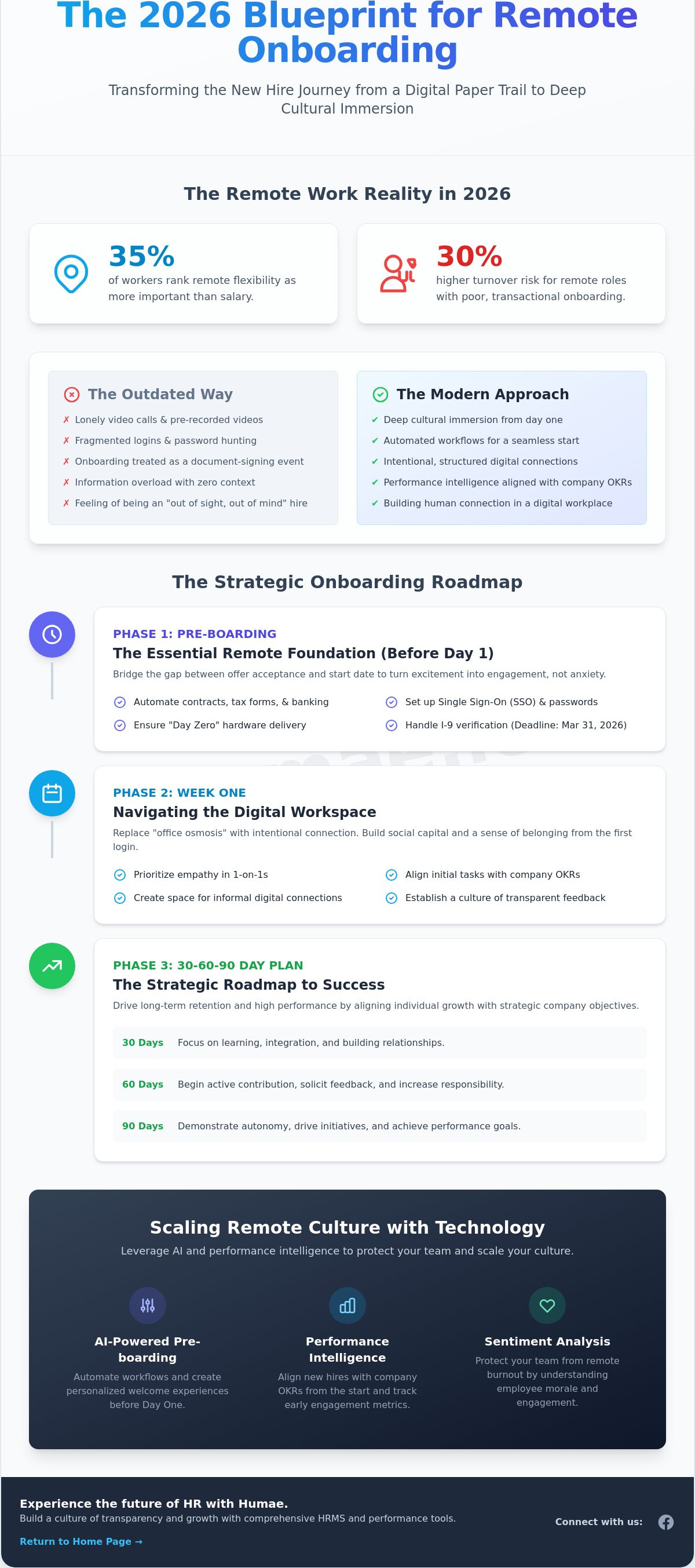
Did you know that in 2026, 35% of workers rank remote work flexibility as more important than their actual salary? Yet, many organizations still treat the first week as a series of lonely video calls and fragmented logins. If your current new hire onboarding checklist for remote employees feels like a digital paper trail rather than a warm welcome, you're risking early turnover and a total lack of visibility into progress. We know that building a deep human connection in a digital workplace is the primary challenge HR leaders face today.
Experience the future of HR with Humae. Build a culture of transparency and growth through our comprehensive HRMS and performance intelligence tools. Return to Home Page. Connect with us on Facebook.
Stop treating onboarding as a document-signing event. Learn how to transition from transactional hiring to deep cultural immersion, reducing the 30% turnover risk inherent in remote roles.
Optimize your new hire onboarding checklist for remote employees by automating contracts and ensuring tech setups are ready before "Day Zero."
Build social capital from week one by prioritizing empathy in 1-on-1s and creating space for informal digital connections.
Drive long-term success with a 30-60-90 day roadmap that aligns individual growth with company OKRs through performance intelligence.
Leverage AI-driven sentiment analysis to scale your culture and protect your team from the hidden costs of remote burnout.
Discover how Humae transforms the employee experience at humae.io. Connect with our community on Facebook.
The Evolution of Remote Onboarding in 2026
Remote work is no longer a temporary adjustment; it's the professional standard. In 2026, the employee onboarding process has evolved from a series of administrative hurdles into a deep strategic immersion. We've moved past the era where onboarding meant signing PDFs and watching pre-recorded videos in isolation. Today, it's about building a digital home from the very first interaction. Companies that treat hiring as a simple transaction often face a 30% higher turnover rate because they fail to foster a genuine sense of belonging. A modern new hire onboarding checklist for remote employees must prioritize cultural integration over mere compliance.
Forward-thinking HR leaders are ditching static documents for a robust workforce management infrastructure. This shift ensures that your onboarding journey is dynamic and responsive. By integrating technology with empathy, you bridge the physical distance between team members. You create an environment where a new hire feels seen and valued, even when they're working thousands of miles away. It's about replacing the handshake with a seamless digital experience that reflects your company's core values and long-term vision.
Why Traditional Checklists Fail Remote Teams
Onboarding as the Foundation of Performance Intelligence
The first week sets the pace for an employee's entire tenure. Modern HRIS systems now allow organizations to track early engagement metrics as early predictors of long-term retention. By using performance intelligence from day one, you establish a culture of transparent, data-driven feedback. This isn't about micromanagement; it's about providing the specific support a remote worker needs to become a high performer. When you align onboarding tasks with company OKRs immediately, you give new hires a clear sense of purpose and direction.
Pre-boarding: The Essential Remote Foundation
The silence between an offer acceptance and the first day is where excitement often turns into anxiety. Pre-boarding is the bridge between the offer and the start date. It's your first real opportunity to prove that your organization is organized, tech-forward, and welcoming. A high-impact new hire onboarding checklist for remote employees starts long before the official clock begins. By automating the heavy lifting—and perhaps offering resources to explore Data Broker Removal to protect their personal privacy—you allow your new hire to focus on people and culture rather than hunting for passwords.
Administrative Automation and Compliance
Frictionless starts require zero-touch administration. Use self-service portals to handle tax forms and banking details before day one. For U.S. based teams, stay ahead of the regulatory curve. The temporary flexibility for remote I-9 document inspection ends on March 31, 2026. After this date, you'll need to use permanent remote verification via E-Verify or physically inspect documents. Secure your perimeter early by setting up Single Sign-On (SSO) and password management. When the employee logs in for the first time, every digital door should already be open. You can streamline these administrative workflows to ensure compliance without the manual headache.
The Digital Welcome Experience
Hardware logistics are the backbone of remote trust. "Day Zero" delivery of equipment is non-negotiable. There's nothing more isolating than starting a remote job without a laptop. Once the tools are in hand, shift your focus to social familiarization. Granting early access to the Employee Directory lets new hires put faces to names before their first meeting. This reduces "Zoom fatigue" and builds immediate context. Consider these assets for your Welcome Kit 2.0:
- A personalized welcome video from the leadership team to set the tone.
- Branded digital wallpapers and Slack emojis to foster immediate brand pride.
- An assigned "Digital Buddy" for informal, peer-to-peer support outside the management chain.
- A thoughtful physical gift to bridge the digital distance, such as natural producer honey; to discover unique gift options, visit Természetízei.hu.
Setting clear expectations for the first 24 hours is vital. Don't leave them guessing what to do after their first login. A structured schedule for day one, shared during pre-boarding, provides a necessary psychological safety net. This proactive approach ensures your new hire onboarding checklist for remote employees delivers a world-class experience from the very first click.
Week One: Navigating the Digital Workspace
Week one is the moment of truth. The excitement of pre-boarding meets the reality of daily operations. For a remote hire, this transition can feel like stepping into a silent room. Your new hire onboarding checklist for remote employees must solve this by prioritizing human connection over administrative tasks. The first 1-on-1 shouldn't be a status update. It's a space for empathy. Ask about their setup, their energy levels, and their initial impressions. This builds the psychological safety necessary for long-term high performance and shows them that they're joining a community, not just a payroll.
Social capital is harder to build through a screen, so you have to be intentional. Schedule introductory "Coffee Chats" with cross-functional peers. These informal meetings replace the spontaneous kitchen chats of a physical office. They allow the new hire to understand how different departments interact and who the key stakeholders are. Alongside these chats, clarify your communication norms. Remote teams thrive on a balance of synchronous and asynchronous work. Defining when to use Slack versus a scheduled meeting prevents burnout and keeps the workflow steady. By the end of week one, introduce initial OKR tracking. Aligning their early tasks with broader company goals provides immediate clarity. They aren't just learning the ropes; they're contributing to a shared vision from day five.
Cultural Immersion in a Virtual World
Technical Training and Tool Mastery
Mastering the tech stack is the final piece of the puzzle. Provide an interactive walkthrough of the Humae platform. Show them how to navigate the employee directory, request time off, and track their progress. Success for the first five days isn't about shipping a major project. It's about feeling confident in their digital workspace and understanding who to ask for help. A clear definition of week one success reduces the pressure and allows for genuine learning. It ensures that the transition from a new hire to a high performer starts on a solid, tech-enabled foundation.
The 30-60-90 Day Strategic Remote Roadmap
Onboarding isn't a sprint; it's the opening chapter of an employee's career. While most organizations stop after the first week, a strategic new hire onboarding checklist for remote employees extends through the first 90 days to ensure long-term alignment. This period is where you transform a newcomer into a key contributor who understands the "why" behind their "what." It's about moving from administrative setup to deep organizational value.
Transitioning from Onboarding to Performance Management
Connecting onboarding to long-term success requires a shift in focus. You aren't just checking off tasks anymore; you're managing outcomes. Setting long-term OKRs that inspire intrinsic motivation is essential. By using modern performance management systems, you can track growth without the need for constant micromanagement. AI insights can even help you identify early training needs before they become performance gaps. This data-driven approach ensures that your new hire onboarding checklist for remote employees leads directly into a high-performance career.
Fostering Long-Term Remote Engagement
Engagement shouldn't be left to chance. At the 90-day mark, schedule a "Stay Interview" to understand what's working and what isn't. The 90-day mark is the make or break point for remote hires because it's typically when initial excitement fades and the potential for digital isolation peaks. Encourage your new team members to contribute to the company handbook. Their fresh perspective is invaluable for improving the experience for the next person. It shows them that their voice matters and they're part of the company's evolution.
Scaling Remote Culture with Humae’s AI-Powered Platform
Scaling a remote culture manually is an impossible task. As your team grows, the personal touch that defined your early days can easily get lost in a sea of Slack messages and email threads. This is where modern workforce infrastructure becomes essential. Humae provides an intuitive interface that centralizes the entire remote experience. It's the digital home where your new hire onboarding checklist for remote employees transforms from a static list into a dynamic, interactive journey. By housing everything in one place, you eliminate the "tech fatigue" that often plagues new hires during their first month.
One of the most significant challenges in 2026 is identifying "quiet quitting" or digital isolation before it leads to turnover. Humae addresses this SERP gap directly through AI-driven sentiment analysis. Our platform monitors engagement patterns and feedback to provide early warning signs of remote burnout. Instead of waiting for a quarterly survey, you get real-time analytics dashboards that offer deep visibility into team health. This allows HR leaders to step in with empathy exactly when a new hire needs support, ensuring that the 90-day "make or break" point mentioned earlier becomes a milestone of success rather than a departure date.
Efficiency doesn't have to come at the cost of the human element. By streamlining time-off management and OKR tracking into a single, automated workflow, you reduce the administrative friction that frustrates remote workers. When an employee can see their goals, request a break, and connect with a colleague through the directory in just a few clicks, they feel empowered and respected. Integrating a platform like StatusPulse into your communications stack further enhances this transparency by providing real-time visibility into system health. This level of organization signals a professional, visionary culture that top talent expects in the modern digital workplace.
The Human-Centric Technology Approach
Getting Started with Modern Workforce Infrastructure
Moving away from legacy systems or fragmented spreadsheets is the first step toward a scalable future. Transitioning to an AI-powered HRMS allows you to customize your new hire onboarding checklist for remote employees to fit your unique organizational DNA. You can set up automated triggers for pre-boarding, week-one intros, and 90-day reviews in minutes. Ready to transform your remote experience? Explore Humae’s features and see how we help you build a high-performance team.
Mastering the Future of Remote Connection
Remote onboarding in 2026 is no longer about ticking boxes; it's about building a digital home. We've explored how a strategic new hire onboarding checklist for remote employees must bridge the gap between "Day Zero" pre-boarding and long-term performance intelligence. By focusing on empathy during week one and maintaining a clear 90-day roadmap, you ensure that every hire feels seen and valued from their home office. You're not just hiring workers; you're cultivating high performers who understand their impact from the very first login.
Success now relies on a centralized workforce management infrastructure that provides visibility without sacrificing the human element. Real-time OKR and sentiment tracking allow you to catch burnout before it starts, keeping your team aligned and inspired. With AI-powered performance intelligence, you can turn data into deep human connection. It's time to move past fragmented tech stacks and embrace a unified experience for your global workforce. Ready to transform your organizational culture? Streamline your remote team with Humae today. The digital workplace is evolving fast. With the right tools and a human-centric approach, you can build a team that thrives regardless of distance.
Frequently Asked Questions
What is the most important part of a remote onboarding checklist?
Human connection is the most vital component of your new hire onboarding checklist for remote employees. While logistics matter, a new hire who feels socially isolated is significantly more likely to leave within the first year. Prioritize empathy by scheduling non-work meetings and introducing them to the team through a dynamic Employee Directory immediately.
How long should the remote onboarding process last in 2026?
A strategic remote onboarding process should last at least 90 days. In 2026, the transition from a new hire to a high performer requires a structured 30-60-90 day roadmap. This timeline allows for gradual knowledge absorption, independent project ownership, and eventual full integration into company OKRs without overwhelming the employee.
What equipment should I provide for a remote employee?
How do I build company culture for employees who never visit the office?
Building culture requires replacing "office osmosis" with intentional digital interactions. Use social communication channels, virtual coffee chats, and AI-driven sentiment analysis to keep a pulse on team health. Culture is lived through shared goals and transparency, which you can foster by aligning every hire with company OKRs from their first week.
How can AI improve the onboarding experience for new hires?
AI improves the experience by automating repetitive administrative tasks and providing predictive insights into employee engagement. It helps HR managers identify when a new hire might be struggling with digital isolation or burnout. By reducing administrative bloat, AI allows you to focus on the human side of the new hire onboarding checklist for remote employees.
What are the common mistakes in virtual onboarding?
The most common mistake is treating onboarding as a one-week administrative sprint rather than a long-term strategic journey. Information overload and a lack of social connection are also frequent pitfalls that lead to early turnover. Don't dump dozens of links on a new hire without providing the cultural context and support they need to succeed.
How do I track the success of my remote onboarding program?
Track success through real-time analytics, engagement scores, and retention rates at the 90-day mark. Monitor how quickly new hires reach their initial OKRs and use sentiment tracking to gauge their overall wellbeing. Data-driven performance intelligence provides the visibility you need to refine your process and ensure long-term team health.
What is the role of a "buddy" in remote onboarding?
A "buddy" provides informal, peer-to-peer support for navigating the unwritten rules of your organization. This person isn't a manager; they're a dedicated guide for technical questions and cultural nuances. Having a buddy reduces the anxiety of starting in a virtual vacuum and speeds up social integration within the digital workspace.