Mastering Modern Leadership Skills: The 2026 Guide to Human-Centric Management
By Humae · 14 April 2026
leadership skills
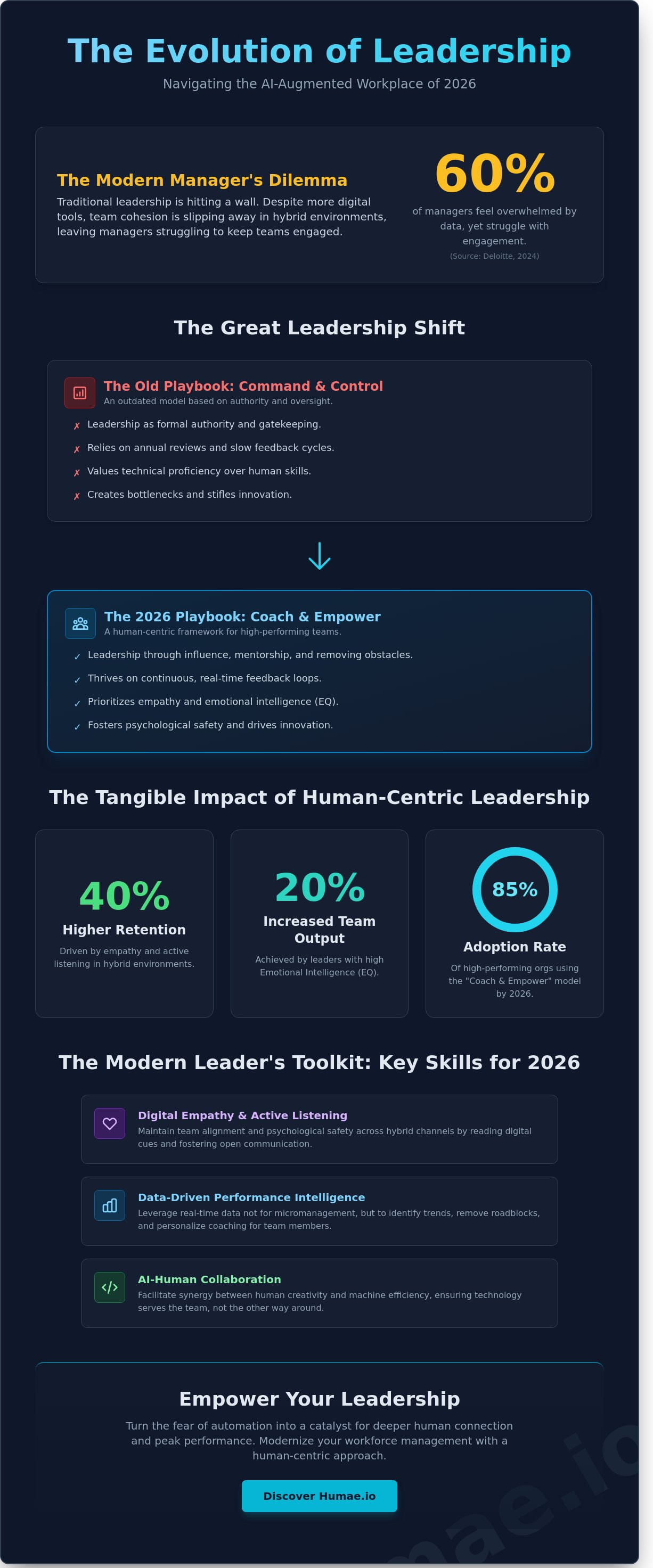
What if the most critical component of your 2026 tech stack isn't a new algorithm, but your capacity for radical empathy? Recent research from a 2024 Deloitte study reveals that 60% of managers feel overwhelmed by data, yet they still struggle to keep hybrid teams engaged. You've likely noticed that traditional leadership skills are hitting a wall when faced with the complexities of an AI-augmented workplace. It's frustrating to have more digital tools than ever while watching team cohesion slip through your fingers as if you're managing ghosts in a machine.
We believe that technology should serve people, not replace them. This guide promises to equip you with a precise framework for human-centric management, blending emotional intelligence with the data-driven insights needed to lead high-performing teams. We'll explore how to align company goals with individual motivation to improve your retention rates by a targeted 15% within the next six months. You're about to discover how to turn the fear of automation into a catalyst for deeper human connection and peak performance in a world that's moving faster than ever.
Humae: Redefining the intersection of technology and human potential. Return to our home page or connect with us on Facebook.
Key Takeaways
- Transition from a "Command and Control" mindset to a "Coach and Empower" approach to thrive in the 2026 AI-augmented landscape.
- Master the art of digital empathy and active listening to maintain high team alignment across hybrid communication channels.
- Leverage real-time performance intelligence to transform your leadership skills into a data-driven competitive advantage.
What Are Leadership Skills in the Era of AI and Hybrid Work?
Leadership in 2026 is an action, not a static title. It's the ability to guide, inspire, and align diverse teams toward shared objectives while maintaining a focus on individual growth. If you look at the fundamental question of What is Leadership?, the answer has shifted from authority to influence. Modern leadership skills now center on human connectivity rather than just oversight. You aren't just a manager; you're a visionary partner who helps people find purpose in their work.
The old "Command and Control" model died years ago. By early 2026, 85% of high-performing organizations have transitioned to a "Coach and Empower" framework. In this environment, leaders act as mentors who remove obstacles instead of gatekeepers who create them. Technical proficiency is a baseline, but it's no longer enough to sustain a leadership role. You can't code or calculate your way through a team conflict or a dip in morale. Leaders need a robust workforce management infrastructure to support this growth. This technology handles the logistical heavy lifting, which frees you to focus on the people who actually drive the results.
The Evolution of the Leader-Employee Relationship
Annual reviews are relics of a slower age. Teams today thrive on continuous, real-time feedback loops that happen in the flow of work. Transparency isn't optional anymore. It builds the psychological safety required for remote teams to innovate without fear. In 2026, soft skills are the new hard skills. Empathy and active listening drive 40% higher retention rates in hybrid environments compared to 2022 benchmarks. If you don't listen, you can't lead.
The Impact of Technology on Leadership Expectations
About Humae
Humae is dedicated to modernizing the recruitment and management experience through human-centric technology. We help businesses grow by putting people first.
The Human-First Core: Empathy, Communication, and Influence
By 2026, technical expertise is a baseline requirement, not a differentiator. Data suggests that emotional intelligence (EQ) is now the primary predictor of performance in high-growth environments. Leaders who master essential leadership skills like self-awareness and social regulation see a 20% increase in team output compared to those relying on technical authority alone. It's about moving from a command-and-control mindset to a supportive partnership that recognizes the human behind the screen.
Digital-first communication demands a new type of active listening. You can't rely on physical body language on Slack or Zoom, so you must learn to read between the digital lines. Pay close attention to response times, punctuation shifts, and emoji usage. On video calls, watch for micro-expressions that signal burnout or hidden disagreement. Modern leadership skills involve identifying these subtle shifts before they turn into resignations or project delays.
Influence replaces formal authority in flat organizational structures. You don't get results by issuing orders; you get them by fostering employee engagement through authentic storytelling. When you share the "why" behind a strategic pivot, you build a narrative that people want to join. This approach turns passive workers into active contributors who feel a personal stake in the company's success. Discover how to streamline your team's growth with our modern hiring tools.
Radical Candor and Constructive Feedback
Direct communication requires a balance of empathy and honesty. Radical candor means you care personally while challenging your team directly. In 2026, feedback must be a fluid, two-way street. Use sentiment analysis tools to monitor team friction in real-time. If the tone in a project channel shifts toward the negative, address it immediately. This proactive approach prevents small misunderstandings from becoming toxic cultural issues that drive away top talent. For more complex organizational challenges, professional consultants like Revive RH|HR can provide essential workplace investigation and career transition support.
Building High-Trust Remote Environments
Trust by default is the only way to manage a distributed workforce. Stop tracking keystrokes and start tracking outcomes. Successful leaders manage time zone gaps by prioritizing asynchronous workflows that respect personal boundaries. Connection is the glue that holds these teams together. Use an employee directory to help team members find shared interests and build rapport outside of their daily tasks. High-trust environments see 50% higher retention rates in remote-first companies.
About Humae
Humae provides innovative HR solutions for the modern, human-centric workplace. We help you build teams that thrive in a digital-first world.
Visit us: Humae Home
Connect with us: Humae on Facebook
Data-Driven Leadership: Leveraging Performance Intelligence
Gut feeling is a relic. While intuition once defined the corner office, the most effective leadership skills in 2026 revolve around performance intelligence. A 2024 Gartner study revealed that 65% of executive decisions are significantly more complex than they were just two years ago. Relying on "instinct" in a high-velocity market is a recipe for bias and missed opportunities. Evidence-based leadership replaces guesswork with clarity, and for those ready to apply this same precision to growth, you can explore AI lead Gen to capture and convert high-intent prospects.
Real-time analytics dashboards empower leaders to act with precision. These tools don't just show what happened; they show why it's happening. When you can see performance trends as they develop, you make faster, fairer decisions. Companies utilizing real-time data saw a 20% increase in diversity within their leadership pipelines by early 2025 because data strips away the unconscious favoritism that often plagues traditional promotions.
AI-driven patterns now identify high-potential employees who might otherwise stay invisible. These "quiet contributors" often possess the exact leadership skills needed for modern management but lack the loudest voice in the room. However, it's vital to avoid "Management by Algorithm." Data should augment empathy, not replace it. Use the numbers to start a conversation, not to end one.
Mastering OKRs for Team Alignment
Traditional annual goal setting fails because it's too static. Research shows 95% of employees don't fully understand their company's strategy. This is why understanding the OKR meaning is essential for modern managers. Objectives and Key Results provide a flexible framework that connects daily tasks to the North Star. Cascading these objectives ensures every team member sees their direct impact on the big picture. Use OKR tracking to celebrate small wins every week; it's the best way to maintain momentum in a hybrid work environment.
AI-Powered Sentiment and Engagement Tracking
Understanding the "Pulse" of your organization is no longer a yearly event. Automated surveys and sentiment analysis tools allow you to monitor morale in real-time. A 2024 Deloitte report found that 82% of HR leaders now prioritize employee experience as a top business metric. AI can predict turnover risks with roughly 90% accuracy by identifying subtle shifts in digital behavioral data. Ethics must remain the priority here. Leaders must ensure privacy and algorithmic fairness to maintain trust. If people feel "watched" rather than "supported," the data becomes useless.
About Humae
Humae provides a modern, technology-driven, yet deeply human-centric approach to recruitment and management. We don't just offer software; we deliver a better experience for both employers and candidates. Our focus is on simplicity, community, and success through innovation.
Actionable Guidance: Building a Leadership Development Culture
High-performing organizations don't wait for leaders to emerge; they build them. Data from 2024 shows that companies with strong leadership pipelines see 2.3 times higher revenue growth. To stay competitive in 2026, you must stop viewing leadership skills as innate traits and start treating them as measurable outcomes of your company culture.
To achieve this, many organizations leverage specialized automation to handle routine tasks; for instance, utilizing an AI sales representative from Global AI Reps allows senior staff to step away from repetitive outreach and focus on high-impact mentoring and strategic decision-making.
Start by identifying potential early. Move beyond simple performance reviews. Look for "cultural catalysts" who demonstrate high emotional intelligence and a natural ability to coach peers. Once identified, apply the 70-20-10 rule. This framework dictates that 70% of development happens through challenging on-the-job experiences, 20% through developmental relationships like mentoring, and only 10% through formal coursework. It's a practical split that ensures learning is grounded in reality.
- Implement Reverse-Mentorship: Pair senior executives with junior employees. This breaks down silos and allows leaders to gain fresh perspectives on digital trends and Gen Z workplace expectations.
- The Leadership Playbook: Create a living document that defines what management looks like at your company. It shouldn't be a policy manual. It's a guide for decision-making and human-centric interaction.
- Peer Coaching Circles: Group 4-5 emerging leaders to solve real business problems together. This builds collaborative muscle and shared accountability.
Developing Learning Agility
Curiosity is the most critical leadership competency for 2026. Leaders must possess the ability to unlearn outdated "command and control" habits that no longer serve a hybrid workforce. Encourage a growth mindset by rewarding experimentation, even when it leads to failure. Upskilling should be a continuous cycle, not a yearly event. If your managers aren't curious about new ways to empower their teams, they'll become bottlenecks in your digital transformation.
Effective Time-Off and Energy Management
Ready to transform your management approach? Discover how Humae empowers modern leaders.
Humae – Human-centric technology for the modern workforce. We combine innovation with empathy to create better workplace experiences.
How Humae Empowers the Next Generation of Leaders
Humae serves as the centralized infrastructure for modern workforce management. It transforms how managers operate by providing performance intelligence that turns bosses into effective coaches. Traditional systems often leave leaders blind to the daily reality of their teams, but Humae changes this by integrating OKRs and feedback directly into the daily workflow. This means goals aren't just checked once a quarter; they're lived every day. When feedback is continuous, teams see a 14% increase in productivity because everyone knows exactly where they stand.
The platform simplifies the administrative burden that usually drains 30% of a manager's weekly capacity. By automating routine documentation and tracking, leaders can reclaim their time. They focus on people, not paperwork. This shift is essential for anyone looking to master modern leadership skills. When the system handles the data entry, you can focus on the human connection that drives results. Leaders who use Humae report spending 50% less time on manual reporting, allowing them to lead with intent rather than reacting to crises.
AI-Driven Insights for Better People Decisions
Humae's sentiment analysis acts as a "weather forecast" for team morale. It identifies subtle shifts in engagement before they turn into turnover. Leaders use these insights to drive employee engagement strategies based on real data, not just gut feelings. Using a single interface for hiring, onboarding, and managing reduces context switching by 40%. This consistency ensures that every new hire experiences the company culture from day one. It removes the friction of managing multiple tools, providing a clear view of team health in one place.
Future-Proofing Your Leadership Strategy
Scaling a startup into an enterprise requires a leadership culture that grows with the headcount. Humae provides the framework to maintain high-performance standards whether you have 10 or 500 employees. It's the partner of choice for visionary leaders in 2026 because it prioritizes the human element through smart technology. Developing your leadership skills is a continuous journey, and Humae provides the data and the time you need to excel. Stop fighting your software and start empowering your team. Transform your leadership today.
Humae – Human-Centric Technology for Modern Teams.
Return to the Home Page
Connect with us on Facebook
Lead the 2026 Evolution with Confidence
The workforce of 2026 won't be managed by spreadsheets or rigid hierarchies. It requires a radical shift toward radical empathy and performance intelligence. You've seen how success today depends on your ability to integrate AI tools while maintaining a human-first culture. Modern managers are moving away from static reviews and toward real-time OKR tracking to keep teams aligned in hybrid environments. Mastering modern leadership skills means bridging the gap between high-tech data and high-touch connection. It's about turning AI-powered performance intelligence into actionable growth for every individual on your team. You have the roadmap; now you need the engine to drive it forward. Don't let your management style get left in the past while the rest of the world moves toward 2026 standards. You're ready to build a culture where technology serves people, not the other way around.
Empower your leaders with Humae’s AI-driven HR platform and leverage our global workforce management infrastructure to stay ahead of the curve. It's time to transform your vision into measurable success.
Return to our Home Page to explore more solutions, or connect with our community on Facebook.
Frequently Asked Questions
What are the top 5 leadership skills for 2026?
The five essential leadership skills for 2026 are cognitive flexibility, digital fluency, radical empathy, ethical AI oversight, and adaptive resilience. A 2024 World Economic Forum report suggests that 44% of workers' core skills will shift within the next 24 months. You've got to master these human-centric traits to stay competitive. These skills allow you to navigate complex hybrid environments while maintaining high levels of psychological safety for your team.
Can leadership skills be learned, or are they innate?
You can definitely learn leadership skills through consistent practice and feedback. Research from 2023 indicates that 70% of leadership development happens through on-the-job experiences rather than innate talent. It's about building habits like active listening and strategic decision-making over time. Don't worry if you aren't a natural leader. Most successful managers spent years refining their approach to people and processes through deliberate effort.
How does AI change the way we look at leadership skills?
AI automates roughly 40% of administrative tasks, which shifts your focus toward high-level strategy and team coaching. You'll spend less time on scheduling and more time on mentoring your staff. Use AI to analyze sentiment or predict turnover risks before they become real problems. This technological shift makes your human connection more valuable. Machines can't replicate the genuine empathy or ethical judgment required for modern management.
What is the difference between management and leadership in a modern office?
Management focuses on maintaining systems and processes, while leadership centers on vision and people. A 2025 industry study showed that teams with visionary leaders are 2.5 times more likely to exceed their annual targets. In a modern office, you can't just be a supervisor who checks boxes. You need to be a coach who inspires growth. Managers handle the how, but leaders define the why for the whole team.
How can I measure the effectiveness of my leadership skills?
You can measure the effectiveness of your leadership skills by tracking employee retention rates and 360-degree feedback scores. If your team turnover is 15% lower than the industry average, you're likely providing the support your people need. Use quarterly engagement surveys to get hard data on how your team perceives your communication. These metrics provide a clear picture of where you excel and where you need to improve your human-centric approach.
How do OKRs help in developing leadership within a team?
OKRs help develop leadership by clarifying expectations and empowering team members to own their results. They reduce the need for micromanagement by focusing on outcomes instead of specific methods. This transparency builds a culture of trust where 100% of your team understands their impact. When people know exactly what success looks like, they're more likely to step up and lead their own initiatives without constant supervision.
What role does emotional intelligence play in digital leadership?
Emotional intelligence acts as the vital bridge between remote screens, helping you detect burnout before it leads to a resignation. Leaders with high EQ see a 20% increase in team productivity during digital transitions. You have to read between the lines of a Slack message or a Zoom call to keep morale high. Understanding the unspoken digital cues is what separates a great digital leader from a mediocre one. When these cues indicate deeper organizational issues, Revive RH|HR provides the necessary expertise for workplace investigations and career transitions.
How can HR software like Humae help me become a better leader?
Humae helps you become a better leader by automating repetitive HR tasks, giving you back at least 10 hours every week. This extra time allows you to focus on building a strong company culture and mentoring your team. Our platform turns recruitment into a positive experience for both you and your candidates. It's the visionary partner you need to ensure your human-centric management remains your top priority.
Return to the Humae Home Page.
Follow us on Facebook for more leadership insights.