Manager Effectiveness Software: The 2026 Guide to High-Performing Leadership
By Humae · 10 August 2026
manager effectiveness software
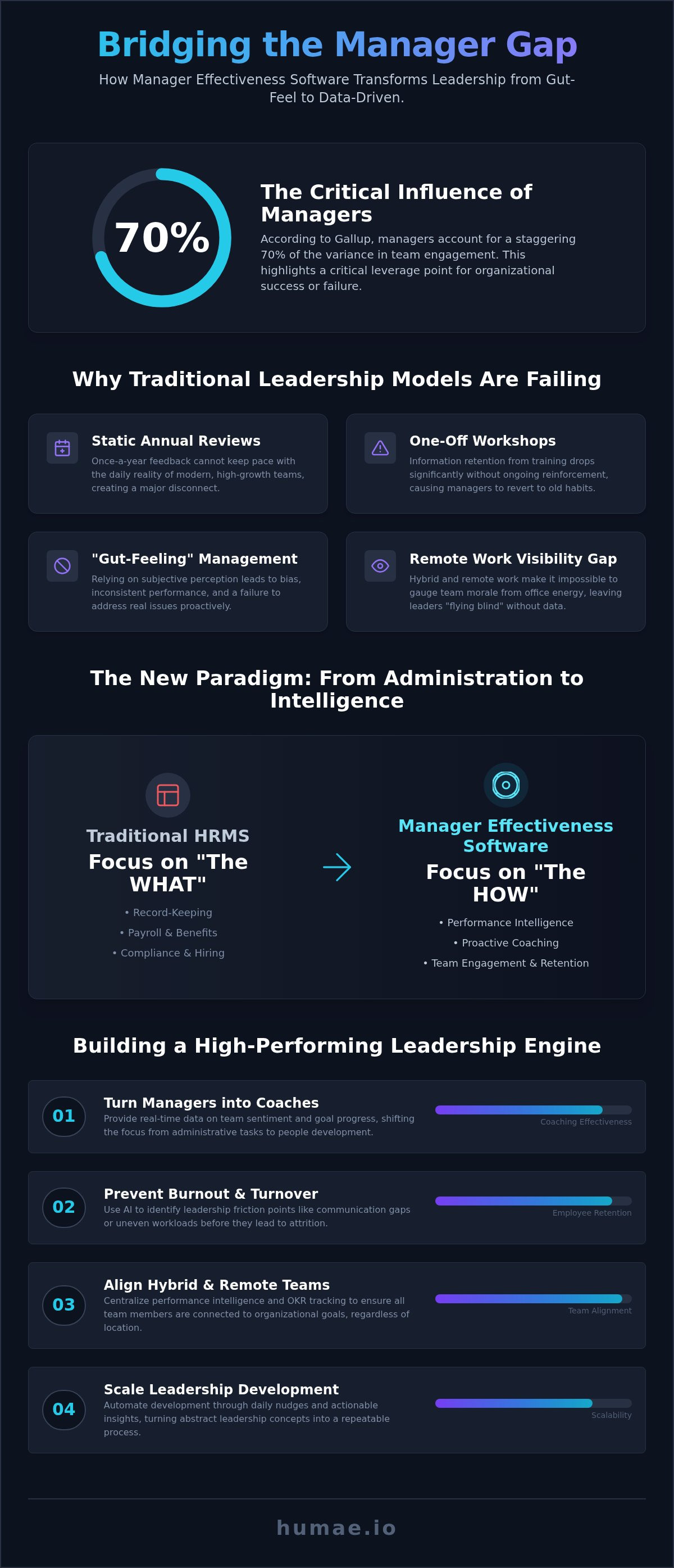
Did you know that managers account for a staggering 70% of the variance in team engagement? It's a heavy burden to carry, especially when traditional training often fails to meet the complex demands of 2026. You've likely seen the symptoms of this disconnect in your own organization. One department thrives while another struggles with turnover, and your best leaders are often buried under administrative tasks instead of developing their people. It's exhausting to manage without visibility into real-time team sentiment or a clear way to scale your culture. This is where manager effectiveness software changes the equation by providing the data you need to lead with confidence.
At Humae, we believe leadership is a measurable output of clarity and feedback, not an innate personality trait. This guide shows you how to transform inconsistent management into a high-performing leadership engine. We'll explore how to use AI-powered intelligence and data-driven frameworks to coach managers at scale. You'll discover how to automate performance tracking and boost employee retention through better, more empathetic leadership. Let's look at how technology can finally make the human element of your business your greatest competitive advantage.
Experience the future of HR with Humae. | Back to Home | Connect with us on Facebook
Key Takeaways
- Identify the critical disconnect between static annual reviews and the fast-paced leadership needs of a modern workforce.
- Explore how manager effectiveness software provides the performance intelligence needed to turn administrative managers into proactive coaches.
- Master the use of AI-driven sentiment analysis and real-time OKR tracking to align hybrid teams and prevent burnout.
- Implement a scalable leadership engine by integrating advanced workforce management tools that prioritize human connection alongside productivity.
- Discover how Humae's infrastructure drives retention through automated leadership development. Explore the Humae platform, return to our Home Page, or follow us on Facebook.
The Manager Gap: Why Traditional Leadership Training Fails in 2026
The business world moves at a pace that annual reviews simply cannot match. In 2026, the disconnect between static, once-a-year feedback and the daily reality of high-growth teams has reached a breaking point. Organizations often rely on outdated Management development models that prioritize administrative compliance over actual human growth. This gap is expensive. According to Gallup, managers account for 70% of the variance in team engagement. When a leader lacks the tools to provide continuous support, the result is a cascade of turnover, burnout, and stalled OKRs. Modern teams require more than just a boss; they need a coach who is empowered by manager effectiveness software to see what is happening in real time.
The shift to remote and hybrid work has transformed visibility from a social habit into a technical challenge. You can no longer gauge team morale by the energy in the breakroom. Without a centralized infrastructure to track sentiment and performance intelligence, leaders are essentially flying blind. This lack of visibility doesn't just hurt productivity; it erodes the trust necessary for a healthy culture. High-performing leadership in 2026 is no longer about "checking in" during a scheduled meeting. It is about having the data to intervene exactly when a team member needs support.
The Limitations of One-Off Leadership Workshops
Traditional workshops often feel like a spark that quickly fades. Research shows that information retention drops significantly just 24 hours after a training session ends. Without ongoing reinforcement, even the most inspired managers return to their old, task-oriented habits. This is why manager effectiveness software is becoming the essential guardrail for modern leadership. Rather than relying on a single day of learning, these platforms provide daily nudges and actionable insights. They turn the abstract concepts of leadership into a repeatable, scalable process that lives within the manager's actual workflow.
From Subjective Feeling to Objective Manager Intelligence
Data-driven organizations are moving away from "gut feeling" management. Relying on a manager's subjective perception of their team leads to bias and inconsistent performance across departments. Performance intelligence software bridges the gap between a leader's intent and their actual impact. By providing objective data on team sentiment and goal progress, technology helps foster intrinsic motivation. It allows managers to focus their energy on people development rather than manual data entry. When leaders have clear visibility into team health, they can move from reactive firefighting to proactive, empathetic coaching.
What is Manager Effectiveness Software?
At its core, manager effectiveness software is a category of HR technology designed to help leaders track, coach, and optimize team performance. It represents a significant shift from the static workforce management infrastructure of the past. While traditional systems focused on record-keeping, modern platforms prioritize performance intelligence. This technology doesn't just store data; it interprets the human interactions that drive your business forward. It acts as the connective tissue between organizational goals and the daily activities of every team member.
The primary difference between a standard HRMS and these effectiveness tools lies in their intent. A traditional HRMS manages the "what" of employment, such as payroll, benefits, and hiring records. In contrast, effectiveness software manages the "how" of leadership. It uses AI to identify leadership friction, such as communication gaps or uneven workloads, before these issues lead to burnout or turnover. By centralizing these insights, organizations can move away from reactive management and toward a proactive, data-driven leadership model. You can explore how advanced performance intelligence transforms daily operations by centralizing these human-centric insights.
Core Components of Effectiveness Platforms
Modern platforms are built on three essential pillars that ensure leadership is both scalable and consistent:
- Continuous Feedback Loops: These systems replace the dreaded annual review with real-time sentiment analysis. Managers can gauge team health instantly, allowing for immediate course correction.
- Integrated OKR Tracking: Transparency is key to alignment. By integrating OKR tracking into daily workflows, every employee sees how their individual tasks contribute to company-wide success.
- Actionable Analytics Dashboards: These provide high-level visibility for HR and granular insights for managers, turning raw data into clear steps for team improvement.
The Role of AI in Modern Management
AI is the engine that makes manager effectiveness software truly transformative. It handles the heavy lifting of administrative tasks like time-off management and directory updates, freeing leaders to focus on people development. Beyond automation, AI-driven coaching prompts offer personalized guidance based on current team sentiment and performance trends. These "nudges" help managers stay mindful of their team's needs without adding to their cognitive load. Manager effectiveness software serves as a digital coach for leaders, providing real-time guidance to navigate complex team dynamics. This ensures that even as an organization scales, the quality of leadership remains high and deeply human.
Essential Features of a Modern Manager Intelligence Platform
A modern manager intelligence platform isn't just a collection of features; it's a strategic infrastructure designed to empower leaders. At the heart of this system is real-time OKR and goal tracking. This ensures transparent accountability by showing exactly how team efforts align with high-level objectives. When everyone sees the same data, the need for micromanagement disappears. Teams gain clarity, and managers can focus on removing blockers rather than just checking status updates.
AI-powered sentiment analysis is another cornerstone of these platforms. It allows you to gauge team health without the friction of survey fatigue. Traditional surveys often feel like a chore, but AI can analyze signals in daily communication to provide a pulse check on morale. Combined with centralized employee directories that feature deep skill-mapping, managers can quickly identify who is best suited for specific projects. This turns a simple list of names into a dynamic talent map that evolves as your people grow.
Efficiency is driven by automated tools that reduce the manager tax. By handling routine administrative work like time-off requests or directory updates, manager effectiveness software allows leaders to spend their time where it matters most: with their people. This shift from admin to action is what defines a high-performing leadership engine in 2026.
Performance Intelligence and Feedback
Continuous performance tracking has officially replaced the outdated annual review. By linking employee engagement strategies directly to manager actions, organizations create a loop of constant improvement. This relies on a centralized source of truth for all employee data. It ensures that coaching sessions are based on objective facts rather than fuzzy memory or personal bias. Leaders can now provide feedback that is both timely and deeply relevant to the individual's growth journey.
Analytics and Reporting for HR Leaders
For HR leaders, the value lies in high-level visualization. You can see leadership quality across different departments, identifying where managers excel and where they need more support. This data is vital for succession planning. It highlights high-potential leaders based on their team's actual performance and sentiment trends. By using workforce management data, HR can predict retention risks before they become exit interviews. It's about moving from hindsight to foresight to keep your best talent engaged and productive.
5 Steps to Implementing Manager Effectiveness Software
Implementing manager effectiveness software requires more than a simple installation. It is a strategic transformation of how your organization develops its leaders. To move from inconsistent management to a scalable leadership engine, you need a structured approach that prioritizes both data and the human experience. Adoption lives or dies by how well the tool integrates into the daily habits of your team.
First, audit your current leadership gaps. Look for departments where performance lags or where turnover is higher than average. Define what success looks like for your organization. Once your goals are clear, select a platform that integrates seamlessly with your existing workforce management infrastructure. A tool that lives where your managers already work is far more likely to see high adoption. Training is the next vital step. Frame the software as a resource for the manager, not a surveillance tool for the executive. Show them how the platform reduces their administrative burden by automating tasks. Finally, roll out OKR tracking to establish a culture of transparency. As you gather data, use AI-driven sentiment analysis to iterate on your approach and address friction points in real time.
Ready to build a high-performing leadership engine? Start your transformation with Humae today.
Defining Your Success Metrics
Success isn't a vague feeling. It is a measurable outcome. Organizations must track improvements in team productivity and goal completion rates to justify the investment. By leveraging modern performance management systems, you can quantify manager growth over time. Measuring the reduction in unwanted employee turnover provides a clear return on investment, as high-performing leadership is the strongest defense against talent loss. These metrics turn leadership development from a soft skill into a hard business advantage.
Managing the Cultural Transition
Change can trigger anxiety. Communicating the purpose behind the new software is essential to avoid Big Brother fears. Be transparent. Explain that the tool exists to provide support and visibility, not to micromanage. Highlighting features that make a manager's life easier, such as automated time-off management, helps build immediate buy-in. When managers see the tool as a partner in their success, it fosters a growth mindset across the team. Continuous feedback loops then become a natural part of the workday rather than a forced exercise.
Scaling Leadership with Humae: The AI-Powered Advantage
Scaling leadership is no longer a manual task. As your organization grows, the distance between executive vision and front line execution often increases. Humae bridges this gap by combining the foundational reliability of an HRMS with advanced performance intelligence. This integrated approach ensures that every leader in your company has the tools to be effective from day one. By centralizing OKR tracking, directory management, and sentiment analysis, we provide the infrastructure needed for a high-performing culture. It is about turning leadership from a series of isolated events into a consistent, company-wide standard.
Remote and hybrid teams face unique challenges in alignment. Without the physical proximity of an office, subtle signals of burnout or misalignment are easily missed. Humae's real-time OKR tracking provides a digital north star for these teams. It ensures that everyone, regardless of their location, understands exactly how their work contributes to the company's success. This transparency reduces the need for constant status meetings and allows managers to focus on high-impact coaching. It is the most direct way to keep a distributed workforce connected and motivated.
AI sentiment analysis gives managers a "sixth sense" for team morale. Instead of waiting for an annual survey or an exit interview, leaders can detect shifts in engagement through daily signals. This allows for proactive intervention before friction turns into turnover. It represents the ultimate evolution of manager effectiveness software, where raw data is transformed into empathetic, human-centered action. By streamlining hiring and onboarding within the same platform, you also ensure that new managers are set up for success before they even hold their first team meeting.
The Humae Difference: Intelligent Infrastructure
Our features are designed to prioritize the human element of HR. By housing your employee directory, OKRs, and performance analytics in a single interface, we eliminate the fragmentation that plagues modern organizations. This helps you build a modern HR infrastructure where data serves people, not the other way around. It is about creating a workspace where every interaction is an opportunity for growth and every manager has the intelligence to lead effectively.
Getting Started with Data-Driven Management
You can see how it works and begin transforming your leadership culture today. Investing in manager effectiveness software early in a company's growth cycle provides a massive ROI by preventing the "leadership debt" that often slows down scaling startups. High-quality management becomes a repeatable process rather than a happy accident. Ready to empower your leaders and align your teams? Explore Humae today and discover how performance intelligence can redefine your business.
The Future of Leadership is Data-Driven and Deeply Human
The journey toward high-performing leadership isn't just about training; it's about the tools that make growth possible every day. By moving away from subjective "gut feeling" management and embracing data-driven frameworks, you create a culture where transparency and support are the default. We've explored how manager effectiveness software serves as the essential infrastructure for this transition. It bridges the gap between organizational goals and individual team health.
Success in 2026 belongs to the organizations that treat leadership as a scalable engine. With centralized manager dashboards, real-time OKR tracking, and AI-driven sentiment analysis, you can identify friction before it impacts your bottom line. This isn't just about efficiency; it's about building a workplace that is deeply human and relentlessly productive. Your managers are your greatest asset, so give them the intelligence they need to thrive.
Empower your leaders with Humae’s AI-powered platform and start transforming your management culture today. The future of your organization depends on the support you provide your leaders right now.
Frequently Asked Questions
What is manager effectiveness software and how does it work?
Manager effectiveness software is a category of HR technology designed to help leaders track, coach, and optimize team performance through data-driven insights. It works by centralizing feedback loops, OKRs, and sentiment analysis to provide a real-time view of team health. By automating administrative tasks, it allows managers to move away from record-keeping and focus on proactive people development.
Can software really make someone a better manager?
Yes, because it provides the objective data and guardrails needed to move beyond subjective "gut feeling" management. Software doesn't replace the human element; it enhances it with AI-driven coaching prompts and performance intelligence. It helps managers stay consistent in their feedback and provides the visibility required to intervene before team issues escalate into turnover.
Is manager effectiveness software the same as a performance management system?
Not exactly, although they are closely related. While traditional performance management often focuses on annual reviews and compliance, manager effectiveness software emphasizes continuous feedback and daily leadership support. It acts as a digital coach for leaders, whereas a standard performance system is often a record-keeping tool designed primarily for HR compliance.
How does AI sentiment analysis protect employee privacy?
Modern platforms use data aggregation and anonymization to ensure that individual responses remain private. The AI analyzes high-level patterns and trends across the team rather than tracking specific individuals. This allows leaders to address morale issues or burnout risks without compromising the psychological safety or the personal privacy of their team members.
What are the most important features to look for in a manager tool?
You should prioritize real-time OKR tracking, AI-powered sentiment analysis, and a centralized employee directory. A high-performing platform must also include automated workforce management features to reduce the administrative burden on leaders. Deep skill-mapping and actionable analytics dashboards are essential for scaling leadership quality across different departments as your organization grows.
How much does manager effectiveness software typically cost in 2026?
Pricing typically depends on the specific features and the size of your organization. Most providers offer tiered monthly rates based on the number of employees, while enterprise solutions with human coaching elements may require custom quotes. It's best to evaluate providers based on the specific ROI they offer in terms of retention and productivity rather than just the base cost.
Does manager effectiveness software integrate with my existing payroll or HRMS?
Yes, most modern platforms are built to integrate seamlessly with your existing workforce management infrastructure. This ensures that data flows between your employee directory, payroll, and effectiveness tools without manual entry. Integration is a vital differentiator that ensures high adoption rates and maintains a single source of truth for all your HR data.
How do I convince my managers to use a new software platform?
Focus on how the tool makes their daily lives easier rather than just adding to their workload. Highlight features like automated time-off management and real-time visibility that reduce their administrative "manager tax." When leaders see the software as a supportive partner that helps them hit their OKRs, they are much more likely to embrace the transition.