Lattice: The Complete Guide to People Management Platforms in 2026
By Humae · 18 April 2026
lattice
What if the 40 hours your HR team spends on annual reviews every quarter could be cut by 85% without losing a single insight? Since its launch in 2015, lattice has set the gold standard for structured feedback, helping over 5,000 companies move away from messy spreadsheets and disjointed emails. You likely already feel that manual performance reviews are a massive drain on your culture. It's frustrating when data sits in silos and your team's hard work goes unnoticed because the tools are too clunky to use daily.
We agree that high-growth teams deserve more than just a digital filing cabinet; they need a centralized hub that turns feedback into a competitive advantage. You'll discover how platforms like Lattice revolutionized the industry and why AI-native alternatives are the essential next step for 2026. We'll explore how to automate feedback loops to boost retention, use Benchmarcx to measure and benchmark your talent experience in real-time, and finally see a clear ROI on your team's productivity.
Humae is your partner in bridging the gap between cutting-edge technology and human connection. We help you build a future-proof workplace where people come first. Return to our home page for more insights, or join our community on Facebook.
Key Takeaways
- Explore how lattice transformed People Operations by integrating performance, engagement, and growth into a single mission-driven platform.
- Identify the core features of high-performance HRMS infrastructure that foster continuous feedback and long-term employee retention.
- Distinguish between legacy "AI-added" features and "AI-native" systems to leverage deeper sentiment analysis for your high-growth team.
- Evaluate organization maturity and cost models to decide when to transition from traditional tools to value-based SaaS alternatives.
- Learn how Humae’s real-time OKR tracking and human-centric automation provide the logical next step for teams outgrowing standard platforms.
What is Lattice? Defining the Modern People Management Platform
Lattice isn't just another HR tool. It's a category-defining People Success platform that redefined how companies manage their most valuable asset: their people. Since its inception, the platform has helped over 5,000 organizations move away from cold, administrative checklists toward a strategy centered on human growth. Lattice co-founder Jack Altman envisioned a world where employee engagement and performance weren't separate silos. By 2026, this vision has become the industry standard. The software bridges the gap between what a company needs and what an employee wants to achieve.
The platform's mission focuses on the "People Success" model. This approach moves HR from the back office to the boardroom. It treats employee development as a business driver rather than a cost center. By 2026, the shift to hybrid work has made this centralized system essential for maintaining culture across time zones. It provides a single source of truth for managers and employees alike, ensuring that no one feels disconnected from the company's core mission.
The Core Components of a People Platform
Performance management in the modern era has evolved. The platform replaces the dreaded annual review with continuous feedback loops and weekly 1:1 check-ins. This ensures that goals remain relevant as market conditions change. It's about looking forward, not just documenting the past.
Employee engagement tools provide real-time pulse surveys. These aren't just generic forms; they use sentiment tracking to identify trends in team morale before they lead to turnover. Growth and development modules then map out career paths using competency matrices. This gives employees a clear roadmap for their future, which has been shown to reduce turnover by an average of 20 percent in high-growth firms.
Why Companies Search for Lattice in 2026
Modern teams struggle with tool fatigue. Studies show the average enterprise now manages over 15 different HR-related applications. Lattice solves this by consolidating performance, OKRs, and engagement into a single interface. This integration allows for data-driven decision making. Managers can see exactly how engagement scores correlate with hitting quarterly targets, allowing for proactive interventions.
Transparency isn't just a buzzword anymore. It's a requirement for the 2026 workforce. Features like public praise and visible OKRs ensure everyone knows how their work contributes to the bigger picture. This builds a culture of accountability and recognition that thrives even in fully remote environments. Companies don't just want a database; they want a partner that helps them build a winning culture.
About Humae
At Humae, we believe that technology should serve humanity, not the other way around. We are your visionary partner in building modern, tech-driven, and deeply human-centered recruitment experiences.
- Explore our approach: Humae Home
- See how we work: How It Works
- Discover our solutions: Features
- Join our community: Humae on Facebook
Essential Features of High-Performance HRMS Infrastructure
Static employee directories are relics of the past. High-performing teams in 2026 require a living ecosystem where data flows seamlessly between performance, growth, and engagement. Software platforms like lattice have pioneered this shift, turning HR from a back-office function into a strategic engine. To build a resilient workforce, your Human Resource Management System (HRMS) must act as a central nervous system, not just a database. It's about creating a space where employees feel seen and supported every single day.
Continuous feedback is the fuel for high employee retention. A 2024 Gallup study found that employees who receive meaningful feedback weekly are 3.2 times more likely to stay engaged. Waiting for a quarterly sit-down is too slow for modern business. Real-time course correction prevents small frustrations from turning into resignations. If you want to see how these features look in action, explore our integrated HR solutions.
OKR Tracking and Goal Alignment
Understanding the OKR meaning is the first step toward high-velocity growth. In 2026, goals aren't set in January and forgotten in a spreadsheet; they're dynamic and visible. Cascading goals are essential for organizational transparency. When a developer sees exactly how their daily tasks impact a 15% increase in quarterly revenue, their sense of purpose doubles. It eliminates the "why am I doing this?" factor that drains productivity.
Integration is key. High-performance infrastructure pulls real-time progress updates directly into weekly 1:1 meetings. This ensures every conversation is grounded in actual progress. It moves the needle from "what are you doing?" to "how can I help you succeed?" The lattice framework excels at this by making goals part of the daily workflow rather than a separate chore. This alignment ensures that individual wins are company wins.
Performance Intelligence and Feedback Loops
The traditional annual review has finally died. It's been replaced by "anytime" feedback and performance intelligence. This shift allows managers to identify skill gaps 6 months before they become critical project failures. Instead of looking backward, performance intelligence software looks forward, using AI to predict which teams might need extra support or training. It transforms feedback from a judgment into a development tool.
Using analytics dashboards helps leaders visualize team health instantly. These tools can flag burnout patterns, such as a sudden drop in engagement scores or excessive overtime, before top talent decides to leave. At the same time, it highlights high-potential individuals who are ready for promotion. Data-driven empathy is the new standard for people management, ensuring no one is overlooked in a fast-growing company.
Humae combines technology with a human-centered approach to transform your recruitment and management experience. We help you build cultures where people and businesses thrive together.
Explore more or return to our Home Page.
Connect with us on Facebook.
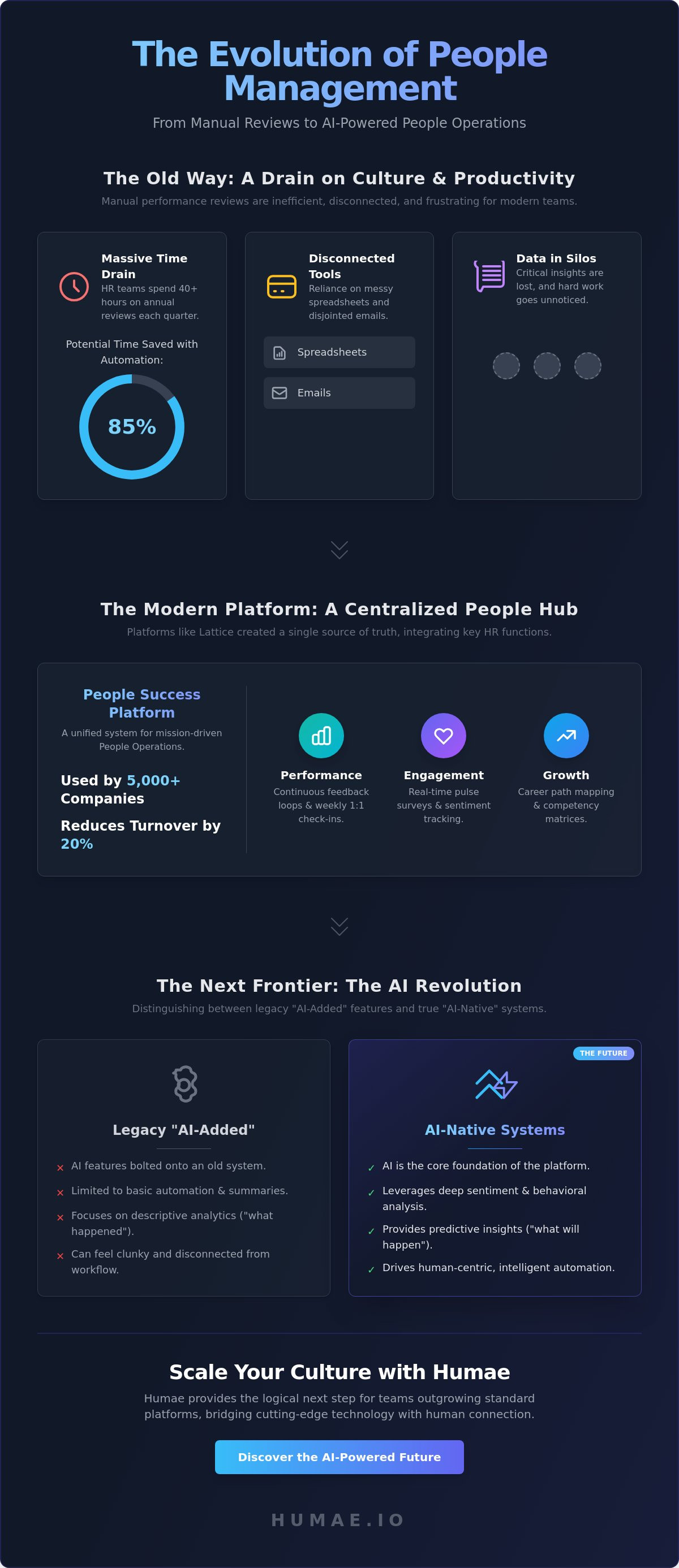
The AI Revolution: How HR Intelligence Surpasses Legacy Systems
The administrative burden of performance cycles is disappearing. By January 2026, automated systems started drafting initial performance reviews by synthesizing a year's worth of Slack kudos, project completions, and peer feedback. This doesn't replace the manager. It frees them from the "blank page" problem, allowing them to focus on the human conversation rather than data entry. It's about augmenting capability, not replacing intuition.
Successfully deploying these automated workflows at scale often requires the expertise of specialized partners. Consulting firms like Ethicrithm Inc. help enterprises manage the complex AI operations and engineering needed to turn these technological capabilities into sustainable business outcomes.
AI-Powered Sentiment and Engagement
Standard surveys are losing their effectiveness. High-growth companies have largely replaced annual check-ins with real-time sentiment analysis. We're moving from "what happened" to "why it happened" using sophisticated natural language processing. This technology is vital for detecting early signs of turnover through employee engagement strategies that analyze the tone and context of communication. If the "vibe" of a team shifts, the system flags it before the resignation letters arrive. Privacy remains the priority. Modern platforms use differential privacy to ensure individual feedback stays anonymous while giving leadership the clarity they need to prevent burnout.
Workforce Management Infrastructure in 2026
Defining workforce management for the AI era requires a focus on predictive capacity. AI now predicts future staffing needs based on current performance velocity with 92% accuracy. This infrastructure supports the entire talent acquisition cycle, where automated onboarding ensures new hires are productive 30% faster than traditional methods. Beyond logistics, AI agents have emerged as personal career coaches for every employee. These agents analyze internal mobility trends to suggest specific skills or mentors, turning a standard job into a personalized career path. It's a visionary approach where technology serves the individual's growth as much as the company's bottom line.
Humae: Human-Centered Innovation
We build the bridge between cutting-edge automation and genuine human connection. Discover how we're redefining the hiring experience at Humae Home.
Stay updated with our latest insights on Facebook.
How to Choose Between Lattice and AI-Native HR Alternatives
Selecting a people management platform in 2026 requires a shift from looking at features to looking at workflows. While lattice remains a powerhouse for organizations that need a structured, record-heavy environment, your choice depends on your company's maturity. If your HR team is still transitioning from manual processes, a full-scale platform can feel overwhelming. You need to assess if your managers are ready for deep analytics or if they just need help having better conversations.
- Cost Structure: Lattice typically operates on seat-based pricing. This is predictable for stable enterprises. For fast-scaling teams, value-based SaaS models often provide better ROI by aligning costs with actual engagement metrics rather than just headcount. To further maximize your budget, LicenseIQ offers an AI-native software intelligence platform that helps companies discover and recover wasted spend on Microsoft 365 licenses.
- The Integration Test: A tool is only useful if people use it daily. Check for deep integrations with Slack and Microsoft Teams. Data from 2025 indicates that 70% of employees engage more frequently with HR tools when they don't have to leave their primary communication app.
- The Adoption Test: If a manager needs a manual to give feedback, the tool has failed. Modern platforms must be intuitive enough for a first-time lead to use without a three-hour training session. High adoption rates are the only way to ensure data integrity.
Comparing Legacy Leaders vs. AI Innovators
Lattice is the established standard for mid-market performance management, providing the stability and compliance features larger corporations crave. Humae serves as the AI-first alternative for teams that value intelligence over simple record-keeping. While lattice organizes data, Humae interprets it. Startups using AI-native tools often see a 50% faster time-to-value because the system automates the heavy lifting of goal alignment and sentiment analysis that usually takes weeks to configure.
Implementation Strategy for New HR Software
Success requires a phased approach. Don't flip the switch on everything at once. Start with engagement pulses to build a baseline of trust across the organization. Once the team is comfortable, introduce performance modules. Training is essential for using modern management tools effectively. Track your success by measuring the frequency of feedback; a successful rollout should see a 20% increase in peer-to-peer recognition within the first 90 days.
Ready to see how AI can transform your team's culture and streamline your workflows? Explore the Humae feature set today.
Humae – Redefining the intersection of technology and human connection in modern HR. We offer a visionary approach to recruitment and people management, ensuring every interaction is meaningful.
Follow our journey on Facebook
Scaling with Humae: The AI-Powered Future of People Operations
As organizations expand, the administrative weight of legacy systems often slows down momentum. While platforms like lattice provide a solid foundation for performance reviews, high-growth teams in 2026 require more than just static data entry. They need a proactive partner. Humae bridges the gap between basic management and intelligent operations. It's built specifically for companies that have outgrown the limitations of traditional tools. By 2025, 75% of HR leaders reported that manual data reconciliation was their primary bottleneck. Humae eliminates this friction by centralizing every touchpoint into a single, cohesive ecosystem.
Real-time tracking isn't a luxury; it's a necessity for survival. Humae integrates OKR progress directly with AI-driven sentiment analysis. This means leadership sees more than just a percentage of completion. They see the emotional health of the team behind the goal. If a project hits a 40% delay, the AI identifies whether the cause is a resource gap or burnout before it becomes a turnover statistic. This level of insight transforms managers from reactive fire-fighters into proactive leaders who understand the "why" behind the numbers.
A centralized employee directory serves as the ultimate source of truth for your culture. It isn't just a list of names. It's a dynamic map of skills, roles, and availability. Humae simplifies time-off management by placing it right next to performance metrics. When you can see leave patterns alongside productivity trends, you make better decisions about workload distribution. It removes the need to toggle between multiple apps just to approve a vacation request or check a team member's status. Efficiency becomes the baseline, not the goal.
- Eliminate data silos with a unified source of truth.
- Predict turnover using AI sentiment analysis.
- Align individual goals with company-wide OKRs in real-time.
- Automate repetitive HR tasks to focus on strategy.
The Humae Advantage: AI at the Core
Every feature we build delivers actionable intelligence. Data without direction is just noise. Humae streamlines hiring and onboarding for organizations that need to scale 2x or 3x within a single year. Automated workflows ensure new hires feel connected from day one, reducing early churn by up to 33% based on recent industry benchmarks. Humae is the AI-powered infrastructure for modern teams.
Ready to Transform Your Workforce?
Scaling doesn't have to mean losing your company's soul. You can maintain high performance while fostering a culture of empathy and growth. Explore our advanced performance tools to see how your team can thrive. We invite you to take a personalized tour of our ecosystem. Visit the Humae Home Page to see the future of HR in action.
About Humae
Humae is dedicated to redefining the intersection of technology and human potential. We build tools that make work more human, even as they become more automated.
Master the Future of People Operations
The landscape of HR technology is shifting rapidly. Industry reports indicate that by 2026, 80% of HR leaders will integrate AI-driven intelligence into their core infrastructure to replace static, manual processes. While legacy platforms like lattice provided a solid foundation for performance tracking, the next era demands more than just record-keeping. You need a centralized workforce management infrastructure that connects every individual goal to a tangible business outcome. Modern teams are ditching manual surveys for AI-driven sentiment analysis to capture real-time engagement data. This shift ensures that your integrated OKR tracking remains accurate and reflects the actual pulse of your organization. It's time to move beyond administrative tasks and focus on the human experience at the heart of your business. Success in the coming years depends on your ability to adapt to these intelligent systems. Don't let your growth be limited by outdated tools when the future is already here.
Experience the future of HR with Humae, Book a demo today
Return to the Humae Home Page or connect with us on Facebook.
Frequently Asked Questions
What is the main purpose of a platform like Lattice?
Lattice centralizes performance, engagement, and employee growth into a single digital ecosystem. It replaces fragmented spreadsheets with automated feedback loops and real-time goal tracking. In 2026, it serves as the cultural pulse of a company, ensuring every team member stays aligned with high-level objectives through a unified interface. This clarity helps managers focus on coaching rather than chasing down status updates.
How does Lattice compare to traditional HRMS systems?
Traditional HRMS systems focus on administrative records like payroll and benefits, while Lattice prioritizes the employee experience and talent development. A 2024 industry report showed that platforms like this increase manager-employee interaction frequency by 40%. It's a layer of engagement that sits on top of or integrates with your existing system of record to drive actual performance.
Is Lattice suitable for small startups or just large enterprises?
Lattice scales effectively for teams ranging from 20 to over 5,000 employees. Small startups use it to build a culture of feedback early, while enterprises leverage its advanced analytics to prevent turnover. Data from 2025 indicates that companies with fewer than 100 employees see the fastest adoption rates due to the platform's intuitive design and quick setup times.
Can AI really improve employee performance reviews?
AI eliminates human bias by analyzing objective data points instead of relying on a manager's memory. It summarizes months of feedback into clear, actionable insights in seconds. According to a 2025 HR Tech survey, AI-assisted reviews reduced the time spent on documentation by 65% while simultaneously increasing employee satisfaction scores by providing more consistent and fair evaluations.
What are the most important features to look for in a people management platform?
Prioritize real-time feedback tools, automated 1:1 agendas, and deep integration capabilities. A modern platform must offer sentiment analysis to catch burnout before it leads to resignation. Look for systems that provide 360-degree reviews and clear career pathing visualizations to keep your top talent motivated and engaged. Efficiency and ease of use remain the top drivers for long-term platform adoption.
How does OKR tracking integrate with performance management?
OKRs provide the "what" while performance management handles the "how" through continuous coaching. In the Lattice environment, individual goals link directly to company-wide results, making progress visible to everyone. This transparency ensures that 90% of employees understand exactly how their daily tasks contribute to the firm's broader success, which significantly boosts overall morale and productivity.
What is the typical ROI of implementing an AI-powered HR platform?
Organizations typically see a 25% reduction in voluntary turnover within the first 18 months of implementation. By automating routine administrative tasks, HR teams reclaim roughly 12 hours per week. These efficiency gains allow leaders to focus on strategic growth and human connection rather than manual data entry. The investment pays for itself by retaining high-performing talent who feel valued.
How do AI-native platforms like Humae handle data privacy?
Humae uses enterprise-grade encryption and strict data residency protocols to ensure all employee information remains secure. We follow GDPR and SOC2 Type II standards, meaning your data is never used to train public AI models. Privacy isn't just a feature; it's the foundation of the trust we build with every partner. We ensure that your sensitive HR data stays within your controlled environment.
Humae: Redefining the Human Experience in Recruitment
We blend cutting-edge technology with deep empathy to create a better hiring journey for everyone. Our mission is to transform recruitment from a process into an experience that inspires growth and builds community. We believe that when technology serves people, everyone wins.
Ready to innovate your HR strategy? Return to our Home Page to explore our solutions.
Stay connected with our community on Facebook.