Intrinsic Motivation: The Modern Leader’s Guide to Sustainable Drive
By Humae · 2 May 2026
intrinsic motivation
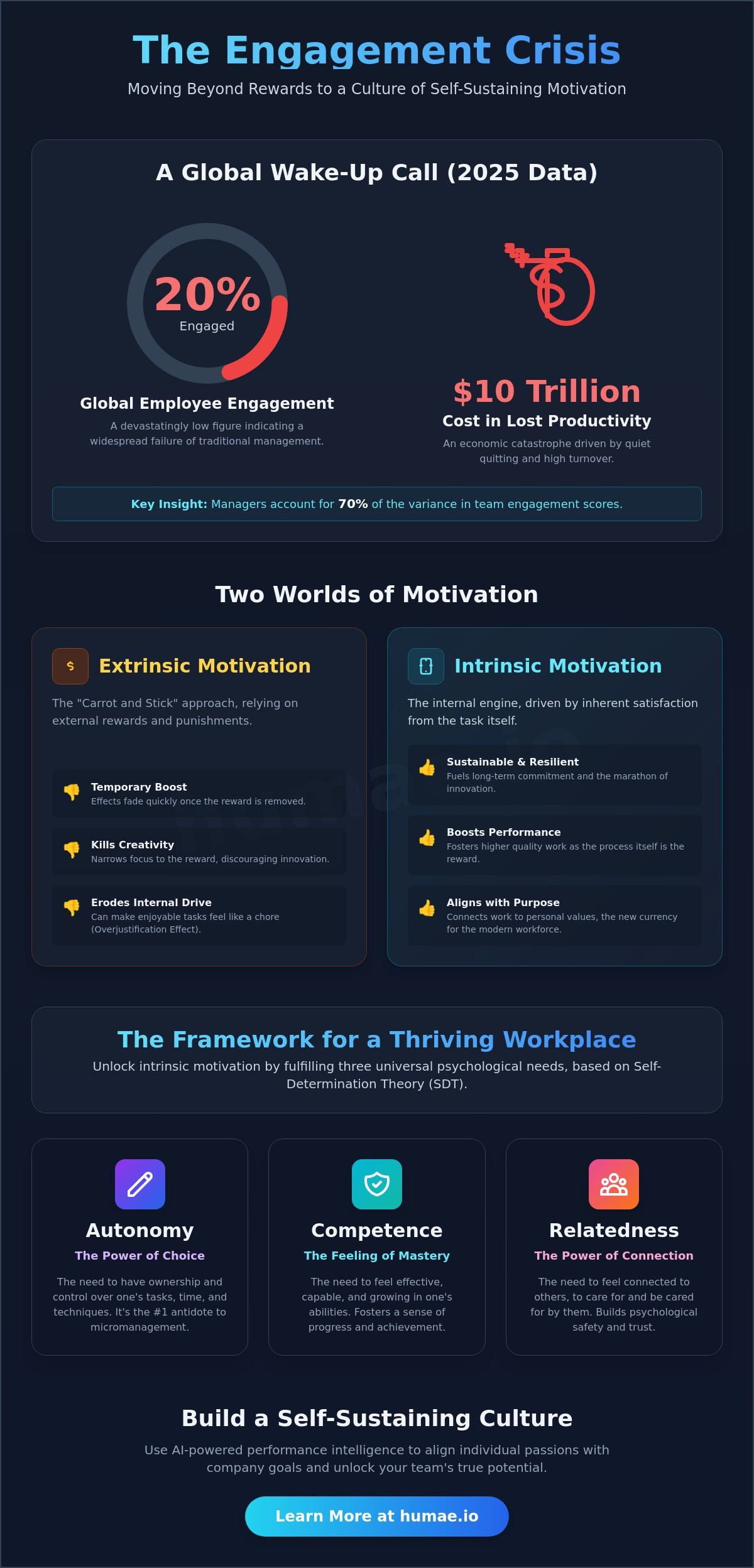
Global employee engagement plummeted to just 20% in 2025, costing the world economy a staggering $10 trillion in lost productivity. It's a wake up call for leaders who realize that traditional bonuses and perks aren't enough to stop quiet quitting or high turnover. You've likely noticed that while external rewards provide a temporary boost, they fail to build the intrinsic motivation required for long term commitment. It’s exhausting to rely on expensive incentives that don't actually solve the underlying engagement gap, especially when managers account for 70% of the variance in team scores.
We're here to help you unlock a more powerful engine. This guide provides a clear framework to move beyond fleeting rewards and build a self-sustaining culture. You'll discover how to align individual passions with company OKRs and reduce your reliance on extrinsic incentives. We will show you how to transform your workplace into an environment where high performance is a natural byproduct of autonomy and purpose.
Explore more at Humae Home or connect with us on Facebook.
Key Takeaways
- Discover how to transition from a reward-heavy management style to a culture where work itself provides the primary drive.
- Master the three pillars of Self-Determination Theory—Autonomy, Competence, and Relatedness—to build a resilient and engaged workforce.
- Learn to identify and prevent the "Overjustification Effect" from accidentally eroding the intrinsic motivation of your top talent.
- Implement continuous feedback loops and radical transparency to keep individual passions perfectly aligned with company OKRs.
- Utilize AI-powered performance intelligence to detect engagement dips and strengthen team connections through data-driven sentiment analysis.
Explore more modern HR solutions at Humae Home or follow our updates on Facebook.
What is Intrinsic Motivation? Defining Internal Drive
Global employee engagement fell to 20% in 2025, a low point that costs the world economy an estimated $10 trillion in lost productivity. These numbers from Gallup’s 2026 report suggest that traditional management tactics are failing. To understand the shift in modern leadership, we must first answer a fundamental question: What is Intrinsic Motivation? At its core, it's the drive to perform a task for its own sake rather than for some separable consequence. It's the difference between a developer who codes all night because they're obsessed with solving a logic puzzle and one who does it only to avoid a performance review.
Intrinsic vs. Extrinsic Motivation
Extrinsic motivation relies on the "carrot and stick" approach. Bonuses, titles, and the fear of punishment are classic examples. These work for simple, repetitive tasks, but they're disastrous for modern, creative roles. Research shows that external rewards can actually decrease creativity by narrowing a person's focus. When the prize is the only goal, people take the shortest path to get there, often sacrificing quality. Intrinsic motivation, by contrast, fosters long term resilience and higher work quality because the reward is baked into the process itself.
The Psychology of Inherent Satisfaction
Build a better workplace with Humae:
Discover how our tools help you align team passion with company goals. Visit us at Humae Home to see our modern HR solutions in action. Stay updated on the latest leadership trends by following our Facebook page.
The Science of Drive: Self-Determination Theory (SDT)
Deci and Ryan’s Self-Determination Theory (SDT) is the gold standard for understanding what truly moves people. Unlike outdated models that treat employees like cogs in a machine, SDT recognizes that humans have three innate psychological needs. These needs are universal. They apply whether you're leading a software team in Budapest or a sales department in New York. When these needs are met, intrinsic motivation flourishes. When they're ignored, engagement craters. Integrating these principles into your employee engagement strategies isn't just about being a "nice" employer; it's about building a high-performance engine that doesn't run out of fuel.
Autonomy: The Power of Choice
Autonomy isn't about working in total isolation. It's about ownership. It means having a say over your tasks, your time, and your technique. Micromanagement is the #1 killer of internal drive because it strips away this sense of agency. In a 2024 study, U.S. employees with high autonomy reported engagement levels significantly higher than the national average of 31%. Modern leaders are now experimenting with "results-only" work environments. In these setups, performance is measured by actual output rather than hours spent at a desk. This shift empowers people to find their own "flow" without a manager hovering over their shoulder, which is essential for creative problem solving.
Competence and Relatedness
Competence is the feeling of being effective and capable. It's the satisfaction of growing in a role and mastering new challenges. If a task is too easy, people get bored; if it's too hard, they feel defeated. Modern management must find the "Goldilocks zone" of difficulty to keep skills sharp. Relatedness, the third pillar, is the need to feel connected to a team and a mission. With hybrid employees reporting 34% engagement in 2026—the highest of any group—it's clear that connection isn't just about physical proximity. It’s about a shared purpose and feeling that your work matters to the people around you.
Balancing these three needs requires a data-driven approach to human emotions. If you want to see how technology can help you track these psychological pillars in real-time, explore Humae's performance features. By focusing on these core human needs, you create a culture where drive is self-sustaining rather than forced.
Build a better workplace with Humae:
Discover how our tools help you align team passion with company goals. Visit us at Humae Home to see our modern HR solutions in action. Stay updated on the latest leadership trends by following our Facebook page.
Why External Rewards Can Fail: The Overjustification Effect
Imagine paying a child to read books they already love. Eventually, they'll stop reading once the money disappears. This is the Overjustification Effect in action. It happens in offices every day. When we attach a price tag to a task that someone finds inherently rewarding, we shift their focus from the activity to the outcome. This shift effectively erodes intrinsic motivation. Harvard research highlights the three drivers of intrinsic motivation as the foundation for high performance, yet many leaders accidentally undermine them with "if-then" rewards that prioritize short term speed over long term passion.
Managers often ask if they should scrap bonuses entirely. The answer is no. Money matters, but it functions as what Frederick Herzberg called a "hygiene factor." If you don't pay people fairly, they'll be unhappy and leave. However, once you cross the "Threshold of Fair Pay," more money doesn't lead to more passion. It simply prevents dissatisfaction. To keep drive alive, rewards should be unexpected and given after the task, rather than used as a carrot to force a specific behavior. When pay is fair, money comes off the table as a distraction, allowing people to focus on the work itself.
The Pitfalls of Improper Incentives
Performance-contingent rewards often lead to "gaming the system." If a sales team is only rewarded for call volume, they'll make 100 low-quality calls instead of 10 meaningful ones. This creates short term spikes in data but leads to long term burnout and a hollow culture. Recognition also plays a role. While 69% of employees would work harder if their efforts were better recognized, the method matters. Public rewards can sometimes feel like social pressure, whereas private, specific praise often strengthens internal drive more effectively without the risk of creating a "transactional" atmosphere.
When Extrinsic Motivation is Necessary
Extrinsic hooks are still useful for "algorithmic" tasks. These are repetitive jobs with a clear set of instructions and a single goal. In these cases, bonuses can drive efficiency because creativity isn't the primary requirement. External rewards are also vital in your total rewards strategy during initial talent acquisition. A competitive salary gets talent through the door, but it's the culture and purpose that keep them there. The goal is to use extrinsic factors as the initial "hook" while building the infrastructure for deep, intrinsic commitment.
Build a better workplace with Humae:
Discover how our tools help you align team passion with company goals. Visit us at Humae Home to see our modern HR solutions in action. Stay updated on the latest leadership trends by following our Facebook page.
4 Strategic Pillars to Foster Intrinsic Motivation
Moving from psychological theory to daily leadership requires a shift in infrastructure. You don't just find intrinsic motivation; you build a system that allows it to surface. To help build this foundation by attracting talent through specialized employer brand strategy, check out GBS Worldwide. In a world where only 20% of employees are engaged as of 2025, the old ways of top-down command are obsolete. Modern leaders focus on four strategic pillars to create a self-sustaining drive within their teams. These pillars transform the workplace from a site of obligation into a hub of purpose.
- Radical Transparency: Share the "Why" behind every major decision. When people understand the financial or strategic logic of a project, they feel like partners rather than tools.
- Continuous Feedback: Scrap the annual review. Managers account for 70% of the variance in engagement scores, so real-time, supportive dialogue is your most powerful lever.
- Skill Mastery: Provide personalized growth paths. People stay where they grow. If an employee feels their skills are stagnating, their internal drive will vanish within weeks.
- Value Alignment: Connect individual passions to the company’s mission. When a developer sees how their code improves a user's life, the work becomes its own reward.
Clarity Through OKRs
Ambiguity is the enemy of autonomy. To give your team a "north star," you need a framework that provides absolute clarity. Understanding the OKR meaning is essential here. Objectives and Key Results provide the "Why" behind the "What." They allow employees to see exactly how their daily tasks contribute to the bigger picture. Tracking progress in real-time through these metrics builds a sense of competence. It gives people the freedom to choose their own path to the goal, which is the very definition of autonomy in action.
Fostering a Culture of Mastery
Leaders should encourage "stretch assignments" that challenge employees without breaking them. These projects should match an individual’s specific passions to keep them in the flow state. Peer-to-peer recognition also plays a massive role in building relatedness. When colleagues acknowledge each other's growth, it reinforces the value of mastery more than any manager's praise ever could. This continuous cycle of feedback and achievement prevents "engagement gaps" before they lead to turnover. If you're ready to modernize your team's drive, explore our performance intelligence tools to see how data can fuel human passion.
Build a better workplace with Humae:
Discover how our tools help you align team passion with company goals. Visit us at Humae Home to see our modern HR solutions in action. Stay updated on the latest leadership trends by following our Facebook page.
Scaling Motivation with Performance Intelligence
Scaling intrinsic motivation across an entire organization is impossible with spreadsheets and gut feelings alone. Modern leadership requires a robust workforce management infrastructure to turn psychological theory into measurable growth. Technology shouldn't replace human connection; it should amplify it by removing the administrative friction that kills creativity. When your systems are intuitive, people spend less time fighting tools and more time in the "flow state." Humae acts as the system of record for human potential, ensuring that no talent goes unnoticed and no spark of drive is extinguished by red tape.
AI powered platforms now analyze team sentiment to gauge Relatedness in real time. Instead of waiting for a resignation letter, leaders can identify an "engagement dip" months before it leads to turnover. This is critical when you consider that manager engagement fell to 22% in 2025. By using sentiment analysis, you can spot where teams feel disconnected from the mission. It allows for proactive empathy. You can intervene with the right support at the right moment, rather than performing an exit interview when it's already too late.
Data-Driven Insights into Employee Drive
Analytics dashboards allow you to spot patterns in productivity and time off that humans might miss. For example, a sudden drop in a high performer's output often signals a lack of challenge or a breakdown in autonomy rather than a lack of skill. Real-time OKR tracking keeps motivation visible and actionable. It ensures every team member knows exactly how they're winning. To see how these insights can transform your culture, explore Humae features for performance intelligence. These tools make growth a transparent, shared journey rather than a mystery.
Building the Future of Work
The future of work is a shift from "tracking hours" to "managing energy and outcomes." In a world where 40% of employees reported high stress in 2025, protecting mental energy is a strategic priority. This starts on the very first day. Humae’s onboarding tools set the stage for internal drive by immediately connecting new hires to their purpose and their peers. You aren't just filling a seat; you're launching a career. Start building a motivated, self-sustaining team today by focusing on the human experience behind the data.
Build a better workplace with Humae:
Discover how our tools help you align team passion with company goals. Visit us at Humae Home to see our modern HR solutions in action. Stay updated on the latest leadership trends by following our Facebook page.
Build a Self-Sustaining Culture Today
Global employee engagement hit a record low of 20% in 2025. It's time to stop relying on "carrot and stick" tactics that trigger the Overjustification Effect. By focusing on autonomy, competence, and relatedness, you create a workplace where intrinsic motivation is the default setting. High performing teams don't just happen; they're built through radical transparency and personalized growth paths that align individual passions with company OKRs.
Scaling this human centric approach requires a modern infrastructure. You can now detect "engagement dips" and strengthen team bonds before they impact your retention rates. With real time OKR tracking and AI driven sentiment analysis, you have the tools to manage energy rather than just tracking hours. It's about empowering people to reach their full potential within a global workforce management infrastructure designed for the 2026 business world.
Empower your team with Humae’s Performance Intelligence and start building a culture that thrives from the inside out. Your team’s best work is waiting to be unlocked.
Explore more modern leadership solutions at Humae Home or connect with our community on Facebook.
Frequently Asked Questions
Can intrinsic motivation be learned or developed?
Yes, you can develop internal drive by intentionally shifting your environment and mindset. While personality plays a role, leaders cultivate this by providing "stretch assignments" that align with an individual’s strengths. By fostering a growth mindset, employees learn to find satisfaction in the process of mastery rather than just the final result. It is about building habits that prioritize the joy of the task over the external prize.
What is the biggest killer of intrinsic motivation in the workplace?
Micromanagement is the primary killer of drive in the workplace. When a leader dictates every technique and time slot, they strip away the sense of agency that humans crave. This lack of autonomy leads to the "quiet quitting" trend seen in 2024. People stop caring about the quality of work when they feel like interchangeable parts in a machine rather than valued contributors.
How do OKRs help with employee motivation?
OKRs boost motivation by providing a "north star" that connects daily tasks to a larger purpose. They move the focus from "what" is being done to "why" it matters. When employees see real time progress toward a meaningful goal, their sense of competence grows. This clarity reduces the anxiety of ambiguity and allows for more creative freedom in how goals are met.
Is intrinsic motivation better than extrinsic motivation?
Intrinsic motivation is superior for creative and complex problem solving, while extrinsic rewards work best for repetitive tasks. Research shows that external prizes can actually narrow focus and hinder innovation. For sustainable drive, you need a culture where the work itself is rewarding. This does not mean you ignore pay; it means you use fair pay to take money off the table as a distraction.
How can I measure the intrinsic motivation of my team?
You can measure your team's drive through sentiment analysis and engagement surveys. Traditional metrics like "hours worked" are deceptive. Instead, look for indicators of "flow," such as high quality output and proactive problem solving. AI powered platforms can now spot an "engagement dip" months before it turns into a resignation letter, allowing for timely, empathetic interventions that save your culture.
What happens to intrinsic motivation when you start paying someone for a hobby?
Paying someone for a hobby often triggers the "Overjustification Effect," which can actually kill their intrinsic motivation. Once the activity becomes a transaction, the brain shifts its focus from internal joy to the external reward. If the payment stops, the person often loses interest in the hobby entirely. Leaders must be careful not to turn every passion project into a bonus-contingent task.
Can an AI-powered HR platform really help with motivation?
Yes, an AI-powered HR platform helps by identifying patterns that are invisible to the naked eye. These systems analyze team Relatedness and sentiment to provide a health check of your company culture. By reducing the administrative friction that kills drive, technology allows leaders to focus on human connections. It acts as a system of record for potential, not just a tool for tracking attendance.
How do I balance autonomy with accountability?
You balance autonomy with accountability by focusing on outcomes rather than methods. Set clear "Key Results" but give your team the freedom to decide how to achieve them. This "results only" approach ensures that everyone is responsible for their impact while maintaining the ownership required for deep engagement. Accountability then becomes a shared commitment to excellence rather than a fear of punishment.
Build a better workplace with Humae:
Discover how our tools help you align team passion with company goals. Visit us at Humae Home to see our modern HR solutions in action. Stay updated on the latest leadership trends by following our Facebook page.