Improving HR Efficiency for Small Business: The 2026 Infrastructure Blueprint
By Humae · 8 May 2026
improving hr efficiency for small business
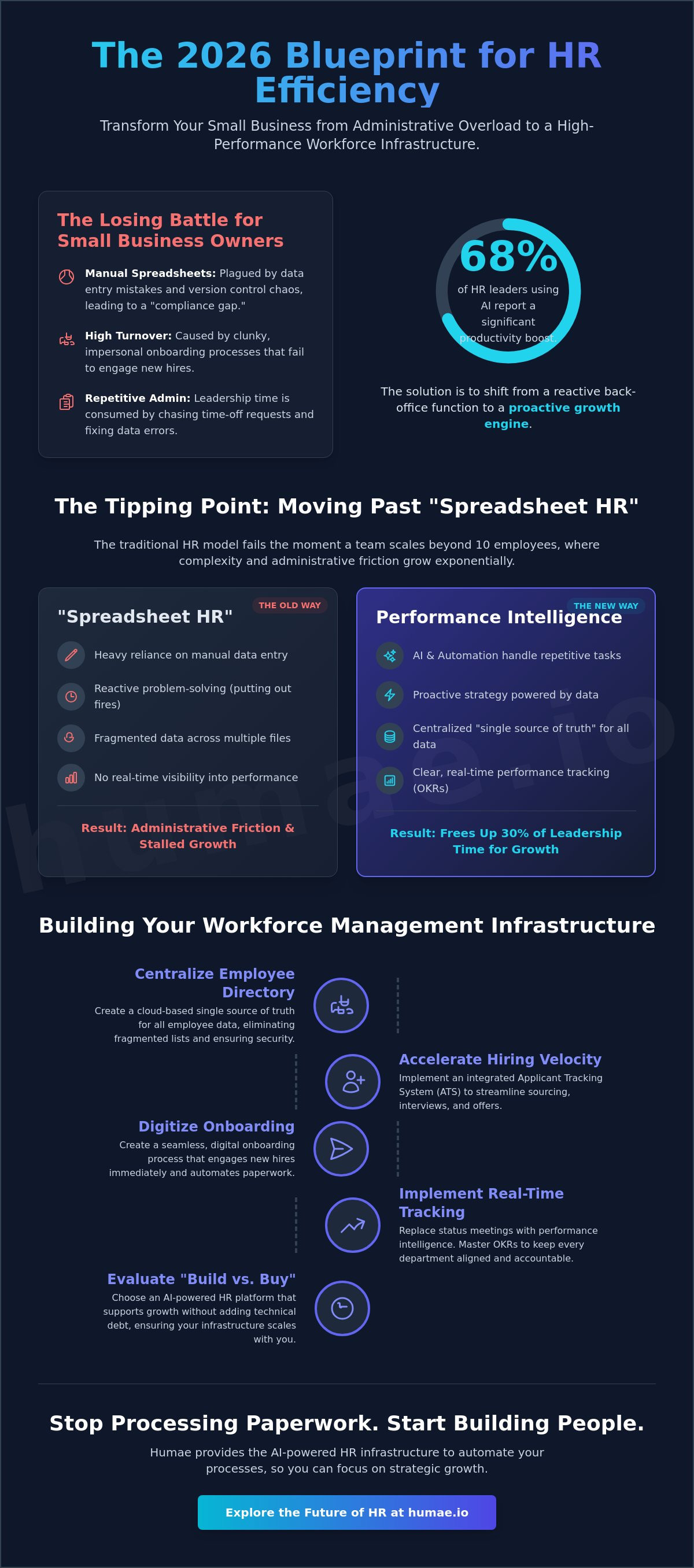
Did you know that 68% of HR leaders currently using AI report a significant boost in their team's productivity? Despite this, many owners still find that improving hr efficiency for small business feels like a losing battle against manual spreadsheet errors and high turnover caused by clunky onboarding. It's exhausting to manage a growing team when you lack real-time visibility into performance and spend your best hours on repetitive admin tasks.
Humae
Return to Home | Follow us on Facebook
Key Takeaways
- Shift your focus from administrative input to strategic output. Learn why spreadsheets don't work once your team hits double digits.
- Build a solid foundation for improving hr efficiency for small business using a centralized employee directory.
- Accelerate your hiring velocity with an integrated ATS and a digital onboarding process that engages new hires immediately.
- Replace endless status meetings with real-time tracking. Use this guide to master OKR meaning and keep every department aligned.
- Evaluate the "Build vs. Buy" decision. Ensure your HRMS infrastructure supports growth without adding technical debt.
Humae
Return to Home | Follow us on Facebook
What is HR Efficiency for Small Business in 2026?
The traditional "Spreadsheet HR" model fails the moment a team scales beyond 10 employees. At this tipping point, the complexity of managing data, compliance, and employee needs grows exponentially. By May 2026, the industry has moved past basic record-keeping. The new standard is performance intelligence. This shift moves HR from a reactive back-office function to a proactive growth engine. The goal is clear: free up at least 30% of leadership's time so they can focus on core business tasks. A foundational understanding of Human Resource Management principles is essential, but the execution must be digital to stay competitive.
The Hidden Costs of Administrative Friction
Efficiency vs. Effectiveness: Why You Need Both
Efficiency is about doing things fast. Effectiveness is about doing the right things. You can use automation to send out onboarding emails in seconds, but if those emails don't help the new hire feel connected, you've been efficient but ineffective. This is why you need a robust workforce management infrastructure. A centralized employee directory serves as your single source of truth. It ensures that when you improve your speed, you aren't sacrificing the human experience. When systems work, people can focus on being people, which is the ultimate goal of improving hr efficiency for small business.
Building Your Workforce Management Infrastructure
This structural approach is a prerequisite for modern human resources. By May 2026, the baseline for any competitive startup is a system that handles the "boring stuff" automatically. This allows your leadership to focus on culture and high-level strategy. Resources like Human Resources for Small Business emphasize that having these systems in place early prevents the organizational debt that kills scaling companies. It's about building a foundation that scales before you feel the pressure of a growing headcount.
Centralizing the Employee Directory
Automating Time-Off and Absence Management
Email-based vacation requests are a major source of administrative friction. They lead to lost requests, staffing shortages, and frustrated employees. Automated time-off management removes the middleman. Employees check their own balances and submit requests through a self-service portal. The system automatically checks for conflicts and updates the team calendar. This level of transparency is essential for a hybrid workforce where you can't always see who is at their desk. Despite 70% of small businesses feeling confident in their payroll compliance as of 2026, the actual time spent on manual verification remains a massive drain. You can easily automate your team's schedule to reclaim those lost hours and ensure everyone stays aligned.
Humae
5 Steps to Automating the Employee Lifecycle
Automating the employee lifecycle isn't about removing the human element. It's about removing the friction that prevents human connection. By following a structured five-step blueprint, you can stop reacting to personnel issues and start orchestrating growth. This approach is central to improving hr efficiency for small business because it creates a predictable, repeatable experience for every team member from hire to retire. When your processes are automated, you're not just saving time; you're building a culture of reliability.
- Step 1: Implement an Applicant Tracking System (ATS) to centralize your talent pipeline.
- Step 2: Build a digital-first onboarding flow that starts before the first day.
- Step 3: Transition to automated performance check-ins to replace outdated annual reviews.
- Step 4: Centralize all employee records to ensure you're always audit-ready.
- Step 5: Leverage analytics dashboards to spot and fix productivity bottlenecks in real-time.
Streamlining Talent Acquisition
Talent acquisition is your first point of contact with future stars. Implementing an integrated ATS isn't just about storing resumes; it's about hiring velocity. Industry data shows that using an ATS can reduce time-to-hire by 40% by automating job distribution and initial screenings. This speed ensures you don't lose top-tier talent to faster competitors. Beyond speed, automation fosters a superior candidate experience. Automated communication keeps applicants informed, reflecting a professional and organized brand. To understand the full scope of this process, check out our guide on choosing an ATS for growth.
The First 90 Days: Automated Onboarding
Onboarding sets the tone for long-term retention. A digital-first experience allows you to move cumbersome paperwork into a "pre-boarding" phase. This shift saves Day 1 for team lunches and culture immersion rather than tax forms. Using automated checklists ensures that no critical training or hardware setup is missed. This level of organization actually makes the process feel more "human" because managers can focus on the person rather than the checklist. The SBA's guide to HR for small businesses emphasizes that structured onboarding is a key factor in reducing early turnover. When the system handles the admin, you can focus on making your new hire feel at home.
Humae
Leveraging Performance Intelligence and OKRs
A deep dive into OKR meaning reveals why this framework is so effective for lean teams. It's not just about setting targets; it's about creating a shared language of success. When goals are visible to everyone in your HR platform, you eliminate the need for endless "status update" meetings. Teams know exactly what matters, which saves hours of wasted administrative effort every week. This clarity is the ultimate efficiency hack for a growing company.
Real-Time OKR Tracking for Team Alignment
Annual reviews are a relic of the past. In a high-growth environment, waiting twelve months to give feedback is a recipe for misalignment. Modern infrastructure supports continuous feedback loops. By integrating OKRs directly into your daily workflow, you provide constant clarity. This visibility is vital in chaotic startup environments where priorities can shift quickly. When every employee sees how their work contributes to the big picture, engagement and productivity naturally rise without the need for micromanagement.
AI-Powered Sentiment Analysis
Retention is your biggest efficiency lever. A November 2025 survey highlighted that 23% of small business owners are deeply concerned about talent sourcing. It's much more efficient to keep the stars you already have than to constantly recruit new ones. This is where AI-driven sentiment analysis changes the game. By analyzing patterns in feedback and engagement data, AI can detect burnout signals weeks before a resignation letter hits your desk. This proactive approach is the core of a modern employee engagement strategy. AI doesn't replace empathy; it supports it by highlighting exactly where your human support is needed most. You can leverage performance intelligence to build a more resilient, connected workforce today.
Humae
Transitioning to an AI-Powered HR Platform
Why Modern Teams Choose Humae
Humae is designed for leaders who value both technology and human connection. Our platform replaces fragmented tools with a single, centralized infrastructure. By utilizing Humae's features, you can manage everything from your employee directory to complex OKR tracking in one place. This consolidation is the most effective way to eliminate the administrative friction we've discussed throughout this guide. If you're ready to see how a seamless transition looks, our how it works section provides a clear roadmap for moving your team onto a modern system.
Next Steps: From Chaos to Efficiency
The path to a high-performance workforce starts with a single step. We recommend auditing your current manual processes today. Identify the three tasks that consume the most leadership time each week. Whether it's chasing vacation requests or manually tracking candidate emails, these are your first targets for automation. This simple act of documentation often reveals exactly where your growth is being throttled by administrative friction; for those looking to automate their external growth channels, you can check out Global AI Reps to optimize your sales outreach.
Humae
Build the Future of Your People Operations
Improving hr efficiency for small business is about leveraging tools like real-time OKR tracking and AI-powered sentiment analysis to stay ahead of burnout. These aren't just features. They're the foundation of a resilient team. You've seen the data: 50% of leaders are already using AI to extract better insights as of May 2026. It's time to join them and reclaim that 30% of your leadership time for what truly matters. Your team deserves a system that supports their growth while you focus on the big picture.
Streamline your team today, Discover Humae. We're here to help you turn your people operations into your greatest competitive advantage. Let's build a workplace where everyone thrives.
Humae
Frequently Asked Questions
What is the first step to improving HR efficiency for a small business?
The first step is auditing your current manual processes to identify specific time-wasters. Most founders discover that tracking time-off or managing candidate emails consumes five to ten hours of their week. Pinpointing these friction points is essential for improving hr efficiency for small business before you commit to any new software or systems.
Can AI really help a small business with HR without losing the human touch?
Yes, AI handles the repetitive administrative burden so you can focus entirely on your people. By May 2026, 68% of HR leaders report that AI tools actually improve their productivity and insights. Automation takes over scheduling and data entry; this gives you more time for meaningful 1:1 conversations and culture building.
How much time can HR automation actually save my management team?
Is an HRMS affordable for a startup with fewer than 20 employees?
Modern SaaS platforms offer per-employee pricing that makes them very accessible for small teams. For a 25-person company in 2026, the estimated monthly cost for HR software ranges from $164 to $625. For example, Gusto's "Simple" plan is priced at $49 per month plus $6 per person; this fits most lean startup budgets.
What is the difference between an HRIS and a standard employee spreadsheet?
An HRIS is a dynamic, secure database while a spreadsheet is a static file prone to manual errors. Spreadsheets lack real-time updates and automated workflows; this creates a "Compliance Gap" as you grow. A centralized system is vital for improving hr efficiency for small business because it provides a single source of truth.
How do OKRs improve overall team productivity in small businesses?
OKRs provide a shared language of success that keeps every team member aligned without constant status meetings. By setting clear Objectives and Key Results, you ensure everyone knows exactly what matters most. This transparency is especially helpful in high-growth environments where priorities can shift quickly; it keeps the team focused on results.
What are the common mistakes when implementing HR software?
The most frequent error is choosing a platform that is too complex for your team's current needs. Many businesses pay for enterprise features they never use; this leads to low adoption rates among employees. It is better to start with an intuitive interface that solves your immediate pain points like onboarding and time-off tracking.
Do I need a full-time HR person to use an AI-powered HR platform?
Humae