HR Software for Hybrid Work Models: The 2026 Infrastructure Guide
By Humae · 8 July 2026
hr software for hybrid work models
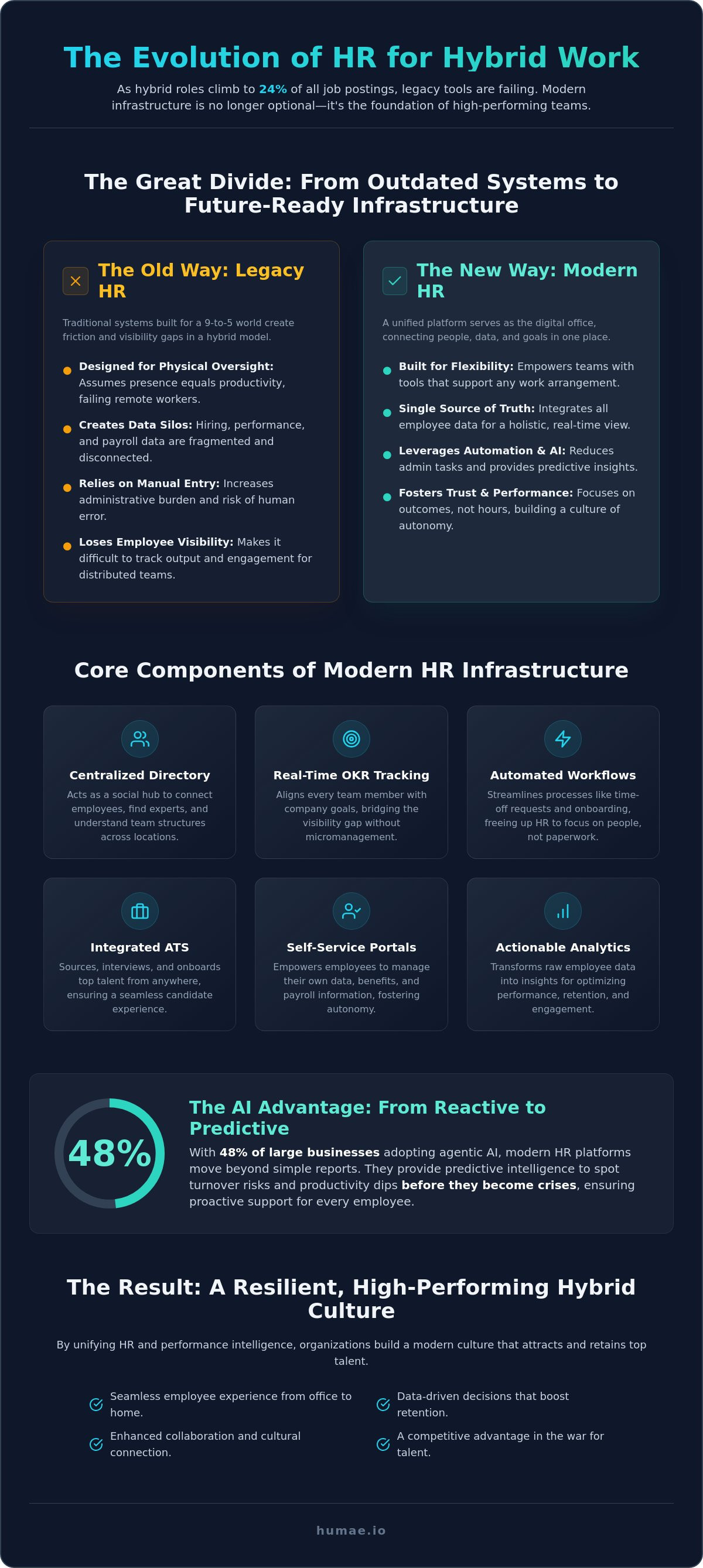
Hybrid work success isn't just a policy issue; it's an infrastructure challenge that only the right technology can solve. You likely feel the friction every day. It's the frustration of losing visibility into remote output or watching company culture fade across fragmented chat tools. Since hybrid job postings jumped to 24% of all listings by 2025, choosing the right hr software for hybrid work models has become the defining factor for organizational health in 2026.
We understand that you want more than just a digital filing cabinet; you need a visionary partner to help you lead. This guide shows you how to build a high-performing hybrid team using AI-powered tools that bridge the gap between office and remote work. We'll explore how to establish a single source of truth for employee data, align your people through digital OKRs, and use automated workflows to finally kill the administrative burden for good. It's time to stop managing spreadsheets and start empowering people.
Key Takeaways
- Learn why legacy systems fail and how modern hr software for hybrid work models serves as the essential digital office for distributed teams.
- Discover how to bridge the visibility gap using real-time OKR tracking to ensure every team member stays aligned without micromanagement.
- Identify the essential features like centralized directories and automated time-off management that streamline operations across multiple time zones.
- Use analytics dashboards to transform raw employee data into actionable insights for optimizing workplace performance and retention.
- Explore how a unified infrastructure combining HRMS and performance intelligence fosters a modern organizational culture that values human connection.
The Evolution of HR Software for Hybrid Work Models
The physical office has transformed from a mandatory destination into a strategic choice. As organizations embrace the hybrid work model, the digital environment has become the only consistent "location" where culture and productivity intersect. In this new reality, hr software for hybrid work models serves as the primary infrastructure for the modern enterprise. It is no longer just a system of record; it is the digital floorplan that connects distributed teams.
Legacy systems often fail because they were designed for a linear world. They assume that if an employee isn't at their desk, they aren't working. Modern infrastructure shifts this focus from static records to real-time data. This transition allows leaders to move away from micromanagement and toward a culture of trust and high performance. When your workforce management infrastructure is built for flexibility, it becomes a massive competitive advantage that attracts top talent and keeps them engaged.
Why Traditional HRIS is No Longer Enough
Traditional HRIS platforms were built for the 9-to-5 era. They rely on manual entry and assume a level of physical oversight that simply doesn't exist in 2026. These legacy tools often create data silos where hiring information lives in one place and performance data in another. This fragmentation is dangerous for hybrid teams. Without a unified view, managers lose visibility into remote employee output, leading to burnout or disengagement. Modern hr software for hybrid work models solves this by integrating hiring, onboarding, and daily management into a single, fluid experience.
The Role of AI in Modern Workforce Infrastructure
AI is the bridge that spans the physical gap between office and remote workers. We've moved past simple descriptive analytics that tell you what happened last month. Today's tools provide predictive intelligence, helping you spot turnover risks or productivity dips before they become crises. With 48% of large businesses already adopting agentic AI, the technology is now a standard requirement for maintaining team cohesion. For a deeper dive into these structural changes, check out our Workforce Management Guide. This intelligence ensures that no matter where an employee logs in from, they have the same access to support and growth opportunities as someone sitting in the headquarters.
Essential Features for Hybrid Employee Management
Building a high-performing team in 2026 requires more than a flexible policy. It demands a robust digital foundation. When you select hr software for hybrid work models, you're choosing the tools that define your team's daily experience. The goal is simple: eliminate friction. This means moving away from fragmented tools and adopting a unified platform that handles everything from hiring to daily performance management. High-performing organizations don't just "let" people work from home; they provide the infrastructure to make them successful there.
A modern Applicant Tracking System (ATS) is the first step in this journey. In 2026, hiring is no longer limited by geography, but it is limited by the quality of your candidate experience. An integrated ATS allows you to source, interview, and onboard talent regardless of their physical location. This ensures your remote-first promise is backed by a professional, seamless experience from day one. Once hired, employees need self-service portals that function as their personal HR assistant. These tools empower your people to access benefits, update personal data, and view payroll information without waiting for an email response. This autonomy is vital for maintaining momentum in a non-linear work environment where people work at different times.
The Digital Employee Directory: Your Hybrid Hub
A static contact list is no longer enough for a distributed team. In a hybrid world, your Employee Directory must act as a social hub and a visibility tool. It's the place where team members discover who's who, find subject matter experts, and understand the organizational structure at a glance. By providing rich profiles and clear reporting lines, you foster the social connectivity that often goes missing when people aren't sharing a physical space. It's about making the invisible visible and ensuring that a new hire in another city feels just as connected as the person in the office. You can explore Humae features to see how a modern directory creates a more cohesive culture.
Streamlining Time Off and Absence Management
Scheduling conflicts can quickly derail a hybrid model. If you don't know who is in the office and who is remote, collaboration becomes a guessing game. Automated Time Off Management solves this by providing a single source of truth for availability. It handles complex calculations across multiple time zones and ensures that leave requests don't create bottlenecks. This level of transparency reduces the administrative burden on HR managers and gives teams the clarity they need to plan projects effectively. When you have hr software for hybrid work models that automates these basics, you free up your leadership to focus on strategic growth. If you want to see this in action, it might be time to check out our unified platform today.
Bridging the Visibility Gap with Performance Intelligence
The visibility gap is the silent killer of remote productivity. When managers can't see the physical work happening, they often fall back on micromanagement as a defense mechanism. This creates a culture of distrust that drives away your best talent. Modern hr software for hybrid work models solves this by shifting the focus from hours logged to outcomes achieved. Performance intelligence isn't about surveillance; it's about providing the data needed to support teams wherever they are. By using real-time insights, leaders can identify who needs help and who is ready for their next challenge without ever having to "check in" just for the sake of it.
Moving beyond the "out of sight, out of mind" mentality requires a structural change in how we measure success. Traditional annual reviews are too slow for the pace of 2026. Instead, high-performing hybrid organizations use continuous feedback loops to maintain alignment. This ensures that every employee, whether in the office or at home, receives the recognition and guidance they need to thrive. It's about creating a transparent environment where performance is measured by impact, not by who stays latest in the office.
Implementing OKRs for Hybrid Alignment
Objectives and Key Results (OKRs) act as the North Star for distributed teams. In a hybrid setting, clear goals are more than just targets; they're a vital communication tool. When everyone has access to a digital dashboard showing progress, the need for endless status meetings drops significantly. Real-time tracking ensures that momentum stays high even when the team is physically separated. For a comprehensive look at how to set these up, read our OKR Meaning and Guide. This transparency allows remote employees to see exactly how their daily tasks contribute to the company's broader mission, fostering a deep sense of purpose.
AI Sentiment Analysis: The Pulse of Your Team
Empathy can be hard to scale in a digital-first environment. AI sentiment analysis bridges this gap by analyzing qualitative feedback to detect early signs of burnout or disengagement. By monitoring the "pulse" of the organization through anonymous surveys and communication patterns, hr software for hybrid work models provides actionable intelligence before issues escalate. It's about maintaining a human connection in a tech-driven workplace. Instead of waiting for a crisis to find out a team is struggling, leaders can intervene with support immediately. This proactive approach turns raw data into a supportive safety net for every employee, ensuring that the human element remains at the center of your digital infrastructure.
Actionable Analytics for Hybrid Workplace Optimization
Data is the compass that guides a successful hybrid strategy. Without clear insights, you're essentially guessing how your team feels and performs. High-performing organizations use hr software for hybrid work models to transform raw employee data into a roadmap for growth. This process begins with identifying the metrics that actually drive value. You should focus on project velocity and goal attainment rather than simple attendance. By using centralized dashboards, you can monitor turnover trends in real time; this allows you to intervene before a localized issue becomes a company-wide problem. It's about having the pulse of the organization at your fingertips.
Optimization also extends to your physical footprint. In 2026, the office is a tool for collaboration, not a default setting. Analyzing office utilization data helps you understand when and why people come in. This allows you to optimize real estate costs without sacrificing culture. If the data shows that your team only uses the office for deep-dive brainstorming on Tuesdays, you can adjust your space requirements accordingly. Finally, you must leverage performance intelligence to identify your top talent. These are the individuals who thrive in a distributed environment and can serve as mentors for others. When you have the right data, you stop reacting to changes and start leading them with confidence.
Building Data-Driven Engagement Strategies
Engagement isn't a feeling; it is a measurable outcome. By using analytics to see which teams are most active and aligned, you can tailor your retention strategies to what actually works. This might mean adjusting communication cadences or providing more targeted support for remote-heavy teams. For a deeper look at this approach, explore our Employee Engagement Strategies. Real-time data ensures your culture stays vibrant regardless of where people log in. It's the difference between hoping people are happy and knowing they are supported.
Optimizing the Onboarding Experience
First impressions are permanent. In a hybrid world, you need a consistent onboarding flow that delivers the same magic to someone in the office as it does to a remote hire. Tracking time-to-productivity for new hires reveals where your process might be lagging. If you want to see how we've automated this flow to save HR teams hours of manual work, learn how Humae works. A seamless start is the best way to ensure long-term loyalty and high performance. Ready to transform your data into action? Explore our analytics dashboards today and see the difference a unified platform makes.
Why Humae is the Ultimate HR Platform for Hybrid Models
Hybrid work is no longer an experiment; it's the standard for high-performing organizations in 2026. To lead effectively in this environment, you need more than just a collection of disconnected tools. You need a unified ecosystem that serves as your company's digital backbone. Humae provides the essential hr software for hybrid work models that acts as the engine for your organizational growth. By combining a comprehensive HRMS with advanced OKR tracking and performance intelligence, we eliminate the invisible gaps where productivity and culture often slip through. It's a visionary approach that prioritizes the human experience while leveraging the most sophisticated technology available.
We've designed our platform to be a true partner in your journey. Whether you are scaling a fast-moving startup or managing a large enterprise, our infrastructure adapts to your specific needs. The integration of an Applicant Tracking System with daily performance management ensures that the employee journey is seamless from the very first interview. This isn't just about administrative efficiency; it's about building a workplace where people feel seen, valued, and aligned with a common purpose, regardless of their physical location. When your technology reflects your values, your team can focus on what they do best.
A Single Interface for Global Teams
Tool fatigue is a major obstacle for distributed teams. When your people have to switch between five different applications just to request time off, check their goals, or find a colleague's contact info, you lose focus and momentum. Humae solves this by offering a single, intuitive interface for all your HR needs. This human-centric design ensures that the technology supports the work rather than getting in its way. You get a centralized source of truth that simplifies life for HR managers and empowers employees to take ownership of their professional lives. It's about making complex organizational processes feel simple, rewarding, and deeply connected.
Ready to Transform Your Hybrid Workplace?
The shift from traditional management to performance intelligence is the most significant evolution in the modern workplace. You don't have to navigate this transition alone. By choosing the right hr software for hybrid work models, you are investing in the long-term resilience and happiness of your team. Humae offers the visibility, alignment, and automation you need to thrive in a distributed world. It's time to move beyond the limitations of legacy systems and embrace a future built on data, trust, and empathy. Visit Humae Home to start your journey toward a higher level of organizational health and see how we can help you build the team of the future.
Build the Workforce of Tomorrow Today
Transitioning to a hybrid model is no longer about simple flexibility; it's about building a digital ecosystem where every employee can thrive. We've explored how selecting the right hr software for hybrid work models bridges the visibility gap and replaces micromanagement with real-time OKR tracking. By moving from static records to actionable analytics, you create a culture of trust and high performance that attracts and retains top talent.
Your team deserves a centralized workforce infrastructure that feels both powerful and human. Humae provides the AI-powered performance intelligence needed to stay ahead in 2026. It's time to stop fighting legacy tools and start empowering your people with technology designed for the way we work now. The future of work is already here, and it's built on connection, data, and empathy.
Experience the future of HR with Humae
Frequently Asked Questions
What is the most important software feature for hybrid work?
Outcome-based visibility is the cornerstone of any successful hybrid strategy. In a distributed environment, you can't rely on physical oversight; instead, you need tools that track results and progress in real time. Features like OKR tracking and performance intelligence allow managers to see impact without resorting to micromanagement. This transparency builds a culture of trust and ensures that everyone stays aligned with the company's core objectives regardless of their location.
How does HR software help maintain company culture in hybrid teams?
A robust digital office serves as the primary hub for organizational culture when the physical office is optional. Modern hr software for hybrid work models uses centralized employee directories and social recognition tools to keep team members connected. By providing a single source of truth for all employee data, you ensure that remote workers have the same access to information and growth opportunities as their in-office counterparts, preventing the formation of second-class remote citizens.
Can AI really detect employee burnout in a remote setting?
Yes, AI-driven sentiment analysis can identify early warning signs of disengagement by analyzing qualitative feedback and engagement patterns. Rather than waiting for an exit interview, leaders can use predictive intelligence to spot when a team's morale is dipping. This proactive approach allows for immediate support and intervention. It turns raw data into a human safety net, ensuring that the mental well-being of your workforce remains a top priority in a digital-first environment.
How do OKRs differ from traditional goal setting in hybrid models?
OKRs are dynamic and transparent, whereas traditional goal setting often relies on static, top-down directives that get lost in email chains. In a hybrid model, OKRs provide a live roadmap that any employee can check at any time to see how their work contributes to the bigger picture. This real-time alignment is essential for distributed teams because it replaces the need for constant status meetings and provides a clear, objective measure of success.
Is it difficult to migrate from a legacy HRIS to a hybrid-ready platform?
Modern API-first platforms have made the transition from legacy systems significantly faster and more accurate than in previous years. While older HRIS tools often trap data in silos, a hybrid-ready platform is designed for integration and easy data flow. Most organizations can complete the migration process within weeks rather than months. Choosing hr software for hybrid work models that prioritizes an intuitive user experience ensures that your team adopts the new system with minimal friction.
How does workforce infrastructure impact employee retention?
Frictionless employee experiences are a major driver of long-term loyalty in the modern workplace. If your infrastructure makes it difficult to request time off, find colleagues, or track goals, employees will eventually look for a more supportive environment. High-quality workforce infrastructure reduces the administrative burden and allows people to focus on meaningful work. When employees feel that their tools empower them rather than hinder them, they're much more likely to stay committed to the organization.