How to Prevent Performance Review Bias: The 2026 Guide to Fair Evaluations
By Humae · 7 June 2026
how to prevent performance review bias
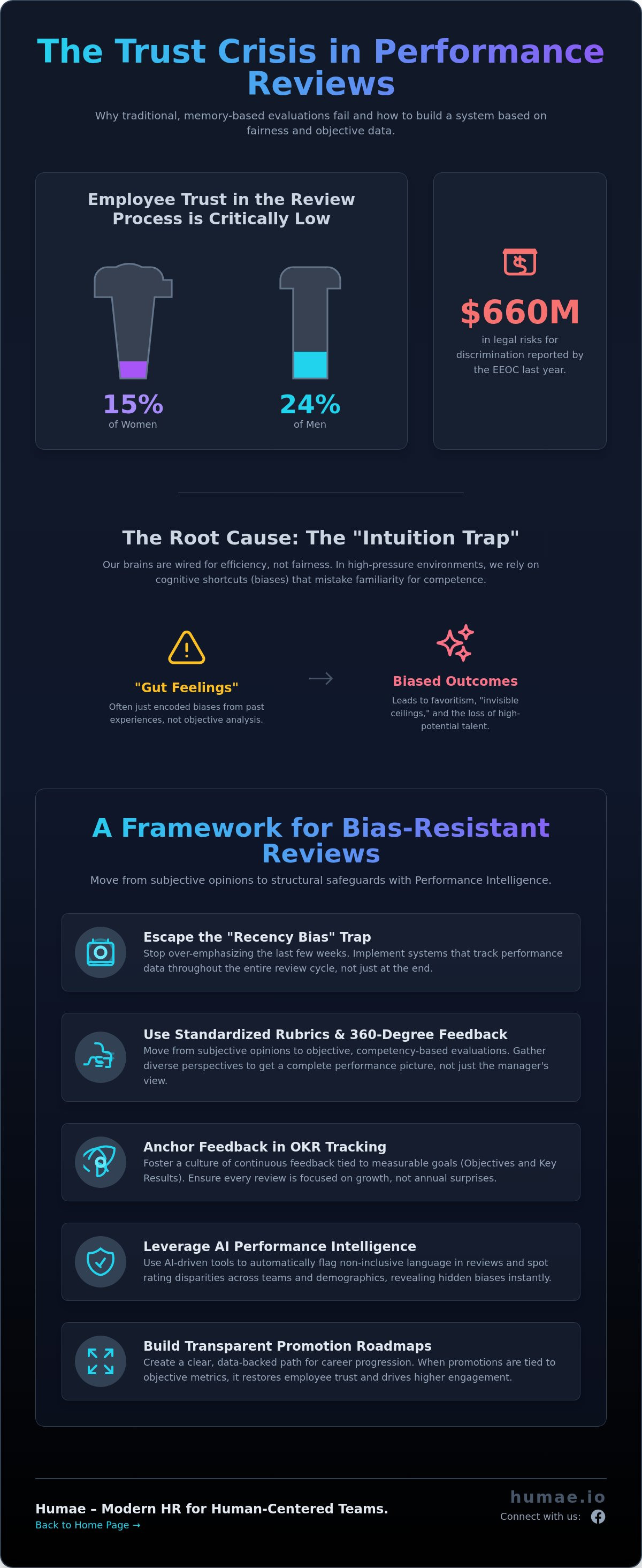
Did you know that only 15% of women and 24% of men actually trust their performance review process? It's a startling reality that points to a systemic breakdown in how we measure success. You've likely felt the tension in the room during review season, or perhaps you've seen high performers walk out the door because they felt a promotion was based on favoritism rather than facts. We all want a workplace where merit is the only currency, but unconscious prejudices often cloud even the best intentions. Learning how to prevent performance review bias isn't just about fairness; it's about protecting your culture and your bottom line from the $660 million in legal risks reported by the EEOC last year.
We agree that the traditional, memory-based review is broken. That's why this 2026 guide is designed to help you move beyond basic awareness training into a new era of Performance Intelligence. You'll learn how to implement structural safeguards and leverage AI-driven data to anchor human intuition in objective reality. We're providing a clear framework to help you achieve higher engagement scores and make promotion decisions that are backed by hard evidence. From 360-degree feedback loops to real-time goal tracking, it's time to transform your evaluations into a source of organizational trust and growth.
Key Takeaways
- Escape the "intuition trap" by identifying how hidden cognitive shortcuts like recency bias distort your team's true performance data.
- Implement standardized rubrics and 360-degree feedback to move from subjective manager opinions to objective, competency-based evaluations.
- Foster a culture of continuous feedback anchored in OKR tracking to ensure every review is focused on measurable growth, not annual surprises.
- Learn how to prevent performance review bias by using AI-driven Performance Intelligence to flag non-inclusive language and spot rating disparities instantly.
- Build a transparent, data-backed roadmap for promotions that restores employee trust and drives higher organizational engagement scores.
- Leverage your commitment to fairness to strengthen your employer brand; discover GBS Worldwide to learn how to communicate these cultural values to attract top-tier talent.
Why Performance Review Bias Persists in the Modern Workplace
Performance review bias isn't a simple oversight; it's a systematic distortion of objective employee evaluation. It occurs when subjective filters, rather than hard data, dictate a person's worth within an organization. Despite decades of diversity training, these prejudices remain embedded in the corporate fabric. Understanding how to prevent performance review bias starts with admitting that our brains aren't naturally wired for objectivity in high-stakes environments. We often mistake familiarity for competence and confidence for capability.
This challenge of distinguishing facts from impressions is why many forward-thinking HR teams use HubHound for professional background checks, ensuring that every hire starts with a foundation of verified objectivity.
The "intuition trap" is perhaps the most dangerous obstacle. Many well-meaning managers believe they possess a unique ability to "read people." In reality, these gut feelings are often just encoded biases from past experiences. When managers rely on intuition, they're not using a superpower; they're using cognitive shortcuts that favor people who look, act, or think like them. By 2026, the cost of this complacency has become impossible to ignore. With the EEOC securing $660 million in relief for discrimination victims in fiscal year 2025, the financial risk is just the tip of the iceberg. The real damage lies in the immediate churn of high-potential talent who refuse to work in environments where their contributions are ignored or undervalued, often seeking more transparent opportunities through platforms like alpha.jobs instead.
The Psychological Roots of Evaluator Error
Our brains crave efficiency. In a high-pressure management environment, the sheer volume of decisions creates a heavy cognitive load. To survive, the brain uses heuristics, or mental shortcuts, to process information quickly. While these shortcuts help us decide what to eat for lunch—perhaps by scrolling through creative recipes or kitchen hacks on So Yummy—they're disastrous for fair evaluations. Research shows that as stress increases, so does our reliance on these biases. We stop looking at the nuances of a year's worth of work and start focusing on the most recent or most comfortable data points. This is why how to prevent performance review bias must involve more than just "trying harder" to be fair.
How Bias Erodes Organizational Trust
There's a direct, undeniable correlation between perceived review fairness and long-term employee retention. When feedback feels arbitrary, it creates "invisible ceilings" for underrepresented talent groups, stifling innovation and diversity. Employees don't just want a raise; they want to know the game isn't rigged. Building a foundation of transparency in your workforce management infrastructure is the first step toward recovery. It shifts the burden of proof from a manager's "vibe" to verifiable performance metrics. We must stop trying to "fix" human psychology with one-off workshops and start fixing the infrastructure of the review process itself. This is the only way to ensure fairness becomes a structural reality rather than a corporate slogan.
10 Common Types of Performance Appraisal Bias to Watch For
Identifying the problem is the first step toward a solution. When we look at how to prevent performance review bias, we must first name the ghosts in the machine. Traditional biases have haunted HR for decades, but they've evolved into more complex forms as our work environments have changed. It's not just about favoritism; it's about the subconscious shortcuts our brains take to simplify complex human behavior. Here are the primary culprits that distort your evaluations.
- Recency Bias: This occurs when a manager overemphasizes an employee's actions from the last two weeks while ignoring the previous eleven months. It rewards "sprinting at the finish line" rather than consistent excellence.
- Halo and Horns Effect: A single standout trait, like being a great public speaker, can "halo" an entire evaluation, making a manager overlook technical deficiencies. Conversely, the "horns" effect happens when one mistake colors every other metric.
- Central Tendency: To avoid difficult conversations or conflict, some managers rate everyone as "average." This safe route effectively punishes your top performers and fails to correct your underperformers.
- Leniency vs. Severity Bias: We've all seen the "strict teacher" who never gives a five and the "cool coach" who gives everyone a pass. This inconsistency makes cross-departmental comparisons impossible.
Modern Biases: Proximity and Digital Presence
In our hybrid world, proximity bias has become a silent productivity killer. Managers often subconsciously give higher ratings to the people they see by the coffee machine, even if remote peers are delivering better results. Similarly, the "always-on" bias equates Slack activity or quick Teams replies with actual output. You can't rely on vibes to solve this. Using real-time analytics dashboards allows you to compare output against presence, ensuring that visibility doesn't trump value.
Identity and Affinity Biases
Affinity bias is the natural, yet harmful, tendency to favor people who share our background or interests. It's the "he reminds me of a younger version of myself" trap. When combined with confirmation bias, where a manager only looks for evidence that supports their existing opinion, it creates a cycle of unfairness. This often shows up in narrative feedback. Research shows that women are frequently labeled as "abrasive" for the same behaviors that earn men the "assertive" tag. Spotting these patterns is essential if you want to build a truly inclusive culture. Exploring modern tools at humae.io can help you flag these linguistic disparities before they become permanent records.
Strategic Frameworks for Mitigating Bias in Performance Management
Identifying the psychological roots of prejudice is only the first step. To truly change outcomes, you must build a structural "armor" around your evaluation process. Fairness shouldn't depend on a manager's mood or their ability to remember a year's worth of work. It should be a byproduct of the system itself. When you look at how to prevent performance review bias, the goal is to replace subjective "vibes" with a rigorous, data-backed framework that leaves no room for the intuition trap.
This shift requires moving away from the "empty text box" approach. Traditional reviews often ask managers to "describe the employee's performance," which is an invitation for every bias we've discussed to take root. Instead, modern organizations are decoupling performance intelligence from memory-based reporting. By using real-time data, you ensure that evaluations are based on a continuous stream of achievements rather than a single, flawed memory of the last two weeks.
Standardizing the Evaluation Rubric
Clear, predefined competencies eliminate the mental space where "gut feelings" usually thrive. When you align job descriptions directly with performance review criteria, you create a shared language for success. Managers should be required to provide "Evidence-Based" comments rather than "Opinion-Based" adjectives. For example, instead of allowing a manager to call an employee "unreliable," the system should require them to cite specific missed deadlines or data points. This forces the evaluator to ground their judgment in reality, significantly reducing the influence of affinity or confirmation bias.
Calibration: The Quality Control of HR
Calibration is the process where leadership teams meet to "audit" ratings before they are ever communicated to employees. Think of it as peer review for managers. During these sessions, HR acts as a neutral moderator to spot "rating outliers." If one manager gives their entire team "fives" while another in the same department gives mostly "threes," the calibration session brings these discrepancies to light. It ensures that a "high performer" in Marketing meets the same standard as a "high performer" in Engineering. This level of oversight is essential for maintaining organizational trust and ensuring that raises and promotions are truly merit-based. Applying this same level of scrutiny and expertise to your hiring process is just as vital; Altum Recruitment helps businesses maintain high standards by identifying and securing top-tier talent through specialist-led recruitment.
Finally, implementing 360-degree feedback is vital for balancing a single manager's perspective. By incorporating insights from peers and direct reports, you dilute the power of any individual's subconscious prejudice. When multiple viewpoints align, the data becomes undeniable. This multi-source approach, combined with standardized rubrics, creates a transparent environment where employees feel seen and valued for their actual contributions. Explore how analytics dashboards can help you visualize these feedback loops and ensure consistency across every level of your workforce management.
How to Build a Bias-Resistant Continuous Feedback Culture
Stop treating reviews as an annual post-mortem. By the time the yearly meeting happens, the damage is already done. Transitioning to weekly check-ins ensures that feedback is fresh, relevant, and actionable. It removes the "surprise" element that often triggers defensive reactions from employees and leads to frustration. When you look at how to prevent performance review bias, consistency is your greatest ally. It shifts the manager's role from a judge to a coach.
The "Journaling" method is a game changer for data integrity. We've already discussed how recency bias distorts evaluations by focusing only on the last few weeks of work. Real-time documentation of both wins and losses creates a comprehensive record that spans the entire review cycle. This digital paper trail forces managers to look at the full picture. It transforms the review from a flawed memory test into a data-driven conversation that reflects an entire year of contribution.
Anchoring Feedback in Objective Key Results (OKRs)
OKRs serve as the ultimate antidote to subjective, personality-based reviews. Instead of debating whether an employee has a "good attitude," you focus on whether they hit their measurable key results. By anchoring performance in OKR tracking, you connect individual daily tasks directly to high-level company objectives. This clarity leaves no room for "gut feelings" to take over the narrative. Our employee performance intelligence software automates this alignment, making it impossible for bias to hide behind vague performance descriptors.
Training Managers for High-Impact Conversations
Fair evaluations require a fundamental shift in language. Manager training should focus on moving from "What I think" to "What I observed." Statements like "I feel you're not committed" are replaced with "I observed that you missed the last three project deadlines." Providing templates for constructive criticism ensures that feedback remains focused on growth rather than personal judgment. This behavioral approach builds psychological safety, allowing employees to feel comfortable challenging feedback if they feel it's unfair. When employees know the criteria are objective, they're more likely to engage with the process and stay with the company long-term.
Ready to modernize your approach? See how Humae's Performance Intelligence tools can help you build a culture of fairness today.
Scaling Fairness with AI-Powered Performance Intelligence
Human effort has its limits. Even the most well-trained manager can't manually audit thousands of feedback points for subtle patterns of prejudice. Technology provides the final, essential layer of defense. Learning how to prevent performance review bias is a human commitment, but scaling that commitment across a growing organization requires a digital partner. In 2026, fairness isn't just a goal; it's a measurable metric that lives within your data.
The foundation of this approach is a centralized HRIS. When all your performance data, peer feedback, and OKR progress live in a single source of truth, bias has nowhere to hide. You move away from fragmented spreadsheets and toward a unified system where every rating is visible, comparable, and anchored in reality. This transparency doesn't just protect the company from the legal risks highlighted by the 88,201 EEOC charges filed in 2025; it builds a culture where employees know their work is being judged on merit, not on a manager's mood.
AI as the Neutral Observer
Humae’s AI-driven sentiment analysis acts as a real-time coach for managers. As they write evaluations, the system flags non-inclusive language or gendered adjectives that might skew the perception of an employee's contribution. It doesn't just stop at words. Our Analytics Dashboards analyze rating distributions across different demographics instantly. If a specific department shows a trend of lower scores for remote workers or underrepresented groups, the system alerts HR immediately. This reduces the administrative burden on your team while increasing the accuracy of every single review. It's fairness at scale, powered by intelligence.
Getting Started with Humae
Integrating Humae’s performance intelligence tools into your current workflow is a seamless transition. You don't need to overhaul your entire culture overnight. Start by connecting your existing goals to our real-time dashboards to gain executive-level transparency. From there, you can roll out standardized rubrics and AI-assisted feedback loops that empower your managers to have high-impact, objective conversations. We're here to help you replace intuition with evidence. Build a better organizational culture with data that reflects the true potential of your people. Explore our full suite of tools at humae.io and take the first step toward a more equitable future.
Building a High-Trust Culture Through Objectivity
Fairness isn't a destination; it's a structural commitment. By replacing the "intuition trap" with standardized rubrics and 360-degree feedback, you've already taken the first step toward a more equitable workplace. Moving from annual surprises to a continuous feedback loop ensures that your team feels valued for their real-time contributions. This shift protects your most valuable asset: your people. Understanding how to prevent performance review bias is essential for any leader who wants to eliminate favoritism and drive genuine engagement.
Now is the time to anchor your culture in evidence rather than gut feelings. With real-time OKR tracking and AI-driven sentiment analysis, you can spot disparities before they lead to churn. Centralized workforce management and actionable analytics dashboards provide the transparency your employees deserve. Build a fairer workplace with Humae’s AI-powered performance intelligence and ensure every evaluation is data-backed. You're not just fixing a process; you're building a future where everyone has a fair shot at success. Let's make every review an opportunity for growth.
Frequently Asked Questions
What is the most common type of bias in performance reviews?
Recency bias is widely cited as the most frequent error in traditional evaluations. It happens when managers weigh events from the last few weeks more heavily than the entire year of work. This creates an inaccurate picture of performance and punishes those who were consistent early on. It's a natural brain shortcut that we must actively counteract with better documentation and continuous feedback loops.
Can AI really remove human bias from the workplace?
AI acts as a neutral observer rather than a complete replacement for human judgment. It helps by flagging non-inclusive language and identifying demographic rating disparities that humans might miss during a busy review cycle. While it doesn't delete bias entirely, it provides the data needed to address it. Using these tools is a core part of how to prevent performance review bias at scale.
How often should performance reviews be conducted to reduce bias?
Move from annual events to continuous feedback cycles, such as weekly or bi-weekly check-ins. Frequent touchpoints reduce the pressure of a single meeting and ensure documentation is current. This approach eliminates the "memory test" aspect of evaluations. It keeps goals at the center of the conversation throughout the year, making the final review a summary of progress rather than a stressful surprise.
What is proximity bias and how does it affect remote workers?
Proximity bias is the tendency to favor employees who are physically present in the office. Remote workers often receive lower ratings simply because they're less visible to managers during the workday. To solve this, evaluations must focus on output and objective metrics rather than physical presence. Real-time analytics and dashboards help ensure that remote talent isn't overlooked due to their location. To find high-performing professionals who excel in these results-oriented remote environments, you can visit IMO Talent and explore Africa's premier talent platform.
How do standardized rubrics help prevent favoritism?
Rubrics replace vague adjectives with specific, measurable competencies. By requiring evidence for every rating, you leave less room for a manager's "gut feeling" to influence the outcome. This structure ensures that every employee is judged against the same set of rules. It creates a level playing field across different departments and leadership styles, making favoritism much easier to spot and correct.
What should I do if I think my performance review was biased?
Start by requesting a follow-up meeting to discuss specific evidence for the rating. Bring your own documentation of achievements and OKR progress to provide a fuller picture of your contributions throughout the year. If the issue persists, use your organization's formal appeal process. Transparency in workforce management should allow for these healthy, data-backed disagreements to ensure every employee feels heard and valued.
How does real-time OKR tracking improve evaluation fairness?
OKR tracking anchors evaluations in hard data rather than personality traits or likability. When goals are measurable and visible, the review becomes a discussion about results instead of subjective opinions. This clarity is a fundamental strategy for how to prevent performance review bias effectively. It ensures that success is defined by actual impact, not by who you know or how well you network.
Why is calibration important in the performance management process?
Calibration meetings allow leadership teams to review ratings across the board to ensure consistency. They help identify "easy" or "tough" graders before scores are finalized and shared with the team. This quality control step ensures that a "four" in sales means the same thing as a "four" in engineering. It's essential for maintaining organizational trust and ensuring that raises and promotions are fair.