How to Improve Hiring Process Quality: A Data-Driven Guide for 2026
By Humae · 11 May 2026
how to improve hiring process quality
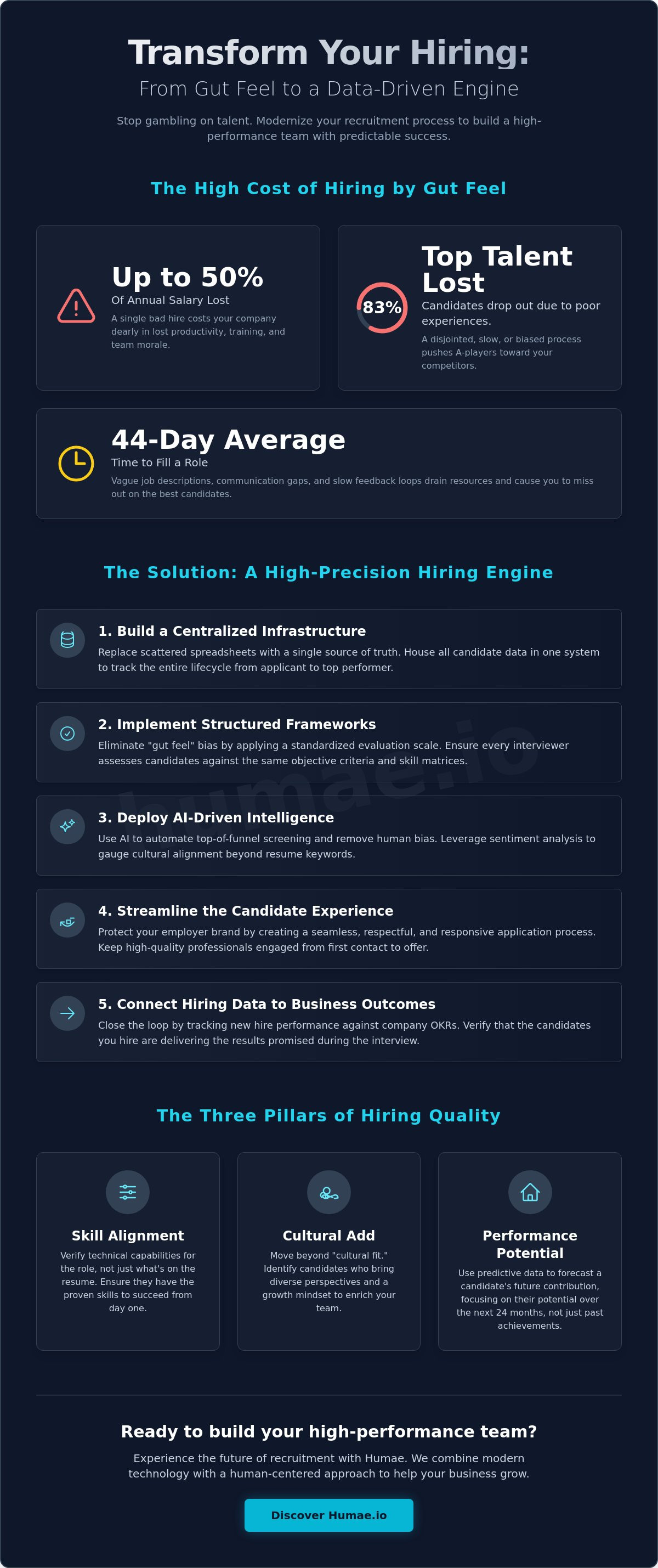
Did you know a single bad hire in 2026 can cost your company up to 50% of their annual salary? With the average cost per hire now reaching $4,800, relying on a gut feeling is no longer a viable business strategy. If you're struggling with high attrition in the first 90 days or inconsistent interview feedback across departments, you're likely searching for concrete ways on how to improve hiring process quality. It's exhausting to watch 83% of top-tier candidates walk away simply because of a disjointed or negative interview experience.
We agree that recruitment shouldn't feel like a high-stakes gamble. This guide will show you how to transform your hiring from an intuitive art into a high-precision engine using modern infrastructure and AI intelligence. You'll learn to build standardized evaluation frameworks and gain total visibility into which sourcing channels produce your best long-term performers. We'll walk through the exact steps to align recruiters and hiring managers, ensuring every new team member is a predictable success story rather than a costly mistake.
Key Takeaways
- Replace gut feelings with data by building a centralized workforce infrastructure that houses all candidate information in one place.
- Master how to improve hiring process quality by applying structured interview frameworks to ensure every manager uses the same evaluation scale.
- Deploy AI-driven sentiment analysis to identify cultural alignment and automate top-of-funnel screening to remove human bias.
- Protect your employer brand by streamlining the application process, which keeps high-quality professionals from dropping out of your pipeline.
- Connect hiring data to OKR tracking to verify that new hires are actually delivering the results they promised during the interview.
What is Hiring Process Quality and Why Does It Fail?
Hiring quality isn't a vague feeling or a "good vibe" during a coffee chat. In 2026, it's a multidimensional metric that combines long term performance, employee retention, and cultural contribution. When companies fail to define these parameters, they fall into the "Intuition Trap." This is where hiring managers rely on gut feelings rather than objective data, leading to systemic bias and inconsistent results. Understanding how to improve hiring process quality starts with recognizing that a bad hire costs far more than just a recruiter's fee. Recent data confirms a poor recruitment choice can cost a company between 30% and 50% of that employee's annual salary, factoring in lost productivity and the hit to team morale.
The transition from traditional, reactive hiring to data driven talent acquisition is no longer optional. Modernizing your Recruitment process requires a shift in mindset where every stage of the funnel is tracked and optimized. By utilizing advanced analytics, you can move away from guesswork and toward a system where every hire is a calculated investment in your company's future success. If you want to know how to improve hiring process quality, you must first look at the foundation of your evaluation criteria.
The Three Pillars of Hiring Quality
Common Bottlenecks in the Recruitment Funnel
Quality often fails because of friction in the process. Vague job descriptions are a major culprit, often attracting a high volume of mismatched candidates. This creates a 44 day average time to fill that drains resources. Another issue is the communication gap between hiring managers and recruiters, which leads to misaligned expectations. When feedback loops are delayed, "A-players" don't wait around; they drop out of the process for more responsive competitors. Fixing these bottlenecks is the first step toward a high precision hiring engine.
Building the Infrastructure for High-Quality Hiring
Quality hiring isn't an accident; it's the result of a deliberate system. Many leaders ask how to improve hiring process quality without first looking at their underlying foundation. If your candidate data is scattered across spreadsheets and emails, you've already lost the battle for efficiency. You need a centralized workforce management infrastructure to house every touchpoint. This isn't just about storage. It's about creating a single source of truth that allows your Applicant Tracking System (ATS) to communicate directly with your performance management tools. When these systems talk, you can see if the candidates you're hiring today actually meet the performance benchmarks of your top 10% next year.
Before you even post a job, you must build a "Skills Matrix." This document defines non-negotiable technical abilities versus "nice-to-have" traits. It prevents the common trap of hiring for a "general good fit" and instead focuses on specific competencies. By establishing this framework early, you ensure every interviewer is looking for the same evidence, which is the most effective way on how to improve hiring process quality across different departments. This infrastructure ensures that your team remains aligned from the first screening to the final offer.
To maintain this alignment as your organization grows, you might explore HCM services that specialize in professional HR outsourcing and infrastructure support.
Step 1: Define the Role via Skills-Based Planning
Start by defining the role through its intended outcomes. Instead of listing "must have 5 years of experience," try "must be able to reduce customer churn by 15% within the first 6 months." Collaborate with department heads to list the top 5 KPIs for the new hire's first half-year. You should also use historical data from your current top performers to model an "ideal" profile. This data-driven approach ensures you aren't just filling a seat, but solving a specific business problem.
Step 2: Standardize the Evaluation Framework
Standardization is the enemy of bias. You need scorecards that force interviewers to provide objective, numerical ratings rather than "vibes." Train your team on behavioral interviewing techniques to elicit real-world evidence of skills. A critical step is eliminating "debrief bias." Require every interviewer to submit their independent feedback before any group discussion occurs. This protects the integrity of the data and leads to a more accurate assessment of the candidate's true potential. If you're ready to see how a modern ATS and performance dashboard can streamline this for you, it's time to upgrade your toolkit.
Leveraging AI and Performance Intelligence
AI isn't just about speed; it's about precision. In 2026, top-tier HR teams are moving beyond basic automation and using AI-driven sentiment analysis to understand candidate engagement levels that human recruiters often miss. These tools analyze tone and word choice during initial video screenings to detect genuine enthusiasm and cultural alignment. This layer of performance intelligence allows your team to rank candidates based on objective behavioral markers rather than subjective impressions. It's a game-changer for anyone looking at how to improve hiring process quality without adding hours of manual labor to the recruitment cycle.
AI-Powered Screening and Bias Reduction
Modern AI tools can mask identifying information like names, gender, or graduation years to promote a purely skills-based evaluation. Using natural language processing (NLP), systems analyze candidate responses for consistency across multiple stages. This removes the "halo effect," where a single good impression masks a lack of technical depth. You're effectively automating your "speed-to-lead" while maintaining a high quality bar. It ensures that every candidate who reaches a hiring manager has already proven they have the capabilities to succeed.
Predictive Analytics for Future Success
Stop guessing who will succeed and start modeling it. Use analytics dashboards to build "Success Profiles" based on your internal high-performer data. For example, since internal hires are 81% more likely to be rated as top performers in their first review cycle, your analytics can help identify which external candidates share those same high-performing traits. You can also identify "Red Flags" that correlate with early turnover. If candidates who wait more than 7 days for feedback have a 40% higher attrition rate after they're hired, the data shows you exactly where your process needs a fix. Visualizing these trends helps you refine your strategy in real-time.
Improving Quality Through Candidate Experience
Transparency builds trust from the first touchpoint. Provide clear communication at every stage, from disclosing salary ranges to outlining specific interview timelines. You should also ensure your employee directory and internal onboarding materials reflect the innovation you promise in your job ads. If a candidate sees a disjointed internal system during their final tour, they'll assume the day-to-day work environment is equally chaotic. High-quality hiring is about more than just finding skills; it's about securing commitment through a superior brand experience that proves you value your people.
The Speed vs. Quality Paradox
The average time to fill a position is currently 44 days. Moving too slowly is the primary reason companies lose their top-choice candidates to more agile competitors. You don't have to sacrifice deliberation for speed. Use automation to keep candidates "warm" with regular, automated updates during the final decision stages. This balances high-tech efficiency with the high-touch human interaction that top talent demands. If you're ready to modernize your approach and stop losing talent to slow feedback loops, see how Humae streamlines the candidate journey.
Onboarding as the Final Stage of Hiring
Quality hiring doesn't stop when the contract is signed. It ends when the new hire is fully integrated and contributing to the team's success. Use structured onboarding checklists to support them from day one, ensuring they have access to the right tools and mentors immediately. It's also vital to collect "New Hire Feedback" within the first 30 days. This helps you identify gaps in the handoff from recruitment to operations. By closing this loop, you ensure that the "quality" you identified during the interview translates into long-term retention and high performance on the job.
Closing the Loop: Connecting Hiring to OKRs
Recruitment doesn't stop when the offer letter is signed. To build a high-precision hiring engine, you must connect your talent acquisition data to actual business results. By May 2026, the most successful HR teams are those that link a candidate's "promised skills" directly to their OKR tracking outcomes. If a developer was hired for their expertise in a specific framework, your systems should track whether they actually hit their deployment milestones within the first six months. This creates a transparent feedback loop that proves the value of your recruitment strategy. Discovering how to improve hiring process quality requires looking at the data long after the onboarding phase is finished.
Measuring Quality of Hire Over Time
Continuous Process Improvement
Treat your hiring process as a product that needs regular "version updates." Don't let your interview questions or screening filters become static. Encourage hiring managers to take full ownership of these quality metrics, as they're the ones who feel the impact of a bad hire most directly. When managers see the correlation between a structured interview and a high-performing team member, they become your biggest advocates for data-driven recruitment. See how Humae automates quality at every stage to keep your process lean, effective, and human-centered.
Transforming Recruitment into a Competitive Advantage
The future of talent acquisition belongs to leaders who treat recruitment as a data science rather than a guessing game. You've seen how a single bad hire can cost up to 50% of an annual salary; however, you now have the blueprint to prevent those losses. By establishing a centralized workforce management infrastructure and linking candidate promised skills to real-time OKR tracking, you turn every hire into a measurable success. Mastering how to improve hiring process quality isn't just about faster screening. It's about building a culture where data and human empathy coexist to drive long term performance.
Ready to lead the change? Elevate your hiring quality with Humae, the AI-powered HR platform built for modern teams. Our suite offers AI-driven performance intelligence and sentiment analysis to ensure you never miss an A-player again. It's time to stop gambling on gut feelings and start building a high-precision engine for growth. Your team deserves the best. With the right tools, you're ready to find them.
Frequently Asked Questions
How do you measure the quality of a hiring process?
Measure success by tracking retention rates at the 90-day mark and performance ratings after the first year. You should also analyze "Time to Productivity" to see how quickly new hires reach 100% output. These metrics provide a clear picture of how to improve hiring process quality by identifying which stages of your funnel produce the most successful long term employees.
Can AI really improve hiring quality without introducing new biases?
Yes, AI improves quality by masking identifying information like names, gender, and graduation years during the initial screening. This forces a purely skills-based evaluation of every applicant. By focusing on objective data points rather than subjective impressions, your team can reduce the "halo effect" and ensure only the most capable candidates move forward in the pipeline.
What is the most important metric for hiring process quality?
First-year retention is the most critical metric because a bad hire in 2026 costs up to 50% of their annual salary. If employees are leaving within the first six months, it's a clear sign that your screening process didn't align with the actual job requirements. High retention proves that your evaluation framework successfully matched the candidate's skills to your company's long term needs.
How does structured interviewing improve the quality of hire?
Structured interviewing is a proven method for how to improve hiring process quality because it ensures every candidate is graded on the same scale. When every interviewer uses a pre-defined scorecard, you eliminate "gut feeling" decisions that lead to inconsistent results. This standardization makes it easier to compare candidates objectively and select the person with the highest performance potential.
What should I do if my hiring managers and recruiters disagree on candidate quality?
Revisit the Skills Matrix you established before opening the role to settle any disagreements with data. Disagreements usually happen when the "ideal profile" isn't clearly defined. Use the numerical ratings from your interview scorecards to have an objective discussion. This keeps the focus on measurable competencies rather than personal preferences or vague "cultural fit" concerns.
How can I speed up my hiring process without sacrificing quality?
Automate repetitive tasks like interview scheduling and top-of-funnel screenings to reduce your time-to-fill average. Currently, the average time to fill a position is 44 days, which is often too slow for top-tier "A-players." Automation handles the administrative heavy lifting, allowing your recruiters to spend more time building meaningful relationships with high-quality candidates who are already vetted.