How to Implement a Continuous Feedback Culture: The 2026 Leader’s Guide
By Humae · 3 June 2026
how to implement a continuous feedback culture
The annual performance review isn't just outdated; in the 2026 'low-hire-low-fire' market, it's a liability that masks deep-seated disengagement while the US unemployment rate sits at 4.6%. You probably feel the friction every cycle. Managers dread the awkward conversations, while employees view the process as a biased, irrelevant box-ticking exercise. Learning how to implement a continuous feedback culture is the only way to replace these stagnant rituals with a high-performance, AI-supported growth loop that actually drives results.
We understand that moving away from traditional structures feels daunting, especially when you need to maintain compliance with evolving privacy laws and AI governance. This guide shows you how to transition to a system that turns every interaction into actionable data. You'll master real-time alignment on company OKRs and discover how to boost employee retention through better engagement. We'll explore the technical framework for sentiment analysis, the shift in 2026 engagement drivers, and the practical steps to foster psychological safety across your entire organization.
Key Takeaways
- Replace static appraisals with Performance Intelligence to bridge the feedback gap in distributed teams.
- It's time to transform the neural "fight or flight" response into a catalyst for growth by fostering psychological safety.
- Master the 5-step framework on how to implement a continuous feedback culture that empowers your people while hitting organizational targets.
- Remove human bias using Performance Intelligence and analytics dashboards to provide objective data for every leader.
- Stay on track with your strategic goals by integrating real-time feedback loops directly into your OKR tracking.
What is a Continuous Feedback Culture in 2026?
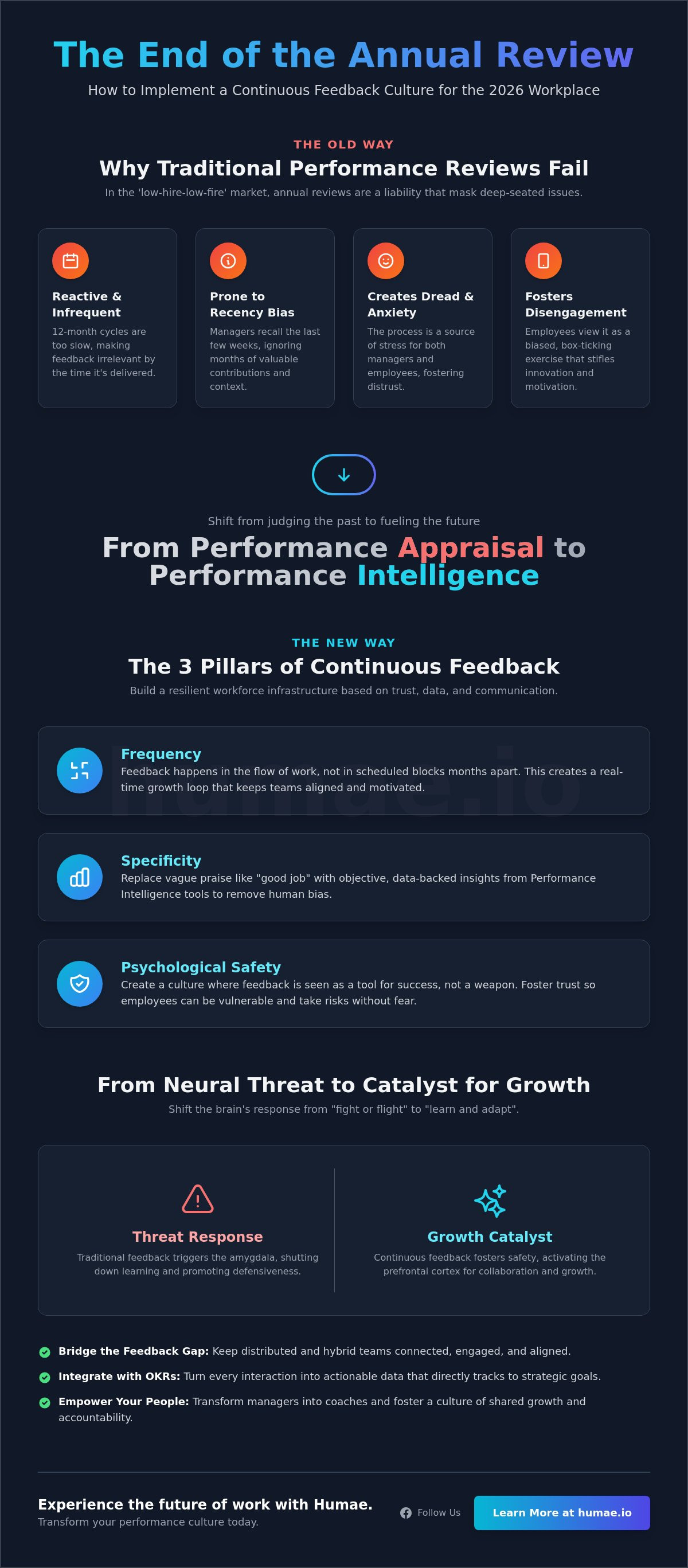
Performance appraisal is a relic of a slower era. In 2026, forward-thinking organizations have traded the rigid "Performance Appraisal" for "Performance Intelligence." This isn't just a change in terminology; it's a fundamental shift from judging past behavior to fueling future potential. Understanding how to implement a continuous feedback culture starts with recognizing that feedback isn't an event. It's a workforce infrastructure. This logic follows the principles of a continual improvement process, where small, iterative adjustments lead to massive organizational gains over time.
Distributed and hybrid teams now face a widening "Feedback Gap." In a digital-first environment, the lack of spontaneous "watercooler" praise or quick course corrections creates a vacuum. Employees often fill this silence with anxiety or disengagement. To bridge this, a modern feedback culture rests on three non-negotiable pillars:
- Frequency: Feedback must happen in the flow of work, not in scheduled blocks months apart.
- Specificity: Vague praise like "good job" is replaced by data-backed insights from Performance Intelligence tools.
- Psychological Safety: Employees must feel that feedback is a tool for their success, not a weapon for their dismissal.
The goal is to replace the "Annual Review Hangover," characterized by stress and recency bias, with a "Real-Time Growth Loop" that keeps everyone aligned and motivated.
The Death of the Annual Performance Review
Twelve-month cycles fail because they're fundamentally reactive. In a fast-paced market where the US unemployment rate sits at 4.6%, you can't afford to wait a year to tell a high-performer they're doing well or a struggling employee how to pivot. Traditional reviews suffer from heavy recency bias, where managers only remember the last three weeks of work. This inaccuracy kills innovation. When employees know their risks won't be evaluated fairly until months later, they stop taking them.
Why Real-Time Communication is the New Standard
The Psychology of Feedback: Building Trust and Safety
Feedback often feels like a threat, not a gift. When a manager says, "Can I have a word?", the human brain doesn't distinguish between a professional critique and a physical predator. The amygdala takes over, triggering a fight or flight response that shuts down the prefrontal cortex, the part of the brain responsible for learning and problem solving. Understanding how to implement a continuous feedback culture requires moving past this biological hurdle. You can't inspire growth while your team is in survival mode.
Psychological safety is the foundation of this entire transition. It's the shared belief that the team is safe for interpersonal risk taking. In 2026, this means creating an environment where employees can admit mistakes or voice concerns without fear of retaliation. Vulnerability starts at the top. When leaders openly share their own development areas, they signal that growth is a collective journey. This shifts the dynamic from "giving feedback," which feels like a judgment, to "sharing observations," which feels like a collaboration. It's about looking at the data together rather than pointing fingers.
Creating a Safe Space for Radical Candor
Managers must evolve into coaches. The era of the "judge" is over. This means the infamous "Feedback Sandwich," hiding a critique between two compliments, is finally dead. In a fast-paced market, this technique is seen as manipulative and confusing. Directness wins in 2026 because it respects the recipient's time and intelligence. Clarity is kind. To build true hierarchical trust, encourage upward feedback. When employees see their input changing leadership behavior, their commitment to the organization triples. You can see this in action by utilizing Performance Intelligence tools that democratize the feedback process.
Feedback as a Retention Strategy
In a "low-hire-low-fire" market with a 4.6% unemployment rate, retention is your most valuable metric. Continuous feedback is one of the most effective employee engagement strategies available today. It prevents "quiet quitting" by ensuring every team member feels seen and valued for their specific contributions. Early intervention through real-time communication reduces grievance risks and prevents small misunderstandings from becoming cultural rot. When feedback is constant, it becomes the heartbeat of the company, keeping everyone connected to the larger mission.
A 5-Step Framework to Implement Your Feedback Cycle
Transitioning from theory to practice requires a structured approach. You can't just tell people to "talk more" and expect a cultural revolution. Learning how to implement a continuous feedback culture means building a repeatable system that scales with your growth. This framework ensures your transition is data-driven, human-centric, and sustainable.
Step 2: Define "Feedback Behaviors" for your specific organization. Every company culture is unique. Some thrive on high-intensity directness, while others prefer a collaborative, nurturing tone. Define what "good" looks like for your team so everyone speaks the same language and understands the expectations.
Step 3: Train managers on constructive criticism vs. destructive critique. Feedback is a skill, not an instinct. Managers need to understand that destructive critique focuses on the person, while constructive criticism focuses on the process and the outcome. This distinction is vital for maintaining psychological safety.
Step 4: Deploy a centralized platform for real-time tracking. Use a system that allows for immediate pulse surveys and peer-to-peer recognition. This keeps the momentum going between formal check-ins and ensures no achievement goes unnoticed.
Step 5: Iterate based on AI-driven sentiment data. Don't set it and forget it. Use analytics dashboards to see where engagement is dipping or where communication is stalling. Adjust your approach based on these objective insights to keep the culture healthy.
Setting the Baseline with an Employee Directory
A successful loop starts with clarity on who is who. Using an employee directory helps map peer-to-peer feedback by making expertise and reporting lines visible to everyone. This transparency removes the friction of finding the right person and establishes clear accountability. Consider setting "Feedback Office Hours" where managers are explicitly available for unscheduled growth conversations, making accessibility a core value.
Structuring the 1-on-1 Cadence
Consistency is the secret to trust. Whether you choose weekly or bi-weekly check-ins depends on your team's velocity, but the cadence must be predictable. Standardizing a "Check-in Template" ensures that every conversation covers both tactical wins and long-term growth goals. Always end with the "Next Steps" rule: every piece of feedback must result in a clear, actionable task. This turns talk into progress. Understanding how to implement a continuous feedback culture is ultimately about these small, disciplined habits that drive long-term excellence.
Leveraging AI and Data for Objective Feedback Intelligence
Subjectivity is the silent killer of organizational trust. When feedback relies solely on a manager's memory, bias inevitably creeps in. You end up rewarding the loudest voices while overlooking the quiet contributors. Learning how to implement a continuous feedback culture means replacing these shaky foundations with objective data. In 2026, Performance Intelligence isn't a luxury; it's the infrastructure that ensures every employee is seen and valued fairly.
Analytics dashboards provide a bird's-eye view of team health that no weekly meeting can match. They help leaders spot burnout before it leads to a resignation. By tracking engagement metrics and morale shifts, you can intervene when a team member starts to disengage. In a market where the US unemployment rate is 4.6%, you can't afford to lose talent to preventable exhaustion. This isn't about micromanagement. It's about proactive care. However, with great data comes great responsibility. As of 2026, California’s CPRA requires companies to document privacy risk assessments for high-risk activities like using AI for promotion decisions. Protecting privacy while gathering insights is the only way to maintain the psychological safety we discussed earlier.
AI-Powered Sentiment Analysis
Morale shifts often happen in the quiet spaces between meetings. Humae’s AI platform identifies these shifts by turning qualitative comments from pulse surveys into quantitative growth data. This technology allows you to spot the "Silent High Performer," the employee who delivers exceptional results but doesn't seek the spotlight. By quantifying their engagement and impact, you ensure their contributions are recognized alongside their more vocal peers. It's about making the invisible visible through smart technology that respects the individual.
Performance Intelligence vs. Performance Monitoring
The difference between intelligence and monitoring is transparency. Performance monitoring feels like "Big Brother," while Performance Intelligence feels like a personal coach. Performance Intelligence is the 2026 standard for HRMS that leverages AI to provide actionable coaching insights without compromising human dignity. Using data to justify promotions and rewards makes the process indisputable. It removes the "favoritism" narrative and replaces it with a merit-based system that everyone can trust.
If you're ready to modernize your approach, you can explore our Performance Intelligence solutions to see how data transforms culture.
Sustaining the Loop: Integrating Feedback with OKRs
Feedback is the fuel, but strategy is the engine. Without a clear connection to organizational goals, even the most frequent feedback loop can feel aimless. Mastering how to implement a continuous feedback culture requires anchoring every conversation in OKRs. This alignment ensures that individual growth isn't happening in a vacuum. It's directly contributing to the company's mission. When a manager discusses a team member's progress, they should be able to point exactly to which Key Result that growth supports.
Real-time tracking allows leaders to pivot instantly when Key Results are at risk. You don't have to wait for a quarterly post-mortem to realize a project is off track. Continuous loops provide the data needed to course-correct in week three, not month three. This agility is what separates 2026 market leaders from those stuck in the rigid cycles of the past. As you scale from a 5-person startup to a 500-person enterprise, the complexity of these connections grows. Maintaining a culture that celebrates "Micro-Wins" daily keeps momentum high across large, distributed teams. These small bursts of recognition ensure that achievements are recognized while they're still fresh and impactful.
Feedback as an OKR Catalyst
Aligning personal development with organizational objectives creates a powerful synergy. When employees see how their specific skill-building directly impacts a company-wide goal, their sense of purpose and retention increases. Real-time feedback speeds up the OKR cycle by providing immediate validation or redirection. Peer-to-peer recognition also plays a massive role here. When colleagues acknowledge each other's contributions toward a shared target, it builds a horizontal layer of accountability. This peer-driven motivation is often more effective than traditional top-down management in a hybrid world.
The Role of Modern HRMS
A centralized HRIS is the essential skeleton of a modern organizational culture. It provides a single source of truth for performance data, OKR tracking, and employee engagement. For busy managers, automation is the key to consistency. Modern systems can send a feedback "nudge" to leaders when a check-in is overdue or when a team member's sentiment score shows a significant dip. This ensures that how to implement a continuous feedback culture remains a living practice rather than a forgotten initiative on a slide deck.
Discover how Humae automates your continuous feedback loop to drive high performance and human-centric growth across your entire organization.
The Future of Performance is Real-Time
The transition from rigid annual reviews to a dynamic growth loop isn't just an HR trend; it's a strategic necessity for the 2026 workforce. You've explored the framework and the psychology required to build deep-seated trust. Now, it's about execution. Mastering how to implement a continuous feedback culture allows your organization to remain agile, keeping every team member aligned with company goals through objective, data-driven insights.
By integrating feedback directly with your OKRs, you ensure that every conversation fuels progress. This approach eliminates the "annual review hangover" and replaces it with a self-sustaining cycle of high performance. Leveraging technology to remove bias and monitor team sentiment ensures your culture remains healthy as you scale, protecting both your people and your productivity.
Ready to transform your workplace? Build a feedback culture that scales with Humae. Our platform offers AI-driven sentiment analysis, integrated OKR tracking, and real-time performance intelligence dashboards to empower your leaders and support your people. Let's create a future where every voice drives growth.
Frequently Asked Questions
How do I give constructive feedback without discouraging my employees?
Focus on the specific process or behavior rather than the individual's personality. Use objective data from Performance Intelligence tools to keep the conversation grounded in facts. This approach frames the discussion as a collaborative effort to solve a problem together. It lowers the emotional stakes and ensures the employee feels supported in their professional growth journey.
Is continuous feedback better than annual reviews for remote teams?
Continuous feedback is essential for remote and hybrid teams because it bridges the digital "Feedback Gap." Without regular check-ins, remote workers often feel isolated or uncertain about their performance. Real-time communication ensures they remain visible and valued. It provides the consistent alignment needed to keep distributed teams connected to company-wide goals and culture.
How much time should managers spend on continuous feedback each week?
Managers should dedicate approximately 15 to 30 minutes per direct report each week for intentional feedback. When you master how to implement a continuous feedback culture, these interactions become a natural part of the daily workflow. This small time investment prevents major performance issues later. It also builds the trust necessary for high-speed decision making and innovation.
What are the best tools for tracking employee performance in 2026?
The most effective tools are integrated HRMS platforms that offer Performance Intelligence and real-time analytics dashboards. These systems replace subjective memory with objective data. They allow leaders to track progress toward OKRs and monitor team sentiment simultaneously. This holistic view ensures that performance evaluations are fair, transparent, and based on actual impact rather than recency bias.
Can AI really help with employee feedback and sentiment analysis?
AI-driven sentiment analysis identifies morale shifts and engagement patterns that are often invisible to the human eye. By analyzing qualitative data from pulse surveys, AI provides a quantitative baseline for team health. This helps leaders spot burnout early and intervene before it affects retention. It's a powerful tool for removing human bias and ensuring every employee is heard.
How do we encourage employees to give feedback to their managers?
Establish a culture of "Upward Feedback" by having leaders model vulnerability and openness. Actively ask for input on management styles and act on the suggestions you receive. When employees see their feedback leading to tangible changes in leadership behavior, they feel safe to share their observations. This builds a foundation of mutual trust that strengthens the entire organization.
What happens if an employee disagrees with the feedback they receive?
Treat a disagreement as a collaborative exploration rather than a conflict. Use objective data from your Performance Intelligence dashboard to ground the conversation in reality. If the disagreement persists, use it as an opportunity to clarify expectations and refine future OKRs. This ensures both parties are aligned on what success looks like moving forward.
How do I measure the success of a feedback culture implementation?
Track metrics such as employee retention rates, engagement scores, and the velocity of OKR completion. A successful strategy for how to implement a continuous feedback culture will show a measurable increase in team alignment. You should also see a decrease in voluntary turnover and a rise in peer-to-peer recognition across your analytics dashboards.