How to Identify and Close Skills Gaps: The 2026 Workforce Intelligence Guide
By Humae · 13 September 2026
how to identify and close skills gaps
By 2026, the global talent shortage is projected to cost organizations a staggering $5.5 trillion. If your team feels slower despite working harder, you're likely dealing with invisible productivity leaks and wondering how to identify and close skills gaps before they impact your bottom line. Manual, biased performance reviews simply can't catch these deficits. We understand how frustrating it is to see high turnover just because your best people don't see a clear path for growth. You know your workforce has potential, but without the right tools, you're essentially flying blind in a fast-moving market.
This guide provides a masterclass in the data-driven framework needed to surface hidden talent deficits. We'll move beyond guesswork to give you a clear map of your current versus required competencies. You'll learn how to implement a scalable reskilling framework and leverage AI-driven insights to automate the identification process. By the end, you'll have the intelligence needed to transform your HR department into a high-performance engine that supports every employee's journey. We're here to help you bridge the gap between where your team is today and where they need to be to thrive in a digital-first economy.
Key Takeaways
- Master the data-driven framework for how to identify and close skills gaps using real-time OKR tracking and AI-powered performance insights.
- Discover how to prioritize talent deficits into critical, strategic, and operational levels to ensure your development budget targets high-impact areas.
- Learn to balance internal upskilling with external talent acquisition to bridge competencies effectively while maintaining organizational agility.
- Explore how personalized learning paths and internal mobility programs can eliminate productivity leaks and foster a culture of continuous growth.
- Understand the value of centralizing workforce data within a modern HRMS to automate gap identification and build a scalable infrastructure for success.
What Is a Skills Gap and Why Static Audits Fail in 2026?
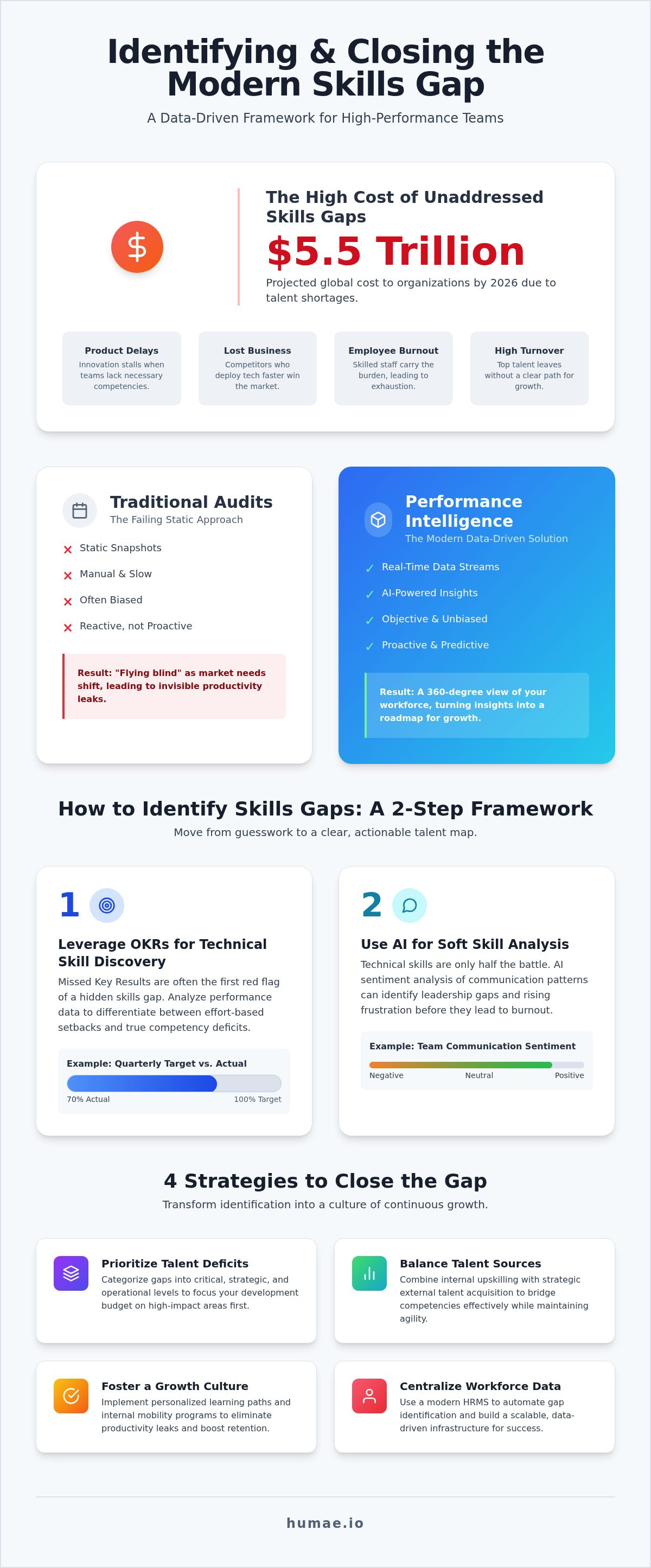
Understanding what a skills gap is starts with recognizing the void between your team's current capabilities and your organization's future goals. It isn't just about missing degrees or certifications. In 2026, it's about the mismatch in micro-skills that prevents a company from pivoting quickly. Traditional annual skills audits fail because they're static snapshots of a world that moves at the speed of AI. By the time you finish a manual audit, the required competencies have already shifted. This is why learning how to identify and close skills gaps requires a move toward Workforce Intelligence; a real-time, data-driven approach to talent management.
The True Cost of Unaddressed Talent Deficits
When talent deficits go ignored, your innovation engine stalls. Research from CIO Dive suggests that tech talent shortages could cost organizations $5.5 trillion by 2026 due to product delays and lost business. Beyond the balance sheet, these gaps create a cycle of employee burnout. When a small group of "skilled" individuals carries the burden of missing competencies, turnover spikes. High turnover then leads to increased recruitment costs, creating a financial leak that's hard to plug. Organizations that don't bridge these gaps quickly find themselves falling behind competitors who can deploy new technologies in weeks rather than months.
Why Traditional HR Systems Struggle to Keep Up
Legacy HRIS platforms often act as simple filing cabinets. They store data but don't analyze it. If you're still relying on manual tracking spreadsheets, you're looking at the past, not the future. These systems lack the AI capabilities needed to detect sentiment or track real-time growth. Without a modern Workforce Management Guide to follow, leaders struggle to see the invisible productivity leaks happening every day. Modern workforce intelligence solves this by centralizing data and providing the predictive insights necessary to stay ahead of the curve.
How to Identify Skills Gaps Using Performance Intelligence
Real-time data acts as the organizational pulse. You can't fix what you can't see, and waiting for an annual review to spot a deficiency is a recipe for failure. Performance intelligence moves the needle from reactive to proactive. By integrating various data streams, you gain a 360-degree view of where your team excels and where they're hitting a wall. Learning how to identify and close skills gaps effectively means turning these insights into a roadmap for growth rather than a list of past mistakes.
Leveraging OKRs for Objective Skill Discovery
Missed key results are often the first red flags of a talent deficit. When a team consistently fails to hit a technical target, it's rarely just a lack of effort. Often, it's a sign that the underlying competency simply isn't there. You need to differentiate between effort-based setbacks and true skill-based failures. For a deeper dive into setting these benchmarks, see our OKR Meaning Guide. By analyzing these trends, you can pinpoint exactly where technical training is required to unblock your pipeline.
AI Sentiment Analysis: Uncovering the Soft Skill Gap
Technical skills are only half the battle. In a remote or hybrid environment, emotional intelligence and leadership are the glue that holds teams together. AI sentiment analysis provides a window into these "invisible" qualities. By analyzing communication patterns and feedback cycles, AI can identify leadership gaps or rising frustration levels before they lead to burnout. These sentiment trends predict the need for management training long before a formal complaint ever reaches HR. It's a supportive way to ensure every team member feels heard and capable.
Mapping these competencies shouldn't be a manual chore. A centralized employee directory allows you to visualize your entire talent landscape at a glance. When you combine this with 360-degree reviews that focus on future potential, you create an environment where growth is inevitable. If you're ready to see these insights in action, you can explore our performance intelligence tools to start building your data-driven strategy today.
Analyzing the Data: Prioritizing Your Talent Strategy
Gathering data is only the first step. The real challenge lies in knowing which deficits require immediate action and which can wait. When learning how to identify and close skills gaps, you must move beyond simple lists and look for patterns. Use analytics dashboards to visualize talent density across your entire organization. This birds-eye view helps you identify "Skill Clusters." These are areas where a single, well-designed training program can resolve multiple deficiencies across different departments simultaneously. It's a supportive, high-impact way to maximize your L&D budget while fostering a community of shared learning.
To keep your strategy focused, categorize your findings into three distinct levels:
- Critical: Gaps that halt production, compromise security, or cause immediate revenue loss.
- Strategic: Deficits that prevent you from reaching your 2026 growth targets or adopting new AI technologies.
- Operational: Minor inefficiencies that slow down daily workflows but don't threaten core business functions.
Creating a Skills Matrix That Actually Works
Defining your talent landscape requires a clear x and y axis: proficiency versus business importance. A skill might be rare in the market, but if it doesn't drive your specific organizational objectives, it isn't a top priority. This validation process must include department heads who see daily performance firsthand and can confirm if the data matches reality. By layering in real-time Performance Intelligence, your matrix evolves from a static spreadsheet into a living document. It ensures you're always focusing on the competencies that actually move the needle for your business.
The Buy vs. Build Decision Framework
Choosing between reskilling and external hiring is a strategic pivot point. If the gap is strategic and requires deep organizational context, building from within is almost always better for retention and morale. It shows your team that you're invested in their long-term success. Conversely, if you face a critical technical deficit that threatens a product launch, it's time to utilize an Applicant Tracking System (ATS) to find specialized experts. This framework helps you compare the long-term cost of acquisition versus the value of internal growth, ensuring your talent strategy remains sustainable, human-centered, and results-oriented.
Closing the Gap: Actionable Strategies for Modern Teams
Identifying a deficit is only half the battle. To truly master how to identify and close skills gaps, you need a strategy that blends human empathy with technological precision. It's about more than just buying a course; it's about creating a culture where growth is built into the job description. By utilizing internal mobility programs, you can move existing talent to the projects where they're needed most. This not only fills immediate needs but also keeps your best people engaged and motivated by offering new challenges. Peer-to-peer mentorship programs further support this by ensuring that specialized knowledge doesn't stay siloed within a single department. These programs empower your veterans to become teachers, reinforcing their own expertise while lifting the entire organization's baseline.
Sometimes, the gap is too wide to bridge internally. In these cases, your talent acquisition strategy must be surgical. Instead of broad job descriptions, focus on the specific core competencies you identified during your audit. This ensures that every new hire is a direct solution to a known problem. When you hire for specific skills rather than generic titles, you build a more resilient workforce that's ready to tackle the complexities of 2026 and beyond. A focused approach to recruitment saves time and resources, allowing you to scale with confidence.
Reskilling for the AI Era
The speed of technological change means that AI literacy and data interpretation are now high-leverage skills for every role. Transitioning toward skills-based hiring allows you to focus on what a candidate can actually do rather than just where they went to school. To make reskilling sustainable, you must integrate learning into the daily workflow. Short, targeted training sessions are often more effective than long, infrequent workshops. This approach ensures your team stays agile without feeling overwhelmed by additional work. It's a supportive way to help your employees evolve alongside the tools they use every day.
Optimizing Onboarding to Prevent Future Gaps
Prevention is often the best cure. A modern HRIS plays a vital role here by helping you identify a new hire's competencies from their very first day. We recommend setting specific OKRs within the first 90 days to verify that their skills align with the role's requirements. This period is a prime opportunity to establish continuous feedback loops. When you catch a slight mismatch early, a small amount of support can prevent it from becoming a major productivity leak later. If you want to streamline this process and ensure your team is always equipped for success, you can explore our workforce management tools to start building a future-proof talent strategy today.
Close the Gap with Humae: AI-Powered Workforce Infrastructure
Humae isn't just a management tool; it's the performance intelligence layer your organization needs to thrive. By centralizing talent data within our intuitive HRMS interface, you eliminate the data fragmentation that often hides critical talent deficits. It's much easier to master how to identify and close skills gaps when all your competency data, OKRs, and feedback cycles live in one secure place. You can automate the entire identification process using our AI-driven performance intelligence tools, which surface productivity leaks before they impact your quarterly targets. This proactive approach ensures that your leadership team is always one step ahead of market shifts.
Scaling your team becomes effortless when your infrastructure is fully integrated. Our Applicant Tracking System (ATS) and onboarding tools work in harmony to ensure that every new hire fills a specific, data-validated void in your organization. You can track the success of your closing initiatives with real-time analytics dashboards, giving you the confidence that your L&D investments are yielding measurable results. We believe that technology should support the human element of your business, making growth feel like a shared victory rather than a technical hurdle.
Performance Intelligence That Drives Growth
Real-time feedback is the engine of rapid skill acquisition. When employees receive immediate, AI-powered insights into their performance, they can adjust and grow in days, not months. Our centralized employee directory makes resource planning simple by mapping every individual's unique skills to your strategic business needs. This visibility allows you to deploy talent where it's most effective, reducing burnout and increasing engagement. You can explore Humae features to see how we turn raw performance data into a supportive growth map for every member of your team.
Building a Future-Proof Team
The shift from reactive to proactive talent management is the hallmark of a visionary organization. Don't wait for a project delay to realize your team is missing critical capabilities for 2026. Mastering how to identify and close skills gaps requires a partner who understands both the technical and human side of HR operations. We invite you to see how it works in a live demo and discover how we can help you build a culture of continuous excellence. It's time to stop guessing and start growing with a platform that values your people as much as your progress.
Master Your Talent Evolution
The workplace of 2026 demands a shift from reactive hiring to proactive workforce intelligence. You've learned that static audits are a thing of the past. Real-time OKR tracking and AI sentiment analysis are the new standards for identifying hidden potential and addressing friction before it leads to turnover. By centralizing your data, you can finally see the invisible productivity leaks that hold your team back. Understanding how to identify and close skills gaps is no longer just an HR task; it's a strategic necessity for success in a competitive digital landscape.
Humae provides the centralized infrastructure you need for smarter hiring and real-time performance intelligence. It's time to stop guessing and start building with data-driven confidence. Optimize your team's growth with Humae to bridge the gap between your current capabilities and your future goals. Your team's potential is waiting to be unlocked, and with the right tools, you'll thrive in the era of AI. We're excited to support your journey toward a more efficient, human-centered organization. Let's build something great together.
Frequently Asked Questions
What is a skills gap analysis and why is it important for 2026?
A skills gap analysis is a systematic review of the difference between your team's current capabilities and the competencies required to meet your business goals. In 2026, it's critical because over 90% of enterprises face talent shortages. Understanding how to identify and close skills gaps ensures your organization remains competitive as 70% of job types evolve due to automation. It's the foundation for strategic planning and long-term sustainability for modern teams.
How can AI help in identifying skills gaps within a large organization?
AI automates the discovery process by scanning vast amounts of performance data to find patterns that human managers might miss. It uses sentiment analysis to detect frustration or leadership deficits in communication and analyzes real-time performance metrics to flag technical shortfalls. This technology provides a scalable way to monitor thousands of employees simultaneously. It offers precise insights that make large-scale workforce management both efficient and human-centered, allowing you to act before productivity drops.
What is the fastest way to close a skills gap in a startup?
The fastest route for a startup is often a hybrid approach of surgical hiring and targeted micro-learning. Using an Applicant Tracking System (ATS) allows you to quickly find experts who fill immediate technical voids. Simultaneously, implementing short, high-impact training sessions helps existing team members adapt without losing momentum. This dual strategy ensures you maintain your agility while building a resilient foundation that supports rapid scaling and innovation without the need for massive budgets.
How do OKRs relate to employee skill development?
Objectives and Key Results (OKRs) act as a diagnostic tool for skill development. When a key result is missed, it often reveals a specific competency gap rather than a lack of effort. Mastering how to identify and close skills gaps through OKR metrics allows you to see exactly where technical or soft skills are falling short. This data-driven approach ensures every learning initiative drives measurable growth for your entire team and aligns with business goals.
Should I prioritize hiring new talent or training existing employees to close gaps?
This decision depends on the urgency and nature of the gap. Training existing employees is better for retention and preserving company culture, especially for strategic roles requiring deep internal knowledge. However, if a gap is critical and threatens immediate product delays, hiring via an ATS provides the fastest solution. A balanced strategy uses performance intelligence to decide when to invest in your current team and when to bring in fresh expertise for the future.
What are the most common skills gaps found in modern tech teams?
Modern tech teams frequently struggle with AI literacy, data interpretation, and advanced cybersecurity. Beyond technical skills, there's a growing deficit in emotional intelligence and leadership, which are vital for managing remote teams. Identifying these gaps requires a move away from static audits toward continuous performance monitoring. By focusing on these high-leverage areas, organizations can bridge the $5.5 trillion global skills gap that threatens the tech industry by late 2026 and beyond.
How does sentiment analysis reveal hidden leadership or communication gaps?
Sentiment analysis scans feedback and communication patterns to detect underlying emotional trends like rising frustration or disengagement. These patterns often signal a lack of effective leadership or a breakdown in team communication before they manifest as formal complaints. It provides a supportive way for HR leaders to intervene early, offering management training or conflict resolution tools. This preserves the human connection within a digital-first organization and prevents talent loss due to unaddressed cultural issues.