Employee Onboarding Software: The 2026 Guide to Integrated Workforce Success
By Humae · 3 August 2026
employee onboarding software
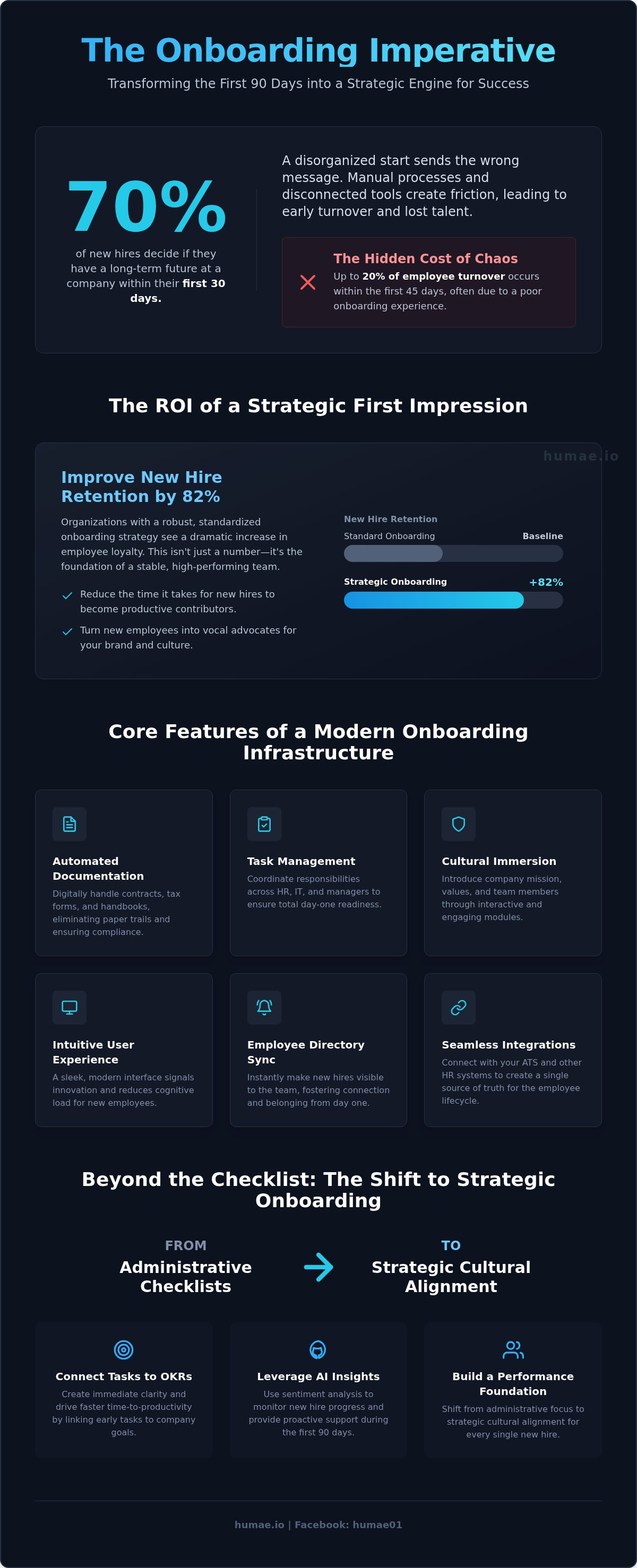
70% of new hires decide if they have a future at your company within their first 30 days. It's a staggering reality that highlights why a great first impression isn't just about a welcome lunch; it's about the systems that support it. When manual data entry errors and disconnected tools create a disorganized first week, top talent begins to drift away. You deserve a process that mirrors the innovation of your brand. Modern employee onboarding software acts as the vital bridge, turning a chaotic start into a seamless, human-centric integration that builds trust immediately.
We agree that the traditional, paperwork-heavy approach is broken and often leads to early turnover. You need a way to reduce time to productivity while ensuring every new hire feels a deep sense of cultural alignment and personal value. This 2026 guide reveals how to transform those critical first 90 days into a strategic engine for workforce success. We'll explore how to automate data syncing to your employee directory, link individual tasks directly to company OKRs, and use real-time analytics to ensure your new team members are set up for long-term growth.
Humae | Official Website | Facebook | Back to Home
Key Takeaways
- Shift your focus from administrative checklists to strategic cultural alignment to build a high performance foundation for every new hire.
- Discover how modern employee onboarding software automates the transition from candidate to team member by syncing data instantly to your employee directory.
- Leverage AI driven sentiment analysis to monitor new hire progress and provide proactive support during the critical first 90 days.
- Connect early onboarding tasks directly to organizational OKRs to create immediate clarity and drive faster time to productivity.
Humae | Official Website | Facebook | Back to Home
Why Employee Onboarding Software Is Vital in 2026
Success in the modern workplace starts long before a new hire completes their first task. We define employee onboarding software as a centralized digital infrastructure designed to automate the transition from candidate to productive team member. It's the foundation for the entire employee lifecycle and performance intelligence cycle. This technology ensures that the moment a contract is signed, the journey toward high performance begins without friction. When you treat onboarding as a strategic pillar rather than an administrative chore, you set a standard for excellence that resonates through the entire organization.
The workplace has moved past the era of simple checklists. We now focus on organizational socialization, which is the strategic process of helping new hires adjust to the social and performance aspects of their new roles. Companies that rely on manual processes often face high hidden costs. Data silos and disorganized first weeks lead to early turnover. Research indicates that up to 20% of employee turnover occurs within the first 45 days. Disorganization suggests a lack of care, which is a message no scaling company can afford to send to its best talent.
The Core Functions of Onboarding Platforms
Modern platforms do the heavy lifting so your team can focus on building relationships. A robust employee onboarding software solution provides the essential tools to scale culture with speed and precision.
- Automated documentation: Digitally handle contracts, tax forms, and handbooks. This eliminates the paper trail and ensures compliance with 2026 standards without manual intervention.
- Task management: Coordinate responsibilities across HR, IT, and hiring managers. This ensures every laptop is ready and every system access is granted before the new hire even logs in.
- Cultural immersion: Introduce company mission and values through interactive modules. This helps new hires feel the brand's heartbeat from day zero.
The ROI of a Modern First Impression
A strong start pays dividends for years. Organizations with a robust onboarding strategy can improve new hire retention by 82%. This isn't just a statistic; it represents the long term stability of your team. By utilizing an integrated feature set, you reduce the weeks it takes for a new hire to contribute to company goals. Beyond the balance sheet, your brand reputation thrives. New employees become vocal advocates when their first week feels like a well orchestrated welcome rather than a confusing hurdle. Investing in this experience proves that you value your people as much as your results.
Humae | Official Website | Facebook | Back to Home
Core Features of a Modern Onboarding Infrastructure
Your digital interface is the new office lobby. First impressions are now formed through a screen, making an intuitive and fresh user experience essential for your brand image. When new hires log into your employee onboarding software, they should feel a sense of clarity and excitement. A clunky, outdated system suggests a stagnant culture, while a modern, sleek platform signals innovation. It's about building trust through design. An interface that's easy to navigate reduces the cognitive load on new employees, allowing them to focus on learning their roles rather than fighting with software.
Visibility creates immediate belonging. A centralized employee directory ensures that every new hire is visible to the team the moment they join. This transparency allows colleagues to reach out with a welcome message, breaking the ice before the first meeting even begins. Mobile accessibility takes this a step further. Modern workers value flexibility. They want to be able to review their benefits or complete a quick task on their own terms, whether they're on a train or at a desk. Your choice of employee onboarding software defines how effectively you respect their time and autonomy.
Integrations are the invisible threads that hold your workforce together. Your onboarding tool must communicate seamlessly with your Applicant Tracking System (ATS) and your performance intelligence software. This creates a single source of truth that spans the entire employee lifecycle. By choosing a platform that prioritizes both technical precision and user empathy, you can explore features that turn compliance into a competitive advantage.
Automation That Humanizes the Process
Technology should remove the "work about work" so people can focus on people. E-signatures and secure digital lockers keep sensitive data safe without the need for scanners or physical mail. This speed matters. Triggered workflows automatically notify IT to prepare hardware the moment a contract is signed, ensuring the new hire feels expected and valued. Personalized welcome portals go even deeper. They tailor content based on the specific role, department, or location. This level of personalization makes a large organization feel small, supportive, and deeply human.
Data Continuity and Workforce Management
Efficiency is born from continuity. Information captured during the recruitment phase flows instantly into the employee directory, eliminating the need for tedious, manual data re-entry. This seamless handoff prevents errors and saves hours of administrative time. Integrating time-off management directly into the onboarding flow allows hires to understand leave policies and plan their year from week one. For global teams, scalability is a necessity. A modern system manages complex compliance and cultural nuances across borders, ensuring every remote worker feels like a first-class citizen of the organization.
Humae | Official Website | Facebook | Back to Home
Beyond the Checklist: AI and Performance Intelligence in Onboarding
Onboarding is no longer a static event; it's an evolving conversation powered by data. While traditional systems focus on whether a form was signed, advanced employee onboarding software looks at how a person is actually integrating into your culture. We see a shift from reactive task management to proactive support. AI doesn't just track progress. It predicts outcomes. By analyzing early engagement patterns, predictive analytics can identify which new hires are thriving and which might need a little extra encouragement. AI-driven sentiment analysis monitors early feedback to prevent "new hire regret" and early turnover. This isn't about replacing the human touch. It's about giving leaders the insights they need to be more present and empathetic when it matters most.
Visionary leadership requires a commitment to using technology as a bridge, not a wall. When you leverage performance intelligence, you're not just watching numbers. You're watching the growth of a human being. This approach transforms the first 90 days from a trial period into a launchpad for a long-term career. By understanding the nuances of a new hire's experience, you can intervene before minor frustrations become major reasons for leaving. It's a proactive way to build a high-performing, resilient team from the ground up.
Aligning Early Goals with OKR Tracking
Purpose drives performance. From the very first week, new team members should see how their specific tasks contribute to the bigger picture. Integrating your onboarding flow with OKR Meaning and tracking ensures that every action feels meaningful. We recommend setting short-term "quick win" goals during the first thirty days. These small victories build the confidence and momentum necessary for long-term success. When a hire sees their impact reflected in company objectives, their commitment to the mission deepens instantly.
The Power of Continuous Feedback
The first 90 days are a delicate window for any organization. Relying on a single check-in at the end of three months is a risk most scaling companies can't afford to take. Modern employee onboarding software automates the scheduling of 30, 60, and 90-day reviews to ensure consistent communication. This creates a safe space for real-time sentiment sharing. Managers can understand exactly how a new hire feels about their training and team integration. Using performance intelligence allows you to tailor the training path for each individual. If someone excels in one area but struggles in another, the system adapts to their needs. This personalized approach proves that you're invested in their unique growth journey.
Humae | Official Website | Facebook | Back to Home
Bridging the Gap: Integrating Onboarding with the Full HR Ecosystem
Integrating your employee onboarding software into a broader digital ecosystem is the difference between a fragmented experience and a unified culture. When a candidate signs an offer, their data shouldn't just sit in a recruiting folder; it should flow instantly into a system that understands the full employee lifecycle. To understand how these components fit together, it's helpful to explore What is an HRIS? and how it serves as the backbone of your organization. Centralizing your workforce management into a single platform eliminates the confusion of managing five different siloed tools. This lifecycle view ensures that the data collected during onboarding informs future leadership development and succession planning from day one.
A unified approach does more than just save time. It creates a narrative for each employee. When your onboarding data is connected to your performance intelligence, you can see how early training correlates with long term success. This bird's eye view allows visionary leaders to identify high potential talent earlier than ever before. By bridging the gap between hiring and management, you ensure that no valuable insight is lost in translation. Efficiency and empathy work together when your tools speak the same language.
From Candidate to Team Member
The transition from applicant to colleague should be invisible to the hire but highly visible to the manager. Interview notes shouldn't disappear once the hire is made. Instead, they should become the foundation for the first performance coaching session. By ensuring the employee directory is the single source of truth for all people data, you create a transparent environment where everyone knows who is who and what they bring to the table. For a deeper look at the underlying systems, read about What is Workforce Management? and its role in modern HR infrastructure. This continuity builds trust and shows the new hire that their journey is being handled with care and precision.
Reducing Administrative Friction
Manual spreadsheets and endless email threads are the enemies of scaling companies. They create security risks and inevitable human errors that frustrate new hires before they even start. A unified workforce management infrastructure keeps sensitive data secure within a single, audited system. This isn't just about efficiency; it's about equity. When policies and data are centralized, every employee has access to the same transparent information. This level of openness fosters a culture where everyone feels treated fairly. If you're ready to see how a connected system can transform your team, explore the Humae platform today.
Humae | Official Website | Facebook | Back to Home
Scaling Your Culture with Humae: The AI-Powered Onboarding Partner
Leaders who look ahead understand that the right employee onboarding software is a catalyst for cultural growth. Humae is designed for those who refuse to choose between cold efficiency and warm empathy. We provide a platform where technology serves the human experience. By integrating performance intelligence from the very first hour, you aren't just filling a seat; you're building a high-performing team. Our real-time analytics dashboards give you the power to optimize your onboarding funnel. You can see exactly where new hires are thriving and where they might need more support, allowing for constant refinement of your culture.
Transforming a fragmented hiring process into a unified experience is the first step toward long term success. Humae centralizes your infrastructure so you can focus on what truly matters: your people. We've built this platform to eliminate the friction that usually slows down scaling companies. Instead of chasing email threads, you're tracking progress and celebrating milestones. This clarity is what makes a modern organization feel like a community. When your systems are aligned, your people can be too.
Designed for Modern, Tech-Forward Teams
Scalability is built into our DNA. Whether you're onboarding your first hire or your five-hundredth, the infrastructure grows alongside your ambitions. Our empathetic AI is a tool for support, not a replacement for connection. It handles the data so you can handle the culture. We believe that technology should empower HR professionals to be more human, not less. By automating the administrative burden, we give you the space to mentor, lead, and inspire. Explore our features to see how we simplify every step of the journey.
The Future of Onboarding is Here
The era of juggling multiple siloed tools is over. An "all-in-one" platform is the only sustainable way to manage a modern, dynamic workforce. It ensures that data, performance, and culture are always in sync. This integration prevents the information gaps that lead to disengagement and turnover. See how it works and start building your dream team today. The Humae promise is simple: a professional, innovative, and deeply human approach to HR that puts your success first. We're your partner in building a future where every employee feels valued from day zero.
Humae | Official Website | Facebook | Back to Home
Transform Your First Impression into Lasting Success
The evolution of work in 2026 demands more than just a digital signature. It requires a strategy that turns every new hire into a long term advocate from their very first day. We've explored how a unified employee onboarding software infrastructure eliminates the friction of data silos and manual entry. By connecting early tasks directly to organizational goals and using AI to monitor sentiment, you create a culture where people feel seen and valued immediately. The transition from a candidate in your ATS to a high performing contributor in your employee directory should be seamless, transparent, and deeply human.
Scaling your organization successfully depends on the strength of your foundation. You now have the roadmap to move beyond administrative checklists and embrace a future where technology enhances empathy. It's time to build a workforce that isn't just productive, but truly aligned with your vision. Success is no longer about the quantity of hires, but the quality of their integration into your dream team. Let's build something remarkable together.
Build your high-performance team with Humae and experience the power of AI powered performance intelligence, integrated OKR tracking, and a global workforce management infrastructure designed for an empathy first candidate experience. Let's make every new beginning count.
Humae | Official Website | Facebook | Back to Home
Frequently Asked Questions
What is the difference between onboarding and orientation?
Orientation is a brief, one-time event focused on administrative tasks and company policies. Onboarding is a comprehensive, strategic journey that lasts for the first 90 days or longer. While orientation handles the "what," onboarding focuses on the "how" and "why" of your culture to ensure long term success and alignment with company goals.
How does onboarding software improve employee retention?
Employee onboarding software creates a consistent, high quality experience that builds trust from the first interaction. Organizations with a strong onboarding process can improve new hire retention by 82%. By providing clear OKRs and reducing administrative friction, you help new hires feel valued and productive, which significantly lowers the risk of early turnover.
Can onboarding software help with remote and hybrid teams?
Digital platforms serve as the primary cultural bridge for remote and hybrid employees. They provide a centralized hub where new hires can access training, meet their team, and complete tasks from any device. Automated workflows ensure that remote workers receive their hardware and system access on time, making them feel like a first class citizen of the organization.
Does employee onboarding software integrate with an ATS?
Modern platforms are designed to integrate seamlessly with your Applicant Tracking System (ATS). This connection allows candidate data to flow directly into the employee directory the moment an offer is accepted. It eliminates the need for redundant data entry and ensures that important interview notes are available for the first performance coaching sessions.
What are the must-have features in an onboarding platform for 2026?
The most effective platforms now include AI driven sentiment analysis, real-time OKR tracking, and mobile-first accessibility. You should also look for automated documentation, secure e-signatures, and integrated workforce management tools. These features work together to create a professional, innovative, and deeply human experience for every new team member.
How long should the digital onboarding process take?
The digital journey should begin during the pre-boarding phase and continue through at least the first 90 days. While initial paperwork might be completed in hours, the cultural and performance integration requires ongoing check-ins. A continuous onboarding approach ensures that new hires are supported as they move from their first task to full productivity.
Is AI in onboarding impersonal for new hires?
AI actually enhances the human connection by providing managers with the insights they need to be more empathetic. Instead of replacing people, AI identifies sentiment patterns that suggest a hire might need extra support or a personal conversation. It removes the administrative burden so leaders can spend more time building real relationships with their team.