Employee Coaching Techniques: 2026 Leader''s Guide
By Humae · 25 August 2026
employee coaching techniques
Did you know that executive coaching can generate a 788% return on investment through gains in productivity and employee satisfaction? It's a staggering figure, yet many leaders still battle stagnant performance and the high cost of turnover when development feels out of reach. You've likely felt the frustration of giving feedback that fails to trigger real change or watching targets slip away despite your best intentions. It's time to move beyond guesswork and embrace a more precise, human approach to leadership.
This guide helps you master the essential employee coaching techniques and frameworks needed to transform performance and foster a high-growth culture. We'll provide a practical toolkit you can use immediately to boost engagement and clarify every performance conversation. You'll discover how modern performance intelligence and OKR tracking turn coaching into a data-informed feedback loop that delivers results. Let's build a workplace where every individual has the support they need to thrive and succeed.
About Humae
Humae provides the AI-powered infrastructure for performance intelligence and workforce management. Visit our official website at learn more and follow us on Facebook for more insights. Back to Home
Key Takeaways
- Understand how traditional management is evolving into a collaborative coaching partnership for 2026.
- Master active listening and powerful questioning to drive measurable behavior change. It's about moving from "why" to "how."
- Compare frameworks like GROW, CLEAR, and OSCAR to find the right structure for your performance conversations.
- Learn to implement data-driven employee coaching techniques using real-time OKR tracking and performance intelligence.
- Discover how Humae scales coaching cultures through AI-powered sentiment analysis and centralized feedback loops.
Humae: Performance Intelligence and OKR Tracking. Visit humae.io or follow us on Facebook. Back to Home
Why Traditional Management is Shifting Toward Coaching in 2026
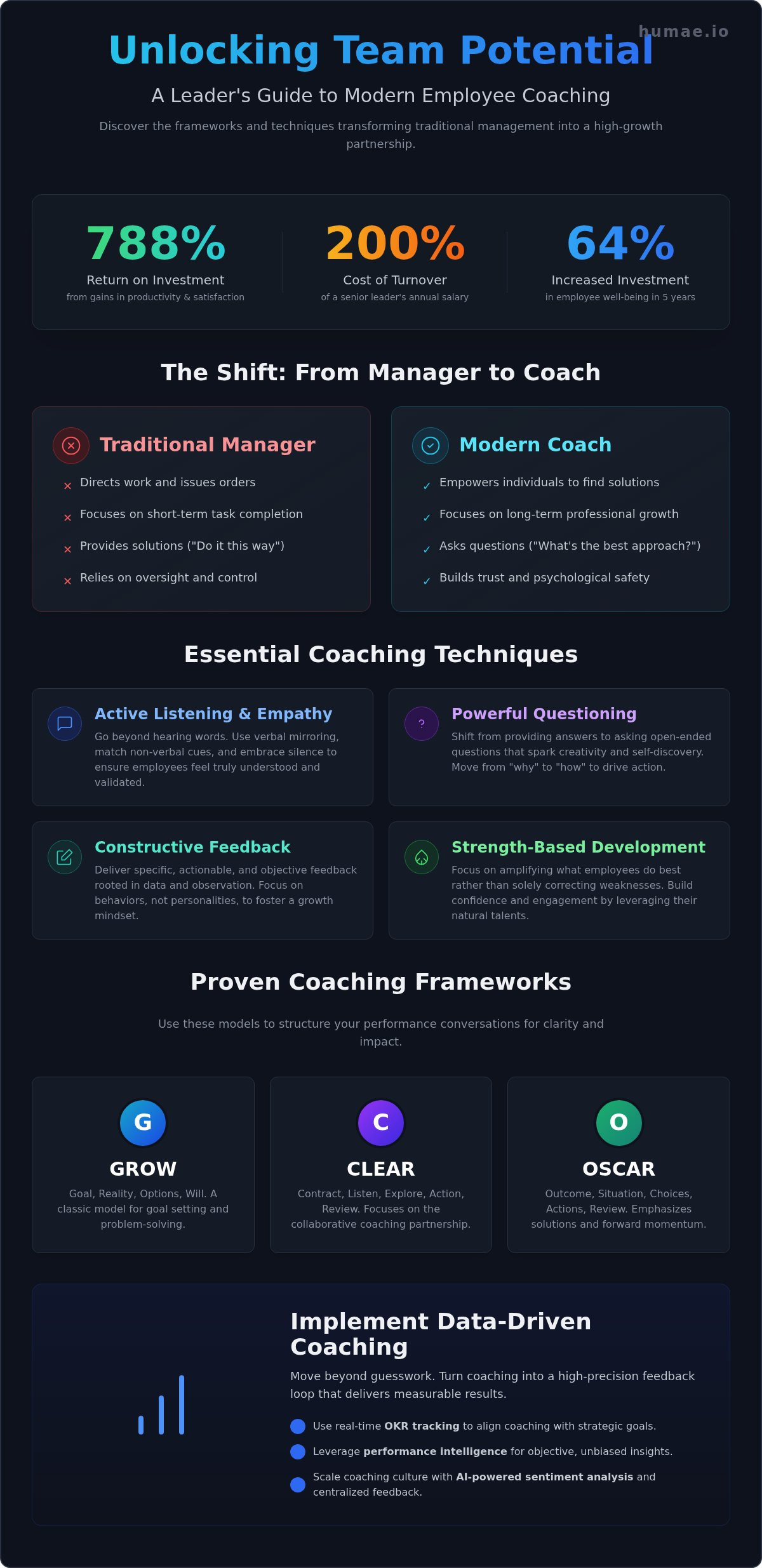
The era of the "boss" who simply issues orders has vanished. In 2026, leadership is defined by the ability to unlock potential through partnership. We define Coaching as a collaborative, ongoing process focused on professional growth rather than mere compliance. This shift isn't just a trend; it's a response to a workforce that demands more than a paycheck. Modern employees prioritize development and meaningful feedback over traditional perks. When people feel their growth is a priority, they stay. With the cost of replacing a senior leader reaching up to 200% of their annual salary, the financial argument for this transition is undeniable.
The ROI of a Coaching Culture
A coaching culture isn't just a soft skill; it's a high-performance engine. Research shows that executive coaching can generate a 788% ROI, driven by massive gains in productivity and team agility. Organizations that embrace these methods report a 64% increase in investment in employee well-being compared to just five years ago. By focusing on career pathing and mentorship, companies significantly reduce turnover costs. For a deeper look at how this fits into the broader organizational structure, explore our guide on What Is Management?
Manager vs. Coach: Understanding the Key Differences
Traditional managers focus on short-term task completion and directing work. Coaches, however, empower individuals to find their own solutions. This distinction is vital for long-term skill acquisition. While a manager might say "do it this way," a coach asks "what's the best approach here?" Implementing modern employee coaching techniques requires a foundation of psychological safety. Without trust, employees won't take the risks necessary for growth. By shifting from a command and control style to a supportive one, leaders foster a high-growth environment where behavior changes because the employee wants it to, not because they're told to. It's about building a future-proof team through empowerment rather than oversight.
Essential Employee Coaching Techniques for High-Performance Teams
Effective leadership in 2026 isn't about having all the answers; it's about asking the right questions. Mastering employee coaching techniques requires a fundamental shift from directing to facilitating. This toolkit focuses on empathy, curiosity, and measurable growth. By moving away from a one-size-fits-all approach, you can tailor your support to each individual's unique strengths and challenges. When coaching becomes a habit rather than a scheduled event, performance naturally accelerates.
Mastering Active Listening and Empathy
Listening is more than just hearing words. It's about ensuring the employee feels truly understood. Use verbal mirroring by repeating key phrases back to them to validate their perspective. Non-verbal mirroring, such as matching their posture or pace, builds deep rapport. Don't fear silence. Often, the most profound insights emerge when you give an employee ten seconds of quiet to reflect. Avoid the advice trap where you jump in to solve the problem. Instead, let them navigate the path to their own solution.
Asking Questions That Drive Action
The quality of your coaching depends on the quality of your questions. Shift from leading questions that suggest an answer to open-ended ones that spark creativity. Instead of asking "did you consider this specific approach?", try "what other options have you explored?". You can use modern coaching models to structure these inquiries effectively. For deeper issues, apply the Five Whys technique. By asking "why" repeatedly, you strip away surface symptoms to find the root cause of a performance hurdle.
Strength-based development is equally crucial. Focus on what employees do best rather than obsessing over weaknesses. When you anchor coaching in objective reality, feedback loops become actionable and timely. Using an analytics dashboard allows you to base these conversations on real-time data rather than gut feelings. This transparency fosters trust and ensures that development efforts align with organizational goals. It's this combination of human empathy and data-driven insight that creates a high-growth culture.
Comparing Modern Coaching Frameworks: GROW vs. CLEAR vs. OSCAR
Structured frameworks turn a vague conversation into a strategic roadmap. Without them, even the most skilled leaders can lose focus. Using proven employee coaching techniques ensures that every session drives a specific result rather than just being a "nice chat." While many models exist, GROW, CLEAR, and OSCAR remain the most effective tools for the 2026 workplace. These structures provide the consistency needed to scale a coaching culture across diverse teams.
The GROW Model: The Gold Standard for Performance
The GROW model is favored for its simplicity and results-oriented nature. It breaks down the conversation into four distinct stages that guide an employee from a problem to a solution. In the Goal stage, you define exactly what the employee wants to achieve. Ask: "What does success look like for this project?" In the Reality stage, you assess the current situation objectively. Ask: "What obstacles are currently standing in your way?" The Options stage encourages brainstorming, while the Will stage secures a commitment to action. This framework is particularly powerful when paired with effective Employee Engagement Strategies, as it ensures personal development aligns with organizational success.
Choosing the Right Framework for Your Team Culture
Not every situation requires the same approach. The CLEAR model (Contracting, Listening, Exploring, Action, Review) is ideal for transformational coaching. It emphasizes the initial "Contracting" phase, where you establish the emotional and professional boundaries of the conversation. Use this when you need to address cultural issues or deep-seated behavioral patterns that require a more empathetic touch. It's about long-term evolution rather than just quick fixes.
In contrast, the OSCAR model (Outcome, Situation, Choices, Actions, Review) is built for speed and solution-focused outcomes. It's the preferred choice for fast-paced business units where immediate problem-solving is the priority. By focusing on "Choices and Consequences," it helps employees weigh their options quickly and take ownership of the results. The best leaders don't just stick to one script. They blend these employee coaching techniques based on individual needs. You might start with CLEAR to build rapport and then switch to GROW to define a clear path forward. This flexibility is what separates a standard manager from a visionary coach.
Implementing Data-Driven Coaching in a Hybrid World
Coaching in a hybrid world requires a bridge between digital metrics and human empathy. You can't rely on casual "water cooler" observations to judge performance anymore. Instead, modern leaders use performance intelligence to anchor their employee coaching techniques in objective reality. This data doesn't replace the conversation; it fuels it with precision. By analyzing real-time performance trends, you identify exactly where a team member needs support before a missed target occurs. It's about being proactive rather than reactive.
Modern platforms now offer AI-driven sentiment analysis. This technology identifies subtle shifts in tone or engagement during asynchronous feedback loops. It acts as an early warning system for burnout or disengagement. When you see a dip in sentiment, it's a clear signal to schedule a 1:1 session. You aren't guessing about morale; you're responding to a documented need with empathy and speed.
Coaching Through the Lens of OKRs
OKR tracking provides a shared language for growth. It eliminates the ambiguity of "doing a good job" by focusing on measurable outcomes. When you understand the OKR Meaning and how it applies to your team, coaching becomes a progress check rather than a critique. You use the data to ask: "What's blocking this specific result?" This aligns individual development directly with company-wide objectives. Every coaching session feels relevant because it connects personal success to the bigger picture.
Best Practices for Virtual Coaching Sessions
Virtual coaching demands high intentionality. You must maintain presence through the screen by minimizing distractions and using active listening cues. Shared digital dashboards are essential here. They act as a single source of truth for development goals and action items, ensuring nothing gets lost in a Slack thread. Consistency is vital for distributed teams. Every employee, regardless of their time zone, deserves the same depth of feedback and support. Digital tools ensure that geography never limits a person's growth potential.
Ready to transform your coaching with real-time data? Explore how our performance intelligence and OKR tracking tools can power your team's growth.
Scaling Your Coaching Culture with Humae Performance Intelligence
Manual note-taking and scattered spreadsheets are where growth cultures go to die. To truly scale employee coaching techniques across a large organization, you need a centralized platform that captures every insight. Humae replaces the chaos of manual documentation with a sophisticated performance intelligence engine. By centralizing coaching notes and feedback, we ensure that no development opportunity is lost in a manager's inbox. This transparency builds a history of growth that stays with the employee, regardless of team changes or organizational shifts.
Empathy is often the hardest skill to scale, yet it's the most critical. Our AI-powered sentiment analysis supports managers by identifying subtle emotional trends in continuous feedback loops. It doesn't replace human intuition; it sharpens it. By flagging potential issues early, the platform allows leaders to apply the right employee coaching techniques at the exact moment they're needed. This proactive approach transforms the manager from a reactive problem-solver into a supportive visionary partner who understands the "why" behind the data.
Automating the Feedback Loop
Managers are busy people. Administrative burdens often push coaching to the bottom of the priority list. Humae solves this by automating the feedback loop, setting reminders for follow-up sessions and tracking progress against action items. This ensures that the momentum gained in a 1:1 session isn't lost to the daily grind. Consistency is the secret to cultural change. Explore the Humae features to see how we streamline performance management for modern teams.
Building a Future-Proof Workforce Management Infrastructure
Coaching is a vital pillar of our Humae workforce management vision. We believe that when employees own their growth data through transparent analytics dashboards, they develop a natural growth mindset. They don't just wait for feedback; they seek it out. By integrating directory data and time-off management, leaders gain a holistic view of the employee's life, ensuring coaching is compassionate and realistic. It's time to build a culture where development is the default. Start your journey toward a high-growth organization today by exploring our platform.
Build Your High-Growth Culture Today
Mastering employee coaching techniques is no longer optional; it's the engine of modern organizational success. By shifting from command and control to a supportive coaching partnership, you unlock a documented 788% ROI in productivity and satisfaction. Whether you adopt the GROW framework for performance or the CLEAR model for cultural growth, the key lies in consistency and data-backed empathy.
You don't have to navigate this transition alone. Explore Humae: The AI-Powered HR Platform for Modern Teams to see how our AI-driven performance intelligence and real-time OKR tracking provide the global workforce management infrastructure your team deserves. Our platform centralizes feedback and sentiment analysis, helping every manager become a visionary coach. The future of leadership is here. It is human, it is data-informed, and it starts with your next conversation. Let's build a workplace where everyone thrives.
Frequently Asked Questions
What are the 5 core coaching techniques every manager should know?
The 5 core employee coaching techniques include active listening, powerful questioning, strength-based development, constructive feedback loops, and goal alignment. Active listening ensures employees feel truly understood, while powerful questioning shifts the focus from past mistakes to future solutions. Strength-based approaches leverage what people do best. Feedback loops keep development timely, and goal alignment ensures everyone moves in the same direction toward organizational success.
How is coaching different from traditional performance management?
Traditional performance management often focuses on past mistakes and annual compliance checks. Coaching is a forward-looking, continuous partnership focused on growth. While management directs tasks, coaching empowers individuals to find their own solutions. It's the difference between telling someone what to do and helping them develop the skills to decide for themselves. This shift increases engagement and reduces the high costs associated with employee turnover.
Can employee coaching techniques be used for remote teams?
Yes, employee coaching techniques are highly effective in hybrid and remote environments when supported by the right digital tools. Virtual coaching requires higher intentionality and deep listening to bridge the screen gap. Leaders use shared digital dashboards to track progress and maintain a single source of truth. Asynchronous feedback through sentiment analysis also helps managers stay connected to remote team members' well-being and performance needs.
How often should coaching sessions take place for maximum impact?
Coaching should be a continuous habit rather than a rare event. While formal 1:1 sessions often happen bi-weekly or monthly, informal coaching moments should occur daily or weekly. Consistency is vital for long-term behavior change. Regular check-ins ensure that development goals stay relevant and that obstacles are removed quickly. Organizations with a strong coaching culture report higher employee well-being and better retention rates over time.
What is the GROW model in employee coaching?
The GROW model stands for Goal, Reality, Options, and Will. It's a structured framework that guides a coaching conversation from a desired outcome to a committed action. You start by defining a specific goal, then assess the current reality and obstacles. Next, you brainstorm various options for moving forward. Finally, you secure the employee's "will" or commitment to specific next steps. This structure provides clarity and accountability.
How do OKRs help in the coaching process?
OKRs provide the objective data needed to anchor coaching conversations in reality. They define clear goals for frameworks like GROW and offer measurable key results to track progress. By using real-time OKR data, coaches can move away from subjective opinions and focus on specific blockers. This alignment ensures that an individual's professional development directly contributes to the company's strategic mission and bottom-line productivity.
What should I do if an employee is resistant to coaching?
Resistance often stems from a lack of trust or psychological safety. Start by clarifying the purpose of coaching as a supportive tool for their growth, not a disciplinary measure. Use active listening to understand their concerns and involve them in setting the agenda. When employees see that coaching helps them achieve their own career goals, resistance usually fades. Building a foundation of empathy is the first step toward a productive partnership.