Custom HR Reporting and Analytics: The 2026 Guide to Data-Driven People Operations
By Humae · 7 July 2026
custom hr reporting and analytics
What if your HR data actually told a story instead of just filling a spreadsheet? You've likely spent too many Friday afternoons manually stitching together data from three different platforms, only for leadership to ask for a trend report your current system simply cannot generate. It's frustrating to feel like you're drowning in numbers but starving for actual insights. This guide shows you how to move beyond basic tracking to build custom hr reporting and analytics that turn fragmented employee data into a strategic engine for growth and engagement.
We understand that modern people operations require more than just a list of names; they require a narrative of human potential. You need a centralized dashboard that automates turnover and performance trends while navigating the complex 2026 regulatory landscape, including new pay transparency mandates and AI oversight laws. By the end of this article, you'll know exactly how to link HR metrics to business outcomes. Let's transform your data from a chore into your most powerful tool for building a thriving organizational culture.
Visit the official Humae website to learn more about our modern HR solutions. You can also return to our home page or follow our latest updates on Facebook.
Key Takeaways
- Transition from manual, reactive paperwork to a proactive workforce infrastructure that anticipates organizational needs.
- Distinguish between historical records and predictive analytics to gain a diagnostic understanding of team dynamics.
- Leverage AI-driven sentiment analysis to move beyond "cold" numbers and capture the genuine emotional pulse of your workforce.
- Implement a practical framework for custom hr reporting and analytics that aligns every metric with your core business objectives.
- Build your intelligence on the foundation of a centralized employee directory to ensure data accuracy and accessibility.
Unlock the full potential of your people operations with Humae. You can always return to our home page for more insights or join our community on Facebook.
Beyond Spreadsheets: What is Custom HR Reporting and Analytics?
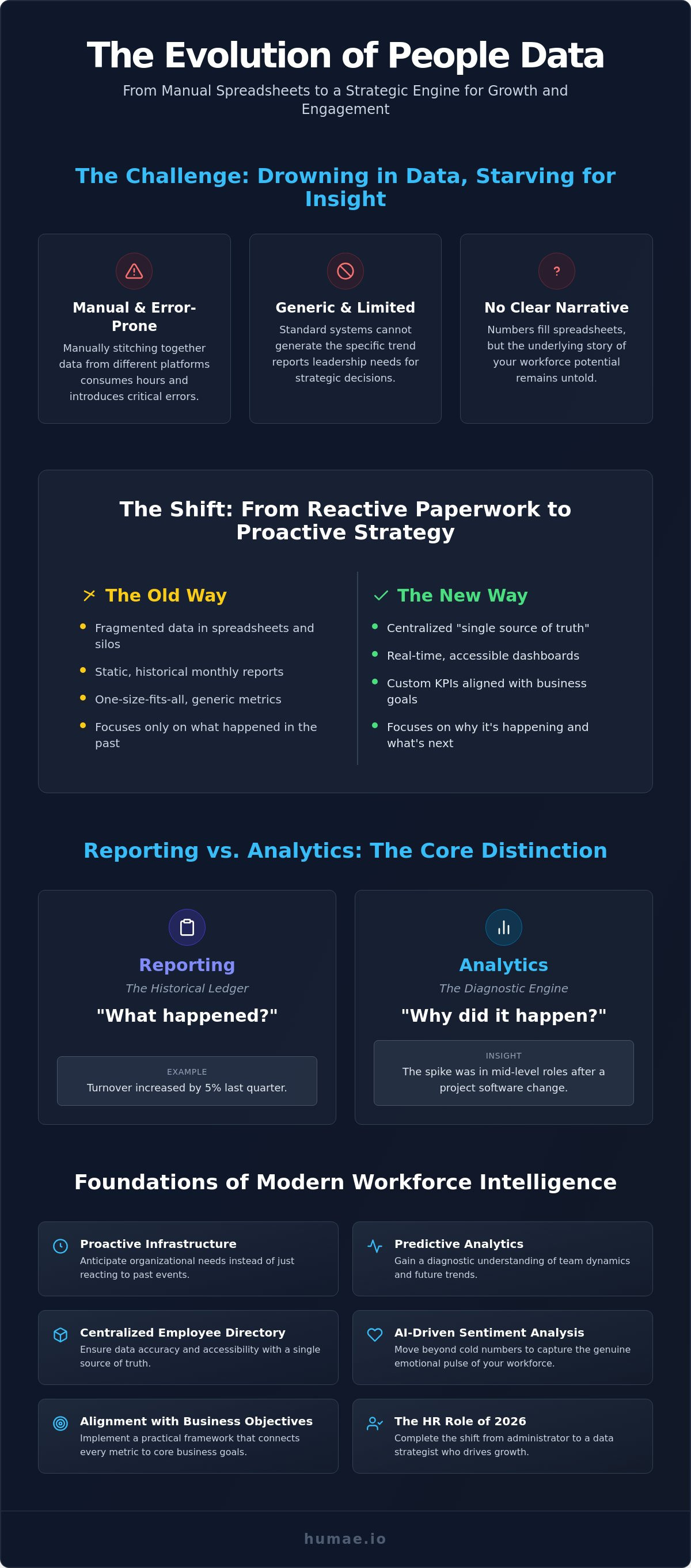
Spreadsheets often feel like a safe harbor, but in a fast-paced environment, they're actually a bottleneck. Manual data entry is prone to error and consumes hours of valuable time every week. Moving toward custom hr reporting and analytics represents a shift away from static, fragmented data toward a living, breathing view of your team. It's more than just a digital version of your paperwork; it's a tailored lens designed to highlight the specific pulse of your workforce. While traditional methods focus on recording what happened in the past, custom reporting builds a bridge to what's coming next.
Standard reports often treat every organization like a carbon copy. They fail because they ignore the specific nuances of your company culture. A generic turnover rate doesn't explain why your top performers are leaving or how your remote work policy affects long-term engagement. Centralization is the vital first step toward clarity. By creating a single source of truth, you eliminate the messy data silos that lead to conflicting numbers and hours of manual correction. This rigorous foundation of People analytics allows you to stop guessing and start making evidence-based decisions that actually move the needle.
The Evolution of People Data in 2026
The role of the HR manager has undergone a massive transformation. By 2026, the shift from administrator to data strategist is complete. You're no longer expected to just manage files; you're expected to drive growth through workforce intelligence. This requires real-time accessibility. Waiting for a monthly static report is like trying to drive a car while looking only at the rearview mirror. For a deeper look at this shift, explore our guide on modern HR infrastructure. Real-time data ensures you can spot a trend on Tuesday and address it by Wednesday.
Why Customization is the Competitive Advantage
Customization provides a distinct edge in a crowded market. If you're in a rapid scaling phase, your metrics should look vastly different from a company focused on long-term retention. Using custom hr reporting and analytics lets you filter out the "data noise" and focus strictly on the KPIs that align with your current business strategy. This transparency doesn't just help the C-suite understand the value of HR; it builds a professional brand presence that shows employees their performance and well-being are being measured with precision and care. It turns data from a cold administrative requirement into a warm, supportive tool for collective success.
Discover how Humae can transform your people operations. You can always return to our home page for more insights or join the conversation on our Facebook page.
Reporting vs. Analytics: Customizing Your Strategic View
Reporting is your organization's historical ledger. It answers the fundamental question of what has already occurred. Analytics, by contrast, is a diagnostic engine. It asks why these events happened and what is likely to happen next. Balancing these two functions is the core of custom hr reporting and analytics. While a report might show you that turnover increased by 5% last quarter, analytics will reveal that the spike was concentrated in mid-level engineering roles following a shift in project management software. This distinction allows you to pivot from looking at granular details to understanding high-level strategic trends without losing the context of the human experience.
Effective custom hr reporting and analytics requires a foundation of clean, reliable data. If your inputs are fragmented or outdated, your insights will be too. Credibility in the boardroom depends on your ability to present data that everyone trusts. When your people data is centralized, you can move beyond simple observation and begin to influence the future of your organization with confidence.
Custom Reporting: The Foundation of Compliance and Clarity
Accuracy is not optional when it comes to compliance. Automating mandatory reports for headcount, turnover, and time-off management ensures that you stay ahead of 2026 regulations without the manual headache. By utilizing an integrated HRIS, you ensure that every stakeholder receives exactly the information they need. Finance requires budget impact; Legal needs compliance logs; department heads need performance snapshots. Custom views allow you to deliver these specific insights instantly, turning HR from a gatekeeper into a service provider.
Custom Analytics: Predicting the Future of Your Team
Modern HR intelligence goes beyond the "what" to focus on the "who" and "when." Predictive analytics can identify flight risks before a resignation letter ever hits your desk. By analyzing patterns in engagement and performance intelligence, you can intervene with supportive measures for at-risk cohorts. This level of sophistication is becoming standard; for example, the Tableau Data Visualization for OCHCO Data project illustrates how large-scale organizations use business intelligence to create ad hoc reporting and custom dashboards. You can use these same principles to prove the ROI of your engagement strategies or forecast hiring needs based on your current growth velocity. If you are ready to see how these insights look in practice, exploring analytics dashboards can help you visualize your team's future.
Transform your workforce data with Humae. Return to our home page for more resources or stay connected through our Facebook page.
The AI Evolution: Custom Performance and Sentiment Intelligence
Data has long been viewed as a cold collection of percentages and bar charts. In 2026, the narrative has shifted. Artificial intelligence allows us to infuse these numbers with human context, creating what we call "warm" intelligence. By leveraging custom hr reporting and analytics, organizations can now move beyond basic tracking to understand the nuances of the employee experience. AI doesn't just aggregate data; it interprets it. It identifies patterns that the human eye might miss, such as a subtle decline in team engagement or a mismatch between workload and output. This technology also plays a critical role in maintaining fairness. For instance, Colorado's Artificial Intelligence Act, which takes effect on June 30, 2026, requires employers to use high-risk AI systems with "reasonable care" to prevent algorithmic discrimination. By choosing ethical, custom tools, you ensure your performance evaluations are both insightful and legally sound.
The goal is to move away from rigid, top-down monitoring toward a supportive, data-driven partnership. AI helps strip away the unconscious bias that often plagues traditional performance reviews. By focusing on objective, real-time data points, you create a more transparent environment where every employee feels seen and valued for their actual contributions. This is the true power of modern custom hr reporting and analytics: it turns raw numbers into a roadmap for a more inclusive and productive workplace.
Sentiment Analysis: The Missing Piece of the Data Puzzle
Annual surveys are a relic of the past. They provide a snapshot of a moment that has likely already passed, making them reactive by nature. Modern people operations rely on continuous feedback loops. AI-powered sentiment analysis scans internal communication patterns and feedback tools to provide a real-time emotional pulse of the team. You can visualize morale through intuitive dashboards, allowing you to address grievances before they escalate into cultural issues. It's about being proactive. When you see a dip in sentiment within a specific department, you can step in with support rather than waiting for an exit interview to find out what went wrong.
OKR Intelligence: Linking Effort to Impact
Effort without direction is just noise. This is why OKR tracking has become the ultimate performance metric for high-growth teams. It bridges the gap between individual tasks and company-wide goals. With real-time visualization, every team member sees how their work contributes to the bigger picture. This transparency identifies bottlenecks instantly. If a key result is stalling, the data shows exactly where the friction is occurring. It's not about surveillance; it's about alignment and collective success. Linking these metrics to your custom reports ensures your team stays focused on what truly matters.
Experience a more human approach to workforce intelligence with Humae. You can always return to our home page for more insights or join our growing community on Facebook.
Designing Your Custom HR Analytics Framework: A Practical Guide
Building a framework for custom hr reporting and analytics isn't about adding complexity; it's about creating clarity. You've already seen how AI and predictive tools shift the landscape. Now, you need a repeatable process to turn those capabilities into a strategic advantage. A successful framework moves your team away from reactive fire-fighting and toward proactive leadership. Success in this transition depends on five practical steps:
- Identify core business questions: Start with the problems you actually need to solve. Are you trying to understand why turnover spikes in specific departments, or are you looking to link training costs to performance gains?
- Centralize data sources: Fragmented data is the enemy of accuracy. Pull your employee directory, time-off logs, and performance intelligence into a single interface.
- Select aligned KPIs: Match your metrics to your current business stage. A startup scaling rapidly needs different insights than an established enterprise focusing on efficiency.
- Design role-based dashboards: A CEO needs a high-level view of organizational health; a department head needs granular details on team velocity.
- Establish a review cadence: Data loses its value if it isn't reviewed. Set a weekly or monthly schedule to act on the insights your system generates.
Selecting Your North Star HR Metrics
Vanity metrics like total headcount might look impressive in a report, but they don't drive growth. You need actionable indicators that reflect the true health of your culture. Focus on Quality of Hire, Employee Net Promoter Score (eNPS), and Revenue per Full-Time Employee (FTE). These metrics provide a diagnostic view of how your human capital contributes to the bottom line. For ideas on how to visualize these key indicators, explore the Humae features list to see modern dashboard design in action.
Data Governance and Security in 2026
Trust is the foundation of any data-driven culture. As workforce monitoring becomes more regulated, your framework must prioritize privacy. New laws, such as Maine's employee monitoring restrictions effective July 29, 2026, require strict disclosure and oversight. Your system needs granular access controls so that sensitive information stays only with authorized personnel. An intuitive interface is just as important as security; if the system is too difficult to navigate, your team will revert to insecure, manual spreadsheets. Secure your workforce intelligence by choosing a partner that values both compliance and user experience. Start building your custom dashboard with Humae today.
Discover the future of people operations with Humae. You can always return to our home page for more resources or follow our latest updates on Facebook.
Scaling with Humae: Custom Workforce Insights for Modern Teams
Scaling a business requires more than just adding names to a payroll. It requires a sophisticated infrastructure that turns individual data points into a cohesive strategy. Humae provides the foundation for this advanced intelligence by replacing fragmented spreadsheets with a unified ecosystem. By moving your operations onto a platform designed for 2026 and beyond, you gain the ability to build custom hr reporting and analytics that reflect your unique organizational DNA. The transition from manual, error-prone tasks to automated, AI-powered insights isn't just a technical upgrade; it's a cultural shift that empowers your HR team to act as visionary partners in business growth.
The heart of this system is a centralized employee directory. This isn't just a digital phonebook; it's the single source of truth for your entire people operation. When your directory is integrated with time-off management and performance intelligence, the data begins to work for you. You can instantly see how leave patterns correlate with team velocity or how individual OKR progress impacts departmental goals. This holistic view ensures that your custom hr reporting and analytics are always grounded in real-time accuracy, allowing you to make decisions with absolute confidence.
The Humae Approach to Human-Centric Data
We believe that technology should serve people, not the other way around. Our platform prioritizes a seamless user experience that encourages high adoption rates across the entire organization. When employees find it easy to log their progress and share feedback, the quality of your data improves. This real-time feedback loop is essential for organizational growth. It allows you to spot talent trends and address potential friction points long before they appear in an annual review. You can explore how it works to see our analytics engine in action and visualize how your team's data can become your greatest competitive advantage.
Ready to Transform Your HR Strategy?
The era of reactive paperwork is over. The most successful organizations in 2026 are those that have traded tracking for empowerment. By choosing a partner that understands both the technical requirements of data governance and the emotional needs of a modern workforce, you're setting your team up for long-term success. Stop spending hours every week on manual reports that only tell half the story. It's time to unlock the full potential of your workforce intelligence. Start your journey toward data-driven excellence with Humae today.
Experience the modern way to manage your team with Humae. You can always return to our home page for more resources or stay connected with us on Facebook.
Building the Future of People Operations
Transforming your HR function from a cost center into a strategic growth engine starts with a single decision: letting go of the manual spreadsheet. You've seen how custom hr reporting and analytics can bridge the gap between simple headcount tracking and genuine workforce intelligence. By centralizing your data into one intuitive interface, you don't just see what happened; you understand why it happened and what you need to do next. This clarity is the foundation of a resilient, high-performing organization.
Modern leadership requires a visionary partner who understands that technology should support human connections. Whether it's through AI-driven sentiment analysis that captures the emotional pulse of your team or real-time OKR tracking that aligns every task with your core mission, the tools for 2026 are already within reach. It's time to lead with both precision and empathy, turning data into your most powerful ally for cultural success. You have the framework; now it's time to act.
Optimize your team growth with Humae analytics and start building a culture where data empowers everyone. Visit the official Humae website to learn more about our modern solutions. You can always return to our home page for more insights or join our growing community on Facebook.
Frequently Asked Questions
What is the difference between HR reporting and HR analytics?
HR reporting focuses on the historical record of what has already occurred within your organization, such as headcount or turnover rates. HR analytics is the diagnostic and predictive process of understanding why those events happened and what is likely to occur next. While reporting provides the data, analytics provides the strategic insight needed to drive growth.
Why should my company invest in custom HR reporting instead of using templates?
Generic templates often fail to capture the unique nuances of your specific company culture and business goals. Using custom hr reporting and analytics allows you to filter out data noise and focus strictly on the KPIs that align with your current strategy, such as rapid scaling or long-term retention. Customization turns a standard administrative task into a tailored competitive advantage.
How does AI improve the accuracy of HR analytics?
AI improves accuracy by eliminating manual data entry errors and identifying complex patterns that are often invisible to the human eye. In 2026, AI also helps organizations stay compliant with new regulations, such as Colorado's Artificial Intelligence Act, by providing objective, data-driven oversight. It infuses cold numbers with warm human intelligence through advanced sentiment analysis.
Can custom HR reporting help with employee retention?
Yes, it's a powerful tool for reducing turnover. By identifying "flight risks" through trend analysis and monitoring sentiment shifts in real-time, you can intervene before a valued team member decides to leave. This proactive approach allows you to address cultural friction points and improve the overall employee experience based on actual data rather than guesswork.
What are the most important HR metrics to track for a startup?
Startups should focus on metrics that measure growth velocity and cultural health. The most critical indicators include Quality of Hire, Time to Productivity, Employee Net Promoter Score (eNPS), and Revenue per Full-Time Employee (FTE). These metrics provide a clear view of how your human capital is contributing to the bottom line during rapid expansion phases.
Is it difficult to migrate from spreadsheets to an HR analytics platform?
The transition is much simpler than most teams expect. Modern platforms use a centralized employee directory to automate the migration process, pulling data from various sources into a single source of truth. Moving away from spreadsheets reduces manual work by hours every week and ensures your custom hr reporting and analytics are always based on real-time, accurate information.
How do I ensure data privacy when using custom HR dashboards?
Data privacy is maintained through granular, role-based access controls that ensure the right people see only the data they are authorized to view. It's essential to use a platform that adheres to 2026 privacy standards, such as Maine's new employee monitoring restrictions. An intuitive interface also prevents security lapses by making it easy for users to follow established governance protocols.
What role do OKRs play in custom performance reporting?
OKRs link individual effort directly to organizational impact, making them the ultimate performance metric. Integrating OKR tracking into your custom reports allows you to visualize progress toward key results in real-time. This transparency helps identify bottlenecks in productivity and ensures that every team member understands how their work contributes to the company's collective success.