Continuous Feedback Software: The 2026 Guide to Performance Intelligence
By Humae · 2 September 2026
continuous feedback software
Did you know that organizations using structured feedback tools see employee retention rates jump by 14%? That's a striking figure, yet many teams still struggle with the ghost of the annual review. You've likely felt the frustration of infrequent recognition or watched managers drown in administrative tasks because they lack modern continuous feedback software. It's exhausting to wait twelve months to address a burnout risk that's happening right now.
We're here to show you a better way. This guide reveals how to transform these outdated processes into a dynamic, AI-driven culture that fuels growth and retention. You'll learn how to leverage performance intelligence to predict turnover, sync feedback with your OKRs, and build a workplace where transparency is the default setting. We'll explore the tools that turn raw sentiment into actionable insights, ensuring your team feels seen and supported every single day.
Humae | learn more | Back to Home | Facebook
Key Takeaways
- Understand why annual reviews are obsolete and how real-time dialogue eliminates the "recency bias" that skews performance data.
- Identify the essential features of continuous feedback software to move beyond calendar-locked meetings and democratize peer recognition.
- Master the steps to establish a consistent feedback rhythm that aligns individual growth with organizational OKRs.
- Leverage AI sentiment analysis to decode team tone and context, allowing you to proactively address burnout before it impacts retention.
- Discover how performance intelligence creates a centralized infrastructure for scaling culture and workforce management.
Humae | learn more | Back to Home | Facebook
Why Annual Reviews Are Obsolete in 2026
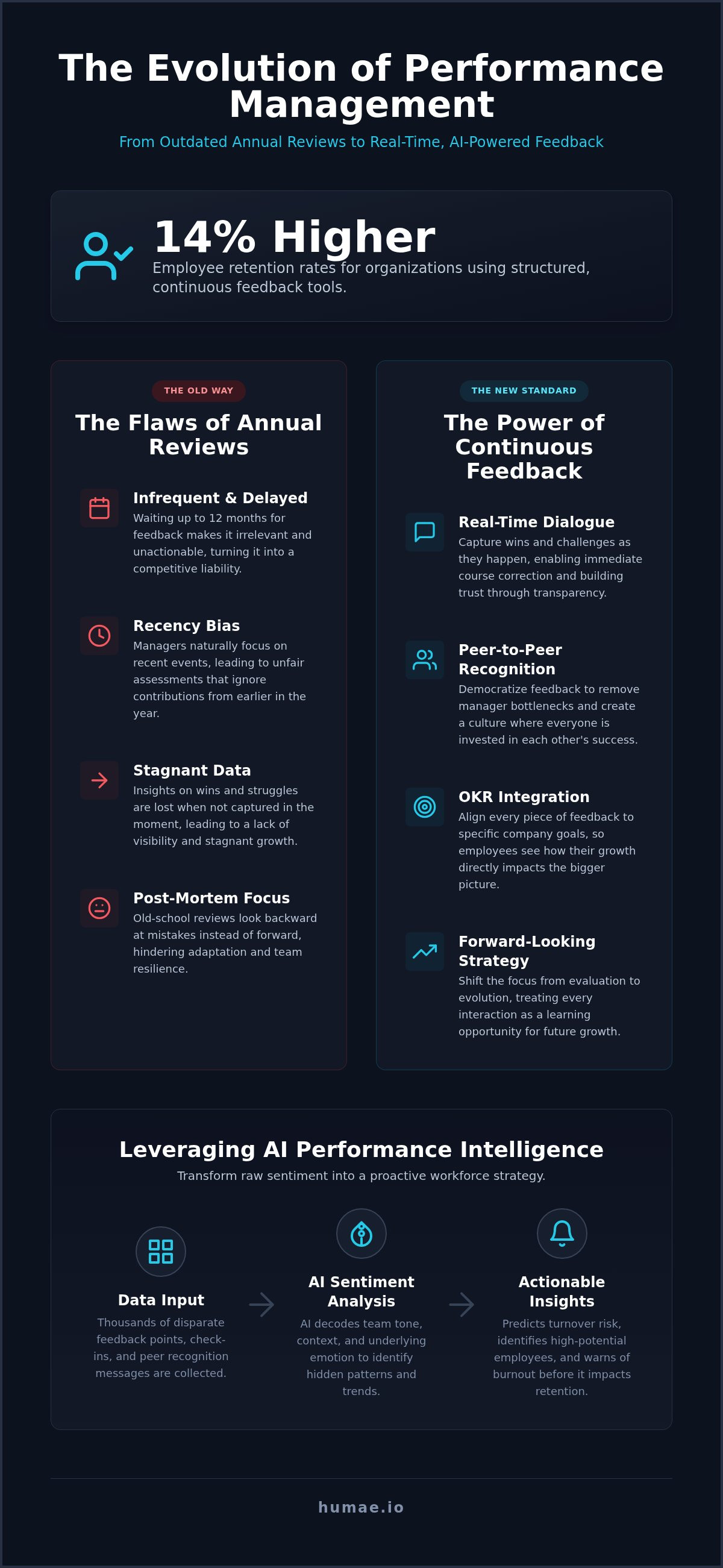
The traditional annual review has finally hit its expiration date. In the hyper-connected business environment of 2026, waiting twelve months to discuss performance isn't just slow; it's a competitive liability. This is why continuous feedback software has become the standard for high-growth teams. It functions as a real-time system for ongoing performance dialogue, moving away from the rigid, calendar-locked constraints of the past.
One of the biggest flaws in old-school Performance Management is recency bias. It's a natural human tendency where managers prioritize an employee's most recent actions over their contributions from months ago. This leads to unfair assessments and a sense of injustice among the workforce. Recency bias ruins morale. By capturing wins and challenges as they happen, teams ensure that every contribution is recognized fairly.
2026 demands agility. Modern people operations have shifted the focus from evaluation to evolution. We're no longer just looking back at what happened; we're looking forward at what can be achieved. Instead of a post-mortem on past mistakes, these tools facilitate a forward-looking strategy that treats every interaction as a learning opportunity. This shift ensures that the workforce remains resilient and adaptable to market shifts.
The Cost of Infrequent Feedback
When feedback is delayed, disengagement sets in quickly. Research from 2026 indicates that organizations using structured feedback tools see 14% higher retention rates. Without these tools, you lose actionable data. If a manager doesn't capture a win or a struggle in the moment, that insight often vanishes. This lack of visibility is a critical failure point in any modern workforce management infrastructure. Stagnant data leads to stagnant growth.
The Benefits of Real-Time Dialogue
Immediate course correction is a superpower for modern managers. It allows teams to pivot before resources are wasted on a failing project. Beyond the technical wins, there's a deep psychological benefit to this approach. Consistent recognition builds a foundation of trust. When a manager offers support in the moment it's actually needed, it transforms the relationship from a hierarchical one into a partnership. Continuous feedback is a tool that empowers both managers and employees through transparency.
Humae | learn more | Back to Home | Facebook
Key Features of Continuous Feedback Infrastructure
Infrastructure isn't just a buzzword; it's the framework that supports sustainable growth. Modern continuous feedback software replaces the annual calendar with a living stream of data. This allows for real-time check-ins that happen when they matter, not just when HR says so. By democratizing the process through peer-to-peer recognition, you remove the bottleneck of the single manager's perspective. It creates a culture where everyone is invested in each other's success, rather than just waiting for a top-down evaluation.
Aligning individual efforts with company goals is critical for any organization. This is where integration with OKR tracking becomes essential. According to the U.S. Office of Personnel Management, effective performance management involves a systematic process for improving organizational effectiveness. In a modern corporate setting, this means every piece of feedback should move the needle on a specific objective. When feedback is tied directly to goals, employees understand exactly how their growth contributes to the bigger picture.
Performance Intelligence and Data Visualization
Dashboards are the central nervous system of this infrastructure. They turn thousands of disparate feedback points into clear, visual growth signals. When housed within a modern HRIS, this data becomes centralized and actionable. HR leaders can use these dashboards to spot organizational trends, such as departmental siloing or specific skill gaps. Predictive analytics can then step in, using historical feedback patterns to identify high-potential employees or warn of potential burnout before it leads to a resignation.
Mobile and Remote Accessibility
Feedback shouldn't feel like a heavy administrative chore. It must be as simple as sending a quick message on a smartphone. For hybrid and remote teams, asynchronous tools are a lifeline. They allow communication to flow across time zones without requiring a live meeting for every minor update. An intuitive interface ensures that non-HR managers actually use the tool daily. It's about reducing the friction between noticing a great contribution and acknowledging it. If you want to see how these features come together, you can explore our performance intelligence tools and start building a more transparent culture today.
Humae | learn more | Back to Home | Facebook
How to Create a Continuous Feedback Loop
Creating a functional loop requires more than just a new login; it's a fundamental shift in your team's mindset. As highlighted in The Performance Management Revolution, the focus has moved from retrospective accountability to proactive development. You must clearly communicate the "why" to your entire staff. Explain that continuous feedback software isn't a surveillance tool, but a platform for faster growth and real-time support. When employees see the benefits for their own careers, adoption becomes natural rather than forced.
Step 1: Audit Your Current Management Culture
Start by identifying where dialogue currently happens. Is it buried in messy Slack threads or lost in hallway chats? You need to gather baseline sentiment data to understand your starting point. Incorporating data-driven employee engagement strategies into this audit phase allows you to see where communication is breaking down. This baseline is essential for measuring the success of your new infrastructure later on.
Step 2: Implement the Right Software Infrastructure
Choose a platform that feels like a natural extension of your daily workflow. It should sync effortlessly with your existing employee directory to eliminate manual data entry. The tool must support a healthy balance between public recognition, which boosts team morale, and private coaching notes for sensitive development areas. If the onboarding process isn't seamless, you'll lose the momentum needed for a successful cultural transition.
Once the infrastructure is in place, you must set a clear rhythm. Whether you choose weekly 1-on-1s or bi-weekly check-ins, consistency is what builds trust. Train your managers to stop acting like judges and start acting like coaches. Performance intelligence provides them with the objective data needed to have meaningful conversations without the usual administrative headache. It's about moving from "I think" to "the data shows," which makes feedback far more palatable for everyone involved.
Finally, you must use the system to improve the system. Monitor the sentiment data coming through your dashboards to refine the process itself. If certain departments aren't engaging or if the tone of feedback is consistently negative, you have the insights to intervene early. A feedback loop is only effective if it's constantly evolving based on the real-time needs of your people.
Humae | learn more | Back to Home | Facebook
Leveraging AI Sentiment Analysis for Better Insights
Technology should feel human. AI in 2026 has moved past simple keyword matching. Modern continuous feedback software uses sophisticated natural language processing to understand the nuance behind every comment. It analyzes the tone and context of dialogue to reveal what's actually happening beneath the surface. This isn't about tracking words; it's about understanding the human experience within your organization. If an employee's feedback becomes increasingly clinical or detached, the system notices the shift even if they don't use negative words.
AI plays a vital role in identifying hidden burnout before it leads to a resignation. By tracking subtle shifts in sentiment over weeks or months, the system can alert leadership to a team that's struggling. It provides managers with empathy prompts to help them navigate difficult conversations. These prompts suggest specific ways to open a dialogue, ensuring the manager feels supported and the employee feels truly heard. It's about giving leaders the right words at the right time.
Privacy and ethics are the foundation of this technology. We believe AI should be used for support rather than surveillance. This means being transparent about how data is analyzed and ensuring that insights are used to improve the work environment, not to penalize individuals. Trust is the currency of any successful feedback culture.
Turning Qualitative Feedback into Quantitative Data
AI categorizes open-ended comments into specific performance themes like collaboration or technical skill. AI-driven sentiment analysis bridges the gap between what employees say and how they feel. This transformation allows HR leaders to see hard data where there was once only subjective opinion. It's also a powerful tool for identifying bias in manager feedback. By flagging inconsistent or biased language, the software promotes equity and ensures that every voice is treated with the same level of respect.
Predictive Performance Intelligence
Using historical sentiment trends allows you to forecast future team productivity. If sentiment is trending downward in a specific department, you can predict a dip in output before it happens. AI helps prioritize which employees need immediate 1-on-1 attention based on these real-time signals. Integrating these insights into the broader performance management system ensures that your people data is never siloed. You can make proactive adjustments that keep your team on track.
Ready to see how AI can transform your team culture? Explore our sentiment analysis features and start making data-driven people decisions today.
Humae | learn more | Back to Home | Facebook
Scaling Growth with Humae Performance Intelligence
Scaling a business requires more than just hiring more people. It requires a system that understands how those people are performing in real time. Humae acts as the centralized infrastructure for performance intelligence, turning raw data into a clear roadmap for growth. By providing a seamless connection between your employee directory and your feedback tools, we eliminate the friction that usually kills engagement. This isn't just about implementing continuous feedback software; it's about building a workforce that is aligned, motivated, and ready for the challenges of 2026.
Startups and enterprises alike use our platform to optimize team growth through actionable analytics. Startups need to scale their culture rapidly without losing the human touch that made them successful in the first place. Enterprises, on the other hand, require the tools to break down silos across thousands of employees and multiple time zones. We provide the clarity needed to make difficult decisions with confidence. When you can see exactly how sentiment impacts productivity, you stop guessing and start leading. We encourage you to explore the Humae features that are currently driving real business impact for modern organizations worldwide.
A Centralized Hub for Workforce Management
Humae integrates hiring, onboarding, and feedback into one intuitive interface. We've seen how "tool fatigue" drains the energy of even the best HR teams. Managers shouldn't have to jump between five different platforms just to check on a team member's progress. By housing your performance data and continuous feedback software capabilities within our core HRMS, we simplify the daily experience for everyone involved. You don't need multiple logins to manage a single employee's journey from their first day to their first promotion. Our platform ensures enterprise-grade reliability and data security, making it the trusted choice for global teams.
The Future of AI-Powered HR
The vision behind Humae is simple yet ambitious. We've built a platform that understands your people as well as you do. By leveraging the AI sentiment analysis we discussed earlier, we help you stay ahead of turnover and burnout before they impact your bottom line. It's time to move past the era of reactive management and embrace a future where data supports empathy. We invite you to discover how Humae works and book a demo to see performance intelligence in action. Feedback is the first step toward a high-performing culture, and we're here to help you take that step with confidence.
Humae | learn more | Back to Home | Facebook
Build a Future-Proof Culture with Performance Intelligence
The shift toward performance intelligence is no longer a luxury; it's a necessity for any team that values its people. By moving away from the static annual review and adopting continuous feedback software, you create a workplace where growth happens in real time. We've explored how AI-driven sentiment analysis provides real-time manager intelligence that prevents burnout before it starts. Aligning your team through integrated OKR tracking ensures that every individual contribution supports your broader company goals without the usual administrative burden.
Humae provides the centralized workforce management infrastructure you need to turn these insights into action. Whether you're a fast-growing startup or a global enterprise, the future of HR is built on transparency and data-driven empathy. Stop reacting to turnover and start proactively building a culture where everyone feels seen and supported. It's time to replace outdated evaluations with a strategy for constant evolution. Success isn't just about the numbers; it's about the humans behind them. We're here to help you lead that change with confidence and clarity.
Ready to transform your culture? Explore Humae, the AI-powered HR platform.
Humae | learn more | Back to Home | Facebook
Frequently Asked Questions
What is continuous feedback software exactly?
Continuous feedback software is a digital infrastructure that facilitates real-time, ongoing dialogue between employees and managers. Unlike static tools, it uses performance intelligence to capture wins and challenges as they happen. This ensures that recognition is timely and development is proactive. The goal is to move away from rigid schedules and toward a living stream of data that helps everyone improve their daily output without waiting for a formal yearly meeting.
How does continuous feedback differ from traditional annual performance reviews?
The main difference lies in frequency and intent. Traditional reviews are retrospective and often plagued by recency bias; they look back at the past year. In contrast, a continuous model focuses on real-time evolution. It allows for immediate course correction and consistent support. This agile approach ensures that performance issues are addressed within days rather than months, making the entire organization more resilient to the fast-paced changes of the 2026 business environment.
Can continuous feedback software help reduce employee turnover?
Yes, it significantly impacts retention. Organizations using these structured tools report employee retention rates that are 14% higher than those without them. By providing constant recognition and addressing burnout risks early through AI insights, you prevent the quiet disengagement that leads to resignations. Employees feel more valued when their contributions are noticed in the moment, which builds a deeper sense of loyalty and commitment to the company's long-term success.
Is AI sentiment analysis safe and private for my employees?
At Humae, privacy is a foundational value. Our AI sentiment analysis is designed to provide manager intelligence for support, not for surveillance. The system anonymizes data where appropriate and focuses on identifying broad team trends rather than penalizing individuals. We maintain transparency with employees about how their data is used to build trust. This ethical framework ensures that AI remains a helpful partner in creating a healthier, more empathetic workplace culture.
How much time does it take for managers to use continuous feedback tools?
It actually saves time by reducing the heavy administrative burden of annual reviews. Instead of spending hours preparing for one massive meeting, managers engage in quick, high-impact interactions throughout the week. Most modern tools integrate directly into existing communication platforms like Slack or Microsoft Teams. This allows feedback to become a natural part of the daily workflow, taking only a few minutes each day while providing much more valuable data for long-term growth.
Does continuous feedback software integrate with our existing HRIS or OKR tools?
Yes, seamless integration is a core feature of a centralized workforce management infrastructure. Humae integrates your employee directory with real-time OKR tracking and performance dashboards. This ensures that feedback isn't siloed in a separate app but is directly connected to the goals your team is working toward. By housing everything in one interface, you ensure that continuous feedback software remains a functional part of your daily HR operations rather than a standalone task.
Can peer feedback be included in the software loop?
Absolutely. Peer-to-peer recognition is a vital component of a modern feedback loop. By democratizing the process, you allow team members to celebrate each other's wins across departments. This reduces the pressure on managers to see everything and provides a more holistic view of an employee's impact. Peer insights often reveal strengths that a direct supervisor might miss, helping to build a more collaborative and transparent organizational culture for everyone involved.