Burnout Risk Indicators in 2026: The Modern Leader’s Guide to Early Detection
By Humae · 21 June 2026
burnout risk indicators
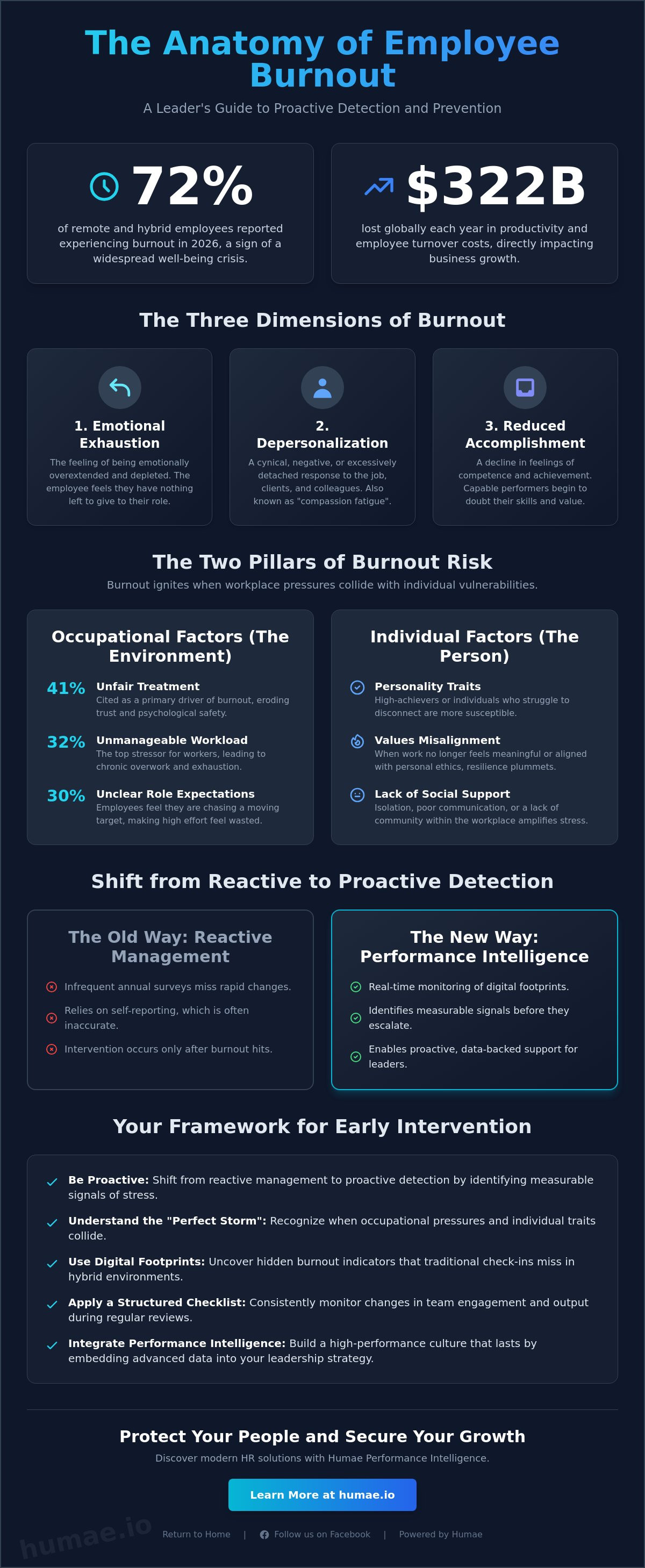
Did you know that 72% of remote and hybrid employees report experiencing burnout in 2026? It’s a staggering reality that costs global employers over $322 billion in lost productivity and turnover every single year. As a leader, you’ve likely felt the frustration of watching team morale dip or seeing a top performer suddenly resign without a clear warning. It’s incredibly difficult to maintain a high-performing culture when the signals of exhaustion are hidden behind digital screens and fragmented workflows.
You know that a healthy, engaged team is your most valuable asset, and you’re right to want a more proactive approach to their well-being. This guide will show you how to master the detection of burnout risk indicators by combining human empathy with modern performance intelligence. We’ll explore the subtle behavioral shifts and data-driven patterns that signal trouble long before it impacts your retention rates. You’ll walk away with a clear framework for early intervention that protects your people and secures your organization’s future growth.
Key Takeaways
- Shift from reactive management to proactive detection by identifying measurable signals of stress before they lead to employee turnover.
- Understand the "perfect storm" created when occupational pressures and individual personality traits collide within your team.
- Discover how to use digital footprints to uncover hidden burnout risk indicators that traditional check-ins often miss in hybrid environments.
- Apply a structured behavioral checklist during your regular reviews to consistently monitor changes in team engagement and output.
- Build a high-performance culture that lasts by integrating advanced Performance Intelligence into your daily leadership strategy.
What Are Burnout Risk Indicators?
Burnout risk indicators are the quantifiable precursors to total employee disengagement. They represent measurable signals that suggest a profound imbalance between an employee's job demands and the resources they have to meet them. To truly understand the baseline of this phenomenon, it helps to ask: What is Occupational Burnout? It isn't a sudden crisis but a slow, often invisible process of physical and mental depletion that can destabilize even the strongest teams.
Leaders often mistake chronic stress for high performance. A "busy period" is temporary; it has a finish line and a period of rest. In contrast, burnout is a sustained erosion of energy. When high-performance culture lacks recovery, it transforms into a significant business liability. Detecting these signals early isn't just about empathy; it’s a critical component of your workforce management infrastructure. If you don't catch these shifts, you’ll eventually face a domino effect of turnover that disrupts every project in your pipeline.
The Three Dimensions of Burnout
Burnout is a multifaceted experience that doesn't look the same for everyone. It typically begins with emotional exhaustion, where the employee feels they have nothing left to give to their role. This often leads to depersonalisation, characterized by a cynical or excessively detached attitude toward work, clients, and teammates. The final stage is a sense of reduced personal accomplishment. Here, even your most capable achievers begin to doubt their competence and value. These signals suggest that the employee’s internal battery is no longer charging, regardless of their previous track record.
Why Traditional Monitoring Often Fails
Most organizations still use outdated tools like annual engagement surveys to gauge health. These are too infrequent to capture the rapid onset of stress in fast-paced, digital environments. The stigma surrounding mental health also makes self-reporting inaccurate. Employees frequently fear that admitting to struggle will be seen as a lack of professional resilience, so they hide the truth until they reach a breaking point. Real-time monitoring of burnout risk indicators through modern performance intelligence allows leaders to see the data before the human cost becomes irreversible. It moves the leadership conversation from reactive questioning to proactive, data-backed support.
The Two Pillars of Burnout Risk: Occupational and Individual Factors
Burnout is rarely the result of a single bad day. It’s the cumulative effect of a systemic collision between environmental pressures and individual vulnerabilities. When leaders analyze burnout risk indicators, they must look beyond the person and examine the infrastructure supporting them. A "perfect storm" occurs when high-intensity workplace demands meet a personality type that struggles to disconnect. If your company culture rewards the "always-on" mentality while neglecting clear boundaries, you aren't just driving performance; you're accelerating exhaustion.
Company culture acts as either a shield or a catalyst. With 41% of workers citing unfair treatment as a primary driver of burnout in 2026, the way leaders manage equity and recognition is paramount. Values misalignment is a particularly silent indicator. When an employee no longer believes their work matters or aligns with their personal ethics, their resilience drops. They aren't just tired; they're disillusioned. Identifying these gaps early allows for cultural shifts before the talent drain begins. You can explore how to build a more transparent culture through modern performance tracking.
Occupational Risk Factors in the Modern Workplace
Workplace factors are often the primary drivers of chronic stress. Recent data shows that 32% of workers cite unmanageable workloads as their top stressor, while 30% struggle with unclear role expectations. In a world of shifting OKRs and constant digital notifications, employees often feel they're chasing a moving target. Without role clarity, high effort feels wasted. This lack of direction, combined with inadequate reward systems that fail to validate hard work, creates a breeding ground for resentment and fatigue. The "digital exhaustion" reported by many is often just a symptom of poorly defined workflows.
Individual Risk Factors and Personality Traits
Individual traits also play a significant role in how stress manifests. High-achievers and perfectionists are frequently at the highest risk because they often lack the internal mechanisms to set healthy boundaries. They take on more than they can handle, driven by a high-achiever syndrome that ties their self-worth to their output. Learning how to spot job burnout involves recognizing when these traits cross from being assets to liabilities. External life stressors, like family care or financial pressure, further lower an individual’s resilience threshold. Recognizing these burnout risk indicators requires a leader who values the human behind the screen as much as the metrics they produce.
Data-Driven Indicators vs. Subjective Observations
Managing by intuition is a relic of the past. In a hybrid world, you can't always see the slumped shoulders or the tired eyes of your team members through a webcam. This is where modern analytics bridge the gap. Instead of waiting for a resignation letter, leaders now look for digital footprints that correlate with high stress. These burnout risk indicators provide a neutral, data-backed foundation for supportive leadership. When you integrate a sophisticated HRIS into your daily operations, you move from guessing to knowing.
Real-time analytics allow you to identify trends before they become organizational crises. If you wait for the annual survey, you're already too late. By the time the results are tallied, your best talent might already be interviewing elsewhere. Modern performance intelligence focuses on the "how" of work, not just the "what." It helps you distinguish between a high-performer who is thriving and one who is simply burning the candle at both ends to keep up with 2026's 42% increase in digital exhaustion.
Performance Intelligence and OKR Lag
A sudden drop in OKR progress is rarely about a sudden loss of skill. It’s often the first sign of cognitive strain. If an employee's effort-to-output ratio starts to climb, they're working harder but achieving less. This declining efficiency is a major red flag. By using sentiment analysis within feedback loops, you can catch shifts in communication tone that suggest frustration or cynicism. These objective burnout risk indicators allow you to start a conversation based on reality rather than assumptions, ensuring your intervention is both timely and helpful.
Time-Off and Attendance Patterns
The "presenteeism" trap is a dangerous illusion of productivity. Employees who never use their leave are often the closest to a total collapse. Research shows remote workers are now putting in 2.5 additional hours per day compared to their in-office counterparts, which significantly accelerates the path to exhaustion. Utilizing time-off management tools allows you to spot these patterns with ease. Frequent, short-term absences or a total lack of downtime are cries for help that data helps you hear. When you see someone avoiding rest, it’s a signal that they need your support to reset their boundaries.
Checklist: How to Monitor Burnout Risk in Modern Teams
Monitoring a team in 2026 requires more than just glancing at a dashboard. It demands a keen eye for the subtle shifts in how people interact and produce. By focusing on observable behaviors, you can implement employee engagement strategies that actually prevent crises instead of just cleaning them up. Using a structured checklist during your weekly syncs ensures that no one on your team, especially remote workers who are often "hidden" from view, falls through the cracks.
Effective workforce management is about spotting the smoke before the fire starts. When leaders adopt a proactive stance, they create a safety net that supports high performance without sacrificing well-being. This checklist focuses on three critical areas where burnout risk indicators manifest most clearly in modern digital environments.
Communication and Social Indicators
Social withdrawal is often the first visible sign of emotional exhaustion. You might notice a team member who was previously vocal in meetings suddenly keeping their camera off or offering only one-word answers. It’s also common to see a rise in uncharacteristic irritability or friction between peers. Pay close attention to the language used in digital channels; a shift from constructive problem-solving to persistent complaining is a clear red flag. These social signals suggest that the individual no longer has the emotional bandwidth to navigate professional relationships effectively.
Work Pattern and Output Indicators
The "always-on" culture is a primary driver of exhaustion. Consistent weekend emails or late-night activity are signs that an employee is struggling to disconnect. You should also watch for a decline in work quality. If a high-achiever starts making unforced errors or missing deadlines they used to hit with ease, it isn't a performance issue; it’s a fatigue issue. These shifts in output are objective markers that the employee's resources are depleted and their cognitive load has become unmanageable.
Digital Presence Indicators
In a remote environment, digital presence is the new body language. Significant delays in response times compared to previous baselines can indicate decision friction or mental fatigue. You might also see signs of "quiet quitting," where an employee stops volunteering for new tasks and does only the bare minimum required to stay under the radar. As a rule of thumb, you should look for clusters of 3 or more indicators over a 30 day period before initiating a formal wellness check-in.
Catching these signals early is the difference between a minor adjustment and a total team collapse. If you're ready to automate this visibility and lead with confidence, explore our Performance Intelligence tools to see how we help leaders protect their most valuable assets.
Proactive Prevention with Humae Performance Intelligence
Prevention is the ultimate competitive advantage in the 2026 talent market. While checklists are helpful, they rely on manual observation that can miss the subtle nuances of digital behavior. Humae serves as your visionary partner in building a resilient, burnout-proof culture by automating the visibility of burnout risk indicators. Our Performance Intelligence tools transform raw data into actionable insights, allowing you to act before stress turns into turnover. By embracing modern management principles, you ensure your organization remains both high-performing and deeply human.
Our AI-driven sentiment analysis provides an early warning system by detecting shifts in communication patterns that humans might overlook. When combined with real-time OKR tracking, you gain a clear view of how workload impacts motivation. This prevents the role ambiguity that currently drives 30% of global burnout cases, ensuring every team member knows exactly where they stand and how they contribute to the collective success. You aren't just managing tasks; you're nurturing the well-being of the people who complete them.
Turning Data into Empathy
Analytics shouldn't be a tool for surveillance. At Humae, we believe data is the bridge to deeper empathy. When a manager sees a spike in burnout risk indicators, the conversation shifts from a performance critique to a supportive check-in. Instead of asking why a deadline was missed, you're empowered to ask how to better balance their current workload or if they need a period of recovery. This level of transparency builds a foundation of trust and data-backed fairness. It ensures that your team members feel seen and valued as individuals rather than just entries in a performance spreadsheet.
Integrated Workforce Infrastructure
A fragmented tech stack adds to the cognitive strain your team already feels. Humae solves this by integrating hiring, onboarding, and performance management into one intuitive interface. Centralized directories and streamlined time-off tools remove the administrative friction that often exacerbates daily stress. When your infrastructure is seamless, your people can focus on the creative, high-value work they love. It’s time to move beyond reactive HR and build a system that supports growth at every level. Discover how Humae helps you protect your team’s well-being and create a culture where everyone can thrive.
Secure Your Team's Future with Data-Driven Well-being
Leading in 2026 requires a shift from reactive damage control to proactive organizational infrastructure. You've learned that burnout is a predictable trend rather than a sudden emotional crisis. By focusing on systemic burnout risk indicators like OKR lag and digital exhaustion patterns, you can intercept stress before it leads to costly turnover. A modern leader doesn't just manage tasks; they safeguard the mental energy of their entire team through consistent, data-backed visibility.
Creating a sustainable culture is about integrating human empathy with advanced performance intelligence. With AI-driven sentiment analysis and real-time OKR tracking, you can provide the support your team needs exactly when they need it. Centralized workforce management allows you to focus on meaningful connection while technology handles the heavy lifting of early detection. It's time to build a workplace where high performance and well-being coexist naturally.
Build a healthier, high-performing team with Humae.
Your leadership has the power to transform the workplace into a space where both people and performance flourish. Let's build that future together.
Frequently Asked Questions
What is the number one indicator of burnout risk?
An unmanageable workload combined with a lack of autonomy is widely considered the primary driver of occupational burnout. While specific burnout risk indicators vary by role, this imbalance creates a sense of helplessness that quickly erodes resilience. When employees feel they have too much to do but no control over how they do it, the risk of chronic stress increases significantly. Leaders must focus on providing both resources and decision making power to mitigate this risk.
Can high performers experience burnout?
Yes, high performers are often at the greatest risk because they naturally take on more responsibility and struggle to set boundaries. Their drive for excellence can lead to high-achiever syndrome, where they tie their self-worth almost exclusively to their output. Without clear signals from leadership that rest is valued, these employees often work through exhaustion until they hit a total collapse. Protecting your top talent requires active monitoring of their workload patterns before they reach a breaking point.
How do you tell the difference between stress and burnout?
Stress is characterized by over-engagement and a sense of urgency, whereas burnout is defined by disengagement and hopelessness. A stressed employee might feel they can get everything under control if they just work harder for a short period. In contrast, someone experiencing burnout feels blunted emotions and a sense that their efforts no longer matter. Identifying these burnout risk indicators early helps distinguish between a temporary push and a systemic decline in team well-being.
Is burnout an individual or organizational responsibility?
Modern HR theory views burnout as a shared responsibility where the organization must provide the infrastructure and culture to prevent it. While individuals can practice self-care, a toxic or poorly designed work environment will eventually overwhelm even the most resilient person. Companies are responsible for creating clear role expectations, manageable workloads, and a psychologically safe environment. This systemic approach ensures that well-being is a core part of the organizational strategy rather than an afterthought.
How can I identify burnout in a remote team?
You can identify burnout in remote teams by watching for digital footprints like a sudden drop in communication frequency or missed deadlines. Remote workers often experience a blur between work and home life, leading to emails sent at unconventional hours or consistent weekend activity. These behavioral shifts are clear signals of cognitive strain. Using performance intelligence tools helps you see these patterns without needing to physically observe the employee in a traditional office setting.
What should a manager do first when they spot burnout indicators?
The first step is to initiate a supportive, non-judgmental conversation focused on the employee’s well-being rather than their performance metrics. Start by mentioning specific observations in a caring way to build trust. This dialogue should aim to uncover the root causes of their stress, such as unmanageable workload or a lack of role clarity. By showing genuine empathy, you create a safe space for the employee to share their challenges and collaborate on a sustainable solution.