Best HRIS for Startups 2026: The Definitive Guide to AI-Powered People Ops
By Humae · 27 June 2026
best hris for startups 2026
By the end of this year, 75% of HR leaders expect AI to handle more than half of their routine administrative tasks. This represents a massive shift for founders and people ops teams who've spent years fighting with bloated legacy systems and manual data entry across disconnected tools. Finding the best hris for startups 2026 is no longer just about digitizing files; it's about building a foundation that actually thinks for you. You need a system that acts as a partner rather than a digital filing cabinet, especially when you're scaling culture in a competitive market.
We know that managing a growing team is complex, which is why this guide helps you choose a workforce infrastructure that scales using AI-driven intelligence and modern OKR tracking. You'll discover how to move from fragmented spreadsheets to a centralized source of truth that automates onboarding and time-off management. We also preview how AI-driven performance intelligence can guide your organization's growth with real-time insights. It's time to build a high-performance culture that thrives on efficiency and human connection.
Humae: Modern People Ops. Visit the official Humae website or follow our updates on Facebook. Return to Home
Key Takeaways
- Learn why manual tracking fails after 15 employees and how to transition to a proactive workforce infrastructure.
- Identify the AI features and OKR tracking tools necessary to align individual goals with your company vision.
- Compare legacy systems against the best hris for startups 2026 to find a modular, intelligence-driven solution.
- Use our 5 step audit to pinpoint operational bottlenecks and ensure your HRIS integrates perfectly with your current stack.
- See how Humae acts as a centralized source of truth that transforms raw data into a scalable growth strategy.
Humae: Modern People Ops. Visit the official Humae website or follow our updates on Facebook. Return to Home
Why Startups Are Moving Beyond Basic HR Software in 2026
For a startup founder, the first 15 hires feel like a family. Beyond that milestone, the administrative weight begins to feel like a tax. The best hris for startups 2026 isn't just a place to store digital paperwork; it's a foundation for growth. In the past, companies relied on fragmented spreadsheets or basic software that did little more than track birthdays. Today, that approach leads to data silos and cultural friction. Modern startups are pivoting toward proactive infrastructure that automates the "HR tax," allowing leaders to focus on their people instead of their manual data entry exports.
The role of AI has shifted from a novelty to a necessity. It now handles the heavy lifting of reducing administrative friction. By integrating hiring, onboarding, and performance into one interface, founders can reclaim hours of their week. This isn't just about efficiency. It's about creating a professional, supportive environment where every team member feels seen and supported from their first day. When your systems are automated, your culture has room to breathe.
The Death of the Legacy HRIS for Small Teams
Legacy tools built for corporations with thousands of employees simply don't work for agile teams. They're rigid, expensive, and often require dedicated administrators to maintain. Startups often fall into the trap of "tool sprawl," using one app for time-off, another for an employee directory, and a third for performance reviews. This fragmentation kills clarity. A centralized hris creates a single source of truth for all employee data. It ensures that when a new hire joins, their information flows seamlessly from the applicant tracking system into onboarding and performance reviews without a single manual keystroke. This level of cohesion is what defines the best hris for startups 2026.
Defining Workforce Management Infrastructure
In 2026, we've moved past basic profiles. We now talk about a Human Resource Management System (HRMS) that acts as an intelligent layer for your business. This infrastructure understands team dynamics. It identifies when a team is hitting their goals and where they might need more resources. Intelligence is the true differentiator. Instead of waiting for a quarterly review to find problems, leaders use real-time data to make scaling decisions in minutes. You aren't just managing records; you're building a resilient organization that stays aligned even as it grows at lightning speed.
Humae: Modern People Ops. Visit the official Humae website or follow our updates on Facebook. Return to Home
Key Features of the Best HRIS Systems for Rapid Growth
Rapidly scaling a startup demands more than just a place to store employee names. You need a dynamic engine that powers productivity and maintains cultural alignment. The best hris for startups 2026 moves beyond administrative tasks to provide a comprehensive suite of tools designed for high-velocity teams. These systems prioritize employee experience while giving founders the data they need to lead effectively. When your infrastructure is built for growth, your team can focus on innovation instead of wrestling with broken processes.
Modern workforce infrastructure must include several non-negotiable features to be effective in today's environment:
- Automated time-off management: Systems that sync directly with team calendars to prevent scheduling conflicts.
- Scalable employee directories: Deep search capabilities and skill mapping that help team members find the right internal experts.
- Actionable analytics: Dashboards that provide real-time insights into retention, diversity, and growth metrics.
AI and Performance Intelligence
The traditional annual review is dead. In its place, the best hris for startups 2026 utilizes AI-driven performance intelligence to create continuous feedback loops. This technology uses real-time objective data to provide a clearer picture of employee contributions than any once-a-year meeting ever could. As discussed in The AI Revolution in HR, the focus is shifting toward systems that can predict outcomes rather than just record them. Some platforms even use sentiment analysis to detect early signs of burnout, allowing managers to offer support before a valued team member decides to leave. This empathetic use of technology ensures that your most important assets, your people, feel supported and understood.
OKR Alignment and Goal Tracking
For remote and hybrid startups, maintaining a shared sense of purpose is a constant challenge. Integrated okr tracking is essential for keeping everyone moving in the same direction. These tools allow you to visualize goal progress across the entire organization, from the CEO down to individual contributors. Instead of tracking progress in static documents, modern systems turn broad objectives into measurable key results automatically. This transparency builds trust and ensures that every employee understands how their daily work contributes to the company's long-term vision. If you want to see how this works in practice, you can explore our intelligent feature set to see how we bridge the gap between strategy and execution.
Humae: Modern People Ops. Visit the official Humae website or follow our updates on Facebook. Return to Home
Comparing HRIS Models: Legacy Systems vs. AI-Driven Infrastructure
Choosing the right platform requires understanding the fundamental difference between simple HR software and true workforce infrastructure. While many platforms claim to be the best hris for startups 2026, they often fall into three distinct categories. Legacy systems represent the old guard. They're characterized by high upfront costs, slow implementation times, and rigid structures. These tools often feel like a collection of siloed data modules that don't communicate with one another. On the other end, we have modern SaaS HRIS options. These are typically user-friendly and modular, but they frequently lack the deep intelligence needed to actually predict team needs or automate complex cultural processes.
The new standard for high-growth companies is AI-First Infrastructure. This model provides unified data and predictive analytics while automating workflows that used to require manual oversight. When you look at Forbes' 2026 HRIS systems comparison, you'll see how the market is splitting between tools that just record data and those that interpret it. Startups should prioritize API-first platforms. These allow for better tech stack integration, ensuring your people data flows into your daily communication tools or project management software without friction. This connectivity ensures that your HRIS isn't just another tab open in a browser, but a core part of your operational nervous system.
The True Cost of a 'Free' HRIS
Free tiers can be tempting for early-stage founders looking to save capital. Unfortunately, these often include hidden fees or restrictive caps that you'll outgrow in a matter of months. The real cost isn't the monthly subscription; it's the productivity loss caused by unintuitive interfaces and manual workarounds. Investing in proper workforce management infrastructure pays for itself quickly through improved retention and better decision-making. When employees have a seamless experience, they feel more professional and connected to the organization from day one.
Evaluating User Experience for Employees
Employee adoption is the only metric that truly matters for a startup HRIS. If your team finds the platform difficult to use, your data will be incomplete and your insights will be useless. Look for a mobile-first design that serves the modern, on-the-go workforce. Reducing friction in daily tasks, such as requesting time off or checking a directory, is vital for maintaining a positive culture. A smooth user experience turns a mandatory tool into a cultural asset that employees actually enjoy using.
Humae: Modern People Ops. Visit the official Humae website or follow our updates on Facebook. Return to Home
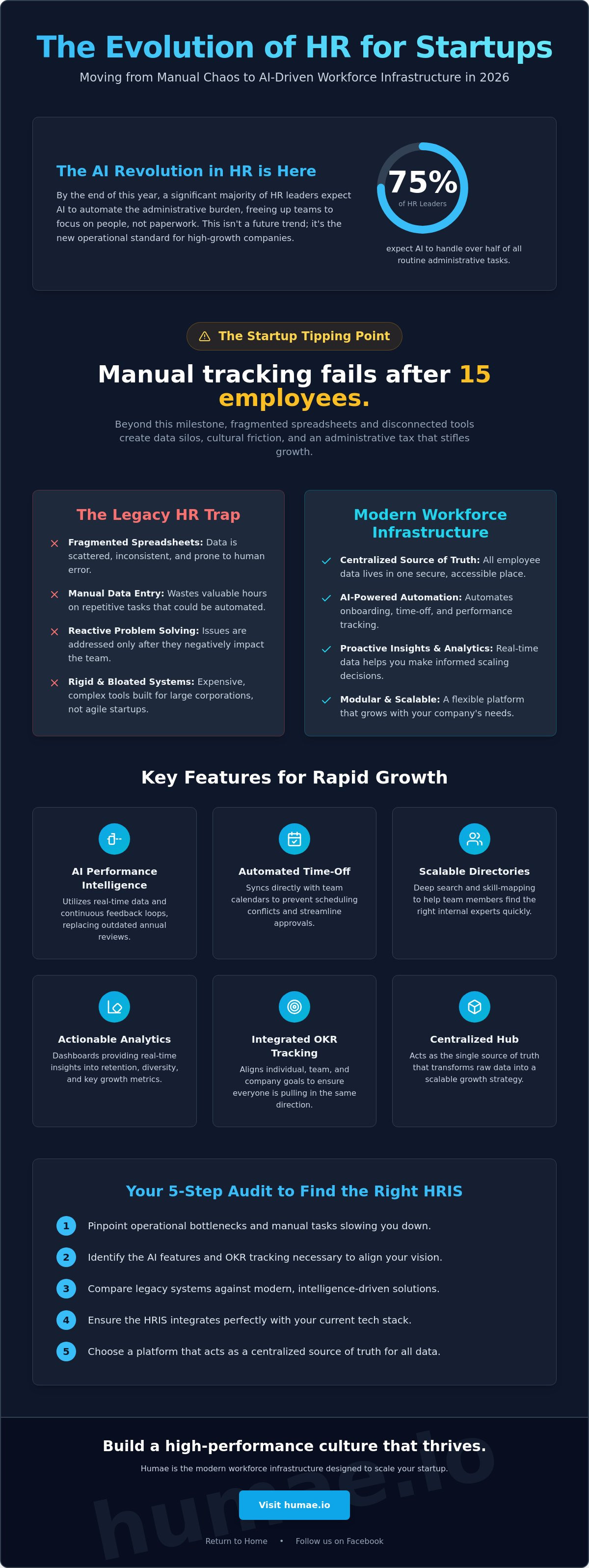
5 Steps to Choose the Right HRIS for Your Scaling Team
Selecting the best hris for startups 2026 is more than a technical purchase. It is a strategic decision that dictates how your culture evolves as you add more talent. Founders often make the mistake of buying for a 500-person company when they only have 10 employees. This leads to complexity that slows everyone down. Instead, you need a system that is agile enough to solve today's problems while providing a clear path for tomorrow's expansion.
- Pinpoint your core bottlenecks. Before browsing features, identify where your team loses the most time. Is it the chaos of manual onboarding? Is it the lack of actionable performance data? Focus on solving your most painful friction point first.
- Verify technical harmony. Your HRIS shouldn't exist in a silo. It must integrate seamlessly with your existing tech stack, from communication apps to calendar systems. An API-first approach ensures that data flows automatically between tools.
- Prioritize culture-fit features. If your organization lives by transparency, look for integrated OKR tracking. If you're a remote-first team, ensure the platform excels at asynchronous communication and remote team management.
- Perform a live "vibe check." Features look great on a landing page, but the employee experience is what matters. Test the interface with a live demo. If your team can't navigate the dashboard intuitively, they won't use it.
- Evaluate the partnership. You aren't just buying software; you're choosing a partner. Look for a provider that offers SaaS flexibility alongside human-centered support. You need a team that understands the unique pressures of the startup world.
Auditing Your Growth Trajectory
A system that works for 10 people might feel claustrophobic when you hit 100. You need a platform that supports international hiring and stays compliant with evolving regulations, such as the 2026 updates to state-level Paid Family and Medical Leave programs. Scalability means having the infrastructure to manage a distributed workforce without adding more administrative headcount. You can explore the Humae features to see how a modern, modular system adapts to each stage of your growth journey.
The Importance of Real-Time Analytics
Headcount is a vanity metric. To truly understand your organization, you need dashboards that reveal the story behind the numbers. Modern analytics tools now track diversity, equity, and inclusion metrics automatically. This data is vital for justifying people ops budgets to investors or boards. When you can prove that your culture initiatives are driving retention and performance, HR moves from a cost center to a value driver. Ready to transform your people data into a competitive advantage? Experience the power of Humae's analytics today.
Humae: Modern People Ops. Visit the official Humae website or follow our updates on Facebook. Return to Home
Why Humae Is the Leading HRIS for Startups in 2026
Startups in 2026 need more than just a place to store employee records; they need a partner that moves at the speed of innovation. Humae provides a centralized infrastructure specifically designed for high-growth environments where agility is the primary currency. By choosing the best hris for startups 2026, founders ensure their people operations aren't just a back-office function but a strategic advantage. We've built a platform that balances cutting-edge automation with a deeply human-centric design, ensuring that technology serves the person, not the other way around.
The core of our philosophy is turning raw data into actionable intelligence. While other systems might tell you how many people you hired last month, Humae tells you how those hires are aligning with your long-term vision. We integrate OKR tracking, performance metrics, and time-off management into a single, cohesive experience. This unified approach eliminates the friction of switching between tools, allowing your team to stay focused on what they do best: building the future. It's about creating an environment where every data point leads to a better decision for your people.
Streamlining the Employee Journey
A great culture starts long before the first day of work. Humae bridges the gap between hiring and retention by moving candidates from our applicant tracking system to onboarding in one intuitive interface. This transition is seamless, professional, and welcoming, setting a high standard from the very beginning. Once they've joined, our vibrant employee directory helps them find mentors and collaborators across the organization, fostering real connections in remote or hybrid settings. You can see how it works to transform your daily operations into an experience your team will genuinely value.
The Humae Advantage: Performance Intelligence
What truly sets Humae apart is our commitment to performance intelligence. Our AI-driven sentiment analysis monitors the pulse of your organization, helping you detect shifts in team morale before they become turnover statistics. This proactive approach to culture health is why many consider us the best hris for startups 2026. Combined with real-time goal tracking, we ensure that every individual is pulling in the same direction, fueled by clarity and purpose. We don't just track progress; we inspire it. Join the future of work by visiting Humae.io and see how we can help you scale with confidence and empathy.
Humae: Modern People Ops. Visit the official Humae website or follow our updates on Facebook. Return to Home
Empowering Your Team for the Future of Work
The shift from basic HR software to a complete workforce infrastructure marks a pivotal moment for any scaling startup. By embracing AI-powered performance intelligence and integrated OKR tracking, you move beyond simple record-keeping into the realm of proactive organizational growth. Finding the best hris for startups 2026 means choosing a partner that understands the delicate balance between high-tech automation and the essential human connections that drive your business. Your team deserves a platform that fosters clarity and shared purpose, no matter where they are in the world.
With global workforce management capabilities and real-time analytics, you can finally eliminate the administrative friction that stalls your progress. It's time to leave legacy tools behind and start building a culture that scales with confidence and empathy. Build your modern workforce infrastructure with Humae today and take the first step toward a more intelligent workplace. We're here to support your journey every step of the way.
Humae: Modern People Ops. Visit the official Humae website or follow our updates on Facebook. Return to Home
Frequently Asked Questions
What is the best HRIS for a small startup in 2026?
The best hris for startups 2026 is a platform that serves as a flexible foundation for growth rather than a rigid database. It should prioritize ease of use for the employee while providing managers with actionable intelligence. By choosing a system that integrates performance and goal tracking from the start, you avoid the technical debt of migrating data as your team expands.
Does a startup really need an HRIS before reaching 50 employees?
Implementing a system early is vital for establishing professional standards and cultural consistency. Waiting until you reach a large headcount often results in a chaotic backlog of manual records and compliance risks. A modern infrastructure allows you to automate repetitive tasks early, freeing up founders to focus on product development and strategic hiring during those critical early stages.
How does AI improve HR management for startups?
AI shifts the focus from administrative maintenance to strategic people operations. It provides predictive insights into team performance and helps identify potential organizational bottlenecks before they impact productivity. This technology also streamlines workflows by handling complex scheduling and onboarding sequences, ensuring that no new hire falls through the cracks during their first weeks.
What is the difference between an HRIS and workforce management infrastructure?
A traditional HRIS acts primarily as a digital filing cabinet for static records. Workforce management infrastructure is a proactive system that integrates daily workflows, such as OKRs and performance intelligence, directly into the employee experience. This difference ensures that people data is used to drive actual business results rather than just sitting in a siloed database.
Can an HRIS help with startup culture and employee retention?
A well-designed platform fosters transparency and provides employees with the self-service tools they need to feel empowered. When people have clear visibility into their goals and a simple way to manage their own data, trust in the organization increases. This professional environment is a key driver for retention in a competitive talent market where the employee experience is paramount.
How long does it take to implement a modern HRIS like Humae?
Modern platforms are designed for rapid deployment and can typically be set up within a few business days. The process is streamlined through intuitive data imports and pre-configured workflows tailored for agile teams. This allows you to modernize your people operations without pausing your core business activities or requiring a dedicated HR department to manage the transition.
What are the most important HRIS features for a remote-first startup?
Remote teams should prioritize features that facilitate asynchronous collaboration, such as integrated OKR tracking and a searchable employee directory. Global workforce management tools are also essential for navigating the complexities of international hiring and compliance. These features ensure that every team member feels connected to the company vision, regardless of their physical location or time zone.
How much should a startup expect to pay for HR software in 2026?
Pricing for the best hris for startups 2026 typically follows a modular model consisting of a monthly base fee combined with a per-employee rate. This structure ensures that your costs remain proportional to your actual headcount. Most providers offer tiered plans that allow you to pay only for the features you currently need, with the option to unlock more advanced intelligence as your organization scales up.
Humae: Modern People Ops. Visit the official Humae website or follow our updates on Facebook. Return to Home