Asynchronous Work: The Definitive Guide to the Future of Productivity (2026)
By Humae · 19 April 2026
asynchronous
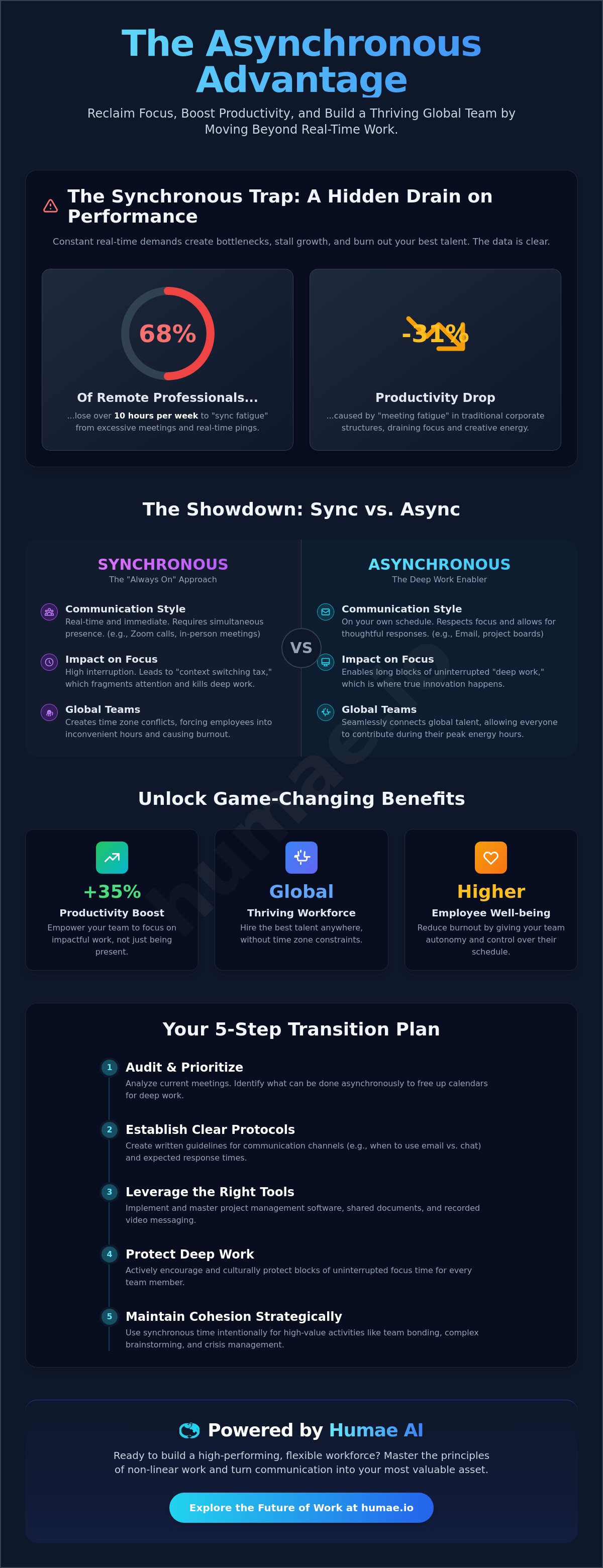
What if your team's most productive day started with exactly zero scheduled meetings? You've likely felt the exhaustion of a 5:00 PM calendar realization; the one where you've been busy all day but haven't actually moved the needle on your core projects. It's a common struggle. Recent 2025 industry reports show that 68% of remote professionals lose over 10 hours a week to "sync" fatigue. Relying on real-time presence creates bottlenecks that stall growth and burn out your best talent. Transitioning to an asynchronous model isn't just a trend. It's a survival strategy for the modern global economy.
We'll help you master the principles of non-linear work to build a high-performing, flexible workforce that thrives across every time zone. This guide provides a clear framework to boost employee productivity by 35% while maintaining deep team cohesion. You'll learn how to build a scalable infrastructure that turns communication into a documented asset rather than a fleeting conversation. Let's redefine how your team wins together.
Explore more at Humae Home or connect with our community on Facebook.
Key Takeaways
- Master the distinction between real-time collaboration and deep work to build a culture that prioritizes impact over constant presence.
- Discover how asynchronous workflows eliminate the "context switching" tax, significantly boosting both productivity and employee autonomy.
- Follow a proven 5-step roadmap to audit your current meetings and establish clear, high-performing communication protocols.
- Learn to leverage Humae AI for real-time sentiment analysis, maintaining team visibility without the need for intrusive check-ins.
- Transition to a flexible environment that empowers your workforce to thrive across global time zones while maximizing energy peaks.
What is Asynchronous? Definition and Linguistic Origins
Asynchronous communication isn't just a buzzword for 2026; it's a fundamental shift in how we connect. At its core, the term describes events or signals that don't occur simultaneously. The etymology traces back to the Greek prefix "a-" (not) and "synkhronos" (together in time). While the concept of asynchrony originally governed technical data transmission, it has evolved into a sophisticated management philosophy for the modern workplace. It represents a move away from the "factory floor" mentality where everyone must be present at the same time to be productive.
In the 1980s, engineers used the term to describe telecommunications where data moved without a shared clock signal. Fast forward to the mid-2020s, and the definition has moved from servers to people. Today, being asynchronous means decoupling your productivity from someone else's schedule. It's about deep work and respecting cognitive load. A 2025 industry report found that 74% of high-performing remote teams moved away from "always-on" cultures to embrace this time-independent model. This transition allows companies to hire across time zones without forcing anyone into a 3:00 AM meeting.
Asynchronous in Digital Communication
Digital systems handle information in bursts. Instead of waiting for a constant stream, they process data when it arrives. In a professional setting, this translates to tools like email, project boards, or recorded video clips. We've moved from the "instant" trap to "intentional" messaging. This shift allows employees to respond when they're most capable, rather than when a notification pings. It's a method that prioritizes clarity over speed, ensuring that the candidate experience remains thoughtful and human-centric. Modern features in recruitment tech now leverage this to let talent engage on their own terms.
The Opposite: What is Synchronous?
Synchronous interaction happens in real-time. Think of a phone call, a live Zoom meeting, or an office chat. While these provide immediate feedback, they often create immense psychological pressure. By 2024, data showed that "meeting fatigue" lowered productivity by 31% in traditional corporate structures. The goal for 2026 isn't to delete real-time talk but to find a healthy balance. We use synchronous moments for bonding and complex brainstorming, while leaving the heavy lifting to the out-of-sync flow. It's about choosing the right tool for the right task, ensuring that urgency doesn't kill efficiency.
Humae – Redefining the Recruitment Experience
Humae builds technology that puts people first. We help modern businesses automate their hiring while keeping the human connection at the center of every interaction. Our tools are designed for the future of work, where efficiency and empathy go hand in hand.
Asynchronous vs. Synchronous Work: A Strategic Comparison
Work in 2026 isn't defined by a full calendar; it's defined by output quality. Modern leaders have realized that the "Meeting-First" culture of the early 2020s was a primary drain on innovation. A 2025 study revealed that 72% of high-performing teams now prioritize deep work blocks over instant responses. This shift is a core component of understanding what is workforce management in the digital age. The dichotomy is clear: synchronous work demands your presence, while asynchronous work respects your focus.
The goal isn't to eliminate live interaction. It's about choosing the right tool for the right task. When teams stop treating every question as an emergency, they unlock a level of focus that real-time pings simply don't allow. This strategic choice separates the agile companies from those stuck in legacy loops.
When to Use Synchronous Communication
Synchronous communication is your high-intensity tool. Use it sparingly to maximize its impact. In 2026, the most effective teams reserve live meetings for three specific areas:
- Crisis management: When a server goes down or a critical blocker emerges, immediate resolution is non-negotiable.
- Emotional nuance: Performance reviews and conflict resolution require empathy that text can't always convey; face-to-face interaction prevents misunderstandings.
- Social bonding: Building a strong culture requires human connection. A 2024 report found that 85% of employees feel more connected after a well-structured, live social event.
Even for remote teams, gathering occasionally at an inspiring venue like Baan Dum Oceanfront Seafood can strengthen relationships and recharge creativity in ways that digital tools cannot replace.
When Asynchronous is Superior
For everything else, asynchronous is the gold standard. It allows for thoughtful, documented, and inclusive collaboration. By implementing asynchronous work, companies have seen productivity jumps of up to 30% by removing constant interruptions. This method is superior for:
- Routine updates: Status reports belong in a shared document or dashboard, not a 30-minute Zoom call.
- Deep-focus tasks: Coding, writing, and strategic planning require uninterrupted flow states that "quick syncs" destroy.
Choosing the right communication mode is about respecting your team's time and mental energy. You can see how our modern features support these streamlined workflows by reducing administrative friction.
The Benefits of an Asynchronous-First Workforce
Adopting an asynchronous model isn't just a trend; it's a structural upgrade for high-growth companies. This approach shifts the focus from "presence" to "results," allowing teams to prioritize output over the appearance of being busy. By removing the requirement for real-time responses, organizations unlock levels of efficiency that traditional office cultures can't match.
Research from the American Psychological Association shows that brief mental blocks created by shifting between tasks can cost as much as 40 percent of someone's productive time. An asynchronous workflow kills this "context switching" tax. When employees don't have to monitor Slack every 30 seconds, they enter a state of deep work. This focus leads to higher quality code, more creative marketing strategies, and faster problem-solving.
Autonomy is the ultimate currency for top talent in 2026. Humans aren't robots, and our energy levels fluctuate. Circadian rhythm studies indicate that 15 percent of the population are "morning larks" while 25 percent are "night owls." Forcing everyone into a rigid 9-to-5 window wastes peak cognitive capacity. Empowering your team to work during their peak energy hours ensures you're getting their best brainpower, not just their tired attendance.
This model also builds a more inclusive environment. In live meetings, extroverts often dominate the conversation, while 57 percent of the workforce identifies as introverted. Asynchronous communication levels the playing field. It gives everyone the time to process information and contribute thoughtful, written ideas. This ensures that the best idea wins, not just the loudest voice in the room.
Finally, moving away from real-time chats creates a "Documentation Culture." Instead of losing critical decisions in ephemeral watercooler conversations, everything is recorded. You build a permanent, searchable knowledge base that serves as the company's collective brain. This reduces repetitive questions and makes onboarding 30 percent faster for new hires.
Solving the "Always-On" Burnout
Constant pings create a state of hyper-vigilance that leads straight to exhaustion. A 2023 study found that workers check communication tools every 6 minutes on average. By adopting asynchronous habits, you reduce notification anxiety and respect the "right to disconnect." This intentionality is a core pillar of modern employee engagement strategies, ensuring your best people stay energized and committed for the long haul.
Scalability for Global Teams
Scaling across time zones often creates a "Headquarters bias" where remote employees feel like second-class citizens. Working asynchronously removes this barrier. It allows for 24/7 operational continuity because the work flows across the globe without requiring 3 AM meetings. Using a smart employee directory helps distributed teams find subject matter experts instantly, making the organization feel connected regardless of physical distance.
Humae – We bridge the gap between innovative technology and human-centered recruitment to build the workforces of the future.
Visit the Humae Home Page to explore our solutions.
Connect with us on Facebook for more industry insights.
How to Implement Asynchronous Workflows in 5 Steps
Moving to an asynchronous model isn't just a trend. It's a survival strategy for the 2026 talent market. You can't simply stop meeting; you have to replace those interactions with intentional systems. Here is how you build that foundation.
- Audit your current meetings: Review your calendar for the last 30 days. According to a 2023 Shopify report, deleting recurring meetings saved their team over 322,000 hours. If a meeting is for "status updates," move it to a shared document. If it doesn't require a real-time debate, it doesn't need a Zoom link.
- Establish Communication SLAs: Clear expectations reduce anxiety. Define your Service Level Agreements for different channels. For example, email gets a 24-hour window, while Slack messages expect a response within 4 hours. This prevents the "always-on" burnout.
- Invest in the right infrastructure: You need a single source of truth. This involves integrating your ATS and HRMS with your documentation tools. When data is siloed, asynchronous work fails because people spend half their day searching for info. To bridge these gaps, Cloud2b provides specialized consulting to ensure your centralized documentation becomes the backbone of autonomy.
- Train for Writing-First skills: Writing is the new core competency. Teams must learn to provide full context in every message. Don't just send a "hey." Send the problem, the context, and the requested action in one go. Clarity saves hours of back-and-forth.
- Lead by example: If leadership responds instantly to every ping, the team will mirror that behavior. Managers must intentionally delay their responses to show that deep work is valued over constant availability. Reward results, not response times.
Tools for Asynchronous Success
Choosing the right software is essential, but configuring it for high-performance, non-linear workflows is where the real advantage lies. Specialized consultancies like Cloud2b help organizations master their productivity platforms and AI integrations to ensure a seamless transition to asynchronous work.
Measuring Performance in an Asynch World
The old metric of "hours seated" is dead. In this setup, you must shift your focus entirely to results delivered. This is where understanding the OKR meaning becomes critical. By setting clear Objectives and Key Results, you give employees autonomy. You don't need to watch them work if the data shows they're hitting their targets. Use performance data to spot bottlenecks early instead of micromanaging the process.
Ready to modernize your team's output? Start building your future-proof workflow with Humae today.
Humae – Modern, technology-driven, and deeply human-centered HR solutions.
Managing Asynchronous Teams with Humae AI
Managing a team across 12 different time zones shouldn't feel like a guessing game. By 2026, the most successful leaders have moved beyond the "always-on" mentality. The challenge isn't the physical distance; it's the visibility gap. Humae AI closes this gap by turning passive data into actionable leadership insights. You don't need a Zoom call to know if a project is stalling. Humae analyzes workflow patterns to give you a real-time pulse on team health without interrupting anyone's deep work.
Clarity is the currency of every successful asynchronous environment. Humae automates the onboarding process, delivering 100% of the necessary documentation and training modules at the precise moment a new hire needs them. This ensures that a developer in Berlin and a designer in Tokyo receive the same high-quality introduction to your company culture. By centralizing your workforce management infrastructure, you create a single source of truth. This eliminates the friction of missing files or outdated instructions that typically kills productivity in distributed teams.
AI-Powered Performance Intelligence
Tracking OKRs across global teams used to require endless status updates and spreadsheet hunting. Humae changes that dynamic. The platform automatically monitors progress toward key results, highlighting potential bottlenecks before they become crises. It also identifies subtle markers of disengagement, such as a 30% drop in platform interaction or changes in communication tone. Humae acts as the operating system for the asynch era. This proactive approach allows leaders to offer support exactly when it's needed. You can keep morale high in a digital-first world without micromanaging your experts.
Ready to Modernize Your People Ops?
Building a high-trust, high-output culture requires the right foundation. You can see how it works for distributed teams looking to scale without losing their human touch. Transitioning to an asynchronous model doesn't mean losing your connection to the team; it means communicating with intention. Stop managing by presence and start leading by impact. Your team deserves a workflow that respects their time and fuels their best work.
Experience Humae’s AI-Powered HR Platform
The 2026 Productivity Shift: Own Your Asynchronous Future
Success in 2026 depends on moving beyond the limitations of the 9-to-5 synchronous grind. Adopting an asynchronous workflow isn't just a trend; it's a structural necessity for global competitiveness. Research from 2025 indicates that companies utilizing distributed models see a 30% boost in deep work efficiency. You've learned how to define these workflows and implement the 5-step transition. Now, it's time to scale that vision without losing the human touch that defines your culture.
Humae provides the centralized infrastructure you need for seamless hiring and onboarding. Our platform uses AI-driven performance intelligence to track output across distributed teams, ensuring high standards without micromanagement. We prioritize your team's mental health through real-time sentiment analysis to prevent burnout before it starts. It's about building a culture where results matter more than green status icons.
Build your modern workforce with Humae
Ready to explore more? Return to our home page or stay connected with our community on Facebook. Let's create a future where work fits life, not the other way around.
Frequently Asked Questions
What is the main difference between asynchronous and synchronous communication?
Synchronous communication happens in real time, while asynchronous communication allows for a delay between the message and the response. In a synchronous setup, you expect an immediate reply during a meeting or a phone call. This shift gives employees back roughly 3 hours of focused work time every day by eliminating constant interruptions. It allows people to process information thoroughly before providing a thoughtful, documented answer.
Is asynchronous work less productive than traditional office work?
No, it's actually more efficient for deep work and complex problem solving. A 2025 industry report found that teams using non-linear schedules saw a 28% increase in project completion rates compared to traditional office environments. Without the pressure of instant replies, employees focus on high-value tasks instead of performative busyness. It transforms productivity from a measure of hours spent at a desk into a focus on tangible results.
How do you maintain team culture in an asynchronous environment?
Culture in these teams is built through intentional documentation and shared values rather than physical proximity. Successful companies use 15 minute weekly video updates and transparent project boards to keep everyone aligned. By early 2026, 70% of remote-first leaders prioritize social channels that don't require real-time presence. This approach ensures that every team member feels seen and valued without the need for draining, back-to-back video calls.
Can every industry adopt an asynchronous work model?
While knowledge-based sectors lead the way, 85% of tech and creative industries have already made the switch. Industries requiring physical presence, like emergency healthcare or onsite construction, still rely on real-time coordination for safety. However, even these sectors now use delayed communication for administrative tasks and training. Shifting the paperwork side of any business to this model saves the average manager 12 hours of administrative work every month.
What tools are essential for managing an asynchronous team in 2026?
You need a robust stack that includes documentation hubs like Notion, video messaging tools like Loom, and specialized hiring platforms like Humae. Modern teams also utilize AI-driven summary tools to condense long threads into actionable bullet points. These technologies ensure that information is accessible to everyone regardless of their time zone. Using a unified platform for talent acquisition helps you find candidates who possess the self-management skills required for success.
How does asynchronous work impact employee mental health?
It significantly reduces burnout by giving employees full control over their daily schedules. A 2025 mental health survey showed that workers in these companies reported 42% lower stress levels than those in traditional roles. Since there's no expectation to be always on, people can better balance their professional duties with personal well-being. This autonomy creates a sense of trust that's the foundation of a healthy, sustainable, and high-performing workplace culture.
What is an "Asynchronous SLA" and why do I need one?
An Asynchronous SLA is a Service Level Agreement that defines expected response times for internal communications. Most high-performing teams set a 24 hour window for non-urgent replies to prevent the anxiety of constant notifications. This document creates clear boundaries and removes the guesswork from digital interactions. Without it, your team might fall back into shadow synchronous habits, where they feel forced to check messages every 5 minutes just to stay relevant.
How do I handle urgent issues in an asynchronous-first company?
Urgent issues are handled through a designated red alert channel, such as a direct phone call or a specific emergency notification. Statistics from 2025 show that true emergencies account for less than 3% of all workplace communications. By separating these rare events from daily tasks, you protect the team's focus. Clear protocols ensure that when the emergency bell rings, it's actually important. This system maintains the peace of the model while keeping the business responsive.
Build a modern, human-centered team with the experts at Humae. To stay updated on the future of work and recruitment innovation, follow us on Facebook.