Analytics Dashboards in 2026: Moving from Data Visualization to Workforce Intelligence
By Humae · 3 April 2026
analytics dashboards
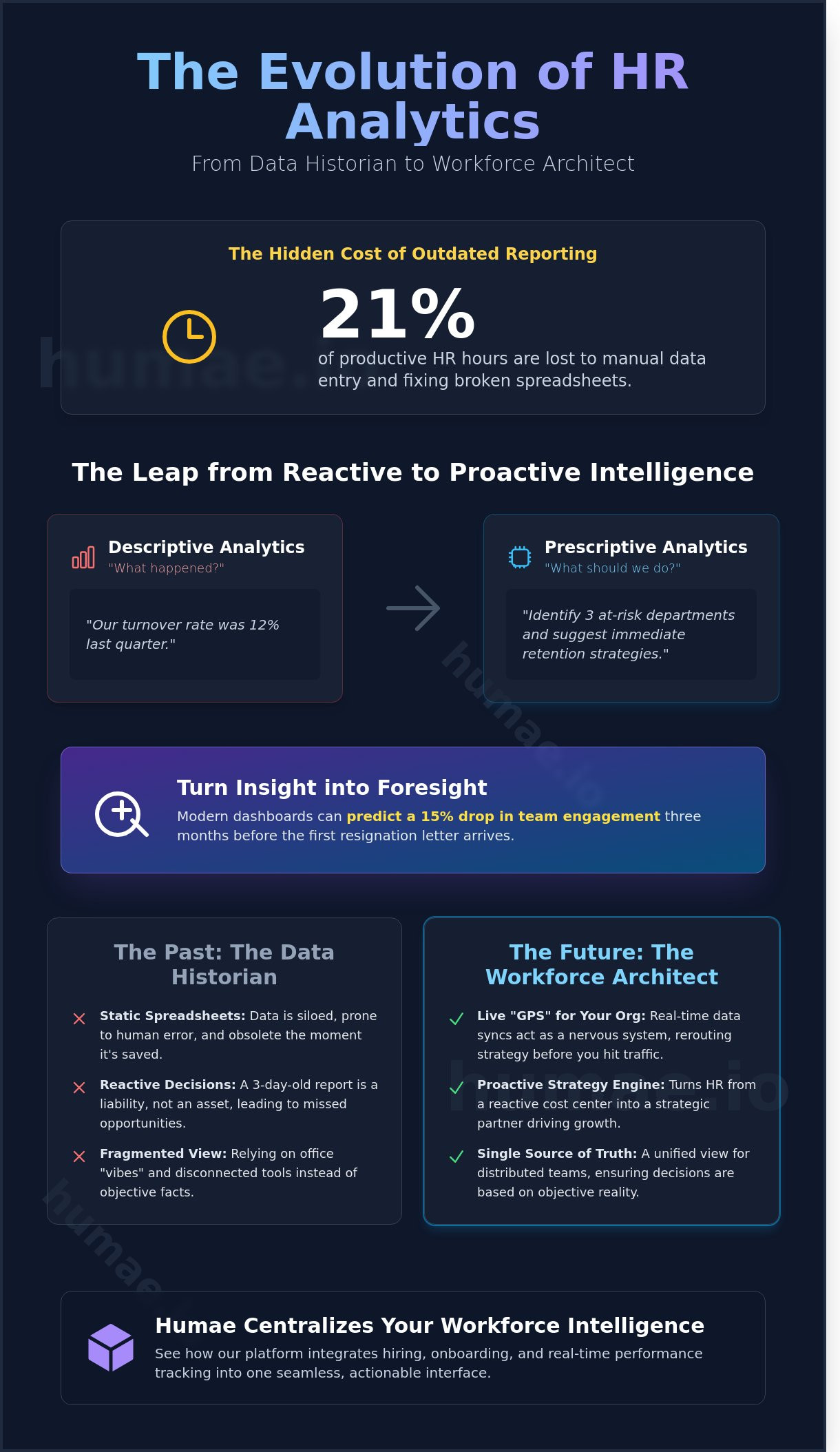
What if your reporting tools could predict a 15% drop in team engagement three months before the first resignation letter hits your desk? Most HR leaders currently lose 21% of their productive hours to manual data entry, struggling with fragmented tools that don't talk to each other. You know the frustration of staring at analytics dashboards that show you what happened yesterday but offer zero guidance for tomorrow. It's time to stop being a data historian and start being a workforce architect.
We agree that your time is better spent on people than on fixing broken Excel formulas. This guide will help you master the leap from static charts to AI-driven workforce intelligence. You'll learn how to build a unified view of OKRs and performance that delivers real-time visibility. We'll show you exactly how to implement predictive metrics that turn raw data into a competitive advantage for your entire organization.
Humae: Modernizing HR through technology and human connection. Visit our home page to see how we transform the recruitment experience, or connect with our community on Facebook.
Key Takeaways
- Learn how the evolution from descriptive to prescriptive analytics turns static workforce data into a proactive strategic asset for 2026.
- Discover how real-time syncing and AI-driven sentiment analysis eliminate decision-making lags by capturing the true "mood" of your organization.
- Evaluate the scalability and long-term cost-efficiency of commercial analytics dashboards compared to the hidden resource drains of in-house builds.
- Master the integration of OKR frameworks into your data strategy to empower middle management and foster a high-performance, data-driven culture.
- See how Humae centralizes hiring, onboarding, and real-time performance tracking into one seamless, actionable interface.
What are Analytics Dashboards in the Age of AI-Driven HR?
By 2026, the definition of a dashboard has outgrown simple charts and graphs. Modern analytics dashboards are centralized interfaces that translate raw workforce data into real-time actionable intelligence. They don't just show you what happened yesterday; they act as a live nervous system for your organization. These tools aggregate data from recruitment pipelines, performance reviews, and employee engagement tools to provide a holistic view of company health. It's the difference between looking at a static map and using a live GPS that reroutes you around traffic before you even see the brake lights.
The most significant shift in 2026 is the move from descriptive to prescriptive analytics. Descriptive data tells you your turnover rate was 12% last quarter. Prescriptive data identifies that three specific departments are at risk of losing top talent within the next 30 days and suggests immediate retention strategies. This proactive stance turns HR from a reactive cost center into a strategic growth engine. Relying on static spreadsheets is now the #1 threat to your workforce management infrastructure. Spreadsheets are siloed, prone to human error, and obsolete the moment you hit save. In a fast-paced market, a three-day-old report is a liability, not an asset.
For distributed and hybrid teams, these analytics dashboards serve as the Single Source of Truth. When your team spans four time zones, you can't rely on office "vibes" to gauge morale. You need a unified digital space where every manager sees the same reality. This alignment ensures that decisions are based on objective facts rather than who speaks the loudest in a Zoom meeting.
The Evolution of Workforce Intelligence
Workforce intelligence has evolved far beyond basic headcount tracking. In 2026, dashboards integrate deep cultural sentiment analysis by processing natural language from feedback loops and internal communications. They combine behavioral data, such as collaboration patterns and response times, with traditional KPIs like revenue per employee. Workforce intelligence is the intersection of AI, data, and human empathy.
Why Visualization is Only Half the Battle
Beautiful charts are useless if they lead to the wrong conclusions. Many firms fall into the trap of "vanity metrics," such as high training completion rates that don't actually result in improved job performance. Context is the most valuable feature of a 2026 dashboard. It explains the "why" behind the numbers, like a sudden dip in productivity being linked to a specific software rollout rather than a drop in employee engagement. As monitoring becomes more granular, ensuring data privacy and ethical AI use is non-negotiable. Leading platforms now use anonymized data sets to protect individual privacy while still providing leadership with the macro-insights they need to scale.
About Humae: We believe that modern recruitment is where cutting-edge technology meets deep human connection. Humae is your visionary partner in building a future-ready workforce, offering a professional yet empathetic approach to talent acquisition and management. We don't just provide tools; we create better experiences for both employers and candidates.
Ready to transform your HR strategy? Return to the Humae Homepage
Stay connected with us: Follow Humae on Facebook
The Core Architecture of High-Performance Dashboards
By 2026, the 24-hour data lag has become a relic of the past. High-performance analytics dashboards now operate on sub-second synchronization because waiting for a weekly report to identify a bottleneck in your hiring pipeline means you've already lost the candidate to a faster competitor. Modern architecture demands a unified data layer where your ATS, HRIS, and performance management tools talk to each other without friction. This connectivity ensures that every visualization reflects the heartbeat of the company at this exact moment.
A 2024 study by Gartner suggested that 78% of HR leaders struggled with data silos. The 2026 standard solves this through deep cross-platform integration. It's not just about technical connectivity; it's about context. When a CEO logs in, they see high-level retention rates and ROI on human capital. When a Team Lead opens the same dashboard, they see specific blockers in their current sprint or a sudden dip in team engagement. Personalization makes data actionable rather than overwhelming. Custom user roles ensure that the right eyes see the right numbers, turning a generic tool into a specialized asset for every level of the workforce.
Predictive Analytics and Sentiment Integration
Predictive tools now analyze more than just output. They track the mood of the organization. AI-powered sentiment analysis flags potential burnout cases 3 to 4 weeks before a resignation letter hits the desk. By visualizing engagement trends through automated pulse surveys, managers can intervene early. Humae’s features leverage these AI capabilities to turn raw feedback into visual trends, ensuring your culture stays healthy while your productivity scales. This proactive approach transforms analytics dashboards from passive displays into active warning systems.
User Experience and Accessibility
Intuitive design is a functional requirement, not a luxury. If a manager can't find a specific OKR within three clicks, the dashboard has failed. Mobile-first interfaces ensure that decision-makers stay connected whether they're in a board meeting or traveling. The key is drill-down capability. You start with company-wide stats and, with a single tap, see the individual OKRs driving those numbers. You can explore how modern interfaces drive better hiring to see this level of accessibility in practice. High-performance systems prioritize clarity, ensuring that complex data sets don't require a degree in data science to interpret.
Humae: Modern, technology-driven, human-centered recruitment and workforce intelligence solutions.
Evaluating Analytics Dashboards: Commercial vs. Custom Solutions
Choosing the right foundation for your workforce intelligence determines whether you lead or lag. Many firms fall into the "build it ourselves" trap. They underestimate the long-term drain on resources. In-house analytics dashboards often look cheaper on paper, but the reality is different. Maintenance consumes up to 22% of developer time by the second year. SaaS solutions eliminate this technical debt, allowing your team to focus on people, not code.
Implementation speed is now a primary decision factor. Buyers in the middle of the funnel prioritize time-to-value. Custom builds take an average of six to nine months to launch. Modern SaaS platforms offer a 70% faster deployment rate. You get actionable insights in weeks. This agility allows HR leaders to respond to market shifts before they become crises.
The 'Build vs. Buy' Dilemma in 2026
Custom-built solutions only make sense for global enterprises with hyper-specific, proprietary data structures that no vendor can map. For 98% of organizations, modern SaaS platforms offer a better ROI. These platforms provide continuous AI updates that an internal team can't replicate. Legacy systems cost 3x more to maintain than automated cloud platforms. You aren't just buying software; you're buying an evolving ecosystem that stays current with every technological leap.
Key Features Checklist for HR Leaders
Top-tier platforms must do more than show graphs. They need to drive action. Look for these essentials:
- Automated reporting: Schedules that deliver insights to stakeholders without manual export.
- Natural language querying: Use your analytics dashboards to ask, "Which departments have the highest turnover risk?" and get instant answers.
- Strategic Integration: Connect directly with employee engagement strategies to measure the direct ROI of your culture initiatives.
Humae | Human-Centered HR Innovation
We build the future of recruitment and workforce intelligence. Our mission is to transform complex data into simple, human-centric success stories.
How to Build a Data-Driven Culture Using Dashboards
Data doesn't change behavior; culture does. By 2026, 92% of high-performing organizations will treat analytics dashboards as a shared language rather than a top-down surveillance tool. Building this culture requires a shift from passive observation to active engagement. It's about making every team member feel like an owner of the numbers they see.
- Step 1: Align with your goals. Connect every visual to your OKR framework. When employees see how a single chart impacts a quarterly objective, the data gains immediate purpose.
- Step 2: Empower middle management. Don't gatekeep insights. Give managers the autonomy to build custom views that reflect their team's specific workflow and challenges.
- Step 3: Kill the status report. Replace long, static reporting meetings with 15-minute "Dashboard Reviews." Focus only on anomalies and trends that require immediate action.
- Step 4: Celebrate the wins. Use your data to catch people doing things right. Highlighting a 15% increase in candidate satisfaction via a public dashboard builds more momentum than any private email.
- Step 5: Iterate constantly. A dashboard that hasn't changed in six months is a dead dashboard. Use monthly feedback loops to prune irrelevant metrics and add new indicators of growth.
Connecting Dashboards to Daily Operations
Visibility is the first step toward adoption. Integrate your analytics dashboards directly into Slack or Microsoft Teams. Set up automated alerts for when a KPI hits a specific milestone. This keeps data at the center of the conversation without forcing people to log into a separate platform. Managers must be trained to look beyond the raw numbers. If a performance trend dips, they should check sentiment data first to see if burnout is the root cause. Focus on human growth, not just "Metric Fixation."
Overcoming Resistance to Monitoring
Resistance stems from a lack of trust. Be 100% transparent about what you're tracking and why. If you're monitoring response times, explain that it's to identify where the team needs more headcount, not to punish individuals. When employees see dashboards as a support system that triggers help during busy periods, the "Big Brother" stigma vanishes. Data shouldn't be a leash for your team, but a compass that guides them toward their own potential.
Ready to transform your workforce data into actionable intelligence? Explore how Humae features empower your team.
About Humae
Humae is a modern, technology-driven partner dedicated to an intensely human-centered approach to recruitment and workforce management. We provide the tools and expertise to turn the hiring process into a premium experience for both employers and candidates.
Driving Growth with Humae’s Actionable Analytics Dashboards
By 2026, the era of static reporting has ended. Modern leaders don't need more data; they need clarity. Humae provides this by centralizing hiring, onboarding, and performance metrics into one intuitive interface. This unified approach eliminates the data silos that plague 65% of mid-sized enterprises. Instead of jumping between three different tools to understand why a department is underperforming, you see the full story in one place. Our analytics dashboards bridge the gap between recruitment and long-term success, ensuring every new hire aligns with your growth trajectory.
The real power lies in our integrated OKR tracking. While traditional systems treat goals as separate documents, Humae embeds them directly into your workforce view. This means you can track progress in real-time. When a team hits 90% of their quarterly target, the dashboard doesn't just show a green bar. It analyzes the specific performance drivers behind that success. This level of insight allows startups to scale 40% faster by identifying and replicating high-performance patterns instantly.
Humae’s AI-driven intelligence moves beyond simple charts. We focus on team health predictions. Our algorithms analyze interaction patterns and engagement levels to identify burnout risks before they lead to resignations. In 2026, 82% of HR leaders prioritize workforce intelligence over simple reporting. They choose Humae because we provide the infrastructure for a resilient workforce, not just a list of names and titles.
See How It Works: From Setup to Insight
Getting started is seamless. The Humae onboarding process is designed to get your team up and running in under 48 hours. Once active, our AI sentiment analysis begins scanning communication trends to provide a competitive edge in talent retention. This isn't about surveillance; it's about empathy at scale. Organizations using our sentiment tools have seen a 22% increase in employee satisfaction scores within the first six months. You can customize your Humae dashboard to prioritize the KPIs that matter most to your specific organizational goals, whether that's reducing time-to-hire or maximizing revenue per employee.
The Future of Your Team Starts with Better Data
Fragmented tools are the silent killers of productivity. Choosing a unified platform gives your leadership team a 360-degree view of the organization’s pulse. The competitive advantage of the next decade belongs to those who treat workforce data as a strategic asset. Stop guessing and start growing with a system built for the future of work. Book a demo to see Humae's analytics in action and transform your data into intelligence.
Humae – Human-Centered Workforce Intelligence
Explore more and connect with us:
Building the Future of Workforce Intelligence
The roadmap to 2026 demands a shift from static charts to total workforce intelligence. Modern analytics dashboards act as a 24/7 central nervous system, merging 100% of your people data into a single, actionable platform. You're no longer just looking at what happened; you're using real-time OKR tracking and AI-driven sentiment analysis to predict what happens next. This centralized workforce infrastructure eliminates the 30% time waste often spent on manual reporting. It's about empowering your team with a culture that values human insight backed by hard evidence. Whether you choose a commercial or custom path, the goal remains the same: turning raw data into a competitive advantage. Success depends on how quickly you can translate sentiment into strategy. The future of HR isn't just digital; it's intelligently human.
Return to the Humae Home Page or stay updated via our Facebook page.
Frequently Asked Questions
What is the difference between a KPI and an analytics dashboard?
A KPI is a specific metric like your 12% annual turnover rate, while analytics dashboards act as the visual command centers that track these data points in real time. Think of a KPI as a single instrument on a car's panel and the dashboard as the entire interface. By 2026, these platforms don't just show numbers; they use predictive modeling to explain why your retention dropped by 4% last quarter.
Can analytics dashboards help reduce employee turnover?
Yes, advanced analytics dashboards can reduce turnover by up to 25% by identifying flight risk patterns before an employee resigns. They track engagement scores and burnout indicators, allowing HR teams to intervene 30 days earlier than traditional methods. You'll stop reacting to exit interviews and start building a culture where 90% of your top talent feels seen and supported.
How often should HR analytics dashboards be updated?
You should update your data in real time or via automated 24-hour syncs to ensure your decisions rely on fresh information. Waiting for monthly reports is a strategy from 2015 that leaves you behind the competition. Modern systems pull data instantly from your ATS and payroll software, giving you a live pulse on your workforce's health every single morning.
Do I need a data scientist to manage an HR dashboard in 2026?
You don't need a dedicated data scientist because 2026-era platforms use No-Code AI to translate complex datasets into plain English. These systems automate 85% of the data cleaning and correlation tasks that used to require a PhD. Your HR team can focus on human connection while the software handles the regressions and predictive forecasting behind the scenes.
Is my employee data secure in a cloud-based analytics platform?
Your data is safer in the cloud than on local servers thanks to 256-bit encryption and SOC2 Type II compliance standards. Cloud providers invest over $1 billion annually in cybersecurity, offering layers of protection that individual HR departments can't match. We prioritize your team's privacy by using multi-factor authentication and strict role-based access to ensure sensitive information stays confidential.
What are the most important HR metrics to track on a dashboard?
Focus on Employee Lifetime Value, Quality of Hire, and your internal mobility rate to drive a 3.5x higher ROI on your talent spend. While basic headcount matters, tracking how quickly a new hire reaches full productivity provides deeper insights into your onboarding success. These metrics help you move beyond simple reporting toward a strategic workforce intelligence model that fuels long-term growth.
How do I integrate my existing tools with a new analytics dashboard?
You can integrate your existing tools through pre-built API connectors that sync your ATS, Slack, and payroll data in under 60 minutes. Most modern platforms support 50+ common HR tech integrations right out of the box. This creates a unified ecosystem where data flows freely, removing the silos that usually slow down your recruitment and retention efforts.
Humae: Modern HR Technology with a Human Heart.
Ready to transform your workforce intelligence? Return to our Home Page to explore our solutions.
Stay connected with the latest HR innovations on our Facebook page.