9/80 Work Schedule: Complete Guide for Modern Teams 2026
By Humae · 4 September 2026
flexible work arrangement policy
In 2026, 55% of job seekers rank a hybrid schedule as their top priority when evaluating new opportunities. This fundamental shift makes a robust flexible work arrangement policy far more than a simple office perk; it's a vital engine for retention and growth. We understand the pressure of managing employee burnout in standard weeks, yet the complexity of tracking non-traditional hours often causes hesitation. You want to empower your team with more rest, but you can't risk a drop in productivity or operational gaps on off-days.
You can bridge this gap by mastering the 9/80 work schedule, a model that grants your team every other Friday off while keeping momentum high. This guide provides a complete framework for implementation, from the specific mechanics of the two-week cycle to the compliance nuances required in 2026. You'll learn how to use performance intelligence and automated tools to ensure your team stays aligned and productive. We're here to help you move beyond rigid structures and embrace a schedule that values human energy as much as business results.
Humae: Empowering modern teams through innovative HR solutions. Visit humae.io or follow us on Facebook. Back to Home
Key Takeaways
- Understand the 9/80 framework to compress 80 working hours into nine days, unlocking a predictable three-day weekend every fortnight for your team.
- Master the two-week cycle to ensure your flexible work arrangement policy balances high-level productivity with employee well-being.
- Establish core hours and communication protocols to maintain seamless collaboration and visibility in hybrid or remote environments.
- Boost retention and morale by shifting the organizational focus from physical presence to measurable, high-impact results.
- Leverage Humae AI to automate complex scheduling and use real-time OKR tracking to keep every team member aligned and empowered.
Humae: Empowering modern teams through innovative HR solutions. Visit humae.io or follow us on Facebook. Back to Home
Understanding the 9/80 Work Schedule Framework
The 9/80 work schedule represents a strategic evolution of the traditional workweek structure. It's a specific type of compressed arrangement where employees complete their standard 80 hours of labor over nine business days instead of ten. This results in a "flex day" every other week, usually a Friday, providing a consistent three-day weekend without reducing total work hours. In the 2026 labor market, where 55% of job seekers prioritize hybrid options, this model offers a competitive edge for recruitment. Unlike the 4/10 schedule, which requires four grueling 10-hour shifts every week, the 9/80 model feels less disruptive to daily life while still delivering significant temporal freedom. A well-defined flexible work arrangement policy acts as the foundation for this transition, ensuring that productivity remains high while giving teams the breathing room they deserve.
The Core Components of a 9/80 Policy
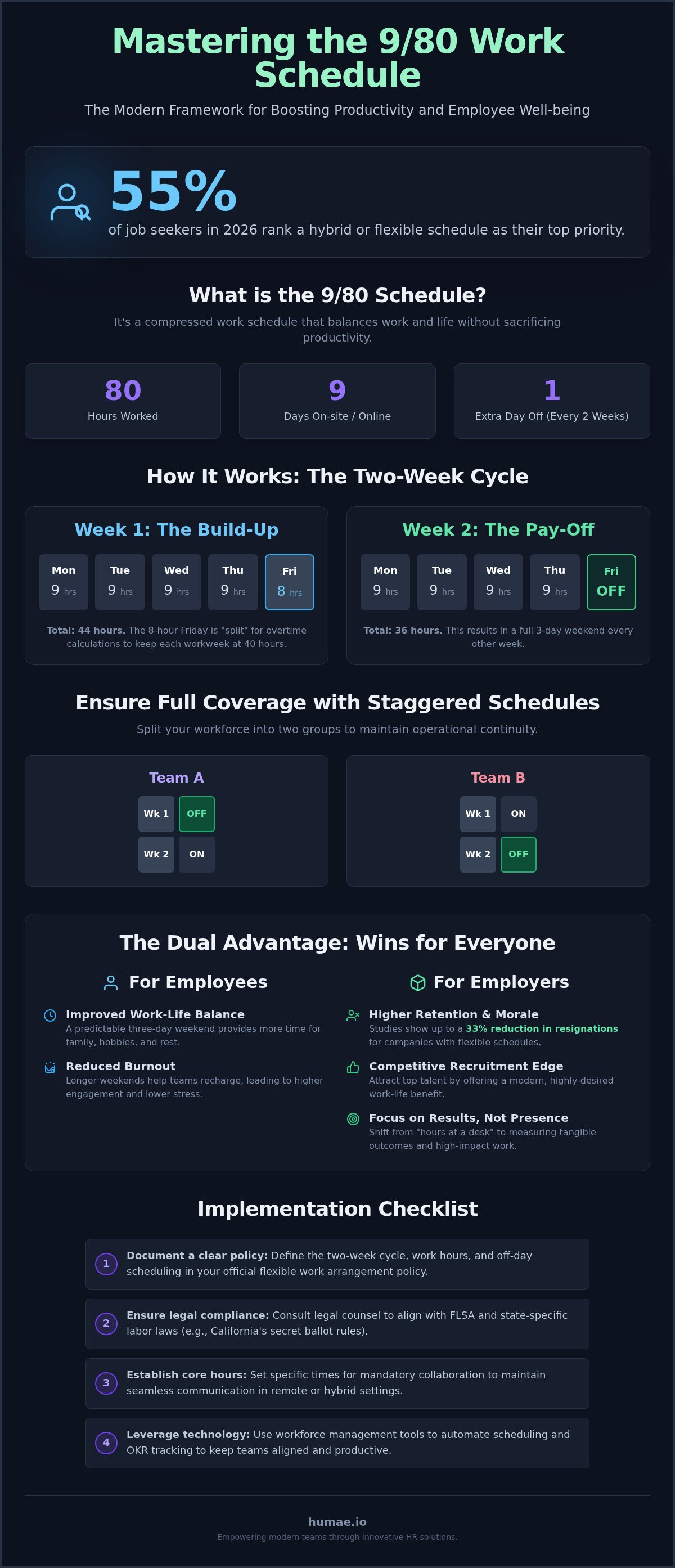
Implementing a successful flexible work arrangement policy requires a clear understanding of the two-week cycle. In the first week, employees typically work four 9-hour days and one 8-hour day. The second week consists of four 9-hour days and one full day off. This structure effectively "splits" the 8-hour day between the two workweeks for overtime calculation purposes. Precise documentation is essential for legal compliance, especially in jurisdictions with daily overtime rules. For example, under California Labor Code section 511, employers must follow a strict secret ballot election process to adopt these schedules legally. Clear policies prevent confusion and ensure that both the business and the employee stay protected as they move toward more agile ways of working.
Why Modern Organizations are Moving Toward Flexibility
The shift toward the 9/80 model reflects a broader movement from monitoring physical presence to measuring tangible outcomes. Modern teams are ditching "productivity paranoia" in favor of performance intelligence. By allowing for a flex day, organizations report a 33% reduction in resignations, as seen in recent hybrid work trials. This arrangement directly addresses employee burnout while maintaining operational efficiency. Successful adoption depends on a robust workforce management infrastructure that can track complex hours and project milestones in real time. When you prioritize mental health and autonomy, you create a culture of trust that naturally drives higher engagement and long-term success for everyone involved.
Back to Home
The Mechanics of the 9/80 Schedule: How It Works
Mastering the 9/80 schedule requires a shift in how you view the calendar. It isn't just about staying late; it's about a precise mathematical redistribution of effort. At its core, this system ensures that your flexible work arrangement policy remains compliant with labor laws while providing a tangible benefit to your team. By extending the workday slightly, you unlock a full day of freedom every two weeks. This structure maintains the traditional 80-hour bi-weekly commitment but packages it into nine productive days instead of ten.
Visualizing the Two-Week 9/80 Cycle
The cycle is easy to follow once you see the pattern. In Week 1, employees work four 9-hour days (Monday through Thursday) and one 8-hour day on Friday. In Week 2, they work four 9-hour days (Monday through Thursday) and have the following Friday entirely off. To keep your business running smoothly, you can stagger these off-days. Half the team takes "Friday A" off, while the other half takes "Friday B." This ensures that your office or digital workspace never goes dark. This method is a practical application of Washington University's Flexible Work Policy, which emphasizes that compressed schedules must meet operational needs without sacrificing service quality.
Managing Overtime and Fair Labor Standards
The biggest hurdle for most managers is the Fair Labor Standards Act (FLSA). To avoid triggering overtime pay for non-exempt employees, the workweek must be defined as starting and ending exactly four hours into the 8-hour Friday. This "split" ensures that both weeks contain exactly 40 hours. If a holiday falls on a 9-hour day, you'll need a clear protocol; often, employees receive 8 hours of holiday credit and use one hour of personal time to cover the difference. Managing these nuances manually is a recipe for error. Modern organizations rely on a robust HRIS to automate these complex calculations and keep compliance airtight. You can streamline your workforce management today by integrating these automated rules into your daily operations.
Back to Home
Evaluating the Pros and Cons for Employers and Employees
Morale isn't a luxury. It's a metric. Implementing a robust flexible work arrangement policy does more than just move blocks on a calendar; it redefines the psychological contract between you and your team. When employees feel trusted to manage their own time, engagement naturally climbs. Productivity often sees a surprising boost during those nine-hour days. Many workers find they can enter a "deep work" state more easily when they have an extra hour to wrap up complex tasks without the distraction of a looming end-of-day rush. However, the nine-hour shift requires stamina. Fatigue can set in if the workload isn't managed correctly, making it vital to monitor performance rather than just physical presence.
From a branding perspective, the 9/80 model is a magnet for top-tier talent. In a market where 55% of job seekers prioritize flexibility, offering a predictable three-day weekend every fortnight makes your organization stand out. It signals that you value human energy and results over rigid, outdated office traditions.
The Employee Perspective: Freedom and Focus
For the individual, the math is simple and compelling. A 9/80 schedule grants employees 26 extra days off per year. That's nearly an entire month of additional freedom without any reduction in pay. The benefits extend beyond just time; there's a significant reduction in commuting stress and costs. One less day on the road means lower fuel expenses and a smaller carbon footprint. Employees use these flex Fridays for everything from medical appointments to passion projects, which means they return on Monday feeling refreshed rather than drained. This sense of autonomy is a powerful antidote to the burnout often found in standard workweeks.
The Employer Perspective: Operational Hurdles and Gains
Employers often fear the "Friday gap," worrying that client needs will go unmet when half the team is away. This is a valid concern, but it's easily solved through staggered scheduling and clear communication. Beyond the logistical shift, there are tangible operational gains. Many organizations report lower utility costs when physical offices operate on a reduced scale or close entirely on flex days. To bridge the social distance that can arise from non-standard hours, smart leaders lean on data-driven employee engagement strategies. These frameworks ensure that even when the team isn't physically together, they remain aligned with the company's core mission. This strategic approach turns a potential hurdle into a core strength of your flexible work arrangement policy.
Back to Home
Implementing a 9/80 Schedule in a Remote or Hybrid Environment
Transitioning to a 9/80 model in a digital-first world requires a shift from clock-watching to transparent collaboration. While traditional offices relied on physical presence, your flexible work arrangement policy in 2026 must lean on digital visibility. You need clear protocols for asynchronous communication to prevent the "Friday bottleneck" where projects stall because key stakeholders are offline. Establish core hours, perhaps from 10 AM to 3 PM, where every team member is available for synchronous meetings. On the 8-hour Friday, response times should remain consistent with any other workday; this ensures that the active half of the team isn't left in a vacuum.
Maintaining Team Synergy Across Different Schedules
Synergy doesn't happen by accident when schedules diverge. We recommend staggering your team into two cohorts; this ensures that 50% of your workforce is always active and reachable. Use shared calendars to mark flex days clearly, so no one is surprised by an "out of office" reply. A centralized employee directory is essential here, allowing anyone to see real-time availability and current time zones at a glance. This transparency builds trust and reduces the friction of non-standard hours, keeping the human connection strong even across varying schedules.
Tracking Success Through Objectives and Key Results
In a remote setting, tracking success by hours logged is a relic of the past. You must pivot to results. Truly understanding the OKR meaning and how it applies to compressed weeks is vital for maintaining momentum. Set specific bi-weekly milestones that align with the 9/80 cycle. Use AI-driven performance intelligence to spot if certain departments are struggling with the longer 9-hour shifts. If fatigue starts affecting output, your data will show it before burnout does. This proactive approach ensures that flexibility leads to growth rather than stagnation. Optimize your team's performance by integrating these intelligent tracking tools into your daily workflow today.
Back to Home
Managing Alternative Work Schedules with Humae AI Intelligence
Traditional HR software often struggles with the unique nuances of a 9/80 cycle. Humae serves as the centralized infrastructure specifically designed for the 2026 workforce. It transforms a manual, error-prone flexible work arrangement policy into a seamless, automated experience. By integrating schedule data with human-centric insights, we help you maintain operational speed without sacrificing the well-being of your team. You get the benefits of a compressed week with the reliability of a standard one. Our platform ensures that your transition to flexibility is backed by data, not just guesswork.
Automating the Complexity of 9/80
The mid-day Friday split is often the biggest technical hurdle for payroll and compliance teams. Humae handles this complex calculation in the background, ensuring your organization stays FLSA-compliant without any manual intervention. Requesting time off within a compressed week can also become confusing for employees and managers alike. Our platform simplifies this by automatically adjusting balances and schedules based on the specific 9-hour or 8-hour workday. You can explore the full breakdown of our logic and technical capabilities in the how it works section. This level of automation removes the heavy administrative burden from your leaders, allowing them to focus on high-level strategy and team coaching rather than wrestling with spreadsheets.
Performance Intelligence: Beyond the Time Clock
True flexibility requires deep visibility. Humae goes far beyond the basic time clock by connecting schedule data with real-time performance intelligence. Our intuitive analytics dashboards provide a clear window into team health and project momentum. You can see exactly how the 9/80 schedule impacts project velocity and meeting attendance at a glance. Most importantly, our AI-driven sentiment analysis tracks continuous feedback to identify early signs of fatigue or misalignment. If the longer 9-hour shifts are beginning to cause stress in a specific department, you'll receive an alert before it leads to turnover or burnout. This proactive approach ensures your flexible work arrangement policy remains a powerful tool for mutual success and long-term retention. We believe that technology should serve the human experience, not complicate it. Visit the Humae homepage to discover how our platform can help you build a more resilient and inspired modern team today.
Back to Home
Mastering the New Rhythm of Work
Adopting a 9/80 schedule is more than a logistical change; it's a strategic commitment to a high-performance culture that respects human energy. By mastering the mechanics of the two-week cycle and establishing a robust flexible work arrangement policy, you empower your team to achieve more while enjoying predictable rest. You've seen how staggered schedules and core hours prevent operational gaps, while results-based tracking replaces the outdated need for constant supervision. The transition to this modern model succeeds when you trade manual complexity for intelligent automation.
Humae provides the essential infrastructure to make this vision a reality. Our platform offers a centralized employee directory for instant visibility, real-time OKR tracking to keep goals aligned, and AI-driven sentiment analysis to safeguard your team's mental health. Don't let administrative hurdles hold your organization back from the benefits of 2026 workplace standards. Explore Humae: The AI-Powered HR Platform for Modern Teams and start building a more resilient, inspired workplace today. Your team's best work is just one flex-day away.
Back to Home
Frequently Asked Questions
Is the 9/80 work schedule legal under the Fair Labor Standards Act?
Yes, the 9/80 schedule is legal under the Fair Labor Standards Act (FLSA). Employers must precisely define the workweek to ensure non-exempt staff don't exceed 40 hours in a seven-day period. This is achieved by splitting the 8-hour Friday into two four-hour segments. While federal law is clear, specific states like California require a two-thirds majority vote from employees to implement this as part of a flexible work arrangement policy.
How do you calculate holiday pay for an employee on a 9/80 schedule?
Most organizations provide 8 hours of holiday pay. If a federal holiday falls on a scheduled 9-hour workday, the employee typically covers the remaining hour using personal time off or by adjusting their hours earlier in the week. Alternatively, if the holiday lands on a flex Friday, the employee often receives the preceding Thursday or following Monday as their day off. Clear documentation in your policy prevents confusion during these periods.
What happens if a sick day falls on a 9-hour workday?
If an employee is ill on a scheduled 9-hour day, they must use 9 hours of sick leave to cover the full shift. It's a common misconception that all days are equal to 8 hours. Accurate tracking is vital to maintain fair leave balances across the team. Using a digital platform like Humae simplifies this by automatically deducting the correct amount of time based on the specific day's scheduled duration and individual leave balances.
Can a 9/80 schedule work for customer-facing teams?
Yes, customer-facing teams can thrive on a 9/80 schedule through strategic staggering. By dividing the team into two groups, you ensure that 50% of your staff is always active on any given Friday. This prevents service gaps while still offering every employee a three-day weekend twice a month. Success depends on clear communication and using a centralized employee directory to show real-time availability to both colleagues and clients.
Does the 9/80 schedule increase or decrease total productivity?
Data from 2026 indicates that compressed schedules often boost productivity by reducing burnout. A randomized trial found that hybrid and flexible models reduced employee resignations by 33% without negatively impacting performance. The extra hour during the nine-hour days allows for deep work periods with fewer interruptions. When a flexible work arrangement policy focuses on results rather than hours, teams often become more efficient and focused on their core objectives.
How do you handle payroll for the split Friday in a 9/80 cycle?
Payroll for a 9/80 cycle requires the workweek to start and end exactly four hours into the 8-hour Friday. The first four hours count toward the previous week, and the second four hours begin the new week. This split ensures neither week exceeds 40 hours. While Humae doesn't process payroll directly, our HRMS provides the precise time-tracking data needed to ensure these complex calculations are accurate and compliant every single period.
Is a 9/80 schedule better than a 4/10 schedule for employee retention?
Many employees find the 9/80 schedule more sustainable than a 4/10 model. Working 10 hours a day can lead to physical and mental fatigue, whereas an extra hour is often negligible for most office roles. The 9/80 cycle provides a more balanced rhythm that mimics the traditional week while still offering 26 extra days off per year. This balance makes it an exceptionally strong tool for long-term retention and overall team satisfaction.