7 Critical Signs You've Outgrown Spreadsheets for HR in 2026
By Humae · 3 May 2026
signs you've outgrown spreadsheets for hr
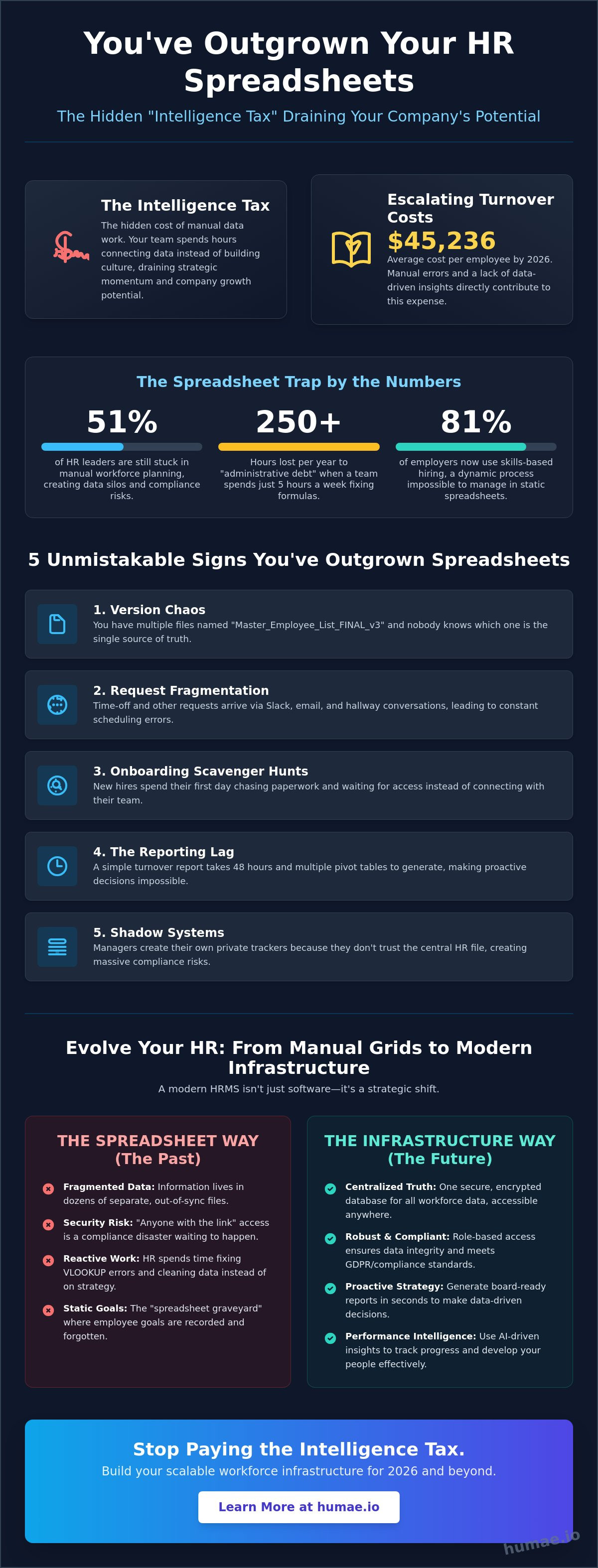
Your HR spreadsheet isn't just a manual burden anymore; it's an "intelligence tax" that actively drains your company's growth potential. You likely rely on these files because they're familiar, but recognizing the signs you've outgrown spreadsheets for hr is essential as the average cost of employee turnover climbs to $45,236 per person in 2026. With 51% of HR leaders still stuck in manual workforce planning, the risk of data silos and compliance errors has never been higher. Guessing your way through performance metrics or GDPR requirements isn't just stressful; it's a strategic liability.
We understand the comfort of a familiar grid, yet there comes a point where manual tracking stops being a tool and starts being a barrier to success. This guide identifies the exact breaking points where your current systems fail and shows you how to transition to a scalable workforce infrastructure. You'll learn how to stop wasting hours on manual updates and start using a centralized, secure system that generates professional, board-ready reports in seconds. It's time to move from surviving your data to using it to empower your people and drive real results.
Humae: Modern HR technology built for real human connections. Back to Home | Visit us on Facebook
Key Takeaways
- Understand the "Intelligence Tax" and how manual data manipulation drains your team's strategic momentum.
- Identify the 5 critical signs you've outgrown spreadsheets for hr to prevent fragmented data from stalling your growth.
- Secure your workplace by replacing "anyone with the link" access with robust, compliant workforce infrastructure.
- Evolve from the "spreadsheet graveyard" of employee goals to dynamic, AI-driven performance intelligence.
- Execute a clear audit of your current "spreadsheet web" to define requirements for a scalable 2026 HR strategy.
Humae: Modern HR technology built for real human connections. Back to Home | Visit us on Facebook
The Spreadsheet Paradox: Why the 'Free' Tool is Costing You Most
The allure of the spreadsheet lies in its price tag: zero dollars. However, this "free" tool often becomes the most expensive line item in your budget. We call this the "Flexibility Trap." While it's tempting to simply add another column for hybrid work status or skills verification, this ease of use leads to a fragmented data nightmare. Recognizing the signs you've outgrown spreadsheets for hr is the first step toward building a modern, resilient company culture. In 2026, where 50% of U.S. companies anticipate increased turnover, relying on static cells is a strategic risk. When your data lives in a grid, it lacks the pulse of your actual workforce.
This brings us to the "Intelligence Tax." This is the hidden cost of manual data manipulation. When your HR team spends hours cross-referencing tabs, they aren't building culture; they're acting as human API connectors. Moving to a Human Resource Management System (HRMS) isn't just about software. It's about reclaiming that time for strategic people operations. In a world where 81% of employers have adopted skills-based hiring, you need dynamic systems that can verify abilities in real-time, not a static list on someone's desktop.
The Hidden Costs of 'Free' Software
HR as a Source of Truth
Shadow spreadsheets are a compliance disaster waiting to happen. When a manager keeps a private list of performance notes on their laptop, your company loses its single source of truth. To scale, you need a robust workforce management infrastructure that centralizes every data point. This shift from reactive fixing to proactive strategy is one of the clearest signs you've outgrown spreadsheets for hr. A single, encrypted database ensures that when you pull a report for a board meeting, the numbers are accurate, secure, and ready in seconds.
Humae: Modern HR technology built for real human connections. Back to Home | Visit us on Facebook
5 Unmistakable Signs You've Outgrown Spreadsheets for HR
Grid-locked data isn't just an inconvenience; it's a signal that your business has scaled past its current tools. If you're still relying on manual entry, you're likely feeling the friction every day. Recognizing the signs you've outgrown spreadsheets for hr early prevents operational bottlenecks from becoming cultural crises. In 2026, where 77% of new job postings are for on-site roles requiring tight coordination, your infrastructure must be faster than a manual refresh button. Here are the five red flags that your current system is failing you.
- Version Chaos: You have more than three files labeled "Master Employee List," and nobody knows which one is current.
- Request Fragmentation: Time-off requests arrive via email, Slack, and sticky notes, leading to scheduling overlaps.
- Onboarding Scavenger Hunts: New hires spend their first day waiting for documents rather than meeting their team.
- The Reporting Lag: Pulling a simple turnover report takes 48 hours of manual data cleaning and pivot tables.
- Shadow Systems: Managers build their own trackers because they don't trust the central HR file.
When managers start building private "shadow" trackers, it's a clear cry for help. It means your central data is so unreliable that leaders would rather do the work twice than use the official source. This fragmentation is a major risk when running your business on spreadsheets. It creates silos that prevent you from seeing the big picture of your workforce health.
The Version Control Nightmare
File names like "Final_Final_v2.xlsx" destroy the bridge between HR and Finance. When payroll is based on one sheet and bonus structures on another, errors are inevitable. In 2026, accuracy is non-negotiable. Real-time syncing isn't a luxury anymore; it's the only way to manage a dynamic team without losing sleep over formula bugs or outdated salary rows.
Onboarding and the Candidate Experience
Your onboarding process is the first real look a new hire gets at your company culture. A manual, frantic process signals a "legacy" mindset that can frustrate top talent. Messy data in the first 90 days is a leading cause of early turnover, which now costs over $45,000 per person. By streamlining the talent acquisition handoff to core HR, you ensure that the excitement of the "yes" carries through to their first productive week. If you're ready to stop the paper trail, you can explore automated onboarding workflows that put the human back in HR.
Humae: Modern HR technology built for real human connections. Back to Home | Visit us on Facebook
Security and Compliance: The Risk of the 'Human Error' Factor
Access control is another red flag that demands your attention. If your Master List is set to "anyone with the link can edit," you've already lost control of your compliance. Without a professional audit trail, you can't prove who changed a salary or deleted a sensitive performance review. These gaps are undeniable signs you've outgrown spreadsheets for hr. With new 2026 regulations like Oregon's requirement for annual written pay breakdowns, the manual burden of ensuring every sheet is accurate and secure has become a full-time liability.
The GDPR Compliance Gap
Spreadsheets are inherently non-compliant for sensitive Personally Identifiable Information (PII). Managing a "Right to be Forgotten" request under GDPR is nearly impossible when employee data is scattered across local drives, email attachments, and "Final_v2" files. You can't delete what you can't find. Transitioning to a centralized HRIS automates these compliance workflows by design. It ensures that data is encrypted, searchable, and erasable with a single click, protecting you from the heavy fines that follow data mishandling.
Data Privacy as Employee Experience
Trust is the foundation of a modern workplace culture. There's a psychological impact when employees realize their sensitive feedback or salary history is "just in a sheet" that could be accidentally shared in a Slack channel. Protecting performance data and sentiment scores from unauthorized eyes isn't just a legal requirement; it's a commitment to your people. By moving to a professional data infrastructure, you signal to your team that their privacy is a priority. It replaces anxiety with the confidence that their most personal professional information is stored in a secure, world-class environment.
Humae: Modern HR technology built for real human connections. Back to Home | Visit us on Facebook
Beyond Record-Keeping: The Need for Performance Intelligence
A spreadsheet is where ambitious employee goals go to die. You might spend hours in January setting up a beautiful template for OKRs, but by March, that file is usually buried under a mountain of payroll updates and leave requests. This "set it and forget it" culture is one of the most dangerous signs you've outgrown spreadsheets for hr. In an era where 50% of U.S. companies expect turnover to rise, you simply can't afford to leave performance data in a graveyard. You need performance intelligence that provides a real-time pulse on your team's health and output rather than a static snapshot from six months ago.
Why Spreadsheets Kill OKRs
Static sheets are history books, not navigation tools. They record what happened, but they don't drive what is happening right now. For the 19% of the workforce currently in hybrid roles, real-time OKR tracking is the only way to maintain alignment across distributed teams. When a goal is updated in a centralized system, the impact ripples through the entire organization instantly. You move away from manual cell-level entry and toward visual dashboards that tell a compelling story. This clarity allows managers to coach in the moment rather than waiting for a quarterly review that's already outdated. When you can't see the link between a daily task and a quarterly objective, you're seeing one of the clearest signs you've outgrown spreadsheets for hr in a competitive market.
AI and the Future of Feedback
The adoption of agentic AI in HR is projected to grow by 327% by 2027. This technology does what a spreadsheet never could; it identifies patterns of burnout and disengagement before they lead to a resignation. Sentiment analysis tools can track the emotional health of your team by analyzing feedback trends, not just raw scores. It's a fundamental shift from reactive record-keeping to proactive people operations. With 81% of employers adopting skills-based hiring in 2026, you need a system that doesn't just list a skill but verifies it through peer feedback and project outcomes. This data becomes the "Performance Intelligence" that CEOs actually value because it proves HR is a strategic engine for growth. If you want to move beyond the grid and start leading with data, explore Humae's intelligent performance features today.
Humae: Modern HR technology built for real human connections. Back to Home | Visit us on Facebook
Building Your Workforce Infrastructure for 2026
Recognizing the signs you've outgrown spreadsheets for hr is the first step toward a more professional, human-centered workplace. In 2026, where HR software for a 25-person business can cost as little as $199 per month, the price of inaction is far higher than the cost of a modern system. You need a foundation that supports your team's growth rather than restricting it with manual rows. Transitioning to a scalable infrastructure isn't just about buying software; it's about building a resilient engine for your company's future.
The roadmap to a modern HR setup follows five clear steps:
- Audit the 'Spreadsheet Web': Identify where formula errors or unauthorized access create the most risk in your current files.
- Define Requirements: Map out exactly what you need for hiring, onboarding, performance, and real-time analytics.
- Evaluate AI Capabilities: Look for platforms that integrate agentic AI to automate workflows, as adoption is projected to grow by 327% by 2027.
- Clean Data Migration: Move your employee info into a central database, ensuring you leave "stale" data and bad habits behind.
- Enable Self-Service: Give managers and employees the tools to update their own info, maintaining data integrity without HR bottlenecks.
When you map out these steps, you'll likely see that the signs you've outgrown spreadsheets for hr are actually opportunities to improve your culture. Modern infrastructure allows your team to focus on people, not pivot tables.
Choosing the Right HRMS for Growth
Avoid the "Frankenstein" stack. Patching together separate, disconnected tools for payroll and recruiting creates the same data silos you're trying to escape. An all-in-one platform ensures that an employee directory acts as more than just a list; it becomes your cultural hub. This visibility is vital for scaling from 50 to 500 employees, where manual coordination becomes impossible. Choose a system that grows with your ambition, not one that requires constant manual maintenance.
The Humae Approach: AI-Powered Simplicity
Humae replaces the grid with a modern, technology-driven interface that keeps humans at the center. We centralize hiring, onboarding, and performance management so you can stop being a data entry clerk and start being a strategic partner. Our platform leverages real-time analytics to help you make data-driven people decisions before turnover costs spike. Ready to move beyond the grid? See how it works and start building your 2026 workforce infrastructure today.
Humae: Modern HR technology built for real human connections. Back to Home | Visit us on Facebook
Empower Your People by Leaving the Grid Behind
The hidden costs of administrative debt are too high to ignore. When you recognize the signs you've outgrown spreadsheets for hr, you're actually seeing the potential for a more connected, resilient company. Moving from static cells to a centralized workforce infrastructure protects you from the $45,236 average cost of turnover seen in 2026. It replaces manual version control with real-time accuracy and professional security that spreadsheets simply can't provide.
Your team deserves better than a scavenger hunt onboarding experience or a graveyard for their career goals. By embracing automated hiring and real-time OKR tracking, you turn HR from a support function into a strategic engine. You'll gain the visibility needed to lead with confidence while building a culture where every employee feels seen and valued. It's time to stop managing rows and start leading people.
Ready to build a modern workforce? Discover Humae's AI-powered HR platform today. Our intuitive interface centralizes hiring and onboarding while leveraging AI sentiment analysis to keep your team engaged.
Humae: Modern HR technology built for real human connections. Back to Home | Visit us on Facebook
Common Questions About HR Data Management
What is the biggest risk of using spreadsheets for HR data?
The biggest risk is the lack of a single source of truth combined with zero audit trails. In a spreadsheet, any user can accidentally delete a cell or change a salary without leaving a trace. This leads to massive inaccuracies in payroll and compliance reporting. When you see these errors, it's one of the clear signs you've outgrown spreadsheets for hr. Professional tools ensure every change is logged and every formula is protected.
At what company size should we stop using Excel for HR?
Most businesses should transition when they reach 10 to 15 employees. By the time you hit 25 employees, the monthly cost of an HRMS ($199 to $850) is significantly lower than the labor cost of manual data entry. Managing more than 15 people on a sheet usually leads to version control nightmares. Scaling beyond this point without infrastructure creates a "flexibility trap" that stalls growth.
How do I convince my CEO to invest in an HRMS instead of a free spreadsheet?
Pitch the transition as a risk mitigation strategy and a way to reclaim "Intelligence Tax" hours. Show them that the average cost of turnover in 2026 is $45,236 per employee. If an HRMS reduces turnover by just 5%, it pays for itself many times over. Focus on how real-time reporting allows for faster, data-driven decisions during board meetings instead of waiting 48 hours for a manual report.
Can I migrate my existing Excel data into an HR platform like Humae?
Yes, you can easily migrate your existing data into Humae through automated bulk imports. You don't have to manually re-type every entry. Our platform is designed to ingest CSV and Excel files, mapping your columns to a secure, encrypted database. This process allows you to leave behind broken formulas while keeping your historical records intact and accessible from day one.
How does an HRMS improve the employee experience compared to a spreadsheet?
An HRMS improves the experience by providing 24/7 self-service and transparent feedback loops. Employees can request time off or view their performance goals instantly from any device. This professional interface builds trust. It signals that the company values their time and privacy, unlike a static sheet that feels like an administrative afterthought and requires manual email chains for simple requests.
Is a spreadsheet or an HRMS better for GDPR compliance?
An HRMS is significantly better for GDPR compliance because it offers built-in encryption and automated data deletion. Spreadsheets are often stored on local drives or shared via email, which violates basic privacy principles. With a centralized system, you can handle "Right to be Forgotten" requests in seconds. You can't achieve that level of security with a file that anyone can copy or download.
What are the hidden costs of managing HR through manual tools?
The hidden costs include hundreds of hours spent "cleaning" data and the high price of manual errors. HR teams often lose five hours per week to spreadsheet maintenance. That's over 250 hours annually that could be spent on talent development. Additionally, a single formula error in a bonus calculation can lead to expensive payroll corrections or legal penalties that far exceed software costs.
Can an AI-powered HR platform really help with employee retention?
AI-powered platforms help retention by identifying burnout patterns 30 to 60 days before an employee decides to quit. By analyzing sentiment and engagement trends, these tools alert managers to disengaged team members. With 50% of U.S. companies expecting higher turnover in 2026, using AI to proactively support your people is a critical competitive advantage that a static spreadsheet cannot provide.
Humae: Modern HR technology built for real human connections. Back to Home | Visit us on Facebook