7 Common HR Workflow Automation Mistakes and How to Avoid Them in 2026
By Humae · 15 May 2026
common hr workflow automation mistakes
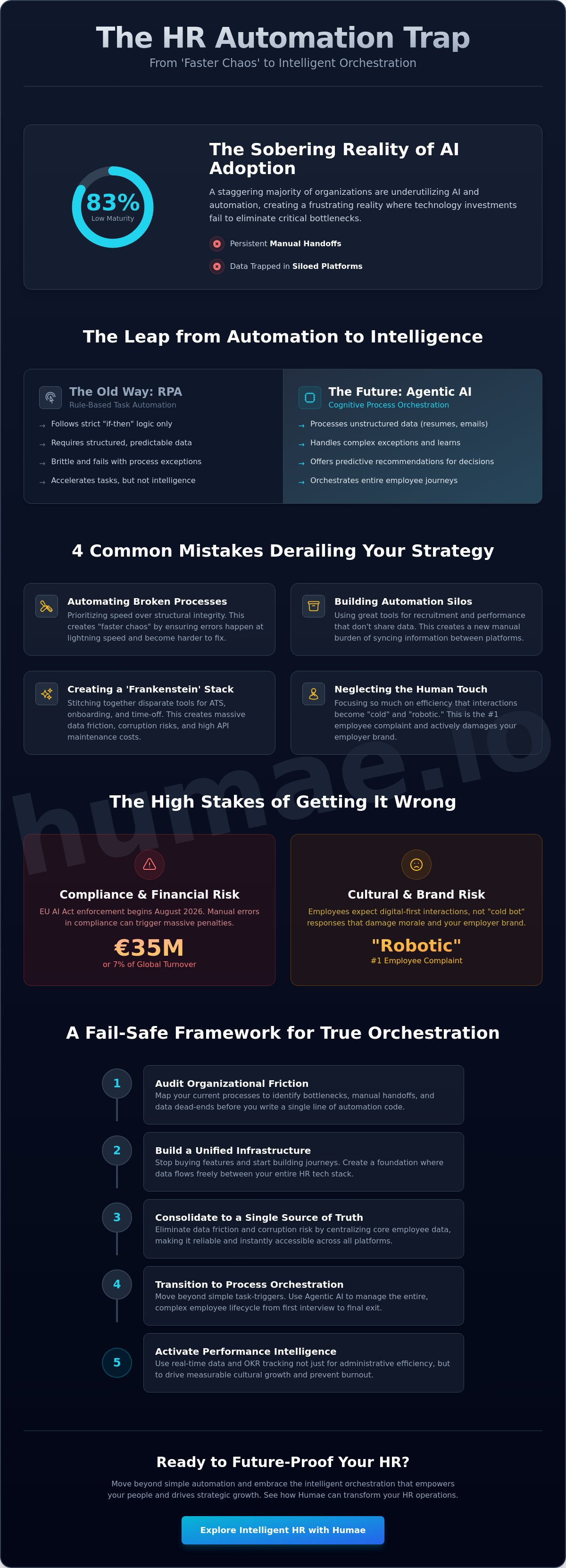
83% of organizations currently demonstrate low maturity in their use of AI and automation, even though the market for these tools is exploding. It's a frustrating reality when you've invested in technology only to find manual handoffs still happening and data remaining trapped in siloed platforms. You're likely trying to balance efficiency with a genuine human connection, yet "robotic" interactions are still the number one employee complaint.
We believe technology should empower your team, not replace the empathy that makes your culture unique. By identifying the most common hr workflow automation mistakes, you can reclaim your time for strategic people work and gain the data-driven insights you need to thrive. We'll explore how to navigate the EU AI Act enforcement coming in August 2026 and show you how to bridge the gap between simple tools and true cognitive AI.
Experience the future of HR with Humae. Return to the Home Page or connect with us on Facebook.
Key Takeaways
- Learn to transition from basic task-triggering to full process orchestration using Agentic AI for a more seamless employee journey.
- Understand why automating a broken manual process fails and how to build a unified infrastructure that connects your entire HR stack.
- Discover how to avoid common hr workflow automation mistakes that lead to "cold bot" interactions and damage your employer brand.
- Master a 5-step framework to audit organizational friction and consolidate your data into a single, reliable source of truth.
- Explore how performance intelligence and real-time OKR tracking can turn administrative efficiency into measurable cultural growth.
Ready to transform your HR operations? Return to the Humae Home Page or follow our latest updates on Facebook.
What is HR Workflow Automation in 2026?
In 2026, HR automation has moved far beyond simple task triggers. It's now the sophisticated orchestration of people processes through AI and integrated software. While 72% of organizations had automated at least one core function by 2023, the real winners in 2026 are those moving toward Agentic AI. This shift represents a massive jump from rule-based Robotic Process Automation (RPA), which only follows strict "if-then" logic, to systems that can process unstructured data like resumes or emails, handle complex exceptions, and offer predictive recommendations. This isn't just about doing things faster; it's about doing them smarter.
Building this capability starts with a solid workforce management infrastructure. Without this foundation, you're merely accelerating existing inefficiencies. Automation without intelligence is just "faster chaos." If you automate a broken process, you've simply ensured that errors happen at lightning speed. This is one of the most common hr workflow automation mistakes leaders make: prioritizing speed over structural integrity. A 2026 benchmark report found that 83% of organizations demonstrate low maturity in their use of AI, proving that having the tools isn't enough; you need a strategic design that supports your people.
The Evolution of People Operations
We've witnessed a shift from physical paper files to a mess of siloed apps, and finally to centralized HRMS platforms. The old debate between "all-in-one" and "best-of-breed" software has ended. Today's successful organizations run on integrated ecosystems where data flows freely between recruitment, performance, and time-off tools. In 2026, real-time data is the heartbeat of decision-making. You don't wait for quarterly reports to see if a team is burnt out. You use live performance intelligence to adjust strategies on the fly, ensuring your people stay engaged and productive.
Why Automation is No Longer Optional
Manual handoffs are now a liability. With the EU AI Act enforcement starting in August 2026, compliance isn't just about checking boxes; it's about robust data governance and bias testing. Manual errors in compliance can cost up to €35 million or 7% of global turnover. Beyond legal risk, your employees expect digital-first interactions. They want instant answers and personalized onboarding, not a three-day wait for a generic email response. HR Orchestration is the synchronized management of the entire employee lifecycle. It ensures that every touchpoint feels intentional and cohesive, from the first interview to the final exit interview.
Strategic and Tooling Blunders: Choosing Efficiency Over Infrastructure
Efficiency is a tempting goal, but it's a dangerous one when it lacks a solid foundation. Many leaders rush to implement new tools without looking at the underlying architecture. This haste often leads to the very common hr workflow automation mistakes that stall organizational growth. If your manual process is already flawed, automating it only amplifies those errors. You end up with a faster version of a broken system, which is much harder to fix once it's embedded in your software.
Another frequent pitfall is building "Automation Silos." You might find a great tool for recruitment and another for performance, but if they don't share data, you've created a new manual burden. Your team ends up spending hours syncing information between platforms, defeating the purpose of the initial investment. Stop buying features; start building journeys. When you prioritize a long list of technical capabilities over how your team actually interacts with the software, you're setting yourself up for low adoption rates. Over-customizing these tools is equally risky. It creates a rigid system that's impossible to maintain or update, leaving you stuck with outdated tech while the rest of the industry moves forward.
The 'Frankenstein' HR Tech Stack
Disparate tools for ATS, onboarding, and time-off management create massive data friction. Every time data moves from one silo to another, the risk of corruption grows. This fragmentation leads to high "API maintenance" costs, where your IT team spends more time fixing connections than building value. A centralized employee directory is the essential anchor for your automation logic. It ensures that every automated trigger, from a promotion to a name change, ripples through your entire system accurately and instantly.
The Goal-Setting Gap
You can't improve what you don't measure. Before clicking "Automate," you must define clear KPIs like Time-to-Onboard or employee response rates. Without these benchmarks, you're prone to "vanity automation"; you're digitizing tasks that don't actually save time or improve the experience. Focus on the friction points that matter most to your people. You can explore Humae Features to see how an integrated infrastructure prevents these blunders by keeping your data and goals in one place.
The 'Cold Bot' Trap: Neglecting Employee Sentiment and Human Touch
The "Human" in Human Resources isn't a suggestion; it's the core of the profession. One of the most damaging common hr workflow automation mistakes is the belief that every interaction can, or should, be handled by a machine. While automation drives efficiency, using it for sensitive people decisions without human oversight creates a "Cold Bot" environment. This "uncanny valley" of HR makes employees feel ignored and undervalued. When technology becomes a wall instead of a bridge, your culture pays the price.
Automated rejection emails or performance warnings sent without context can destroy your employer brand in minutes. Candidates and employees talk. If their most vulnerable moments are met with a generic script, your reputation suffers. Modern 2026 leaders use automation to handle the "what" so their teams can focus on the "why." They leverage technology to strip away administrative burdens, creating the space needed for meaningful 1-on-1s and strategic coaching. Automation should give you time back, not take the soul out of your workplace.
Managing the Empathy Gap
Not all workflows are created equal. Low-empathy tasks, like updating an address or requesting time off, are perfect for full automation. High-empathy workflows, such as conflict resolution or career development, require a human touch. Modern systems now use AI-driven sentiment analysis to monitor employee feedback in real-time. If the system detects frustration or disengagement, it flags the issue for a manager to step in. This "Human-in-the-loop" (HITL) approach ensures that technology acts as a safety net, not a barrier.
The Change Management Failure
Resistance to new tools often stems from fear. Employees worry about job loss or a loss of personal agency. If you fail to communicate the "why" behind your tech stack, adoption will stall. Reframe automation as a set of "superpowers" that allows your team to do more of the work they actually love. Transparency is your best tool here. Implementing clear employee engagement strategies helps bridge the digital divide. It shows your people that technology is there to support their growth, not replace their contribution.
Orchestration vs. Silos: A 5-Step Fail-Safe Automation Framework
Orchestration is the antidote to the chaos of fragmented tools. It's about building a cohesive ecosystem where data moves with purpose. To avoid the common hr workflow automation mistakes we've discussed, you need a fail-safe framework that prioritizes the employee journey over individual features. Successful 2026 organizations don't just "set and forget" their tools; they treat automation as a living part of their culture.
- Step 1: Audit the Employee Journey. Map every touchpoint from the first interview to the final exit. Identify where manual handoffs cause friction or where communication feels "robotic."
- Step 2: Consolidate into a Single Source of Truth. Your HRMS must be the anchor. Fragmented data across multiple platforms is a recipe for error. Ensure every tool feeds back into one central system.
- Step 3: Map Triggers and Lifecycle Actions. Define what happens next. If a candidate is hired in the ATS, the system should automatically populate the directory and trigger onboarding tasks without human intervention.
- Step 4: Implement AI-Driven Intelligence. Move beyond simple triggers. Use cognitive AI to monitor performance trends and sentiment, flagging potential burnout before it leads to turnover.
- Step 5: Continuously Iterate. Use "Pulse" feedback to ask employees how they feel about the automated processes. If a workflow feels cold or confusing, fix it immediately.
Ready to see this framework in action? Explore how Humae orchestrates your entire people operation.
Designing for the Whole Lifecycle
Onboarding shouldn't be an island. In a mature 2026 setup, your onboarding automation flows directly into OKR tracking. This ensures new hires understand their goals from day one. Similarly, time-off management must be synchronized with team calendars to prevent scheduling conflicts. Don't forget offboarding. Automating the exit process protects your security by revoking access instantly while maintaining your brand reputation through professional, personalized exit surveys.
Data Integrity as the North Star
"Dirty data" is the silent killer of automation. Duplicate entries or outdated job titles break your triggers and lead to embarrassing errors. You need automated "data cleaning" routines within your HRMS to keep information pristine. This isn't just about efficiency; it's about compliance. With the EU AI Act enforcement starting in August 2026, your data governance must be robust. Baked-in compliance ensures that your AI-driven decisions are fair, transparent, and legally sound, protecting your organization from massive penalties.
Future-Proofing with Humae: AI-Driven Performance Intelligence
Automation isn't just a way to clear your desk of paperwork; it's the bridge to a more high-performing culture. Most common hr workflow automation mistakes occur when leaders view technology as a purely administrative fix. They focus on the "back-office" tasks but miss the opportunity to drive real business value. Humae changes this narrative by connecting your operational workflows directly to performance growth.
By integrating performance intelligence into your daily operations, you transform your HR team from administrators into strategic growth partners. Instead of chasing down signatures or manually updating spreadsheets, your team spends their time analyzing trends and coaching leaders. Our centralized interface ensures that every piece of data, from a time-off request to a completed project milestone, contributes to a clearer picture of organizational health. This visibility allows you to address potential issues before they impact your culture.
Beyond Basic Automation: Intelligence at Work
Traditional HR systems rely on annual reviews that are often outdated before the ink is dry. Humae uses AI to facilitate continuous feedback loops, ensuring that development happens in real-time. This approach replaces the stress of yearly evaluations with the clarity of ongoing support and recognition. Executive teams also gain access to actionable analytics dashboards that translate complex people data into clear insights for board-level reporting. You can see How it Works to witness how this orchestration creates a more responsive and agile workplace.
Starting Your Automation Journey Correct
The path to a digital-first culture doesn't require an overnight overhaul of every process. We encourage organizations to start small by automating a single high-impact workflow, like onboarding or time-off management, first. This builds internal confidence and demonstrates immediate ROI to stakeholders. As your needs evolve, you need a platform that scales with you, providing more sophisticated tools for OKR tracking and sentiment analysis as you grow from a startup to an enterprise. The future of HR technology isn't about replacing the human element; it's about providing the intelligence humans need to build better workplaces. Start with a foundation that values both your time and your people.
Build a Future Where Technology Empowers People
Modern HR isn't a choice between efficiency and empathy; it's the art of using one to amplify the other. By avoiding the common hr workflow automation mistakes that lead to fragmented data and "cold bot" interactions, you create a culture where every team member feels seen and valued. Success in 2026 requires moving past simple task-triggering toward true orchestration that supports the entire employee lifecycle.
Focus on a centralized workforce management infrastructure that turns administrative burdens into growth opportunities. With tools like AI-powered sentiment analysis and real-time OKR tracking, you can stay ahead of burnout and align your team's efforts with your highest goals. When your systems handle the "what," your people are free to focus on the "why." You don't have to sacrifice your organizational culture for the sake of a digital upgrade.
Ready to automate with a human touch? Discover Humae, the all-in-one AI HR platform.
Your organization deserves a digital environment that feels as authentic and innovative as your mission. Let's build it together.
Frequently Asked Questions
What are the most common HR tasks to automate first?
Start with high-volume, repetitive tasks that don't require deep emotional intelligence, such as time-off requests, onboarding documentation, and initial candidate screening. Automating these areas provides immediate relief from administrative burdens and ensures data consistency across your systems. By tackling these first, you avoid common hr workflow automation mistakes like trying to digitize complex, high-touch processes before your team is ready.
How do I ensure HR automation doesn't feel robotic to employees?
Maintain a "human-in-the-loop" approach for sensitive interactions like performance coaching or conflict resolution. Use technology to handle the logistics, such as scheduling and data gathering, but keep the actual conversation personal and empathetic. Personalizing automated templates with conversational language and providing clear paths to speak with a real person prevents the "cold bot" trap and preserves your unique culture.
Can small startups benefit from HR workflow automation?
Startups benefit significantly because automation allows lean teams to scale quickly without adding massive administrative overhead. Implementing a centralized employee directory and automated onboarding early prevents the data silos that often plague larger, more established organizations. It's about building a scalable infrastructure that grows with you, ensuring your people operations stay agile and data-driven from day one.
What is the difference between RPA and AI-driven HR automation?
RPA follows strict, rule-based logic to perform repetitive tasks, while AI-driven automation uses cognitive capabilities to process unstructured data and make intelligent recommendations. While RPA might simply move a file between folders, AI can analyze candidate resumes or flag employee sentiment trends. In 2026, the shift toward Agentic AI means systems can handle complex exceptions that previously required manual human intervention.
How do I measure the ROI of HR automation?
Track concrete metrics like "time-to-onboard," reduction in manual data entry errors, and employee engagement scores. You should also measure the time reclaimed by HR professionals for strategic work, such as leadership development or culture building. Comparing these KPIs against your pre-automation benchmarks clearly demonstrates how technology drives both operational efficiency and long-term organizational health.
What should I look for in an HRMS for effective automation?
Prioritize a platform that offers deep integration across the entire employee lifecycle, from recruitment to OKR tracking. A centralized source of truth is vital to avoid common hr workflow automation mistakes like data fragmentation and siloed communication. Ensure the system includes real-time analytics and performance intelligence, allowing you to turn raw data into actionable strategies for your team's growth.