2026 Employee Retention: Data-Driven Guide
By Humae · 1 September 2026
employee retention strategies
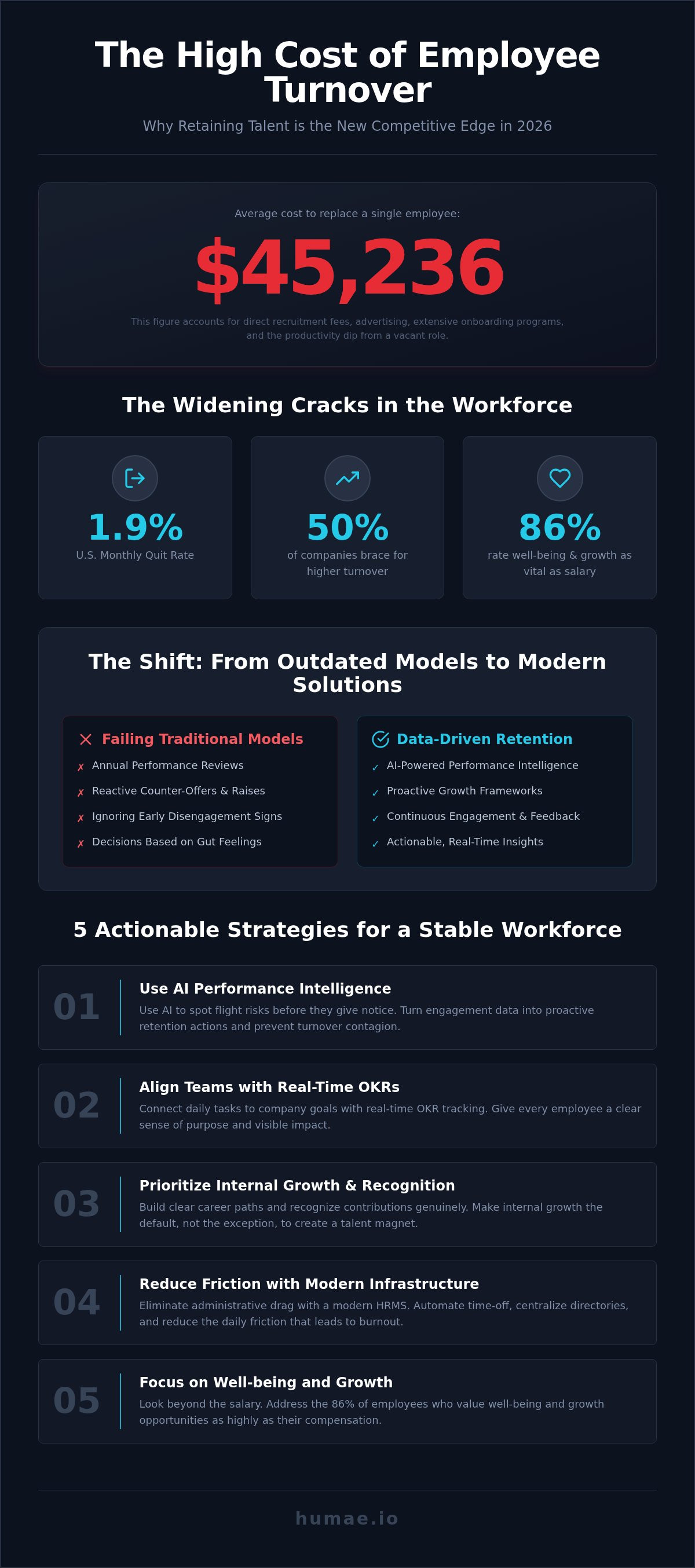
$45,236. That's the average price your business pays every time a single seat goes cold in 2026. With the U.S. monthly quit rate holding steady at 1.9% and half of all companies bracing for higher turnover this year, the stakes have never been more personal. You've likely felt the sting of a senior lead walking out the door, taking years of institutional knowledge with them while the rest of the team's morale takes a hit. Finding effective employee retention strategies isn't just about keeping people; it's about protecting the culture you've worked so hard to build.
We know that constant recruitment is both exhausting and expensive. You deserve a stable, high-performing workforce where engagement scores reflect a truly connected team. This guide promises to help you master the art and science of retention through modern HR infrastructure and AI-driven performance intelligence. We'll preview how to use real-time data to identify flight risks and build transparent growth frameworks that turn your organization into a talent magnet.
Key Takeaways
- Quantify the true cost of turnover, starting with the $45,236 average price tag for every lost employee in 2026.
- Use AI-driven performance intelligence to catch disengagement early and transform static data into actionable insights.
- Master five actionable employee retention strategies that prioritize internal growth and genuine recognition over outdated perks.
- Reduce workplace friction by leveraging modern infrastructure like centralized directories and automated time off management.
- Align every team member with company goals through real-time OKR tracking to ensure every contribution is visible and valued.
The True Cost of Turnover in the 2026 Economy
Losing an employee isn't just a scheduling headache. In 2026, the average cost to replace a single worker has reached $45,236. This figure accounts for recruitment fees, advertising, and the extensive onboarding programs required to get a new hire up to speed. However, these direct expenses only tell half the story. When a senior lead walks out, they take years of institutional knowledge that no digital manual can fully capture. This sudden vacuum disrupts the synergy of agile teams and stalls ongoing projects for weeks.
High turnover rates also act as a red flag for your employer brand. In a transparent digital market, candidates view frequent departures as a symptom of a toxic culture or weak leadership. Relying on reactive retention, like counter-offers or emergency raises, is always more expensive than building a proactive infrastructure. You need a system that identifies friction before it leads to a resignation. For a deeper look at these dynamics, you can consult this employee retention overview to understand the foundational theories of motivation and cost.
Quantifying the Impact on Team Productivity
The productivity dip is a measurable period where output drops to zero for the vacant role and decreases for the surrounding team. Remaining high performers often shoulder the extra workload, which quickly leads to burnout. This environment breeds turnover contagion. Turnover contagion is the psychological ripple effect where a single resignation triggers a cascade of departures as remaining team members begin to question their own commitment and career path. It's a viral threat to your organizational stability that data-driven employee retention strategies can help prevent.
Why Traditional Retention Models are Failing
The era of the annual performance review is over. In 2026, employees demand continuous engagement and real-time feedback. While competitive pay remains a baseline, 86% of workers now consider their well-being and growth opportunities as vital as their salary. Traditional models fail because they lack the workforce management infrastructure to spot early warning signs of disengagement. Without performance intelligence, leadership is essentially flying blind. Modern employee retention strategies must move beyond gut feelings and embrace data-driven insights. Using tools like analytics dashboards allows you to see engagement trends before they turn into exit interviews.
Performance Intelligence: The New Science of Retention
Performance intelligence marks the end of reactive HR. Instead of looking at static metrics like annual turnover rates, modern leaders use actionable insights to understand the present. It's about moving from "what went wrong" to "how can we fix it now." This shift is essential for effective employee retention strategies in 2026. By utilizing AI-driven sentiment analysis, organizations can spot subtle shifts in team communication or engagement levels. This allows for intervention before disengagement leads to a formal resignation.
Research from data-driven retention insights highlights that employees who feel their work has purpose are significantly less likely to leave. Clarity and expectations are the bedrock of long-term loyalty. When a team member understands exactly how they're measured, the anxiety of the unknown disappears. Analytics dashboards now provide this clarity in real time, making team health a visible, manageable metric rather than a guessing game.
Leveraging Real Time OKR Tracking for Purpose
Workplace anxiety often stems from a lack of direction or a feeling that one's efforts don't matter. Real-time OKR tracking bridges the gap between individual tasks and the broader company mission. When every team member sees their specific impact on a shared goal, focus and job satisfaction naturally increase. This transparency reduces the "black box" feeling of corporate strategy. For those looking to implement this framework, our OKR Meaning guide provides a definitive path for 2026.
AI Powered Feedback Loops
Scaling empathy is a major challenge for any growing team. AI-powered feedback loops automate the check-in process without losing the human touch that defines a healthy culture. These systems identify patterns in employee grievances through centralized data, allowing HR to address systemic issues rather than reacting to isolated incidents. AI helps managers become better coaches by providing objective data on team sentiment, which allows them to tailor their leadership style to the specific needs of each individual. This ensures that every employee feels seen and heard, regardless of the company's size.
Implementing these advanced employee retention strategies requires the right technological foundation. You can explore how performance intelligence tools simplify this process by turning complex data into simple, human-centric actions.
5 Actionable Employee Retention Strategies for Modern Teams
Retention isn't a passive state; it's the dynamic result of an intentional culture. To keep your best talent in 2026, you've got to move beyond the basics of compensation and standard perks. Implementing effective employee retention strategies requires a shift toward empathy and growth. Here are five pillars for modern teams:
- Internal Mobility: Prioritize clear career pathing so employees see a future within your walls, not at a competitor's.
- Authentic Recognition: Replace generic awards with a robust system that celebrates specific, high-impact contributions in real time.
- Psychological Safety: Foster an environment where transparent communication channels allow for honest feedback without fear of repercussion.
- Modernized Benefits: Focus on flexibility and mental health support, as 86% of employees now value well-being as much as their salary.
- Continuous Learning: Create a culture of professional development; 94% of workers stay longer when their company invests in their skills.
Designing Career Pathways that Inspire
In 2026, the Individual Development Plan (IDP) is the cornerstone of the employee experience. It's no longer enough to offer a vague promise of a future promotion. You need to use performance data to identify promotion-ready talent before they start looking elsewhere. This proactive approach directly feeds into what is employee engagement and how it functions as a retention driver. When people see a clear, data-backed path for their own growth, they're far more likely to stay committed to your organizational mission.
The Role of Management in Retention
Manager quality remains the single most critical factor in whether an employee stays or goes. We must train leaders to act as mentors rather than taskmasters. Empathetic leadership has a direct, measurable impact on lowering turnover rates. To succeed, managers need the right tools to track team sentiment effectively. By providing them with real-time insights into how their team feels, you empower them to address burnout and friction points immediately. This human-centric approach, supported by technology, ensures that leadership isn't just about hitting targets, but about nurturing the people who reach them. These employee retention strategies only work when managers have the visibility to act on them.
Infrastructure as a Retention Driver: The Role of HRMS
Infrastructure isn't just a technical concern; it's the daily environment where your team lives. In 2026, fragmented tools have become a silent killer of engagement. When an employee has to navigate five different systems just to request a day off or find a colleague's contact info, they feel the friction of a disorganized culture. This frustration eventually leads to disengagement. A centralized HRMS acts as the backbone of successful employee retention strategies by removing these unnecessary hurdles and creating a smooth, professional experience.
A centralized employee directory does more than list names; it builds cross-functional connection. It allows team members to find collaborators and mentors across departments, fostering a sense of community that transcends immediate task lists. Similarly, automated time off and absence management respects the employee's autonomy. By removing the manual "back and forth" of scheduling, you show your team that you value their time and their life outside of work. There's a profound psychological benefit to a self-service HR portal. It grants employees a sense of control over their professional data, which is a vital step in building long-term loyalty.
Streamlining the Employee Lifecycle
The employee journey should feel like a single, cohesive narrative rather than a series of disjointed events. A seamless transition from your Applicant Tracking System (ATS) to the HRMS ensures that the excitement of a new hire isn't dampened by a clunky onboarding process. Integrated data allows you to see which recruitment sources lead to high-performing, long-term stays, effectively improving the quality of hire over time. For a deep dive into setting up these systems, see our Modern HR Infrastructure guide. If you're ready to simplify your operations, you can modernize your HR infrastructure today with our centralized platform.
Data Security and Employee Trust
Trust is the most valuable currency in any organization. In the digital age, how you handle employee data is a direct reflection of your company's integrity. Transparent data handling and secure, accessible HR records build a foundation of confidence. When employees know their personal information is protected and that they have easy access to their own history, their respect for the organization grows. Professional infrastructure signals that you're a stable, forward-thinking partner in their career. It's this sense of security that often makes the difference when a competitor comes calling with a slightly higher offer.
Why Humae is the Foundation for Your Retention Strategy
Retention is not a checklist of perks. It is a structural commitment to your people. Humae provides the AI-powered intelligence needed to understand your workforce on a level that intuition simply cannot reach. In the fast-paced 2026 economy, guessing why people leave is a luxury you can't afford. By analyzing sentiment and engagement patterns, our platform helps you implement proactive employee retention strategies that address friction before it leads to a resignation. We don't just track data. We provide the clarity required to build a culture where people choose to stay.
Our platform centralizes OKR tracking to ensure every employee feels valued and connected to the mission. When goals are transparent and progress is visible, the sense of purpose within your team skyrockets. This isn't just about management oversight. It is about the employee experience. Humae features a user-friendly interface that your team will actually enjoy using daily. We have removed the digital friction that so often leads to burnout, replacing it with a seamless, human-centric experience.
Building a Future Proof Workforce
Whether you are a scaling startup or an established enterprise, Humae scales with you. We integrate performance intelligence directly into your daily operations, making team health a constant priority rather than an annual review afterthought. This structural approach ensures your culture remains strong even during rapid growth. Explore our AI performance features to see how we turn workforce data into a competitive advantage for your brand.
Getting Started with Modern HRMS
The transition from messy spreadsheets to an AI-powered platform is simpler than you think. 2026 is the year to upgrade your workforce management infrastructure and leave reactive HR behind. Real-time analytics dashboards allow you to act on data, not just intuition, saving you from the high costs of preventable turnover. Our system is built to handle the complexities of the modern workplace while keeping the human element at the center of everything. View how it works to begin your transformation and secure your organization's future.
Securing Your Workforce for the Future
The 2026 business environment leaves no room for guesswork when it comes to talent. We've seen that the true value of a company lies in its ability to keep high performers engaged and aligned with a clear mission. By shifting from reactive fixes to a data-driven infrastructure, you create a workplace where loyalty is the natural outcome. Successful employee retention strategies are built on transparency, growth, and the right technological foundation.
It's time to move beyond the friction of fragmented tools and embrace a seamless experience for your team. You can optimize your team's growth with Humae's AI-powered HR platform. Our centralized workforce management infrastructure simplifies complex processes while providing deep insights into team health. Through AI-driven sentiment analysis and real-time OKR tracking, you'll have the power to identify flight risks and celebrate wins as they happen.
Your organization's future depends on the stability of your workforce. By choosing a partner that values both innovation and human connection, you're not just buying software; you're investing in your people. Start building your high-performing, resilient team today.
Frequently Asked Questions
What is the most effective employee retention strategy in 2026?
The most effective employee retention strategies in 2026 focus on the marriage of AI-powered performance intelligence and transparent growth frameworks. It's no longer enough to offer a standard benefits package. Instead, organizations must prioritize continuous engagement and internal mobility. By using data to understand individual needs, leaders can create a personalized work experience that makes employees feel valued and heard every single day, significantly reducing the desire to look elsewhere.
How does an HRMS help with employee retention?
An HRMS serves as the essential infrastructure for managing the modern employee experience. It builds connection through a centralized directory and reduces daily friction with automated time-off management. When administrative tasks are seamless, employees feel more respected and less frustrated. Modern systems also provide the analytics needed to identify disengagement early. This allows managers to have proactive conversations and resolve issues before they lead to a formal resignation.
Can AI really predict when an employee is about to quit?
Yes, AI can identify flight risks by analyzing shifts in communication patterns and engagement scores. Tools like sentiment analysis look for subtle changes in tone or participation that often precede a resignation. This isn't about spying; it's about scaling empathy. By flagging these patterns, AI allows managers to have supportive, proactive conversations. These interventions can address underlying burnout or frustration, helping to keep high-performers on board for the long term.
What are the top reasons employees leave their jobs today?
The top reasons for leaving include poor management, a lack of learning opportunities, and inadequate well-being support. With 94% of employees stating they would stay longer if their company invested in their development, growth is a major factor. Additionally, 86% of workers now view their well-being as being as important as their pay. If these needs aren't met, talent will likely join the 1.9% monthly quit rate seen in early 2026.
How do OKRs impact employee engagement and loyalty?
OKRs build loyalty by connecting individual daily tasks to the company's broader mission. When every team member sees exactly how their work contributes to shared success, their sense of purpose increases. This transparency reduces workplace anxiety and fosters a culture of high performance. Real-time OKR tracking ensures that accomplishments are recognized immediately, which is a critical component of modern employee retention strategies that prioritize visibility and appreciation.
What is the average cost of replacing a high-performing employee?
In 2026, replacing a single employee typically costs between one-half and two times their annual salary. While the average market cost has reached $45,236, this number spikes for high-performers due to their specialized skills and the gap they leave in team synergy. These costs include recruitment, training, and the lost productivity during the ramp-up period. Investing in stable infrastructure is always more cost-effective than the cycle of constant rehiring.
How can small businesses compete with big tech on retention?
Small businesses compete by offering agility and a deeply human culture that large corporations often struggle to maintain. While they might not match big tech salaries, they can provide faster career progression and more flexible work arrangements. Using modern HR tools allows smaller teams to offer the same level of professional infrastructure as giants. By focusing on psychological safety and personal mentorship, small organizations can build incredibly loyal, high-performing workforces that feel truly seen.
Is remote work still a top driver for employee retention?
Remote work remains a significant factor, but the focus has shifted toward total flexibility. Employees in 2026 value the autonomy to choose where and when they work. Organizations that force rigid in-office schedules often see higher turnover rates. Flexibility is no longer a perk; it's a baseline expectation for modern talent. Providing the digital infrastructure to support remote collaboration is now essential for keeping top talent engaged and satisfied over the long term.