2026 Buyer Guide: Employee Sentiment Analysis Tools
By Humae · 13 August 2026
employee sentiment analysis tools
By the time a high-performing employee hands in their resignation, the window to save the relationship has already closed. In 2026, relying on static annual surveys is like trying to navigate a city using a map from the nineties; you're missing the real-time roadblocks that define the current journey. Most HR leaders share the same frustration of low participation rates and mountains of unstructured feedback that feel impossible to translate into clear strategy using traditional employee sentiment analysis tools. It's a reactive cycle that leaves culture to chance rather than design.
We believe technology should serve the human experience, not complicate it. Learn how to evaluate and implement the best employee sentiment analysis tools to turn silent feedback into actionable performance intelligence. You'll discover how to predict disengagement before it leads to turnover and automate feedback analysis to reclaim your team's time. We'll preview the essential features of modern platforms, from AI-driven dashboards to OKR integration, so you can build a culture where data-driven decisions and empathy go hand in hand.
Humae: Performance Intelligence for Modern Teams. Visit our Website | Home | Facebook
Key Takeaways
- Stop reacting to turnover and start predicting it. Real-time data is replacing outdated annual surveys as the primary indicator of team health.
- Master the technology behind the transformation. Modern employee sentiment analysis tools use NLP to decode emotions and identify burnout automatically.
- Prioritize seamless integration for maximum impact. The best platforms connect directly to your HRMS to provide immediate visibility into performance intelligence.
- Prepare for the next wave of HR innovation. See how conversational AI and mental health metrics are redefining the standard for psychological safety in 2026.
- Bridge the gap between morale and business outcomes. Unifying sentiment data with OKR tracking turns raw feedback into a strategic roadmap for growth.
Humae: Performance Intelligence for Modern Teams. Visit our Website | Home | Facebook
Why Traditional Surveys Fail Modern Teams in 2026
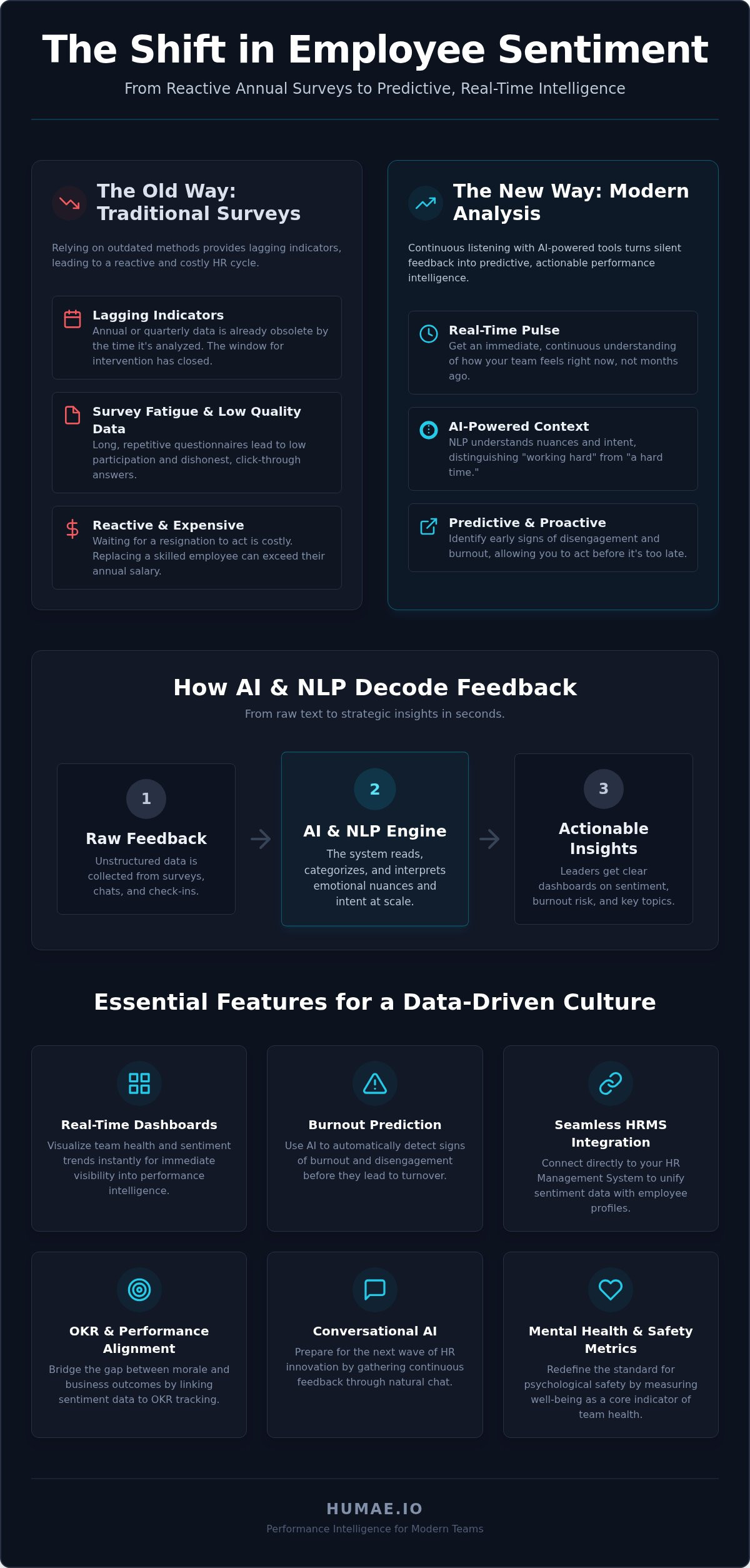
Employee sentiment is the collective emotional state and attitudes of your workforce. It is the pulse of the organization, reflecting how people truly feel about their roles, their peers, and the leadership. In 2026, relying on annual or quarterly surveys is a dangerous gamble. These traditional methods provide lagging indicators; they tell you how people felt months ago, not how they feel right now. By the time you analyze a quarterly report and see a dip in morale, your top performers might already be interviewing elsewhere. The window for intervention has already closed.
Static surveys also suffer from survey fatigue. When employees are bombarded with long, repetitive questionnaires, they stop providing honest feedback. They just click through to finish the task, which leads to poor data quality and a false sense of security for leadership. This is why modern employee sentiment analysis tools have become essential. The transition to continuous listening is no longer a luxury; it's the new standard for organizations that value their people and their time.
The Cost of Reactive HR Management
Reactive HR is expensive. When you miss the subtle signals of burnout, you're essentially waiting for a resignation letter to trigger an action plan. Replacing a skilled employee can cost significantly more than their annual salary when you factor in recruitment, onboarding, and lost knowledge. Beyond the direct costs, poor sentiment measurement leads to a slow decline in organizational productivity. Disengagement doesn't happen overnight. It's a gradual process that modern employee sentiment analysis tools can catch before it reaches the stage of a formal grievance or a total exit.
From Data Points to Human Stories
A numerical score is just a shadow of the truth. While quantitative ratings are easy to graph, they lack the qualitative depth found in unstructured feedback. Understanding the "why" behind a low score is the real goal of modern tools. It's the difference between knowing a team is unhappy and knowing they're unhappy because of a specific software bottleneck or a lack of clear direction. This is why we view employee engagement as a dynamic, living metric rather than a fixed point on a chart. By turning raw data into human stories, you can make decisions that actually resonate with your team's needs.
How AI and NLP Power Real-Time Sentiment Intelligence
Data is the lifeblood of modern HR. However, without a refined engine to process it, raw feedback remains a liability rather than an asset. Modern employee sentiment analysis tools rely on sophisticated Artificial Intelligence to bridge the gap between reading words and understanding feelings. This technology doesn't just look for keywords; it understands intent. While manual reporting takes weeks of spreadsheet gymnastics, AI delivers results in seconds. This speed allows leaders to act while the sentiment is still fresh, turning a potential crisis into a conversation.
The transition from basic keyword matching to context-aware intelligence is a game changer. Older systems might flag the word "hard" as negative, missing the context of an employee saying they are "working hard on an exciting new project." Today's AI understands the difference. It identifies complex themes like burnout, excitement, or confusion across different departments, providing a heat map of the organizational soul. This level of precision ensures that leadership decisions are based on reality, not assumptions.
The Mechanism of Sentiment Categorization
Natural Language Processing (NLP) acts as the linguistic engine in HR technology, enabling software to automatically read, categorize, and interpret the emotional nuances of employee feedback at scale. These algorithms distinguish between neutral, positive, and negative tones with remarkable accuracy. For global organizations, this intelligence must transcend borders. Modern tools now offer robust multi-language support, ensuring that a team's sentiment in Tokyo is just as visible and understood as one in Berlin. By parsing thousands of comments simultaneously, the system provides an objective view of the workplace climate that no human team could replicate.
Predictive Analytics and Early Warning Signs
The true power of AI lies in its ability to look forward. By analyzing historical data patterns, these tools can predict future turnover risks before they manifest as resignations. If the sentiment in a specific department dips below a certain threshold, managers receive real-time alerts. This proactive approach is a cornerstone of a modern workforce management framework. It empowers leaders to intervene early, offering support or resources exactly when they're needed. When you integrate these insights into your analytics dashboards, you're not just managing a team; you're nurturing a culture.
Essential Features of Top-Tier Sentiment Analysis Tools
Choosing the right employee sentiment analysis tools requires looking beyond flashy interfaces to find robust infrastructure. A top-tier platform provides real-time analytics dashboards that offer immediate visibility into team health. Speed is your greatest asset in culture management. If you're waiting weeks for a data analyst to parse results, the moment for meaningful action has passed. These tools must also integrate seamlessly with your core HRMS and directory systems, ensuring that every insight is tied to the correct team structure without manual data syncing.
Honesty requires safety. High-performing organizations use anonymous feedback channels to protect employee privacy, encouraging the kind of raw truth that drives change. However, data alone isn't enough. The most effective tools provide actionable insights that suggest specific manager interventions. Instead of just flagging a low score, the system identifies the root cause and offers a roadmap for resolution. Automated reporting then delivers these insights directly to executive stakeholders, keeping the entire leadership team aligned on cultural health.
Integration with Performance Intelligence
Sentiment data is most powerful when it's contextualized. To gain a complete view of organizational health, sentiment metrics must live alongside OKR tracking. When leadership can see how morale directly impacts goal completion, the business case for culture investment becomes undeniable. Utilizing a centralized performance intelligence features suite allows HR teams to cross-reference sentiment with productivity metrics. This creates a clear ROI for engagement initiatives, showing exactly how a boost in team happiness translates to improved business outcomes.
User Experience for Employees and Admins
Participation is the lifeblood of sentiment analysis. If your tool feels like a chore, employees will ignore it. An intuitive, modern interface is critical for maintaining high participation rates across the board. In 2026, this means offering mobile-friendly feedback options that allow team members to share their thoughts in seconds, not minutes. Automated reminders should be subtle and smart, nudging engagement without becoming a digital nuisance. For administrators, the experience must be just as fluid, with easy setup and clear data visualization that makes complex analysis feel effortless.
Trends Shaping Employee Sentiment Measurement This Year
The landscape of feedback is shifting from interrogation to conversation. In 2026, the most effective employee sentiment analysis tools have moved away from rigid, linear forms toward conversational AI. This technology allows for a more natural exchange where employees feel heard rather than monitored. Beyond simple satisfaction, organizations are now prioritizing psychological safety and mental health metrics as core performance indicators. We're also seeing a move toward hyper-local sentiment analysis. Leadership no longer looks at the company as a monolith; they analyze specific team pods to identify micro-cultures that might be thriving or struggling in isolation. By integrating this data into total rewards and retention strategies, companies can tailor their support to what people actually value.
Ethical AI and the Privacy Paradox
Deep insights shouldn't come at the cost of trust. As AI becomes more invasive, the industry has established strict standards for data encryption and anonymity. In 2026, the goal is to listen at scale while respecting the individual. To ensure your organization stays on the right side of this balance, use this checklist when assessing the ethics of an AI vendor:
- Data Aggregation: Does the tool require a minimum group size (e.g., 5 or more) before displaying results?
- Encryption: Is the data encrypted both at rest and in transit using modern protocols?
- Transparency: Can the vendor explain exactly how their AI models interpret tone without bias?
- Ownership: Does the organization retain full control over its data, with clear deletion policies?
Sentiment Analysis in Hybrid Work Environments
Hybrid work has made the "vibe" of an office harder to read. Modern employee sentiment analysis tools bridge the gap between in-office and remote experiences by measuring digital belonging as a key metric for retention. It's about ensuring a developer in Lisbon feels just as connected to the mission as a manager in the London hub. These sentiment tools effectively replace the physical office watercooler for leaders, providing a space to capture the organic pulse of the team that used to happen in hallways. When you understand the digital heartbeat of your workforce, you can build a culture that transcends physical boundaries.
Ready to see how real-time insights can transform your culture? Explore Humae's performance intelligence features to start building a more connected team today.
Humae: Integrating Sentiment with Performance Intelligence
Humae isn't just a software solution; it's a strategic partner for modern HR teams. While many employee sentiment analysis tools operate as standalone plugins, we've built an all-in-one platform that places human emotion at the heart of business operations. By combining core HRMS features with advanced sentiment intelligence, we eliminate the friction between understanding your people and managing their growth. It's a unified approach that ensures culture is never treated as a secondary priority. We believe that technology should empower leaders to be more human, not less.
The true innovation lies in our real-time analytics dashboards. For the first time, leaders can visualize team morale directly alongside OKR progress. This connection is vital. If a high-priority project is stalling, our platform helps you determine if the issue is a technical bottleneck or a dip in team engagement. This level of performance intelligence allows you to make data-driven decisions that are both effective and empathetic. We've designed the interface to be intuitive and sleek, ensuring that as your organization grows, your tools don't become a burden. Our platform adapts to your pace, providing the clarity you need without the complexity you don't.
A Visionary Approach to People Operations
Humae serves as a visionary partner in building a high-performing culture. We believe that the employee journey is a continuous story, not a series of disconnected events. By keeping hiring, onboarding, and sentiment analysis in one centralized location, you gain a 360-degree view of your workforce. This infrastructure provides actionable analytics that empower leaders to lead with confidence. You don't have to guess how a new policy is being received; you can see the impact in real time and adjust accordingly. It's about moving from reactive management to proactive leadership by having all your people data in one place.
Getting Started with Humae
Setting up your performance intelligence suite shouldn't take months. We've streamlined the onboarding process so you can start gathering insights within days, not weeks. Our simple setup allows you to sync your existing directory and begin measuring the digital heartbeat of your team immediately. We encourage you to explore the platform to see our AI-driven sentiment analysis in action and discover how it can transform your organizational health. Experience how the right employee sentiment analysis tools can bridge the gap between business goals and human needs.
Discover the Humae platform and its AI-powered features
Building a Culture of Continuous Listening
The transition toward real-time organizational intelligence is a fundamental requirement for the modern workplace. We've explored how traditional, static surveys are being replaced by sophisticated employee sentiment analysis tools that utilize NLP to decode the emotional health of a team in seconds. By connecting these insights directly to OKRs and performance intelligence, leadership can finally see the human story behind the numbers. It's about moving from guesswork to certainty while maintaining a deep commitment to the employee experience.
Humae provides the infrastructure needed to turn this vision into reality. Our AI-driven platform offers the real-time tracking and advanced analytics trusted by modern teams from fast-growing startups to global enterprises. You don't have to wait for a crisis to understand your culture; you can nurture it every single day. Take the next step in your HR evolution and start making decisions that resonate with your people.
Transform your team culture with Humae’s AI-powered sentiment analysis
Humae: Performance Intelligence for Modern Teams. Visit our Website | Home | Facebook
Frequently Asked Questions
How do employee sentiment analysis tools work?
These tools use Natural Language Processing (NLP) to analyze written feedback from surveys, chat platforms, or open-ended comments. The AI identifies linguistic patterns and emotional markers to categorize responses as positive, neutral, or negative. Instead of manual reading, the system aggregates this data at scale to provide a high-level view of the organization's emotional climate. It is about turning raw text into clear, actionable metrics for leadership teams.
Are employee sentiment analysis tools truly anonymous?
Most modern employee sentiment analysis tools prioritize anonymity to encourage honest feedback. They achieve this by aggregating data into groups, often requiring at least five to ten respondents before showing specific results for a team. This prevents managers from identifying individual contributors while still providing enough detail to address localized issues. Protecting privacy is essential for maintaining the psychological safety required for a high-performing culture.
Can AI accurately understand employee emotions in different languages?
Advanced AI engines now support dozens of languages with high accuracy. These systems don't just translate words; they understand regional idioms, cultural nuances, and specific workplace jargon. This allows global organizations to measure sentiment across diverse teams without losing the subtle emotional context that varies by location. Whether a team member writes in Spanish, German, or Japanese, the sentiment is captured and reported within a unified dashboard.
What is the difference between an engagement survey and sentiment analysis?
Engagement surveys typically measure long-term commitment and satisfaction through fixed, multiple-choice questions once or twice a year. Sentiment analysis focuses on the immediate emotional state of the workforce by analyzing open-ended text in real time. While engagement provides a snapshot of loyalty, sentiment analysis offers a continuous stream of data that captures how employees feel about specific events, changes, or day-to-day operations.
How often should a company measure employee sentiment?
The standard has shifted from annual checks to continuous listening. Measuring sentiment weekly or even daily through micro-surveys or integrated feedback loops ensures you catch disengagement before it becomes a problem. This frequent cadence allows leaders to respond to shifts in morale immediately, rather than waiting for a quarterly report. It turns HR from a reactive function into a proactive partner that moves at the speed of business.
Can sentiment analysis tools predict when an employee is about to quit?
Yes, by identifying historical patterns of disengagement that typically precede a resignation. If an employee's sentiment score drops significantly over a period of weeks, or if their language shifts from "we" to "I," the system can flag them as a turnover risk. These early warning signs allow managers to intervene with supportive conversations or resources before the employee reaches the decision to leave the organization.
What is the ROI of investing in sentiment analysis software?
The ROI is primarily seen in reduced turnover costs and increased productivity. By identifying burnout early, companies can save the high expense of recruiting and training new hires. Additionally, a workforce that feels heard is generally more productive and aligned with company goals. Aligning sentiment data with performance metrics like OKRs allows leadership to see exactly how a positive culture translates into better financial outcomes.