2026 Buyer Guide: Employee Sentiment Analysis Tools
By Humae · 30 July 2026
employee sentiment analysis tools
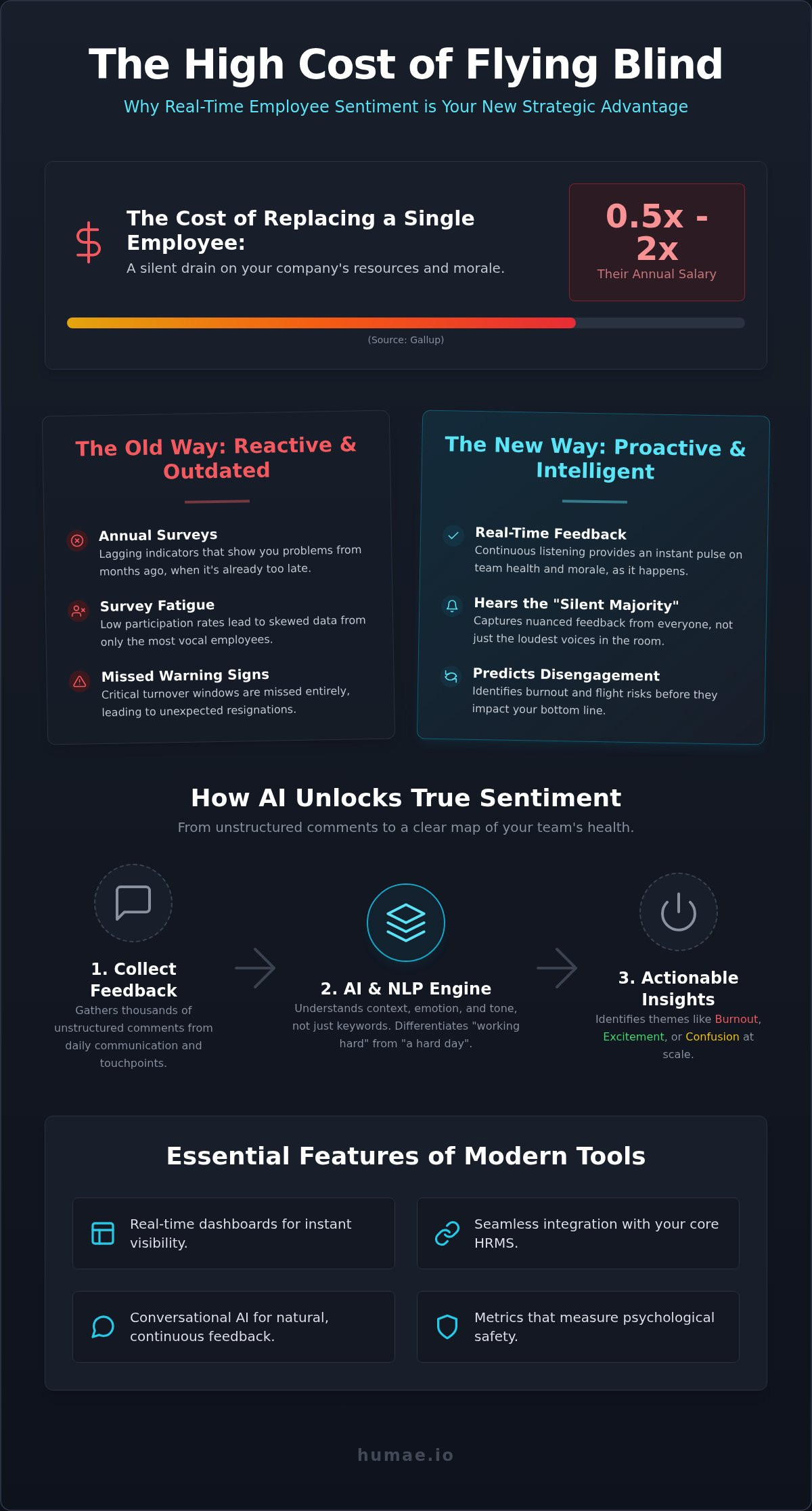
Replacing a single team member can cost your business between one-half to two times their annual salary according to Gallup. It's a staggering figure that proves waiting for an exit interview is a luxury you simply can't afford. You likely already feel the frustration of high turnover rates that seem to arrive without warning, especially when your current employee sentiment analysis tools fail to capture the nuances of the "silent majority." It's exhausting to manage unstructured feedback that feels impossible to analyze, leaving you unable to connect daily morale to your actual business outcomes.
We'll help you evaluate and implement the best technology to turn that silent feedback into actionable performance intelligence. This guide previews how to automate your feedback loops to save time and build a data-driven culture that thrives. We'll show you how to predict disengagement before it leads to a resignation letter. Let's explore how to transform your organizational listening from a manual chore into a strategic advantage for 2026.
Key Takeaways
- Learn why annual surveys fail to catch critical turnover windows and how real-time feedback provides a proactive solution for modern teams.
- Understand how AI and Natural Language Processing categorize complex emotions to help you identify burnout or excitement at scale.
- Evaluate the top employee sentiment analysis tools by focusing on essential features like real-time dashboards and seamless HRMS integration.
- Discover how conversational AI and psychological safety metrics are redefining the way organizations measure workforce health in 2026.
- See how integrating sentiment intelligence with core performance data creates a more holistic and human-centered approach to management.
Why Traditional Surveys Fail Modern Teams in 2026
Static data is a relic. In a world where business moves at light speed, relying on annual or quarterly surveys is like trying to navigate a city using a map from the 1990s. Employee sentiment is the collective emotional state and attitudes of your workforce. It's the invisible force that drives retention, productivity, and innovation. If you don't have a pulse on it, you're flying blind.
Traditional surveys are lagging indicators. They tell you what happened months ago, not what's happening today. By the time you analyze the results of a yearly check-in, your top performers might already be halfway through their onboarding at a competitor. This delay creates a massive gap where critical turnover windows are missed entirely. Modern employee sentiment analysis tools bridge this gap by providing real-time visibility into the team's needs.
There's also the issue of survey fatigue. Employees are tired of long, repetitive questionnaires that feel like a "check-the-box" exercise for HR. When participation rates drop, the quality of your data plummets. You end up with feedback from only the most frustrated or the most complacent, leaving the silent majority unheard. Continuous listening is the new standard for 2026, replacing heavy surveys with light, frequent, and meaningful touchpoints that respect an employee's time.
The Cost of Reactive HR Management
Waiting for a problem to surface before acting is a recipe for high turnover. Burnout doesn't strike suddenly; it's a gradual decline that leaves breadcrumbs in daily communication. When leadership misses these signals, the result is an expensive recruitment cycle. Beyond the hiring costs, a decline in organizational productivity follows every resignation as remaining team members shoulder the extra burden. Spotting disengagement before it reaches a formal grievance stage is the only way to protect your bottom line and your culture.
From Data Points to Human Stories
Numbers lack soul. A quantitative rating might show a dip in morale, but it won't explain the "why" behind the score. This is where Sentiment analysis technology changes the game. Instead of just counting scores, it dives into the qualitative depth of unstructured feedback, turning comments into insights. By understanding the context of employee frustration or excitement, you treat people as individuals rather than data points. This approach makes employee engagement a dynamic metric that evolves with your team, allowing for faster and more empathetic decision-making.
How AI and NLP Power Real-Time Sentiment Intelligence
Manual analysis of employee feedback is a bottleneck that modern organizations can no longer afford. In 2026, the sheer volume of digital communication makes it impossible for HR teams to read and categorize every comment manually. This is where employee sentiment analysis tools step in. They transform thousands of unstructured sentences into a clear, visual map of your team's health. The shift from slow, manual reporting to instant AI analysis means you can address a culture shift the moment it happens, not months later during a post-mortem meeting.
The real magic lies in the move from simple keyword matching to context-aware understanding. Older systems might flag the word "hard" as negative, even if an employee said they were "working hard and loving the challenge." Modern AI understands the difference. It analyzes the relationship between words to grasp the true emotional intent. This deep learning approach to sentiment analysis allows leadership to identify specific themes like burnout, excitement, or confusion across different departments with surgical precision.
The Mechanism of Sentiment Categorization
Algorithms now distinguish between neutral, positive, and negative tones by looking at the entire sentence structure. For global teams, multi-language support is vital; it ensures that cultural nuances and local idioms are interpreted correctly rather than just translated literally. NLP in HR technology is the specialized application of computational linguistics that allows software to understand and categorize the emotional intent of employee communication at scale. This automation removes human bias from the analysis, providing a more objective view of the workplace climate.
Predictive Analytics and Early Warning Signs
Predictive analytics represents the next frontier of organizational listening. By comparing current feedback against historical data, these tools can flag departments at high risk for turnover before the first resignation letter is even drafted. When team sentiment dips below a predefined threshold, managers receive real-time alerts. This proactive capability is a core component of a modern workforce management framework. It turns HR from a reactive department into a strategic partner that prevents disengagement before it spreads. You can explore how these performance intelligence features create a more resilient company culture by visiting our platform overview.
Essential Features of Top-Tier Sentiment Analysis Tools
Selecting the right technology isn't just about collecting data; it's about building a bridge between leadership and the workforce. Top-tier employee sentiment analysis tools must provide immediate visibility through real-time analytics dashboards. This allows HR leaders to see team health trends as they unfold. Integration is the backbone of this process. A tool that doesn't talk to your core HRMS or employee directory creates data silos that slow down decision-making. You need a system that fits into your existing infrastructure, not one that forces you to build around it.
Privacy is the foundation of honest feedback. Without robust, anonymous channels that protect employee identity, the data you receive will be filtered and unreliable. High-quality platforms move beyond descriptive statistics to offer actionable insights. They don't just report a dip in morale; they suggest specific manager interventions based on the identified issues. Using AI-powered sentiment analysis for monitoring employee well-being ensures that these interventions are grounded in scientific patterns rather than guesswork. Automated reporting for executive stakeholders ensures the right data reaches the right people without manual effort.
Integration with Performance Intelligence
Sentiment data is most powerful when it lives alongside your OKR tracking. Knowing that a team missed a goal is one thing; knowing they felt unsupported or confused during the process provides the full context. A centralized performance intelligence features suite allows you to cross-reference morale with productivity metrics. This creates a clearer picture of ROI, showing exactly how improved culture leads to better business outcomes. It turns "soft" data into hard evidence for strategic growth.
User Experience for Employees and Admins
Participation is the lifeblood of sentiment data. If the interface is clunky, participation will tank. An intuitive, mobile-friendly design is essential for a modern, often remote workforce. Employees should be able to share their thoughts in seconds, not minutes. Automated reminders can nudge team members to share their thoughts without feeling intrusive. For admins, the value lies in simplicity. Executive stakeholders need high-level summaries that are generated with one click, saving hours of manual spreadsheet work every month.
Trends Shaping Employee Sentiment Measurement This Year
Interaction is becoming more human even as it becomes more digital. In 2026, the most significant shift is the rise of conversational AI. Instead of clicking radio buttons on a static form, employees now engage in natural, chat-based dialogues. This makes employee sentiment analysis tools feel less like a clinical survey and more like a supportive check-in. This natural flow encourages honesty, providing a much richer dataset than a standard scale of one to ten.
We're also seeing a pivot toward psychological safety and mental health metrics. Organizations have realized that "happiness" is a superficial goal; the real driver of innovation is whether a person feels safe enough to take risks or admit mistakes. By measuring these nuances, leadership can build a culture of trust that transcends traditional performance metrics. Additionally, hyper-local analysis is replacing broad company-wide scores. Leaders now focus on specific team pods to identify micro-cultures, ensuring that a single toxic manager or a localized burnout issue doesn't go unnoticed.
Finally, sentiment data is no longer a standalone HR report. It's being integrated directly into total rewards and retention strategies. If the data shows a specific team values time-off over financial bonuses, the rewards package can be adjusted in real-time. This level of personalization is only possible when you have a continuous pulse on the workforce.
Ethical AI and the Privacy Paradox
Deep insights require data, but they shouldn't come at the cost of trust. The 2026 industry standard for data protection involves zero-knowledge encryption and strict anonymity thresholds. When assessing the ethics of an AI vendor, use this quick checklist:
- Aggregation Limits: Does the tool prevent reporting on groups smaller than five people to protect individual identities?
- Data Ownership: Is it clear that the company, not the vendor, owns the raw sentiment data?
- Transparent Logic: Can the vendor explain how the AI reaches its conclusions without hiding behind a "black box" algorithm?
Sentiment Analysis in Hybrid Work Environments
Measuring the "vibe" of an office is easy; measuring the digital belonging of a remote engineer in a different timezone is the real challenge. Modern sentiment tools bridge this gap by analyzing digital interactions to ensure remote workers don't feel isolated. These platforms effectively replace the physical office watercooler for leaders, providing a digital space where the true temperature of the organization is taken regardless of where the team sits. You can see how Humae builds this digital belonging through our integrated performance and sentiment platform.
Humae: Integrating Sentiment with Performance Intelligence
Humae represents a fundamental shift in how businesses understand their people. We've built an all-in-one AI-powered HR platform specifically for modern teams that refuse to settle for fragmented data. While many employee sentiment analysis tools offer isolated reports, Humae integrates these insights directly into your core HRMS infrastructure. This means you don't just see how people feel; you see how those feelings impact every stage of the employee lifecycle, from the first day of onboarding to long-term performance reviews. We believe that technology should serve the human experience, not complicate it.
True performance intelligence requires deep context. Our real-time analytics dashboards visualize team morale right alongside your OKR tracking and productivity metrics. If a department is hitting its targets but sentiment is plummeting, you'll know exactly where the risk of burnout lies before it leads to a resignation letter. This centralized approach allows you to cross-reference workforce health with business outcomes, turning "gut feelings" into strategic, data-driven decisions. It's a level of visibility that traditional, siloed systems simply can't provide in a fast-paced environment.
A Visionary Approach to People Operations
We see ourselves as more than a software vendor; we're a visionary partner in building your high-performing culture. By housing hiring, onboarding, and continuous sentiment analysis in one place, you eliminate the friction of switching between multiple platforms. This unified infrastructure provides actionable analytics for leaders who want to lead with both empathy and efficiency. It's about creating a workplace where everyone feels heard and every decision is backed by real-time human intelligence. Our goal is to help you build a community, not just a workforce.
Getting Started with Humae
Transitioning to a smarter way of working shouldn't be a technical hurdle for your HR team. Humae is designed with an intuitive interface that scales as your organization grows. The setup process for our performance intelligence tools is remarkably simple, allowing you to start gathering meaningful insights within days. We've removed the complexity to help you focus on what matters most: your people. We invite you to explore the platform to see our AI in action and understand how we turn silent feedback into a competitive advantage for your brand.
Discover the Humae platform and its AI-powered features.
Build a Culture That Listens and Performs
The shift toward continuous listening isn't just a trend; it's a necessity for any organization that values its people and its bottom line. By moving away from lagging annual surveys and embracing real-time employee sentiment analysis tools, you gain the ability to spot disengagement before it leads to a resignation letter. We've explored how AI and NLP turn unstructured chatter into clear, actionable intelligence that connects daily morale directly to your business outcomes. This proactive approach ensures that no team member feels unheard and no cultural shift goes unnoticed.
Integrating these insights with your performance metrics creates a holistic view of your team's health. You can now see the "why" behind the numbers, allowing for empathetic leadership backed by hard data. Whether you're managing a small pod or a global enterprise, the goal remains the same: creating an environment where every voice matters and every goal is reachable. It's time to move beyond static data and embrace a dynamic, human-centered strategy.
Ready to lead with clarity? Transform your team culture with Humae’s AI-powered sentiment analysis. Our platform offers AI-driven performance intelligence and real-time OKR tracking trusted by modern teams at every scale. Let's build a more human workplace together.
Frequently Asked Questions
How do employee sentiment analysis tools work?
These tools use Natural Language Processing (NLP) to scan text from internal feedback channels, pulse surveys, or open-ended comments. By breaking down sentence structure and word choice, the software identifies the emotional intent behind the message. It then categorizes these data points into themes like burnout or excitement, providing a visual map of team health without requiring manual reading.
Are employee sentiment analysis tools truly anonymous?
Most modern employee sentiment analysis tools prioritize anonymity by aggregating data to protect individual identities. They typically require a minimum number of respondents, often five or more, before revealing insights for a specific team pod. This ensures that individual voices are protected while still providing leadership with a clear understanding of the collective mood without compromising employee trust.
Can AI accurately understand employee emotions in different languages?
Yes, 2026 AI models are designed to understand cultural nuances and local idioms rather than just literal translations. These systems use multi-language training sets to detect sarcasm or indirect phrasing specific to various regions. This allows global organizations to maintain a consistent understanding of morale across different geographic locations without losing the essential human context of the feedback.
What is the difference between an engagement survey and sentiment analysis?
Engagement surveys are typically periodic, structured questionnaires that provide a lagging snapshot of how employees felt in the past. In contrast, employee sentiment analysis tools offer a continuous, AI-driven process that monitors the emotional pulse of the organization in real-time. While surveys ask specific questions, sentiment analysis interprets the "why" behind unstructured comments, offering deeper qualitative depth.
How often should a company measure employee sentiment?
Continuous measurement is the new standard for modern teams. Instead of waiting for a quarterly review, companies should use weekly pulse checks or real-time listening tools. This frequency allows managers to catch shifts in morale immediately, preventing small issues from snowballing into larger cultural problems or high turnover rates that impact the bottom line.
Can sentiment analysis tools predict when an employee is about to quit?
Yes, by identifying patterns of declining engagement and specific language associated with burnout. Predictive analytics compare current feedback against historical turnover data to flag departments at high risk. This early warning system gives leadership the chance to intervene with targeted support or rewards before a resignation letter is ever written.
What is the ROI of investing in sentiment analysis software?
The ROI is primarily found in reduced recruitment and onboarding costs. Since replacing an employee can cost between one-half to two times their annual salary, preventing even a few resignations pays for the software many times over. Additionally, higher morale is directly linked to increased productivity and a more resilient organizational culture that attracts top talent.
Is it ethical to use AI to analyze employee feedback?
It's ethical when implemented with transparency and a focus on employee well-being rather than surveillance. Organizations must clearly communicate how the data is used and ensure strict anonymity standards are met. When used as a tool for support and cultural improvement, AI-driven analysis becomes a powerful way to show employees that their voices lead to tangible change.