15 High-Impact Employee Retention Strategies for Modern Teams in 2026
By Humae · 19 August 2026
employee retention strategies
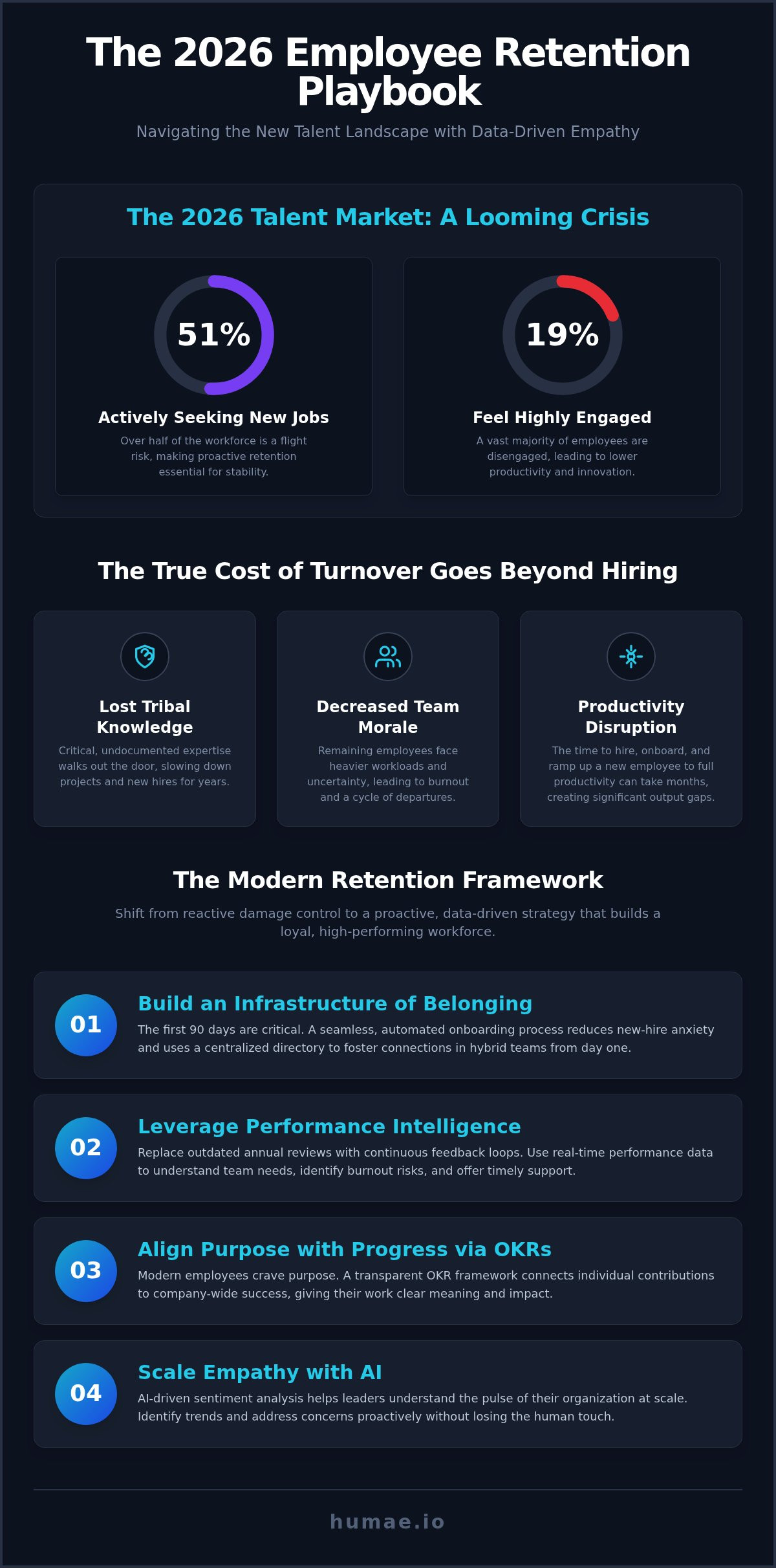
Did you know that in 2026, 51% of employees are actively looking for new job opportunities? It's a startling reality for leaders who feel the heavy sting of losing tribal knowledge. Every time a senior member leaves, the high cost of replacement hiring hits your bottom line. You've likely noticed that traditional perks don't hold the same weight they used to in our hybrid world, where only 19% of the workforce feels highly engaged and effective employee retention strategies are harder to find than ever.
Building a loyal team isn't about guessing what people want; it's about using data to fuel empathy. We'll show you how to combine AI-driven performance intelligence with the human-centric leadership your team actually craves. You'll discover fifteen actionable methods to stabilize your turnover rates, boost morale, and create a culture that naturally attracts the industry's best talent. From real-time OKR tracking to sentiment analysis, we're diving into the specific infrastructure needed to sustain a high-performing, loyal workforce that stays for the long haul.
Key Takeaways
- Learn why the first 90 days are the foundation of loyalty and how a centralized employee directory builds connections across hybrid teams.
- Shift from outdated annual reviews to continuous feedback loops by using performance intelligence to understand your team's real-time needs.
- Discover how modern employee retention strategies leverage transparent OKR frameworks to align individual purpose with company-wide success.
- Explore how AI-driven sentiment analysis helps leaders scale empathy without losing the personal touch that keeps top talent engaged.
- Master the integration of directory, performance, and OKR tracking to build a cohesive organizational culture that survives the 2026 talent market.
The New Science of Employee Retention Strategies in 2026
Employee retention is no longer a human resources checkbox; it's a high-stakes battle for organizational stability. The New Science of Employee Retention defines this process as a strategic, intentional effort to keep high-value talent through deep engagement and personalized growth paths. In 2026, passive retention is officially dead. AI-driven recruitment platforms now scan the global talent pool 24/7, identifying your best people before they even realize they're ready for a change. If you aren't actively cultivating a reason for your team to stay, a competitor's algorithm is already building a reason for them to leave.
The hidden costs of turnover go far beyond simple recruitment fees. When a key player exits, you lose more than a pair of hands; you lose tribal knowledge that can take years to replace. Productivity takes a massive hit, and the remaining team often suffers from morale dips as they shoulder the extra workload. Modern infrastructure is the only foundation that can support a successful retention plan. Without centralized tools like a modern HRMS, leaders are essentially flying blind, unable to see the warning signs of a disengaged workforce.
Understanding Voluntary Turnover in the Modern Era
We've witnessed a definitive shift from "job security" to "career agility." Employees in 2026 don't just want a steady paycheck; they want a platform that accelerates their professional value. Workplace flexibility and remote-first cultures have become the baseline expectation. When talent leaves today, it's rarely just about the money. Most departures are driven by a lack of clear growth opportunities, poor management, or technological frustration. If your team feels held back by clunky, outdated software, they'll find a company that values their time and provides the digital tools they need to excel.
The ROI of a Data-Driven Retention Framework
The financial impact of a solid retention strategy is undeniable. Reducing turnover by even 10% can save a mid-sized organization millions in training costs and lost momentum. By leveraging performance intelligence, leaders can now move from reactive damage control to proactive engagement. Data allows you to identify patterns, such as a sudden dip in OKR progress or changes in sentiment, that signal a high-performer is at risk of burnout. In 2026, employee retention strategies serve as the ultimate competitive advantage for organizations that want to lead their industry. Using analytics to predict turnover before it happens ensures your team stays focused, happy, and productive.
Building the Infrastructure of Belonging from Day One
Belonging isn't a feeling that just happens. It's a structure you build. The first 90 days of an employee's journey determine whether they'll stay for years or leave in months. During this critical window, your employee retention strategies are put to the ultimate test. If your onboarding process is a chaotic mess of emails and missing logins, you're already losing the battle. Modern teams need a foundation that removes friction and emphasizes connection. Understanding What is an HRIS? is the first step toward creating this environment. It's not just about data storage; it's the digital home where a new hire first experiences your brand's values. By automating the boring parts of administrative setup, you allow managers to spend their time where it matters most: building genuine human relationships.
Seamless Onboarding: Beyond the Paperwork
Onboarding shouldn't be about chasing signatures. It's about culture. By using digital workflows to handle repetitive administrative tasks, you free up your leadership to focus on the human side of the business. Integrated task management ensures that every new hire has a clear roadmap from their first hour. This clarity reduces the new-hire fog and lowers anxiety significantly. When a person knows exactly what they need to do and has the tools to do it, they feel an immediate sense of competence. Effective employee retention strategies also prioritize social onboarding. This involves structured introductions to peers and cross-functional partners, ensuring that the new hire feels like a part of the team before their first week ends.
The Employee Directory as a Culture Tool
In remote or hybrid settings, silos form quickly and quietly. A centralized employee directory is the antidote to this isolation. It's not just a list of phone numbers; it's a map of your company's collective intelligence. When an employee can easily find a mentor or see who has expertise in a specific niche, they feel connected to a larger mission. Transparent organizational charts help everyone understand where they fit and how they can grow. By integrating personal interests, hobbies, and unique skills into professional profiles, you transform a sterile database into a vibrant culture tool. This visibility makes it easier to build the cross-team connections that are vital for long-term loyalty. You can explore how a centralized directory bridges the gap between distant colleagues and fosters a sense of community.
Leveraging Performance Intelligence for Proactive Engagement
Annual performance reviews are a relic of a slower era. In 2026, waiting twelve months to check in on your team is a recipe for high turnover. High-performing organizations now rely on performance intelligence to maintain Employee Engagement Strategies that adapt in real-time. Performance intelligence isn't just about tracking output; it's about using data to understand the evolving needs of your workforce. By integrating AI-driven sentiment analysis, leaders can identify the subtle signs of burnout long before it leads to a resignation letter. This proactive approach allows you to intervene with support exactly when it's needed, rather than conducting an exit interview after the damage is done. Creating a fair and inclusive environment is central to high-impact employee retention strategies, and data provides the objectivity needed to keep those promises.
The Power of Continuous Feedback
Continuous feedback is the heartbeat of psychological safety. When feedback becomes a daily habit rather than a quarterly event, you eliminate the grievance build-up that often poisons company culture. This environment of radical candor allows teams to address friction points immediately. Managers shift from being judges to being coaches, using intelligence tools to guide meaningful one-on-ones. They don't just ask how things are going; they come prepared with data-backed insights into what's blocking their team's success. This shift ensures that every employee feels their growth is a priority for the organization.
Actionable Analytics Dashboards for HR Leaders
Analytics dashboards provide the bird's-eye view HR leaders need to spot trends across different departments. If one team shows a sudden drop in participation or a spike in time-off requests, the system flags it as a potential retention risk. These metrics aren't just cold numbers; they are signals of the human experience within your company. By tracking engagement metrics alongside performance data, you can see where the culture is thriving and where it needs a human touch. These dashboards transform raw data into empathy by highlighting the specific human needs behind every performance metric.
Aligning Purpose with Progress through OKR Frameworks
Transparency isn't just a corporate buzzword; it's a retention powerhouse. When an employee feels their work disappears into a void, they quickly start looking for the exit. One of the most effective employee retention strategies is ensuring that every team member understands exactly how their daily tasks fuel the company's mission. OKR frameworks turn abstract goals into tangible progress, providing the clarity needed to keep high-performers engaged. To implement this effectively, you must first understand the OKR Meaning and how it bridges the gap between individual effort and organizational success. OKR tracking software prevents that drifting feeling of "I don't know why I am here" by making impact visible to everyone.
Implementing OKRs for Individual Growth
Success with OKRs requires a structured approach that prioritizes the person as much as the result. First, set ambitious yet achievable individual objectives. These should stretch the employee's capabilities without causing burnout. Second, align these objectives with the broader team and company mission. If a developer sees how their specific code optimization directly supports a goal of 99.9% uptime, their sense of ownership sky-rockets. Finally, update key results weekly to maintain momentum. This rhythm keeps goals top-of-mind and allows for quick pivots before frustration sets in.
Transparency as a Retention Driver
Visible OKRs are the ultimate antidote to office politics and perceived favoritism. When every team member can see what their colleagues are working toward, trust becomes the default setting. Progress tracking also has a massive psychological impact. Celebrating small wins as key results move from 20% to 80% creates a "win streak" mentality that is highly addictive in the best way possible. Furthermore, these frameworks help managers identify professional development opportunities. If an employee consistently hits their targets in a specific area, it's a clear signal they are ready for more responsibility or specialized training. You can align your team's purpose today with Humae and turn goal-setting into a competitive advantage.
Scaling a Human-Centric Culture with Humae AI
Technology often feels like a barrier between leaders and their teams. At Humae, we've flipped that script by designing a platform where technology serves the human experience. Our approach centralizes your most vital workforce management tools into a single, intuitive interface. By integrating the employee directory, performance intelligence, and OKR tracking, we eliminate the friction of jumping between disconnected apps. This unified ecosystem allows you to execute complex employee retention strategies with precision and heart. When your infrastructure is seamless, your culture becomes scalable. Having one source of truth for time-off management and applicant tracking ensures that every stage of the employee lifecycle is handled with care. You can explore the full potential of this integrated approach at humae.io.
AI that Empowers; Not Replaces; Managers
AI shouldn't replace managers; it should empower them to be more human. By automating the repetitive administrative tasks that eat up your day, Humae frees you to focus on genuine connection. Our AI-driven insights help you personalize the employee experience at scale. Instead of generic policies, you can offer support tailored to individual sentiment and performance data. Imagine a system that alerts you when a high-performer's engagement patterns shift, allowing you to have a supportive conversation before they even consider looking elsewhere. The future of HR is predictive, personalized, and deeply empathetic. It's about seeing the person behind the data point and acting before a small frustration becomes a reason to quit. This technology allows you to scale empathy across a global, hybrid workforce without losing the personal touch that defines your brand.
Ready to Transform Your Retention Strategy?
Transforming your retention strategy starts with a commitment to modernizing your infrastructure. The key takeaways for immediate implementation are clear: prioritize belonging from day one, leverage continuous feedback, and align individual purpose with company goals. These aren't just abstract ideas; they are actionable steps you can take today using a modern HRMS. If you're ready to see how these elements work together, you can start a trial or schedule a demo with Humae today. Our platform is designed for organizations that refuse to settle for high turnover and low morale. Don't wait for your turnover rates to climb before you take action. In the competitive talent market of 2026, the organizations that act now to build a supportive, data-informed culture will be the ones that thrive. Your team deserves a workplace that values their contribution and supports their growth.
Leading the Future of Workforce Loyalty
The talent market of 2026 demands more than just competitive salaries; it requires a culture built on transparency and scalable empathy. By integrating real-time OKR tracking and AI-driven sentiment analysis, you move from simply reacting to turnover to meeting your team's needs before they even arise. A centralized employee directory ensures that even in complex remote environments, every team member feels visible and connected to the larger mission. Mastering these modern employee retention strategies ensures your organization remains a premier destination for top-tier talent. Transitioning from traditional management to a data-informed, human-centric approach is the only way to protect your tribal knowledge and sustain growth. It's time to stop managing attrition and start building an infrastructure where your people feel truly valued and inspired.
Discover the Humae platform: the AI-powered HR infrastructure for modern teams and transform your workplace into a high-performing community today.
Your team is your most valuable asset. Investing in their growth and daily experience is the smartest move you can make for a thriving, loyal workforce that carries your vision forward.
Frequently Asked Questions
What are the most effective employee retention strategies for startups?
Startups thrive on ownership and clear impact. The most effective employee retention strategies for smaller teams involve offering equity, fostering a culture of radical transparency, and providing clear paths for rapid career advancement. Because startups often can't compete on salary alone, they must excel at providing a sense of purpose. Using tools like real-time OKR tracking helps every member see their direct contribution to the company's survival and success, which creates a powerful bond of loyalty.
How does AI help in reducing employee turnover?
AI reduces turnover by identifying patterns of disengagement long before an employee decides to quit. Through sentiment analysis and performance intelligence, AI can flag sudden drops in participation or changes in communication tone. These signals allow managers to intervene with supportive conversations or workload adjustments. Instead of relying on gut feelings, leaders use data-driven insights to address burnout proactively, ensuring that high-performers feel supported and understood in a fast-paced environment.
Can an HRMS really improve company culture?
Yes, an HRMS improves culture by removing the administrative friction that often leads to employee frustration. When processes like time-off management and onboarding are automated and seamless, employees feel that the organization respects their time. A centralized platform also serves as a digital home for the team, fostering a sense of stability. By centralizing workforce management, an HRMS allows leaders to focus on human connection rather than getting lost in spreadsheets and paperwork.
What is the difference between employee engagement and retention?
Employee engagement is the emotional commitment an employee has to their work, while retention is the actual outcome of keeping them on the payroll. Engagement is the "why" and retention is the "result." High-impact employee retention strategies focus on boosting engagement through meaningful work and recognition. When employees are highly engaged, they are statistically less likely to leave, but retention also requires structural support like competitive benefits and clear career progression frameworks.
How often should we update our OKRs for better retention?
You should update your OKRs weekly to maintain momentum and ensure alignment across the team. Frequent updates prevent goals from becoming stagnant or irrelevant in a shifting business environment. This rhythm allows for small celebrations of progress, which has a significant psychological impact on motivation. When employees see their key results moving regularly, they feel a sense of achievement and purpose, which is a major factor in long-term organizational loyalty.
Is remote work still a top driver for retention in 2026?
Remote work remains a critical driver for retention, but in 2026, it's viewed as a baseline expectation rather than a perk. Flexibility in where and when people work is now a standard requirement for top talent. However, the focus has shifted toward how companies support remote workers through digital infrastructure. Success depends on providing tools that foster connection and visibility, ensuring that distant team members don't feel isolated or overlooked during promotion cycles.
How do we measure the success of our retention strategies?
Measuring the success of your retention efforts involves tracking both quantitative metrics like turnover rates and qualitative data like employee Net Promoter Scores (eNPS). You should analyze voluntary turnover specifically among your high-performers to see if your best people are staying. Additionally, monitoring the adoption of internal tools and the frequency of feedback loops provides real-time data on cultural health. Consistent sentiment analysis helps you understand the "why" behind the numbers you see.
What role does an employee directory play in team engagement?
An employee directory plays a vital role in engagement by making expertise and personal connections visible across the entire organization. It helps employees find mentors, identify subject matter experts, and connect over shared interests outside of work. In hybrid or remote teams, a directory reduces silos by showing the human side of colleagues. When people can easily see who they are working with and how to reach them, collaboration becomes more natural and inclusive.