15 Employee Retention Strategies to Future-Proof Your Workforce in 2026
By Humae · 2 August 2026
employee retention strategies
Your top performer just accepted a competitor's offer. You saw it coming but didn't have the data to act in time. Sound familiar? In a talent market shaped by AI, remote work, and rising employee expectations, the cost of losing great people has never been higher — and the traditional playbook simply isn't keeping up.
You already know that high turnover drains budgets, fractures team cohesion, and stalls growth. What's changing fast is why people leave — and how quickly disengagement can take root before a single resignation letter lands on your desk. The good news is that the right employee retention strategies in 2026 don't rely on guesswork. They're built on real-time intelligence, continuous feedback loops, and technology that actually understands your people.
This article breaks down 15 proven strategies to help you reduce turnover, strengthen team alignment, and build a culture where your best talent genuinely wants to stay. From AI-driven sentiment analysis to smarter OKR tracking, you'll walk away with a clear, actionable framework for future-proofing your workforce starting today.
Key Takeaways
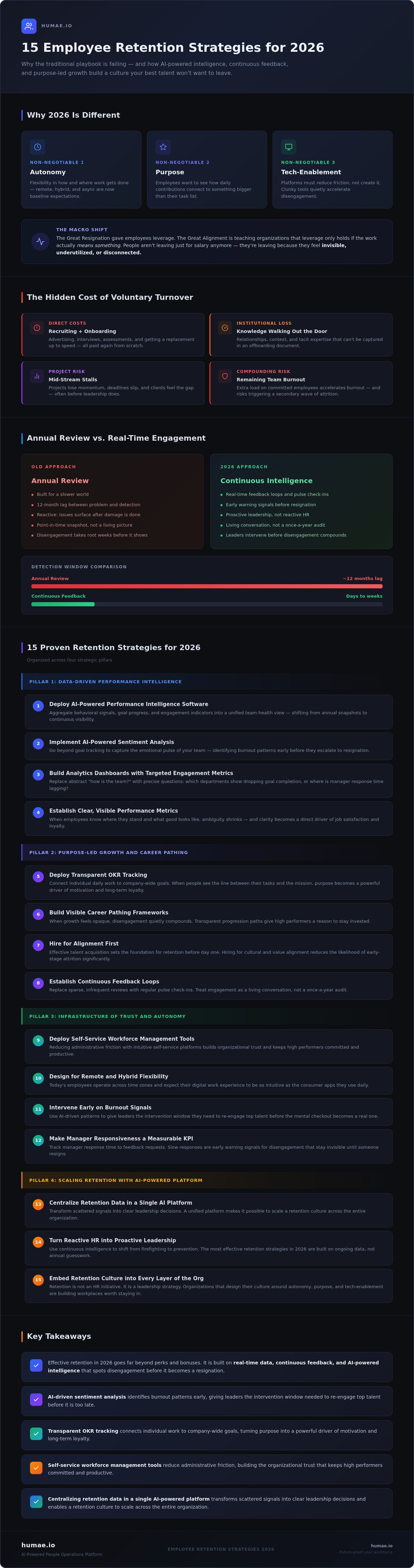
- The most effective employee retention strategies in 2026 go far beyond perks and bonuses — they are built on real-time data, continuous feedback, and AI-powered intelligence that spots disengagement before it becomes a resignation.
- AI-driven sentiment analysis and performance intelligence tools can identify burnout patterns early, giving leaders the window they need to intervene and re-engage top talent before it is too late.
- Transparent OKR tracking connects individual daily work to company-wide goals, turning purpose into a powerful driver of motivation and long-term loyalty.
- A modern workforce management infrastructure reduces administrative friction through self-service tools, building the organizational trust that keeps high performers committed and productive.
- Centralizing retention data in a single AI-powered platform transforms scattered signals into clear leadership decisions, making it possible to scale a retention culture across your entire organization.
The Evolution of Employee Retention: Why 2026 is Different
Something fundamental shifted in the workforce over the past few years. The Great Resignation taught employees that they had leverage. What followed, the Great Alignment, is teaching organizations that leverage only holds if the work actually means something. People aren't just leaving for higher salaries anymore. They're leaving because they feel invisible, underutilized, or disconnected from a purpose larger than their task list.
The old retention toolkit, think Friday pizza, open-plan offices, and annual bonuses, was designed for a workforce that no longer exists. Today's employees operate across time zones, toggle between remote and hybrid setups, and expect their digital work experience to be as intuitive as the consumer apps they use daily. When the tools are clunky, the feedback is sparse, and growth feels opaque, disengagement doesn't announce itself. It quietly compounds.
The 2026 workforce is shaped by three non-negotiables: autonomy, purpose, and tech-enablement. Employees want flexibility in how and where they work. They want to see how their daily contributions connect to something bigger. And they expect the platforms supporting their work to reduce friction, not create it. Organizations that design around these expectations are building cultures worth staying in. Those that don't are funding their competitors' recruiting pipelines.
The High Cost of Voluntary Turnover in the Modern Era
Voluntary turnover is expensive in ways that rarely show up cleanly on a balance sheet. Beyond the direct costs of recruiting and onboarding a replacement, organizations absorb a quieter drain: the institutional knowledge walking out the door, the projects stalling mid-stream, and the remaining team members absorbing extra load while leadership scrambles to backfill. That added pressure accelerates burnout among your most committed people, creating a compounding retention risk that's hard to reverse once it takes hold. Critically, effective talent acquisition practices can set the foundation for retention long before day one, because hiring for alignment reduces the likelihood of early-stage attrition.
Moving Beyond Annual Reviews to Real-Time Engagement
The annual performance review was built for a slower world. In a market where disengagement can take root within weeks of a negative experience, waiting twelve months to surface problems isn't a strategy; it's a liability. Continuous feedback loops, pulse check-ins, and real-time sentiment signals give leaders the visibility to intervene early. This is the foundation of modern people operations: treating employee engagement not as a once-a-year audit but as a living, ongoing conversation. The most effective employee retention strategies in 2026 are built on exactly this kind of continuous intelligence, turning reactive HR into proactive leadership.
Data-Driven Retention: Using Performance Intelligence
Gut instinct isn't a retention strategy. By the time a manager senses something is wrong, the employee has often already mentally checked out, updated their LinkedIn profile, and started taking recruiter calls. Employee performance intelligence software changes that equation entirely by giving leaders a continuous, data-backed view of team health rather than a snapshot taken once a year.
At its core, performance intelligence software aggregates behavioral signals, goal progress, feedback patterns, and engagement indicators into a unified picture of how your people are actually doing, not how you assume they are. When clear performance metrics are visible to both employees and managers, something important happens: ambiguity shrinks. People know where they stand, what good looks like, and how their work connects to outcomes that matter. That clarity is a direct driver of job satisfaction and, by extension, loyalty.
Analytics dashboards add another layer of precision. Instead of asking "how is the team doing?" in the abstract, leaders can ask targeted questions: Which department has seen a drop in goal completion rates over the last six weeks? Where is manager response time to feedback requests lagging? These aren't just operational questions. They're early warning signals for disengagement that would otherwise stay invisible until someone resigns.
AI-Powered Sentiment Analysis: The Pulse of Your Team
Sentiment analysis tools go beyond tracking what employees say and start interpreting how they feel. By processing qualitative responses from pulse surveys, check-in comments, and ongoing feedback channels, AI can identify language patterns that correlate with disengagement, frustration, or burnout risk. A comment like "I feel like my work doesn't matter here" carries a very different weight than "I'm stretched thin this quarter," and modern sentiment tools are built to recognize that difference.
The result is qualitative data that actually drives decisions. Instead of a manager reading through hundreds of open-text responses and making subjective judgments, the system surfaces themes, flags anomalies, and prioritizes where attention is needed. Privacy remains a critical design consideration here: well-built platforms aggregate and anonymize responses at the team level, so individuals are protected while leadership still gains genuine cultural insight. The goal isn't surveillance. It's understanding.
Platforms like Humae are built around exactly this principle, combining AI-driven sentiment analysis with continuous feedback infrastructure so that people operations teams can act on real signals rather than waiting for exit interview data that arrives too late.
Predictive Analytics in Workforce Planning
Historical engagement data is one of the most underused assets in workforce planning. When you analyze patterns across previous departures, you start to see recurring precursors: a drop in goal activity, a decline in peer recognition exchanges, reduced participation in team check-ins. Predictive analytics tools use these patterns to flag current employees who are showing similar trajectories, giving HR and people leaders a window to intervene before a flight risk becomes a resignation.
Proactive intervention for high-potential employees doesn't have to be dramatic. Sometimes it's a timely conversation about growth opportunities. Sometimes it's adjusting workload distribution before burnout sets in. The key is having the data early enough to make those conversations feel supportive rather than reactive.
None of this works without data integrity at the foundation. An integrated HRIS ensures that the information feeding your predictive models is accurate, current, and consistent across the organization. Fragmented data produces fragmented insights. When your systems talk to each other, your employee retention strategies stop being reactive and start becoming genuinely predictive.
Purpose-Led Growth: OKR Tracking and Career Pathing
People don't leave jobs. They leave situations where their work feels pointless. When employees can't see how their daily tasks connect to something larger, motivation erodes quietly and consistently until the only logical next step is finding somewhere that offers clearer direction. Goal transparency isn't a nice-to-have in 2026; it's one of the most underestimated employee retention strategies available to modern leaders.
The psychological mechanism here is straightforward. Seeing real-time progress toward meaningful goals triggers a sense of momentum that's deeply motivating. When that visibility disappears, when goals are set in January and revisited in December, employees fill the gap with uncertainty. Uncertainty breeds disengagement. And disengagement, as we've established, compounds fast.
OKR tracking software closes that gap by making goal progress a living, visible part of how work happens every day, not a periodic event managed through a spreadsheet. When managers use OKR data to structure regular one-on-ones, those conversations shift from status updates to genuine development discussions. That shift matters enormously for retention.
Defining OKR Meaning for Modern Teams
KPIs measure performance against a fixed standard. OKRs do something different: they align ambition with direction. A KPI tells you whether you hit your number. An OKR tells you whether you're moving toward something that actually matters. For a deeper breakdown of how this framework operates in practice, OKR Meaning: The Definitive Guide is worth reading in full.
In a retention context, the distinction is critical. KPIs can feel like a measuring stick. OKRs, when set correctly, feel like a shared mission. The key is calibration: objectives should be ambitious enough to inspire, but key results need to be specific and achievable enough that progress is visible within weeks, not quarters. That visible progress is what keeps high performers engaged rather than restless.
Career Pathing as a Retention Lever
Knowing what you're working toward today matters. Knowing where it leads tomorrow matters more. Career pathing connects individual growth to organizational needs, making advancement feel like a system rather than a mystery. When employees can see a transparent map of what promotion looks like, which skills are required, which milestones signal readiness, they invest in their own development rather than scanning job boards.
Performance intelligence tools play a direct role here. By identifying skill gaps across teams, they give managers the data to have honest, specific conversations about what's needed for the next level. Vague encouragement doesn't build loyalty. Clear criteria do. Organizations that combine real-time OKR tracking with performance intelligence can match individual growth trajectories to actual business needs, creating advancement pathways that benefit both the employee and the organization simultaneously.
The result is a growth mindset that's structural, not aspirational. When people believe the organization is genuinely invested in their trajectory, they stay to see it through.
The Infrastructure of Trust: Modern Workforce Management
Trust isn't built through mission statements. It's built through systems that work. When an employee submits a time-off request and hears nothing for three days, when onboarding paperwork is still being chased in week two, when there's no easy way to find a colleague's contact details across a distributed team, confidence in the organization quietly erodes. These aren't minor inconveniences. They're signals about how much the company actually values its people's time. And in 2026, that signal travels fast.
Workforce management infrastructure is the operational backbone of retention. Get it right, and employees experience an organization that respects them. Get it wrong, and no amount of purpose-driven OKR work or sentiment analysis will compensate for the daily friction that makes good people quietly start looking elsewhere. The most overlooked employee retention strategies aren't always the most glamorous; sometimes they're simply about removing the administrative noise that chips away at engagement day after day.
Three areas matter most here:
- Self-service tools that let employees manage their own information, requests, and schedules without routing everything through a manager or HR inbox
- Transparent time-off management that applies consistent policies fairly, so no one feels like approvals are arbitrary or politically influenced
- A centralized employee directory that makes it easy to find, connect with, and understand the humans behind the job titles across a hybrid or distributed organization
That last point deserves more credit than it typically gets. A well-built employee directory doesn't just solve a logistical problem. It actively builds camaraderie by making the organization feel smaller, more connected, and more human, even when teams are spread across multiple time zones. When people can see who they're working with, what those people own, and how to reach them, collaboration accelerates and isolation decreases. Both outcomes directly support retention.
Modern Onboarding: The First 90 Days
The first 90 days are when loyalty is either built or quietly abandoned. Automating the administrative side of onboarding, contracts, policy acknowledgments, system access, benefits enrollment, frees up HR and managers to focus on what actually shapes a new hire's experience: real conversations, meaningful introductions, and clear expectations. When an HRMS handles the paperwork from day one, the human energy that remains can go toward making someone feel genuinely welcomed rather than processed. For a deeper look at how this infrastructure fits together, What is Workforce Management? covers the full framework in practical terms.
Flexibility Through Technology
Managing hybrid schedules without micromanagement requires tools that make visibility the default rather than the exception. Mobile-first HR tools let employees log availability, check team schedules, and submit requests from wherever they're working, without needing a manager to act as the intermediary. That autonomy matters. When managers are freed from administrative coordination, they can spend their time on what actually drives retention: coaching, developing, and genuinely connecting with their people.
This is the kind of employee retention strategy that competitors rarely discuss in enough depth. Flexibility is easy to promise. The infrastructure to deliver it consistently, fairly, and without creating management overhead is where most organizations fall short. Explore how Humae's workforce management tools reduce that friction and give your team the experience they actually expect in 2026.
Scaling Retention with Humae: The AI-Powered Advantage
Scattered data doesn't build retention cultures. Disconnected tools, siloed feedback systems, and dashboards that don't talk to each other force leaders into reactive decisions made on incomplete information. The organizations winning the talent war in 2026 aren't necessarily the ones with the biggest budgets. They're the ones operating from a single, coherent picture of their people.
Humae is built around exactly that premise. By centralizing performance intelligence, sentiment analysis, OKR tracking, and workforce management into one AI-powered platform, it gives people leaders the kind of visibility that turns instinct into informed action. When every relevant signal lives in the same interface, the gap between noticing a problem and solving it shrinks dramatically. That speed is where retention is actually won or lost.
The impact on leadership decision-making is direct. Instead of triangulating between a performance tool, a separate engagement survey platform, and a spreadsheet tracking goal progress, leaders get a unified view that connects the dots automatically. A drop in OKR completion rates, paired with a shift in sentiment signals from a specific team, tells a very different story than either data point would on its own. Humae surfaces that story before it ends in a resignation.
Key Features for Retention Leaders
The platform's retention-focused capabilities work together rather than in isolation:
- Real-time OKR tracking keeps individual goals connected to team and company-wide direction, giving employees the sense of momentum that drives long-term commitment
- AI-driven sentiment analysis processes continuous feedback signals to identify burnout risk and disengagement patterns early, before they become exit conversations
- Customizable analytics dashboards translate people data into the C-suite reporting formats that drive budget decisions and strategic workforce planning
- Performance intelligence tools identify skill gaps, flag flight risks, and give managers the specific data they need to have growth conversations that actually land
- Applicant Tracking System and onboarding infrastructure extend the retention mindset back to day one, because alignment built during hiring compounds over the entire employee lifecycle
This is the kind of integrated infrastructure that separates organizations with genuine employee retention strategies from those simply reacting to turnover after it happens. Both startups scaling quickly and enterprises managing complex distributed teams are choosing Humae because the alternative, patching together multiple point solutions, creates exactly the kind of friction that erodes the employee experience over time.
Getting Started with Modern HR Infrastructure
Transitioning from legacy systems doesn't have to be disruptive. The most effective starting point is identifying where your current tools create blind spots: where feedback goes unread, where goal progress goes invisible, where engagement data arrives too late to act on. Humae is designed to replace that fragmentation with a single, intuitive layer that your team actually wants to use.
The first step is understanding what's possible. Explore Humae's features to see how each capability maps to a specific retention challenge your organization is likely already facing. Then see how it works to understand how the platform fits into your existing people operations workflow without creating new overhead.
Building a workforce that stays isn't about adding another perk to the benefits page. It's about creating the conditions where great people can see their impact, feel genuinely heard, and grow toward something real. That's the employee retention strategy that compounds over time, and it starts with the right infrastructure. Visit Humae to take the next step.
Humae | AI-Powered HRMS for Modern Teams | humae.io
Follow us on Facebook for the latest updates on people operations, HR technology, and workforce strategy.
Your Next Move Starts Now
The organizations that will win the talent competition in 2026 aren't waiting for exit interviews to tell them what went wrong. They're building the kind of environments where great people genuinely choose to stay, and they're doing it with real-time data, not gut instinct.
Effective employee retention strategies come down to three things working together: catching disengagement early through AI-driven sentiment analysis, keeping every team member aligned through real-time OKR tracking, and removing the daily friction that quietly erodes trust through centralized workforce management infrastructure. When these elements connect, retention stops being reactive and starts being a genuine competitive advantage.
The gap between organizations that retain top talent and those that constantly backfill it isn't luck. It's infrastructure. It's intelligence. It's the decision to act before someone updates their LinkedIn profile.
You don't have to figure this out alone. Build a workforce that stays with Humae and give your people the experience they expect in 2026. Your best team is worth it.
Frequently Asked Questions About Employee Retention Strategies
What are the most effective employee retention strategies for 2026?
The most effective employee retention strategies in 2026 combine real-time data with genuine human investment. That means continuous feedback loops instead of annual reviews, transparent goal tracking that connects daily work to company direction, and workforce management tools that reduce the administrative friction employees encounter every day. Perks still matter, but they don't compensate for feeling invisible, undervalued, or unclear about where your career is heading.
The organizations consistently outperforming on retention share one common thread: they act on signals early. They don't wait for exit interviews. They build the infrastructure to spot disengagement weeks before it becomes a decision, and they respond with specific, meaningful action rather than generic reassurance.
How does AI-powered performance intelligence improve employee retention?
AI-powered performance intelligence improves retention by replacing assumption with evidence. Instead of a manager guessing whether someone is struggling or disengaged, the system surfaces behavioral patterns, goal completion trends, and feedback signals that indicate where attention is actually needed. That shift from reactive to proactive is where the real retention value lives.
The practical impact is significant. When leaders can see which teams are showing declining goal activity or reduced feedback participation, they can intervene with a targeted conversation rather than a generic check-in. That specificity makes employees feel genuinely seen rather than managed, which is one of the strongest drivers of long-term loyalty.
Can OKR tracking really help stop employees from leaving?
Yes, and the mechanism is more straightforward than most leaders expect. When employees can see how their daily work connects to team and company-wide objectives in real time, they experience a sense of momentum and purpose that's genuinely motivating. When that visibility disappears, uncertainty fills the gap, and uncertainty is one of the quietest accelerants of disengagement.
OKR tracking also changes the quality of manager conversations. When both parties can reference real progress data, one-on-ones shift from status updates to genuine development discussions. That shift matters because employees who feel their growth is actively supported are far less likely to be browsing job boards.
What is the role of sentiment analysis in modern HR management?
Sentiment analysis gives HR leaders a way to understand how employees feel, not just what they report. By processing language patterns across pulse surveys, check-in comments, and continuous feedback channels, AI can distinguish between someone who's temporarily stretched thin and someone showing early signs of burnout or disengagement. That distinction is critical for knowing when and how to intervene.
Well-designed sentiment tools aggregate responses at the team level to protect individual privacy while still surfacing cultural patterns that leadership needs to act on. The goal isn't monitoring people; it's understanding the organization well enough to support it before small frustrations become departures.
How much does it cost to replace a high-performing employee in 2026?
The full cost of replacing a high performer is consistently underestimated because most calculations only capture recruiting and onboarding expenses. The real cost includes lost institutional knowledge, reduced team productivity during the transition period, the additional load absorbed by remaining colleagues, and the compounding effect on morale when departures become visible to the broader team.
Industry estimates vary widely depending on role seniority and sector, so rather than citing a specific figure, it's worth calculating your own organization's replacement cost by mapping direct hiring expenses against the productivity gap and manager time spent backfilling. Most leaders who run that calculation for the first time find the number significantly higher than expected, which changes how they prioritize retention investment.
Why is workforce management infrastructure important for small businesses?
Small businesses often underestimate how much administrative friction damages employee experience. When time-off requests go unanswered for days, onboarding is manual and inconsistent, or there's no easy way to find a colleague's contact information, employees don't chalk it up to growing pains indefinitely. They start questioning whether the organization respects their time, and that question has a short shelf life before it becomes a job search.
For smaller teams, the stakes are actually higher than in large enterprises because each departure represents a larger percentage of total capacity. Self-service tools, transparent time-off management, and a centralized employee directory aren't enterprise luxuries; they're the operational foundation that makes a small team feel like a professional, trustworthy place to build a career.
How can I improve retention in a fully remote or hybrid team?
Remote and hybrid retention challenges are largely visibility challenges. When people can't see their impact, can't easily connect with colleagues, and don't have reliable tools to manage their own schedules, isolation sets in faster than most leaders realize. The fix isn't more video calls; it's infrastructure that makes the organization feel coherent and connected even when the team is distributed across time zones.
Practical starting points include a well-maintained employee directory that humanizes distributed colleagues, mobile-first tools that give employees genuine schedule autonomy, and continuous feedback channels that replace the organic check-ins that happen naturally in a physical office. When remote employees feel as informed and supported as their in-office counterparts, the retention gap between the two groups closes substantially.