10 Best Tools for Anonymous Employee Feedback in 2026: A Leader’s Guide
By Humae · 4 June 2026
tools for anonymous employee feedback
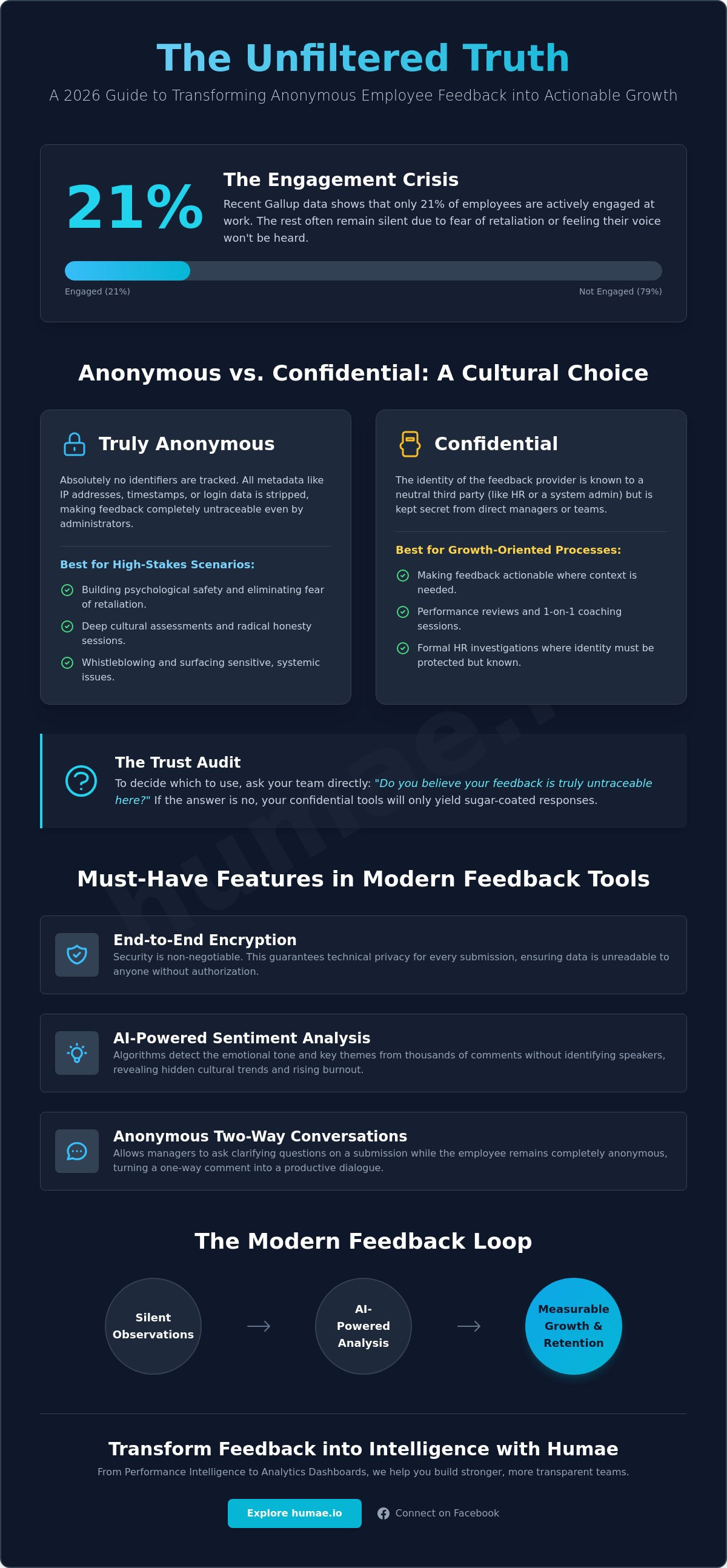
Why do your most talented people stay silent during town halls while your internal reviews tell a completely different story? Recent 2025 Gallup data shows that only 21% of employees globally are engaged at work. This disconnect usually happens because staff fear retaliation or feel their honest opinions will just disappear into a data silo. You've likely dealt with vague, sugar-coated feedback and low participation rates that make it impossible to drive real change.
We understand that great leadership requires more than just a digital suggestion box. You need high-quality, unfiltered insights to improve retention and build a culture of radical transparency. This guide reveals how to transform silent observations into actionable growth using the most secure and innovative tools for anonymous employee feedback in 2026. We will break down ten top-tier platforms that use AI-powered sentiment analysis and deep integrations to turn whispers into a clear roadmap for your organization’s success.
Experience the future of work with Humae. From Performance Intelligence to Analytics Dashboards, we help you build stronger, more transparent teams. Return to our home page to explore our full suite of HR tools, and stay connected with our community on Facebook.
Key Takeaways
- Transition from static annual reviews to dynamic, real-time feedback streams that reflect the true pulse of your organization.
- Distinguish between anonymous and confidential feedback to create a secure environment where radical honesty flourishes without fear.
- Evaluate the top-rated tools for anonymous employee feedback in 2026, focusing on AI sophistication and deep integration capabilities.
- Link sentiment data to your workforce management infrastructure to transform observations into measurable organizational growth.
- Leverage Performance Intelligence and analytics dashboards to understand team dynamics and proactively boost employee retention.
Build a modern culture with Humae. Explore our home page for Performance Intelligence solutions and connect with us on Facebook.
What Are Tools for Anonymous Employee Feedback?
In 2026, tools for anonymous employee feedback are more than just digital suggestion boxes. They are secure ecosystems designed to strip identifying metadata, such as IP addresses or timestamps, from every submission. This technical layer ensures that an employee's voice remains untraceable, even to system administrators. We've moved past the era of annual Employee surveys that only capture a single moment in time. Today, visionary leaders rely on continuous, real-time feedback streams to stay ahead of cultural shifts and operational friction.
Modern leaders treat psychological safety as a core business metric rather than a soft HR concept. When people feel safe, they share the truth. AI plays a massive role here by aggregating thousands of anonymous data points to highlight hidden cultural trends. It can spot rising burnout or a lack of clarity in a specific department before these issues impact your bottom line. This shift from reactive to proactive listening is what defines successful organizations in the current landscape.
The Core Purpose of Anonymity in the Workplace
The primary goal is to eliminate the fear of retaliation. Even in the most open cultures, employees often hesitate to share constructive criticism if they think it might affect their career path. By using tools for anonymous employee feedback, you surface silent issues like process bottlenecks or leadership gaps before they turn into high-cost turnover. This approach also empowers introverted team members or those from diverse backgrounds who might feel less comfortable speaking up in public meetings. Anonymity is the bridge between management and reality.
Key Features to Look for in 2026
Anonymous vs. Confidential Feedback: Which Should You Use?
Choosing between anonymous and confidential feedback isn't just a technical decision; it's a cultural one. While the terms are often used interchangeably, they serve different masters. True anonymity means there are absolutely no identifiers. No IP addresses, no login data, and no metadata are stored. Confidentiality, however, means the identity is known to a system administrator or a specific third party but hidden from the direct manager. If your team is struggling with fear of retaliation, only robust tools for anonymous employee feedback will provide the safety net they need to speak their minds without hesitation.
Anonymity is your best ally during high-stakes scenarios. Use it for whistleblowing, deep cultural assessments, or radical honesty sessions where you need the unvarnished truth about leadership. Confidentiality is better suited for growth-oriented processes. Performance reviews and 1-on-1 coaching require a name to be actionable. To decide which to use, perform a 'Trust Audit'. Ask your team directly: "Do you believe your feedback is truly untraceable?" If the answer is no, your confidential tools will only yield sugar-coated responses that mask real problems.
The Risks of Getting Anonymity Wrong
Deanonymization attempts are the fastest way to destroy a company's soul. When leaders try to play detective to figure out who left a critical comment, they signal that honesty is a liability. This risk is especially high in small departments where the process of elimination makes guessing too easy. In 2026, legal standards around data privacy also make accidental exposure a serious ethical and regulatory concern. If an employee's identity is leaked after promising them total privacy, the damage to your employer brand is often permanent.
Building a Framework for Feedback Transparency
Transparency starts with a clear policy. Tell your team exactly who sees the data and how it impacts organizational decisions. You should integrate these insights into your wider employee engagement strategies to show that feedback leads to tangible change. Communicating the 'Why' behind your choice of anonymity helps build the bridge of trust. If you want to see how data-driven insights can transform your culture, our Performance Intelligence tools bridge the gap between raw data and human growth.
Top 5 Tools for Anonymous Employee Feedback: 2026 Comparison
Selecting the right tools for anonymous employee feedback requires looking beyond a simple "submit" button. In 2026, the true differentiator is AI sophistication. Does the tool just collect text, or does it quantify sentiment? We evaluate platforms based on their Actionability Score. This represents the software's ability to suggest specific leadership interventions based on the data it gathers. Startups need low-friction, high-value setups. Global enterprises require deep integration to avoid the data silos that often hide critical cultural trends.
Standalone specialists still have a place for niche use cases, but the market is shifting. A standalone tool might offer great depth in one area, but it often lacks the context of an employee's actual performance or career path. Choosing between a specialized app and an integrated platform depends on whether you want a quick fix or a long-term cultural transformation.
Standalone Feedback Specialists
Officevibe (Workleap) remains a top choice for teams needing quick pulse surveys. It's user-friendly and costs approximately $3 to $7 per employee per month. For larger organizations prioritizing DEI and complex cultural assessments, Culture Amp is the enterprise standard. Estimates for their engagement module range from $5 to $9 per employee per month. If you need real-time anonymity during live events, Poll Everywhere starts at $10 per month. It's perfect for transparent Q&A sessions where you want to eliminate the fear of speaking up in front of executives. 15Five also offers a robust "Engage" plan starting at $4 per user, focusing heavily on evidence-based engagement metrics.
Integrated HRMS Platforms (The Modern Standard)
Modern leaders are moving away from fragmented software. Top-tier hris systems now incorporate feedback loops directly into the daily workflow. Having feedback data live next to OKRs and performance metrics allows you to see how sentiment affects productivity in real-time. This context is vital for making informed decisions that actually stick.
Humae bridges the gap between knowing and improving employee sentiment. We don't just store data; we turn it into intelligence. By connecting our Performance Intelligence and Analytics Dashboards, you can see exactly how a dip in team morale correlates with project timelines or OKR progress. This integrated approach ensures that feedback isn't just heard. It's used to drive measurable growth across your entire organization, making your culture your greatest competitive advantage.
How to Implement a Feedback Loop That Actually Works
Collecting data is the easy part. The real challenge lies in building a system that turns whispers into tangible progress. To start, you must define your primary objective. Are you trying to fix a broken culture or optimize specific operational processes? Once your goal is clear, select tools for anonymous employee feedback that integrate seamlessly with your workforce management infrastructure. This ensures that feedback isn't an isolated event, but a core part of your organizational heartbeat.
Don't just launch a survey; launch a Transparency Manifesto. Tell your team exactly what you'll do with their honesty and what is off-limits for deanonymization. Use AI to synthesize the raw data into high-level actionable themes. This saves hours of manual reading and highlights the team's emotional state instantly. Finally, you must close the loop. Publicly share what you learned and, more importantly, what you're changing because of it. If people don't see action, they'll stop talking. True leadership in 2026 is about proving that every voice has the power to shift the company's direction.
Avoiding 'Feedback Fatigue'
Constant pinging leads to low-quality data. Instead of bombarding everyone every week, use AI to trigger surveys based on specific employee lifecycle events. This could be the end of a major project or a 90-day onboarding milestone. This context makes the request feel relevant rather than intrusive. To keep participation high, ensure every survey results in at least one visible organizational change. When employees see their words in action, they're far more likely to stay engaged with the process.
Measuring the ROI of Anonymous Feedback
You can't manage what you don't measure. Correlate your feedback sentiment scores with employee retention rates to see the direct impact of your cultural adjustments. You should also track the "speed of resolution." This metric measures how quickly a problem moves from an anonymous submission to a documented fix. Feedback intelligence directly transforms cultural sentiment into measurable financial stability by reducing the massive costs associated with employee turnover. To see how these insights can scale your business, explore our Performance Intelligence solutions.
Transform Feedback into Intelligence with Humae
Humae represents a fundamental shift in how organizations listen. We don't just provide tools for anonymous employee feedback; we act as a visionary partner for your people operations. Most platforms stop at data collection, leaving you with a pile of comments and no clear path forward. Humae changes that by leveraging AI-driven sentiment analysis to help you understand the actual vibe of your team in real-time. You can spot a shift in morale before it impacts your output, allowing for empathetic and timely leadership interventions that keep your best talent engaged.
The true power of our platform lies in its connectivity. We bridge the gap that many competitors ignore by linking anonymous insights directly to your OKR tracking. This ensures that your cultural health and business goals are perfectly aligned. When you see how team sentiment affects goal achievement, you stop guessing and start leading with precision. Our intuitive interface is designed to remove friction, resulting in high participation rates that provide the high-quality data you need to make informed decisions. We make it easy for employees to be honest and even easier for leaders to be effective.
The Power of Integrated Performance Intelligence
We believe in moving from "What happened?" to "What will happen?" Our predictive analytics use historical feedback and performance intelligence to forecast potential turnover or engagement dips. By centralizing feedback, employee directory management, and analytics dashboards in one unified HRMS, you eliminate the data silos that slow down growth. You get a holistic view of your organization that standalone tools simply cannot match. Experience the Humae features built specifically for modern, high-growth teams that value their people as much as their profit.
Get Started with a Modern Feedback Culture
Migrating from fragmented, legacy tools to a unified HR ecosystem is simpler than you think. Innovative leaders are already using Humae to build world-class cultures where transparency isn't just a buzzword, but a daily reality. Our platform scales with you, ensuring that your communication remains open whether you are managing a small startup or a global enterprise. We help you turn silent observations into a roadmap for collective success. Explore how it works and start your journey toward a more intelligent, human-centered organization today.
Lead with Transparency and Intelligence
The transition from silence to a thriving culture of honesty begins with a single choice. You've seen how the right tools for anonymous employee feedback can strip away fear and reveal the cultural trends that truly matter. By moving away from fragmented surveys and embracing a modern workforce management infrastructure, you ensure that every voice contributes to your collective success. It's no longer enough to just collect data; you must turn that sentiment into real-time OKR integration to drive growth.
Closing the loop is what separates visionary leaders from the rest. When you use AI-driven sentiment analysis to understand your team's vibe, you gain the power to act before issues escalate. This proactive approach builds lasting trust and improves retention across every department. You have the roadmap, and the technology is ready to support your vision for a more human-centered organization.
Build a culture of trust with Humae’s AI-powered intelligence and start transforming your organizational sentiment into a competitive advantage today. We're here to help you create a workplace where everyone feels heard and valued.
Frequently Asked Questions
Are anonymous employee feedback tools really 100% anonymous?
Modern feedback systems provide 100% anonymity when they use end-to-end encryption and strip all metadata like IP addresses or timestamps. This technical layer ensures that even system administrators cannot trace a response back to an individual. You should always verify a platform’s technical documentation to confirm they don't store identifying digital footprints during submission.
How do I choose between a standalone survey tool and an integrated HRMS?
Choose a standalone tool if you only need a specific niche feature like live Q&A sessions or deep whistleblowing analytics. However, an integrated HRMS is the better choice for leaders who want to see how sentiment directly impacts performance and OKRs. Centralizing your data prevents silos and makes your feedback actionable within your daily workforce management workflow.
What should I do if I receive negative anonymous feedback about a specific manager?
Focus on the behavior described rather than trying to identify the sender. If multiple reports highlight the same leadership issue, it indicates a systemic problem that needs addressing through coaching or mediation. Use these insights as a catalyst for a departmental "vibe check" to resolve friction without compromising anyone's safety or trust.
How can I encourage employees to participate in anonymous surveys?
Employees participate when they see that their honesty leads to tangible organizational change. Share a summary of the results publicly and announce specific actions you're taking based on that input. When people realize their voices actually shift company policy, participation rates naturally climb because the process feels meaningful rather than performative.
Is it possible to have a two-way conversation while remaining anonymous?
Yes, many advanced tools for anonymous employee feedback include encrypted chat functions. These allow managers to ask clarifying questions while the employee's identity remains fully protected. This turns a static comment into a productive dialogue, helping you get the context needed to solve complex cultural or operational issues without breaking anonymity.
How does AI help in analyzing anonymous employee feedback?
AI processes thousands of open-text comments to identify emotional tone and recurring themes in seconds. It categorizes feedback into positive, neutral, or negative sentiments without you having to read every single response manually. This allows leadership to spot rising burnout or engagement gaps in specific departments before they lead to high-cost turnover.
What are the common pitfalls of anonymous feedback systems?
The biggest pitfall is the "feedback black hole" where data is collected but never acted upon. This destroys trust faster than not asking for feedback at all. Another risk involves leaders trying to guess who wrote a specific comment; this behavior permanently damages psychological safety and stops honest communication in its tracks.
Can anonymous feedback be used for performance improvement plans?
Anonymous feedback shouldn't be used for individual Performance Improvement Plans because these require specific, identifiable examples for legal and growth reasons. Use anonymity for cultural and process improvements instead. For individual growth, rely on confidential 1-on-1s where the focus is on a specific employee's career path and measurable performance metrics.