Workforce Management Infrastructure: The 2026 Foundation for Scaling Teams
By Humae · 9 July 2026
workforce management infrastructure
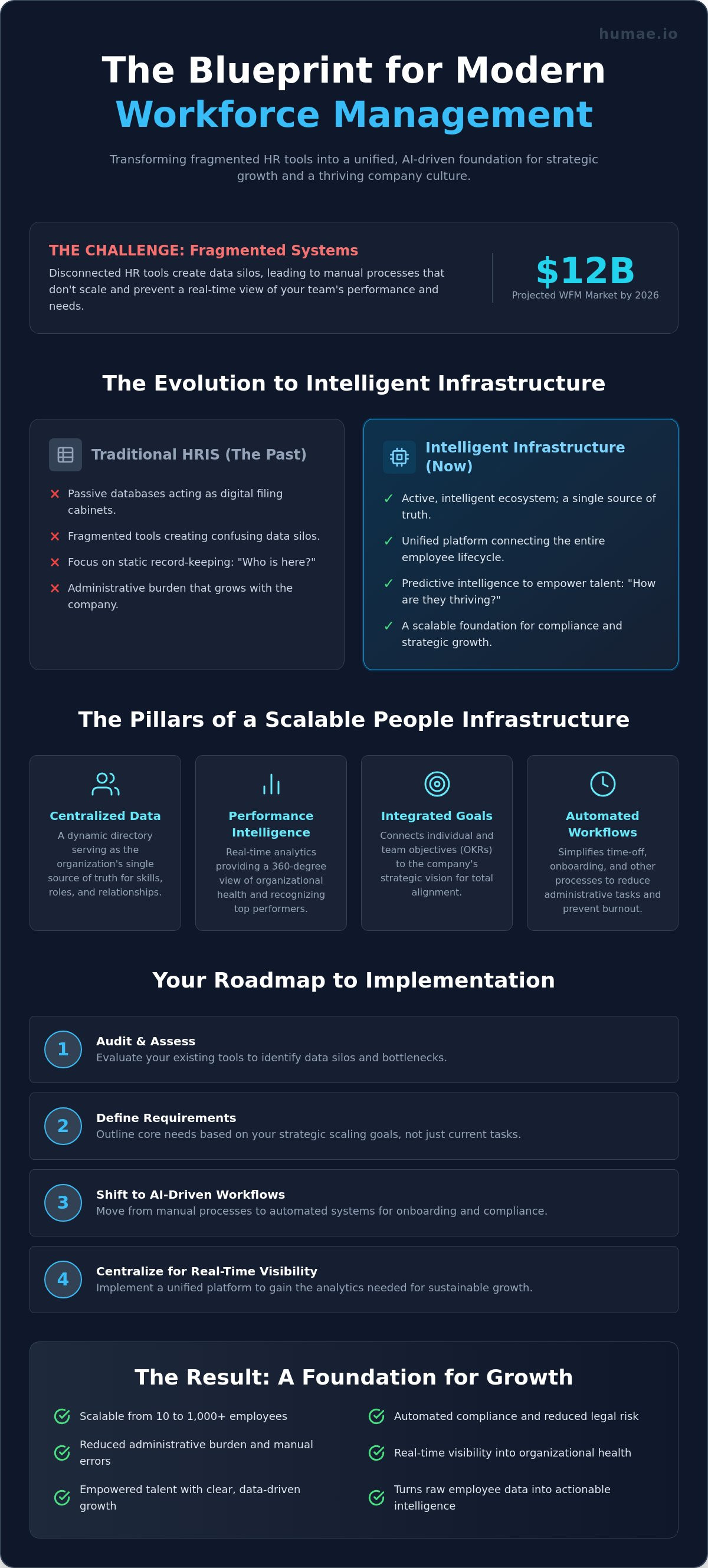
By 2026, the global workforce management market is projected to reach nearly $12 billion. Despite this massive investment in technology, many leaders still feel blinded by fragmented data trapped in disconnected HR tools. You've likely felt the frustration of manual onboarding processes that simply don't scale as your team grows. Without a cohesive workforce management infrastructure, your organization remains stuck in a cycle of administrative debt rather than strategic growth. It's clear that a patchwork of software isn't a strategy; it's a bottleneck that prevents you from seeing the real-time performance of your people.
We understand that you want more than just another digital filing cabinet. You need a unified source of truth that empowers your people and simplifies your day. This article will help you master the core components of a modern workforce management infrastructure to build a scalable, AI-driven foundation for your organization. We will explore how to replace administrative burdens with automated workflows and turn your raw employee data into actionable intelligence that drives real growth. By the end, you'll have a clear roadmap for a culture that thrives on clarity and innovation.
Key Takeaways
- Understand why a modern workforce management infrastructure is the essential unified foundation for managing your team's entire lifecycle in 2026.
- Identify the core pillars of a scalable people strategy, including a centralized employee directory and integrated performance intelligence.
- Shift from manual, rigid legacy processes to AI-driven workflows that automate onboarding and reduce administrative burdens.
- Develop a clear implementation roadmap by auditing your existing tools and defining requirements based on your scaling goals.
- Learn how centralized platforms provide the real-time visibility and analytics dashboards needed to drive sustainable organizational growth.
Defining Workforce Management Infrastructure in the Modern Era
Workforce management infrastructure is the unified digital foundation that manages the entire employee lifecycle. It isn't just a collection of apps; it's the technical backbone that connects hiring, performance, and culture into a single, cohesive experience. In 2026, this infrastructure must go beyond simple record-keeping to include predictive intelligence that anticipates team needs before they become problems. It serves as the single source of truth for employee directories, time-off requests, and performance data. Modern workforce management infrastructure is a strategic organizational asset that transforms human capital data into a primary driver of sustainable growth.
The Evolution from HRIS to Intelligent Infrastructure
Traditional HRIS systems were passive databases designed for storing static employee files. They acted as digital filing cabinets where data often went to be forgotten. Workforce management (WFM) has evolved from these rigid structures into an active, intelligent ecosystem. Modern infrastructure uses real-time data to prompt managerial actions, such as identifying burnout risks or recognizing top performers instantly. We've seen a shift from simply "tracking" employees to "empowering" talent through transparent data access. This allows teams to own their growth instead of just being entries in a ledger. It's about moving from "who is here?" to "how are they thriving?"
Why Infrastructure Matters for Scaling Organizations
Fragmented tools create data silos that lead to poor decision-making and operational friction. When your employee directory doesn't talk to your performance intelligence tools, you lose the big picture. Scaling organizations need a foundation that supports moving from 10 to 1,000 employees without breaking. This infrastructure provides the scalability required to maintain culture while increasing headcount. Without a unified system, your administrative burden grows faster than your revenue. You can explore more about these foundational shifts in our guide on What is Workforce Management?.
A Foundation for Compliance and Performance
By 2026, regulatory changes like the EU Pay Transparency Directive make robust infrastructure a legal necessity. You need systems that automatically handle salary range information and employee data requests with precision. A unified infrastructure handles these complexities in the background, allowing your leadership to focus on human connections. It integrates OKR tracking and analytics dashboards to give you a 360-degree view of organizational health. This clarity builds trust, reduces manual errors, and ensures your team remains compliant while they scale. It's the difference between guessing your next move and knowing it.
The Essential Pillars of a Scalable People Infrastructure
Building a resilient workforce management infrastructure requires more than just installing a few apps. It demands a strategic alignment of four critical pillars: data, performance, goals, and time. When these elements operate within a unified ecosystem, your organization stops reacting to daily crises and starts orchestrating long-term growth. This structural integrity is what allows a startup to mature into an enterprise without losing its cultural essence or operational speed. By investing in these pillars, you create a system where every new hire adds value instead of increasing administrative friction.
Centralized Employee Data and Directories
A dynamic directory serves as the organization's heartbeat. It's far more than a simple contact list; it's a real-time reflection of your talent's skills, relationships, and roles. As organizations expand globally, ensuring data security and privacy within this framework becomes paramount. A secure, centralized directory ensures that the right people have access to the right information at the right time. This level of transparency is essential for building trust in distributed teams. You can read more about Why an Employee Directory is More Than a Contact List to see how it fosters connection across borders.
Performance Intelligence and OKR Integration
Modern performance intelligence software transforms the dreaded annual review into a continuous, life-giving cycle of growth. By using AI-driven sentiment analysis, leaders can detect shifts in team morale or engagement before they lead to turnover. This proactive approach is a core component of a long-term Workforce Management Strategy that prioritizes people over outdated processes. Integrating OKRs directly into your workforce management infrastructure ensures that every team member understands how their daily tasks contribute to the company's North Star. Analytics dashboards then visualize these productivity trends, giving you the clarity to pivot when necessary.
Operational Continuity Through Automation
Scaling requires you to automate the mundane so you can focus on the human. Automated time-off and absence management are no longer optional luxuries. With regulations like the Danish Mandatory Time Tracking Law requiring objective and reliable recording of hours, your infrastructure must handle compliance automatically. This ensures operational continuity by preventing staffing gaps while respecting employee rest periods. Harnessing these pillars through an integrated HRMS platform ensures your infrastructure scales as fast as your ambition, providing a unified source of truth for every employee interaction.
Transitioning from Legacy Systems to AI-Driven Infrastructure
Legacy systems are anchors in a fast-moving market. They demand constant manual attention, require endless data entry, and offer very little foresight in return. Moving to an AI-driven workforce management infrastructure is how you reclaim your time and focus. It’s not just about replacing an old tool; it’s about upgrading your organization’s entire operating system. While the initial shift requires a conscious decision, it’s a direct investment in your team’s long-term productivity and happiness. By 2026, the global workforce management market is expected to reach $11.90 billion, driven largely by organizations ditching rigid databases for intelligent, cloud-based ecosystems.
The transition allows you to move away from "reactive" HR. Instead of fixing problems after they happen, you use predictive analytics to identify burnout before it leads to turnover. AI-driven systems automate routine tasks like onboarding workflows and time-off approvals, ensuring that your managers spend their energy on people, not paperwork. This shift creates a more responsive environment where data flows freely, and decisions are backed by real-time insights rather than gut feelings.
The Role of AI in Modern People Operations
AI doesn't just automate; it understands. Modern people operations now use AI-powered sentiment analysis to gauge team morale in real-time. This helps leaders stay connected to the emotional pulse of the organization, even in remote or hybrid settings. Additionally, automating the applicant tracking process allows you to find the best cultural fits faster by analyzing performance data from existing top performers. Perhaps most importantly, AI reduces bias in performance evaluations. By relying on data-backed insights and objective metrics, your workforce management infrastructure ensures that every employee is judged fairly on their contributions.
Legacy HRIS vs. Modern Workforce Infrastructure
Fragmented tools are expensive. When you calculate the total cost of ownership, including the time lost to data reconciliation and the cost of human error, unified platforms always win. Legacy systems were built as passive repositories, whereas modern infrastructure is an active participant in your growth. For context on how these systems have evolved, you can explore our guide on What Is an HRIS?. Consider the following differences:
- Manual Entry vs. Automated Sync: Stop typing the same data into three different tools.
- Static Reports vs. Real-Time Dashboards: See what’s happening now, not what happened last month.
- Siloed Data vs. Unified Source of Truth: Ensure every department is looking at the same employee record.
Transitioning to a modern platform like Humae provides the centralized visibility you need to scale with confidence. It replaces friction with flow, allowing your culture to remain the priority while the technology handles the complexity.
Building Your Roadmap for Infrastructure Implementation
Building a resilient workforce management infrastructure isn't a one-day event. It's a strategic transition that requires a clear roadmap to ensure your team moves from fragmented tools to a unified ecosystem without losing momentum. Implementation is where your vision for a scalable organization meets reality. By following a structured path, you can eliminate technical debt and create a culture where data empowers every decision. A successful rollout ensures that your technology serves your people, rather than your people serving the technology. It turns a complex technical upgrade into a shared milestone for the entire organization.
Auditing Your Current HR Tech Stack
Before adding new layers, you must understand what's already in place. Start by identifying shadow HR tools. These are the unauthorized spreadsheets, messaging groups, or localized apps that individual departments use to manage their teams because the central system failed them. Every minute spent manually transferring data between these silos is a minute lost to strategic growth. Your audit should determine which features are non-negotiable for your industry, such as specific time-tracking requirements or compliance reporting. This clarity allows you to prune redundancies and focus on a single source of truth for all employee data.
Ensuring User Adoption and Cultural Alignment
The best infrastructure is useless if your team doesn't use it. High adoption rates depend on how well you communicate the "why" behind the change. Managers need specific training to use performance intelligence tools effectively, turning raw data into meaningful coaching moments. It's not about monitoring; it's about providing the support they need to lead better. Establish a continuous feedback loop after the initial launch to identify friction points and improve the system. This human-centric approach ensures that your workforce management infrastructure becomes a natural part of the daily workflow, rather than a burden to be avoided.
Phasing your rollout is often the smartest move for growing teams. Start with core modules like the employee directory and time-off management before moving into complex performance analytics. This allows your team to build confidence in the new system while seeing immediate administrative relief. Start your transformation by exploring how Humae streamlines implementation through intuitive design and supportive onboarding. When your infrastructure is built on a foundation of trust and clarity, scaling becomes a shared success rather than a source of stress. You're not just installing software; you're building the future of your team.
Future-Proofing Your Team with Humae AI-Powered Platform
Scaling a team in 2026 requires more than just ambition; it requires a digital partner that evolves alongside your organization. Humae provides the centralized workforce management infrastructure necessary for modern teams to thrive in a competitive global market. We've designed our platform to bridge the gap between technical efficiency and deep human connection. By consolidating your HRMS, performance intelligence, and growth tools into one ecosystem, we help you eliminate the friction that usually slows down scaling organizations. You aren't just buying software; you're investing in a scalable foundation that grows with your vision.
Finding the right cultural fit shouldn't feel like a guessing game. Our integrated applicant tracking system streamlines the entire hiring process, allowing you to identify and secure top talent with speed and precision. Once your team is in place, Humae's performance intelligence tools facilitate a culture of continuous growth. This isn't about top-down monitoring; it's about providing a supportive environment where feedback is frequent and meaningful. By connecting hiring data directly with performance metrics, you gain a holistic view of your organization's health that legacy systems simply can't match.
Unified Onboarding and Employee Directories
First impressions define an employee's long-term success. Humae creates a seamless first-day experience through automated onboarding workflows that remove the administrative stress from both managers and new hires. Once they're part of the team, the Humae employee directory fosters deep connection in remote and hybrid environments by making expertise, roles, and relationships transparent. This clarity builds trust and accelerates collaboration across distributed departments. You can discover how it works to see our platform's intuitive design and human-centric features in action.
Real-Time Analytics for Data-Driven Decisions
Clarity is your most valuable asset during rapid growth. Accessing actionable insights through the Humae analytics dashboard allows your leadership to spot trends and address bottlenecks before they impact the bottom line. By aligning your entire team with real-time OKR tracking, you ensure that every individual effort contributes to the company's North Star. Humae integrates advanced AI to optimize workforce productivity by analyzing engagement patterns and suggesting proactive improvements. Our scalable SaaS pricing models ensure that whether you're a lean startup or a maturing enterprise, you always have access to the tools you need to succeed.
Empower Your Team for the 2026 Landscape
Scaling an organization requires more than just increasing headcount; it requires a foundation that supports every individual's potential. We've explored how a unified source of truth and automated workflows replace the friction of legacy systems with streamlined efficiency. The shift toward a modern workforce management infrastructure isn't just a technical necessity. It's a commitment to a culture where data drives growth and every employee feels seen and supported. By integrating predictive intelligence and real-time visibility, you move from reactive management to visionary leadership that anticipates needs before they become obstacles.
Your organization's potential is limitless when your technology matches your ambition. It's time to stop fighting fragmented tools and start building a cohesive ecosystem that empowers your people. Build your modern workforce infrastructure with Humae today and experience the power of AI-driven sentiment analysis, real-time OKR tracking, and comprehensive global SaaS support. Let's build a workplace where everyone can thrive.
Frequently Asked Questions
What is the difference between an HRIS and workforce management infrastructure?
An HRIS is typically a passive database used for storing static employee records and files. In contrast, a modern workforce management infrastructure is an active ecosystem that connects daily operations, like time-off requests and directories, with strategic growth tools. It uses real-time data to prompt managerial actions rather than just acting as a digital filing cabinet for historical data.
How does workforce management infrastructure improve employee retention?
It improves retention by providing clarity and reducing the administrative friction that leads to frustration. By utilizing performance intelligence, managers can identify early signs of burnout or disengagement. This allows leadership to provide proactive support and career development opportunities before an employee decides to look elsewhere, fostering a culture of trust and growth.
Can small startups benefit from a full workforce management infrastructure?
Small startups benefit significantly because it prevents the accumulation of technical and administrative debt. Implementing a scalable workforce management infrastructure early ensures that processes like onboarding and goal setting don't break as the team grows. It allows founders to focus on product and market fit instead of manually managing fragmented spreadsheets and disconnected tools.
Is AI-driven performance intelligence secure for sensitive employee data?
Modern platforms are built with enterprise-grade encryption and strict data privacy compliance at their core. AI-driven systems often process anonymized data patterns to provide sentiment insights without compromising the specific privacy of an individual. This ensures that leadership receives actionable intelligence while sensitive employee information remains protected and accessible only to authorized personnel.
How long does it typically take to implement a new HR infrastructure?
Implementation usually ranges from two to six weeks depending on the size of the organization and the complexity of existing data. Many teams choose a phased rollout, starting with core modules like the employee directory and time-off management. This approach often results in visible administrative relief within the first few days of the transition.
What are the most important features to look for in a 2026 HR platform?
Prioritize AI-driven sentiment analysis, integrated OKR tracking, and automated compliance tools. These features are essential for navigating modern regulations like the EU Pay Transparency Directive. A platform should also offer a user-friendly interface that encourages high adoption rates across the entire workforce, ensuring that data remains accurate and up to date.
How does integrated OKR tracking help with workforce management?
Integrated OKR tracking connects individual daily tasks directly to the company's long-term objectives. This transparency ensures that every team member understands their impact on the organization's success. It eliminates guesswork and keeps distributed teams aligned, which is particularly vital during rapid scaling phases where priorities can shift quickly.
Does a centralized infrastructure work for remote and global teams?
A centralized workforce management infrastructure is actually the best solution for distributed teams. It provides a unified source of truth that everyone can access regardless of their location or time zone. This ensures that remote employees stay connected through a dynamic directory and can manage their time off or performance goals without needing to wait for a localized HR representative.