Which Automated Candidate Screening Tools Ensure Compliance? The 2026 Guide
By Humae · 8 September 2026
which automated candidate screening tools ensure compliance?
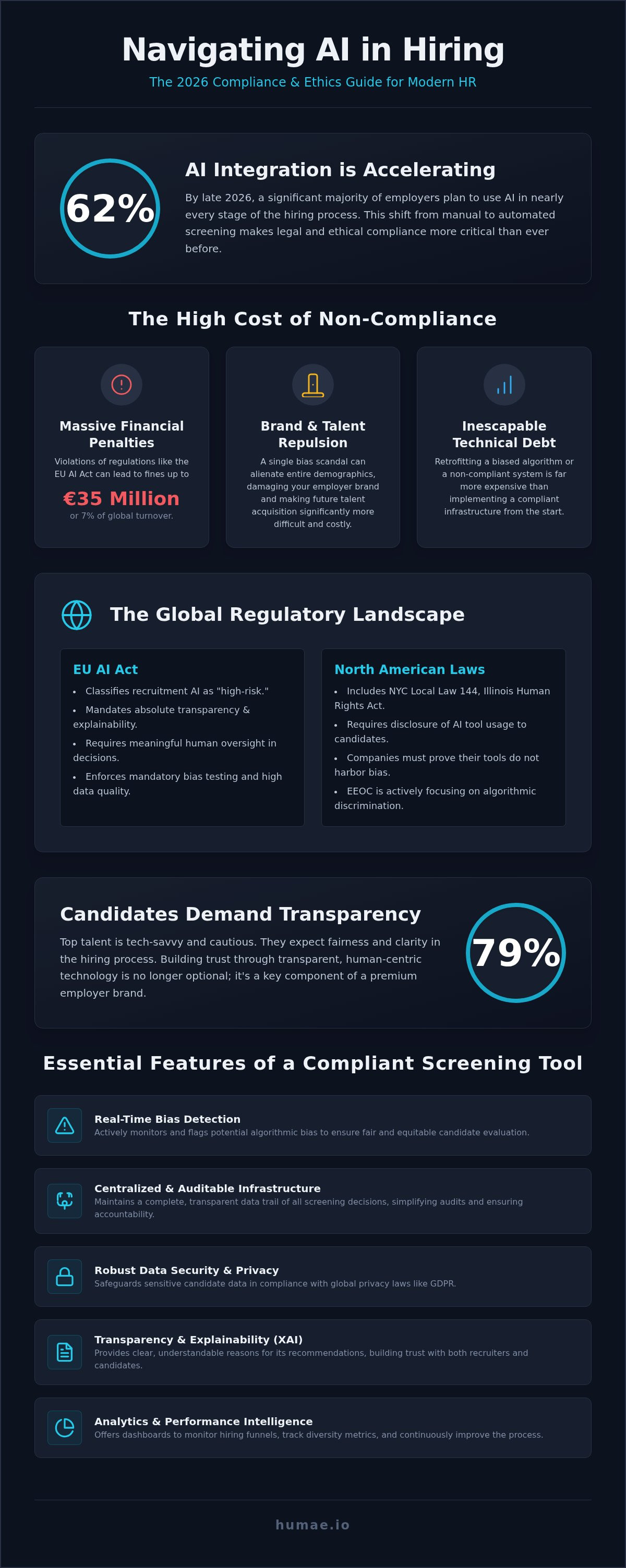
Did you know that by late 2026, 62% of employers expect to use AI for nearly every stage of their hiring process? While the efficiency is undeniable, the legal stakes have never been higher. With the EU AI Act now active and new disclosure rules in Ontario requiring total transparency, the question isn't just about speed anymore. It's about asking which automated candidate screening tools ensure compliance? and how they protect your brand from massive fines.
We understand the tension you're feeling. You need to scale your team quickly without sacrificing quality or falling into the trap of hidden algorithmic bias. It's frustrating to navigate a fragmented legal landscape while trying to maintain a human touch in your recruitment. This guide is designed to replace that anxiety with confidence. You'll discover the specific frameworks that make screening tools legally sound and ethically responsible for modern teams.
We'll provide a curated shortlist of compliant platforms, a practical framework for auditing your vendors, and the peace of mind that comes from a transparent workflow. From centralized data trails to real-time analytics, we're diving into everything you need to build a future-proof hiring infrastructure that puts people first.
Key Takeaways
- Grasp the impact of the EU AI Act and local privacy laws on recruitment to mitigate high-risk legal liabilities and avoid significant fines.
- Find out which automated candidate screening tools ensure compliance? and how they protect your organization from algorithmic bias using real-time detection.
- Master a vendor audit framework that verifies data diversity and independent certifications to ensure your AI recruitment tools are ethically sound.
- Discover how centralized hiring infrastructure and ATS platforms safeguard candidate data while maintaining a transparent, auditable selection process.
- Turn compliance into a strategic asset by leveraging analytics dashboards and performance intelligence to maintain high standards throughout the talent lifecycle.
Why Automated Candidate Screening Compliance Matters in 2026
Scaling a workforce in 2026 requires more than just a large budget. High-volume recruitment has made automation a survival tool. Human teams simply can't process thousands of applications with the speed that modern markets demand. This reliance on tech has created a new urgency. Leaders are constantly evaluating which automated candidate screening tools ensure compliance? because the gap between fast hiring and legal hiring is closing. Artificial intelligence in hiring is no longer a futuristic experiment. It's a regulated utility that requires strict oversight to protect both the company and the candidate.
The High Cost of Non-Compliant Automation
Financial penalties are no longer theoretical. As of August 2026, the EU AI Act dictates that high-risk systems in recruitment must meet rigorous standards. Violations can cost up to €35 million or 7% of global turnover. In North America, the pressure is equally intense. New York City's Local Law 144 and the updated Illinois Human Rights Act now mandate that companies disclose AI usage and prove their tools don't harbor bias. Beyond the courtroom, non-compliance creates a technical debt that's hard to repay. Retrofitting a biased algorithm is significantly more expensive than implementing a compliant infrastructure from day one. A single bias scandal can alienate entire demographic groups, making your future talent acquisition efforts much harder.
Candidate Expectations for Transparent Hiring
Modern talent is tech-savvy and cautious. Research shows that 79% of candidates want full transparency when AI is used in their evaluation. They don't want to be judged by a black box that they don't understand. When selecting which automated candidate screening tools ensure compliance?, you must prioritize features that offer explainability. Providing clear explanations for hiring decisions isn't just about avoiding lawsuits; it's about building a premium employer brand. Top-tier candidates gravitate toward organizations that value fairness and human-centric technology. When you use analytics dashboards to provide feedback and maintain audit trails, you demonstrate a culture of respect. Transparency transforms the application process from a cold, automated transaction into a supportive experience for every participant.
Regulatory Frameworks Governing AI in Recruitment
Compliance in candidate screening is no longer a set of optional ethical guidelines. It's a strict adherence to evolving laws that prevent discrimination and safeguard data privacy. In 2026, the regulatory landscape is fragmented but increasingly aggressive. Regulators aren't just auditing hiring outcomes; they're inspecting the logic behind the software. Organizations are now forced to scrutinize which automated candidate screening tools ensure compliance? before they integrate any new tech into their stack. Failure to do so means risking more than just a bad hire; it means facing litigation for algorithmic bias and data mismanagement.
The EU AI Act and Its Global Impact
The EU AI Act, which became generally applicable on August 2, 2026, has fundamentally changed HR tech. Recruitment software is now classified as "high-risk AI." This classification mandates absolute transparency and meaningful human oversight. It's not enough for a tool to produce a shortlist; it must explain why it chose those candidates. Mandatory bias testing and high data quality standards are now the baseline. This European shift is rapidly becoming the global benchmark. Many leaders are adopting A Framework for Auditing Recruitment Automation Vendors to ensure their global operations meet these rigorous standards, even outside of Europe.
EEOC and Fair Hiring in the Digital Age
In the United States, the EEOC has sharpened its focus on algorithmic fairness. The traditional "four-fifths rule" is now being applied to automated ranking systems to detect disparate impact. If an AI tool ranks one demographic group significantly lower than others, the employer is held responsible for the outcome. Proving non-discriminatory intent requires detailed documentation of the training data used by your vendors. You must ensure your screening tools are built on diverse datasets to prevent historical biases from being automated. To manage this effectively, many teams are moving toward centralized hiring infrastructure that provides clear audit trails for every automated decision.
Local regulations are adding further complexity. New York City's Local Law 144 requires annual independent bias audits, while Illinois and Texas enacted laws effective January 1, 2026, that prohibit intentional AI discrimination. In Canada, Ontario now requires all job postings to disclose the use of AI for screening. Navigating these rules requires a platform that prioritizes data sovereignty and transparency. By choosing tools that offer real-time analytics, you can monitor for bias as it happens, ensuring your recruitment remains both efficient and legally sound.
Essential Features of Compliant Automated Screening Tools
Selecting the right technology is no longer just about finding the best talent. It's about protecting your organization. When you evaluate which automated candidate screening tools ensure compliance?, you must look beyond the surface level features of an Applicant Tracking System. Compliant tools are built with a "compliance-by-design" philosophy. They don't just filter resumes; they actively protect the integrity of your hiring process through proactive bias mitigation and rigorous data security. These tools act as a supportive partner, ensuring that your efficiency never comes at the cost of fairness or legal safety.
Proactive bias detection is the most critical feature in 2026. Compliant platforms use algorithms that are regularly audited for disparate impact. Instead of being a static filter, these tools scan for patterns that might unfairly disadvantage specific demographic groups. If a tool flags a trend that correlates with protected characteristics, it should notify the recruiter immediately. This real-time feedback loop allows you to adjust your criteria before bias becomes baked into your talent pipeline. It's about creating a higher level of user experience where technology serves human values.
Audit trails and reporting are equally vital for maintaining a compliant infrastructure. In a legal challenge, "we didn't mean to discriminate" is not a valid defense. You need a centralized record of every automated decision. This includes why a candidate was ranked highly and why others were disqualified. By using analytics dashboards that provide a clear history of your screening logic, you create a transparent roadmap for auditors. This level of detail ensures that your organization is always ready for a compliance review, providing true peace of mind for leadership teams.
Algorithmic Transparency and Explainability
The era of the "black box" is over. Modern candidates and regulators demand to know the logic behind an automated score. Compliant tools prioritize Explainable AI (XAI). This means recruiters can see exactly which weights were applied to specific skills or experiences. If a tool ranks a candidate at 95%, you should be able to click a button and see the data points that led to that result. This transparency allows for essential human intervention. It ensures that your team remains the final decision-maker, using the AI as a high-speed assistant rather than an autonomous judge.
Robust Data Security and GDPR Compliance
Candidate data is highly sensitive and requires top-tier protection. When asking which automated candidate screening tools ensure compliance?, you must verify their security certifications. Look for vendors that hold SOC 2 Type II or ISO 27001 certifications. These aren't just badges; they are proof of a commitment to data integrity. Features like automated data deletion and right-to-be-forgotten workflows are now mandatory under GDPR and the California Privacy Protection Agency regulations. Your centralized hiring infrastructure should include role-based access controls, ensuring that sensitive personal information is only visible to those who absolutely need it for the hiring decision.
A Framework for Auditing Recruitment Automation Vendors
Buying a tool based on a sales pitch is a risk your legal department won't want to take. As we've discussed, the regulatory landscape in 2026 demands proof of fairness, not just promises. To truly understand which automated candidate screening tools ensure compliance?, you need a structured audit process. This framework allows you to look under the hood of any platform. It ensures that the technology you adopt aligns with your organizational values and global legal standards. By following these steps, you move from reactive troubleshooting to proactive workforce management.
- Step 1: Training Data Scrutiny. Inquire about the diversity and sourcing of the vendor's training data. If the AI was trained on historical data from a period of biased hiring, it will likely replicate those patterns. Ask for documentation on how they balanced their datasets.
- Step 2: Verification of Certifications. Request third-party bias audit reports. Under New York City Local Law 144, annual independent audits are mandatory. A compliant vendor should readily provide these certifications and explain their results.
- Step 3: Privacy Workflow Evaluation. Assess how the tool handles data privacy requests. Can it process a "right-to-be-forgotten" request automatically? Ensure the tool complies with GDPR and the latest CPPA regulations for automated decision-making.
- Step 4: Human Oversight Mapping. Determine where the human remains in the loop. Compliant systems should flag candidates for review rather than making final, unchangeable rejections. Define the specific points where your recruiters intervene to validate AI suggestions.
Questions to Ask Your Potential Vendor
Direct questions often reveal the most about a vendor's commitment to ethics. You should ask: "How does your algorithm handle protected characteristics like age, gender, or disability status?" A compliant tool should be "blind" to these factors or use them only for diversity monitoring. Ask if they can provide a clear audit trail for every automated candidate rejection. If they can't explain why a candidate was filtered out, the tool is a legal liability. Finally, ask about their schedule for bias re-testing. One-time audits aren't enough in a world where algorithms evolve. To see a platform that prioritizes this level of transparency, explore our centralized hiring infrastructure.
Testing the Tool for Disparate Impact
Never roll out a screening tool globally without a pilot phase. Use a diverse pool of mock or historical candidates to check for bias before the tool goes live. Monitor selection rates across different demographic groups to ensure you aren't violating the four-fifths rule. Continuous monitoring is the only way to stay safe. Selection patterns can shift as your job descriptions or candidate pools change. By using real-time analytics, you can spot these shifts early. This proactive approach is what separates a compliant organization from one that is simply waiting for a lawsuit. Finding which automated candidate screening tools ensure compliance? is a journey of continuous verification, not a one-time purchase.
Humae: Building a Compliant Future for Workforce Management
Humae doesn't treat compliance as a checkbox at the end of a project. We integrate it into the very core of our workforce management infrastructure. While many competitors offer isolated screening modules that create data silos, we provide a unified ecosystem. This ensures that every piece of information, from the initial resume scan to the final offer, is tracked and protected. When you are deciding which automated candidate screening tools ensure compliance?, the answer is found in a platform that prioritizes auditability across the entire talent lifecycle. We are a visionary partner for organizations that refuse to compromise on ethics while pursuing rapid growth.
Knowing which automated candidate screening tools ensure compliance? is the first step toward building a resilient organization. An all-in-one platform provides the data consistency that fragmented tools lack. When your hiring data lives in the same environment as your performance metrics, you gain a level of transparency that regulators appreciate and candidates trust. This holistic view allows you to monitor for bias not just during the interview stage, but throughout the employee's entire journey with your company.
Centralized Infrastructure for Compliant Hiring
Compliance shouldn't be a hurdle. It's a baseline for modern recruitment. Our Applicant Tracking System seamlessly transitions candidate data into your employee directory, maintaining a single, consistent record of truth. This centralized approach is vital for meeting 2026 legal standards like the EU AI Act and GDPR. By connecting hiring data with Performance Intelligence, you can verify that your screening criteria actually lead to successful, diverse hires over the long term. This closed-loop system gives you the data consistency needed to defend your processes during a regulatory audit. It transforms compliance from a legal burden into a strategic advantage for your employer brand.
Empowering Modern Teams with Ethical AI
Scaling a culture without bias is a challenge for both startups and global enterprises. Humae empowers modern teams by providing real-time analytics dashboards that monitor fairness across your entire talent pipeline. You don't have to wait for an annual report to see if your AI is performing ethically. Our tools provide the transparency required to build trust with candidates and regulators alike. Discover how our Workforce Management Infrastructure supports your growth by making ethical AI a standard feature. We help you move fast while staying safe, ensuring your focus remains on the people who drive your success. By using AI-driven sentiment analysis and centralized hiring tools, we ensure your organization remains a leader in fair, compliant recruitment.
Future-Proofing Your Recruitment Strategy
Compliance in 2026 is no longer about checking boxes; it's about building a foundation of trust and transparency. We've explored the shifting legal landscape and the rigorous frameworks required to stay ahead of global regulations. When you ask which automated candidate screening tools ensure compliance?, you're looking for a partner that prioritizes auditability and ethical AI design. Modern hiring requires a centralized infrastructure that connects every decision to a clear data trail. By focusing on explainable results and proactive bias detection, your organization doesn't just avoid penalties; it attracts the highest caliber of talent through a culture of fairness.
Ready to build a fairer, more efficient team? Explore Humae’s AI-powered HR platform today. Our comprehensive workforce management infrastructure and AI-driven sentiment analysis provide the deep insights you need to lead with confidence. Follow us for the latest HR innovation on Facebook. Your growth journey deserves a compliant foundation that puts people first. Let's build that future together.
Frequently Asked Questions
Can automated candidate screening tools be 100% unbiased?
No tool is perfectly unbiased because algorithms learn from historical human decisions. The goal when asking which automated candidate screening tools ensure compliance? is to find platforms that actively mitigate these risks. Compliant tools use diverse training sets and offer real-time analytics to flag disparate impact. You should focus on continuous monitoring and human intervention rather than seeking a perfect, bias-free machine. Fairness is a process of constant refinement.
What are the most common compliance risks in AI recruitment?
The most common risks include disparate impact, lack of transparency, and data privacy breaches. Disparate impact occurs when a tool unintentionally filters out protected groups at a higher rate. Privacy risks involve failing to meet GDPR or CPPA standards for data deletion and candidate notification. In 2026, failing to provide an explainable logic for a rejection is a major legal liability. Organizations must ensure their vendors provide third-party bias audits to avoid these pitfalls.
How does the EU AI Act affect companies hiring in the US?
The EU AI Act applies to any organization that places AI systems on the market or uses them within the EU. If your US-based company recruits candidates in Europe, you must comply with high-risk AI requirements. This includes mandatory human oversight and detailed documentation. Many US firms are adopting these standards globally because they represent the most rigorous legal framework. It's often easier to maintain one high standard than different rules for every region.
Is it legal to reject a candidate based solely on an AI score?
Rejecting a candidate solely based on an AI score is legally dangerous in 2026. Laws like NYC Local Law 144 and the EU AI Act emphasize that automated tools should assist, not replace, human judgment. Candidates often have the right to request a human review of an automated decision. Ensure your recruiters use AI scores as a guide while making the final, documented hiring choice. This preserves the human element and reduces litigation risk.
What documentation should I keep for automated hiring decisions?
You should maintain a comprehensive record of selection criteria, automated rankings, and the final human decision. Documentation must include evidence of candidate notifications and records of independent bias audits. Using a centralized hiring infrastructure makes this easier by creating an automated audit trail for every application. These records are essential for defending your process during a regulatory review or a legal challenge. Keeping detailed logs ensures your organization remains transparent and accountable.
How often should a company audit its automated screening tools for bias?
Annual independent bias audits are the legal requirement under New York City's Local Law 144. However, best practices in 2026 suggest continuous monitoring through real-time analytics dashboards. Waiting a full year to catch a bias issue can lead to significant legal exposure and reputational damage. Regular internal reviews every quarter help you adjust your screening logic as your candidate pools shift. Constant vigilance is the only way to ensure your automated tools remain fair and compliant.
What is the role of human oversight in compliant automated screening?
Human oversight is the cornerstone of compliant AI recruitment. It ensures that an accountable person reviews and validates the suggestions made by the algorithm. The EU AI Act specifically requires that high-risk systems allow for human intervention to prevent automated errors. This oversight prevents the "black box" effect where decisions are made without clear logic. By keeping people in the loop, you maintain a supportive, human-centric approach that builds trust with every candidate.