What Is Workforce Management Infrastructure? The 2026 Strategic Guide
By Humae · 18 August 2026
workforce management infrastructure
What if your current HR tech stack is actually the primary bottleneck preventing your team from scaling? In a market projected to reach over 12 billion dollars by 2026, simply having software isn't enough to stay competitive. You need a cohesive workforce management infrastructure that acts as a digital nervous system for your entire organization. It's the difference between reactive firefighting and proactive, visionary leadership.
We understand the frustration of chasing data across fragmented spreadsheets or fixing manual onboarding errors that should have been automated years ago. It's exhausting to feel a disconnection between your high-level OKRs and the daily reality of your team's work. This guide promises to change that. You'll discover how to build a modern backbone that integrates AI intelligence with human-centric operations to scale your team efficiently.
We'll walk through the essential components of a 2026 strategy, including automated workflows for routine tasks, real-time performance visibility, and the shift toward actionable sentiment insights. By the end, you'll have a roadmap to transform your employee data into a single source of truth that empowers every person in your company.
Humae | learn more | Back to Home | Facebook
Key Takeaways
- Modernize your operations by moving from fragmented tools to a unified workforce management infrastructure that serves as your digital backbone.
- Learn how a centralized employee directory and automated onboarding can eliminate manual tracking errors and improve real-time visibility.
- Transition from static annual reviews to dynamic OKR tracking and AI-driven performance intelligence for continuous team growth.
- Discover the strategic steps to audit your current HR tech stack and identify the core KPIs needed for a scalable organizational structure.
Humae | learn more | Back to Home | Facebook
Defining Workforce Management Infrastructure for the 2026 Economy
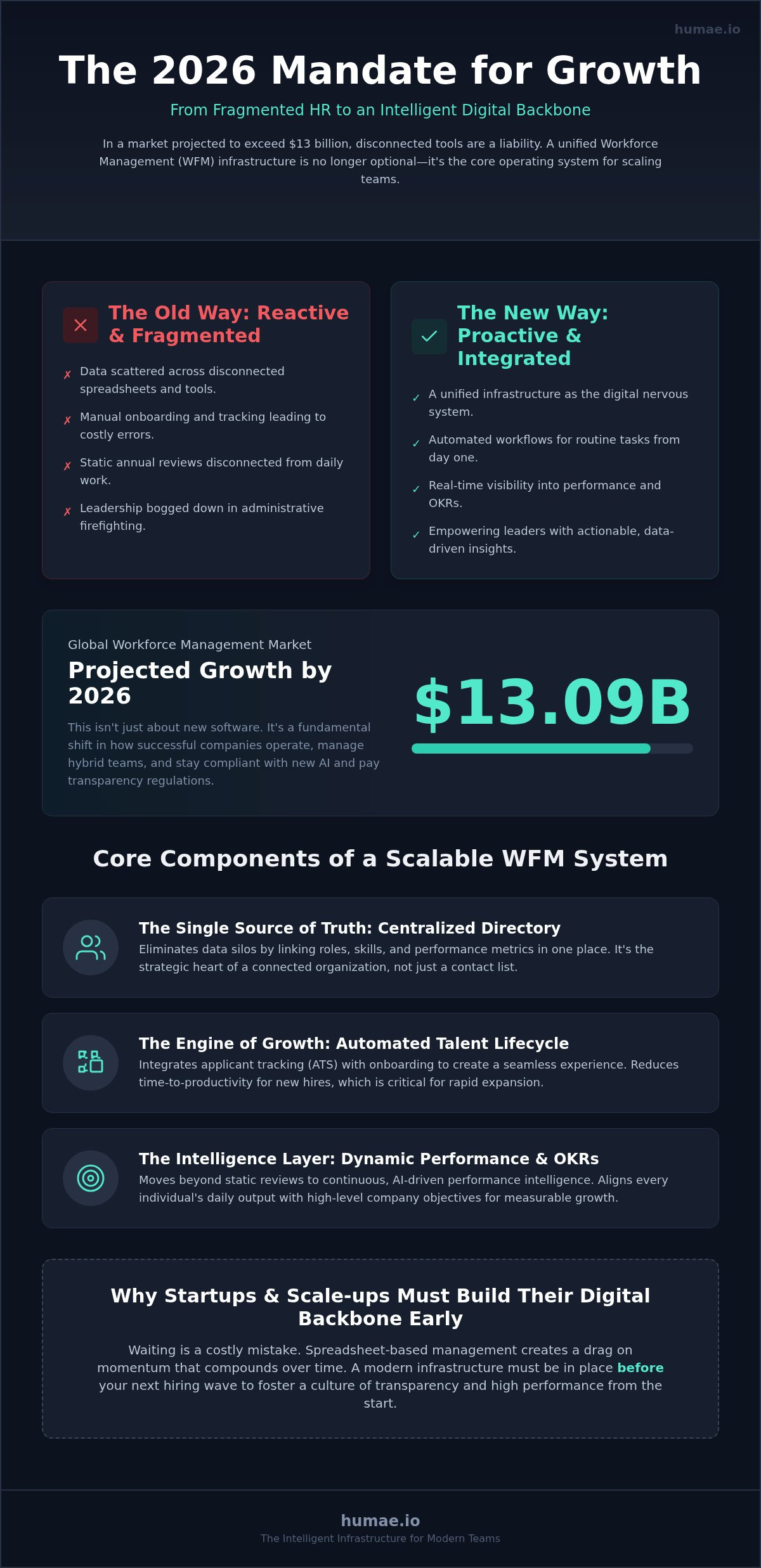
Think of your workforce management infrastructure as the digital skeleton of your organization. It supports every movement, from the first interview to the final performance review. In the past, companies relied on fragmented tools; one for time off, another for hiring, and a messy spreadsheet for everything else. By 2026, this approach is a major liability. New regulations regarding AI in employment and pay transparency require systems that are accurate and auditable. We are seeing a massive shift from purely operational workforce management (WFM) to a strategic model. It's no longer just about filling shifts. It's about aligning every individual's daily output with the company's core mission.
The global market for these solutions is projected to reach up to $13.09 billion by 2026. This growth isn't just about software sales; it's about the necessity of managing hybrid teams across different time zones and legal jurisdictions. A modern infrastructure handles these complexities automatically. It allows leaders to focus on people, not paperwork. When your systems talk to each other, you gain a level of agility that manual tracking simply cannot provide. This agility is the baseline for survival in a fast-paced economy.
The Evolution from HRIS to Integrated WFM
A basic HRIS is often just a digital filing cabinet. It holds names and addresses but fails to tell you how your team feels or why productivity is dipping. Modern workforce management infrastructure connects these data points. It uses real-time analytics to help leaders make decisions based on facts. This connectivity is vital for maintaining culture in a hybrid world where face-to-face interaction is less frequent. When your data is integrated, compliance becomes a byproduct of your daily workflow, not a separate, painful chore. You move from recording history to shaping the future of your team.
Why Startups and Scale-ups Need a Digital Backbone Early
Startups often wait too long to build their digital backbone. They assume they are too small for a full HRMS. This is a costly mistake. Spreadsheet-based management leads to errors in time-off tracking and manual onboarding delays that kill momentum. Your infrastructure must stay three steps ahead of your hiring plan. Building this foundation early allows you to foster a high-performance culture. It creates a space where transparency and accountability are built into the software. This ensures that every new hire enters an environment designed for success, regardless of where they are working from. Scalability isn't just about adding more people; it's about having the systems to support them without breaking.
The Core Components of a Scalable WFM System
Scaling a business in 2026 isn't just about hiring more people. It's about ensuring your workforce management infrastructure can handle the increased load without cracking. This infrastructure consists of several core pillars that must work together seamlessly to support a distributed or hybrid team. Without a unified system, your growth will eventually lead to fragmented data and frustrated employees. A modern digital backbone ensures that as you add headcount, your operational efficiency actually improves rather than declines.
The Employee Directory as a Strategic Asset
A centralized directory is the single source of truth for all employee data. It eliminates the need to update multiple systems when someone changes their address or earns a new certification. In a hybrid environment, knowing who does what is critical for collaboration. A modern directory serves as the heartbeat of the organization, linking roles to specific skills and performance metrics. This allows leaders to build project teams based on actual data rather than guesswork. You can learn more about Why an Employee Directory is More Than a Contact List to see how this asset fuels a connected culture.
Streamlining the Talent Lifecycle
First impressions matter, especially during rapid expansion. Integrating your Applicant Tracking System (ATS) with onboarding creates a frictionless experience for new hires. This reduces the time-to-productivity, which is vital when you need new team members to hit the ground running. Reducing administrative friction during these growth phases prevents your HR team from burning out on repetitive tasks. Check out The 5 Stages of a Modern Employee Onboarding Process for a roadmap to building a welcoming and efficient start for every hire.
Transparency in absence management is another cornerstone of employee trust. With significant regulatory changes taking effect in 2026, such as the launch of Minnesota's paid leave program and expanded PFML benefits in states like Washington and Delaware, manual tracking is no longer viable. Your infrastructure must automatically adjust to these local laws to protect the organization from compliance risks. This reliability ensures that your team remains an Essential Critical Infrastructure Workforce, capable of delivering results because the administrative burden has been lifted from their shoulders. You can explore how Humae centralizes these core components to create a better experience for everyone.
The Intelligence Layer: Performance Monitoring and OKRs
Your workforce management infrastructure should do more than just record hours. It needs to catalyze growth. While legacy systems focus almost entirely on controlling labor costs, modern leaders use an intelligence layer to enable their teams. This layer transforms static data into a living map of organizational progress. By integrating performance monitoring directly into the daily workflow, you remove the anxiety of the annual review. Instead, you create a culture of continuous improvement where everyone knows exactly where they stand at any given moment.
Real-Time OKR Tracking for Agile Teams
Annual reviews are a relic of a slower era. In 2026, high-growth teams rely on real-time visibility. When you connect individual tasks to company-wide objectives, work stops being a series of chores and starts being a meaningful contribution to a shared mission. This transparency drives intrinsic motivation because employees see the direct impact of their effort. To truly master this, you need to understand the OKR meaning and how these results integrate with your broader infrastructure. This alignment ensures that daily work never drifts away from your high-level strategy, even as priorities shift.
AI-Powered Performance Intelligence
Leadership used to depend heavily on gut feel, which is often prone to bias and error. Modern performance intelligence replaces guesswork with data-backed insights. AI sentiment analysis can now identify patterns in communication that suggest burnout or disengagement long before an employee reaches a breaking point. This isn't about surveillance; it's about proactive support.
By using actionable analytics dashboards, you can spot when a specific department is under heavy strain and intervene with empathy and resources. This shift to continuous feedback loops allows for micro-adjustments in management style and resource allocation. It ensures your team stays healthy and productive without the need for heavy-handed oversight. When your workforce management infrastructure includes these AI-driven tools, you transition from being a simple administrator to being a visionary partner for your team. You gain the ability to make decisions based on the pulse of your organization rather than outdated reports.
Building and Implementing Your WFM Strategy
Building a successful strategy starts with an honest look in the mirror. You can't layer advanced AI over a broken foundation. Begin by auditing your current HR tech stack to identify where data silos are slowing you down. Success for your workforce management infrastructure isn't just about technical uptime; it's about how quickly a new hire feels like part of the family or how easily a manager can spot burnout before it happens. Your core KPIs should reflect these human outcomes, measuring things like time-to-productivity and team sentiment alongside traditional operational metrics.
Choosing a platform requires a delicate balance between automation and human empathy. The goal is to remove the "robotic" parts of HR, like chasing signatures or manually updating spreadsheets, so your team can focus on the "human" parts. This shift requires careful change management. You must ensure team buy-in by showing everyone how these new digital tools reduce their daily friction. When people feel that technology is working for them rather than monitoring them, adoption happens naturally.
The Implementation Roadmap
A phased approach prevents overwhelm and ensures each layer of your infrastructure is solid. Start with data consolidation and cleansing. Ensure your employee directory is accurate and serves as a reliable foundation. Next, focus on automating routine workflows. Moving time-off requests and onboarding paperwork to an automated system provides immediate relief for your HR team. Finally, roll out performance intelligence features. This sequence allows your organization to move from basic record-keeping to strategic growth enablement through real-time feedback and OKR alignment.
Selecting the Right Infrastructure Partner
The best technology in the world is useless if your team refuses to use it. When choosing a partner, prioritize user experience (UX) above all else. A unified platform is almost always superior to a patchwork of patchwork tools that don't talk to each other. A single, intuitive interface reduces the cognitive load on your employees and ensures higher adoption rates. To understand how these systems have evolved from simple databases to complex ecosystems, read our guide on What Is an HRIS? The 2026 Guide. This context will help you see why a holistic approach is the only way to scale effectively in 2026.
Ready to build a backbone that supports your team's highest potential? Explore the Humae features that make implementation seamless and human-centric.
Humae: The Intelligent Infrastructure for Modern Teams
Humae provides the exact workforce management infrastructure modern teams need to thrive. We've built a platform that doesn't just manage data; it empowers the humans behind that data. By combining a robust HRMS with advanced performance intelligence, we bridge the gap between operational necessity and organizational growth. This isn't just about tracking hours or managing leave. It's about creating a unified ecosystem where hiring, onboarding, and performance data flow together seamlessly. Our interface is designed for the person using it, whether they're an admin, a manager, or a new hire on their first day. It's clean, intuitive, and remarkably easy to navigate, ensuring that technology never gets in the way of your team's potential.
Scaling a business is often a chaotic process. Humae brings order to that chaos. Our platform is built to grow with you, supporting your journey from a small team of 10 to a global enterprise of 1,000 or more. We ensure that your digital backbone remains strong and flexible at every stage of your evolution. Leaders gain access to real-time analytics and AI insights that allow for fast, confident decision-making. You no longer have to wait for end-of-month reports to understand your team's health or productivity levels. Instead, you have a pulse on your organization's performance every single day, allowing you to pivot and support your people exactly when they need it most.
The Humae Advantage: AI Meets Empathy
Our "Z-shaped" value proposition is simple: we deliver operational efficiency while fostering human growth. This isn't a trade-off. We believe that better systems lead to better cultures. By automating the routine and mundane tasks, we give you more time to focus on the innovative and the personal. Our commitment to a seamless experience means your HR processes will finally match the professional and forward-thinking nature of your brand. We don't just offer tools; we offer a partnership that values human connection as much as digital efficiency. You can Explore Humae's Features to see exactly how we turn this vision into a daily reality for your team.
Ready to Transform Your Workforce Infrastructure?
The future of work is already here, and it requires a different kind of support system. If you're tired of fragmented tools and manual errors, it's time to switch to an intelligent infrastructure. We invite you to book a demo or start a trial to see the difference for yourself. Experience the clarity that comes with a single source of truth and the growth that follows when your team is truly engaged. Our platform simplifies the complex, giving you the freedom to lead with empathy and data. Discover How It Works and take the first step toward a more agile, human-centric organization.
Building a Resilient Foundation for Your Team
The transition to a modern workforce management infrastructure is a defining step for organizations aiming to lead in 2026. By consolidating fragmented data into a single source of truth, you eliminate the administrative friction that stalls growth. We've explored how a centralized employee directory and real-time OKR management allow leaders to move from reactive tracking to visionary strategy. This digital backbone doesn't just manage tasks; it fosters a high-performance culture where every individual feels connected to the company's mission.
Humae provides the AI-powered performance intelligence that high-growth startups and visionary enterprises rely on to scale with confidence. It's time to replace manual errors and siloed tools with a system designed for humans. Your organization's potential is limited only by the systems you put in place to support it. You have the vision; now you need the infrastructure to match it. We're here to help you create a workplace where technology and humanity thrive together.
Start building your modern workforce infrastructure with Humae today
Frequently Asked Questions
What is the difference between workforce management and workforce planning?
Workforce planning focuses on long-term strategy and forecasting your future talent needs. In contrast, workforce management handles the day-to-day execution of those plans. It involves scheduling, time tracking, and performance monitoring. While planning asks who you will need in two years, management ensures your current team is productive and engaged today. Both are essential for a healthy organization, but management is where your strategy meets daily reality.
Is workforce management infrastructure only for large enterprises?
Not at all. In fact, startups and scale-ups often gain the most from a robust digital backbone because it prevents "spreadsheet debt" in their HR processes. Implementing these systems early allows smaller teams to scale without adding massive administrative overhead. It ensures that your culture remains consistent as you grow from ten employees to hundreds, providing a professional experience for every new hire from day one.
How does AI improve workforce management without losing the human touch?
AI improves the experience by taking over repetitive, data-heavy tasks that usually drain a manager's time. For example, AI sentiment analysis can flag potential burnout by identifying patterns in communication. This allows leaders to step in with empathy and support before a problem escalates. Instead of replacing humans, the technology provides the insights needed for deeper, more meaningful human connections and better 1:1 conversations.
What are the core features I should look for in a WFM platform in 2026?
Look for a platform that prioritizes real-time visibility and AI-driven insights. Essential features for your workforce management infrastructure include a centralized employee directory, automated onboarding, and integrated OKR tracking. In 2026, compliance automation is also critical due to changing labor laws. Your platform should serve as a single source of truth that connects your high-level business goals with the daily work of every team member.
How can WFM infrastructure help with employee retention?
Modern infrastructure boosts retention by creating a culture of transparency and fairness. When employees have easy access to their own data, clear leave policies, and visible goals, they feel more respected and valued. Automated workflows reduce the "busy work" that leads to frustration. Furthermore, continuous feedback loops and OKR tracking ensure that every employee sees a clear path for their personal and professional growth within the company.
Can I integrate OKR tracking with my existing HR systems?
Yes, you can. While some legacy systems require complex workarounds, modern platforms like Humae are built to integrate OKR tracking directly into the HRMS workflow. This ensures that goals aren't hidden in a separate document but are visible alongside performance data. Connecting these systems helps align individual tasks with the company's broader vision, making it easier for everyone to stay focused on what truly matters for success.
What is the typical ROI of implementing a modern WFM infrastructure?
The ROI of a workforce management infrastructure is found in both time savings and increased productivity. Companies often see a significant reduction in administrative hours spent on manual onboarding and time-off tracking. Beyond time, the data-driven insights lead to better hiring decisions and lower turnover rates. While exact numbers vary by organization size, the ability to scale without proportional increases in HR headcount provides a clear financial advantage.