The Modern Leader’s Guide to Absence Management in 2026
By Humae · 13 March 2026
absence management
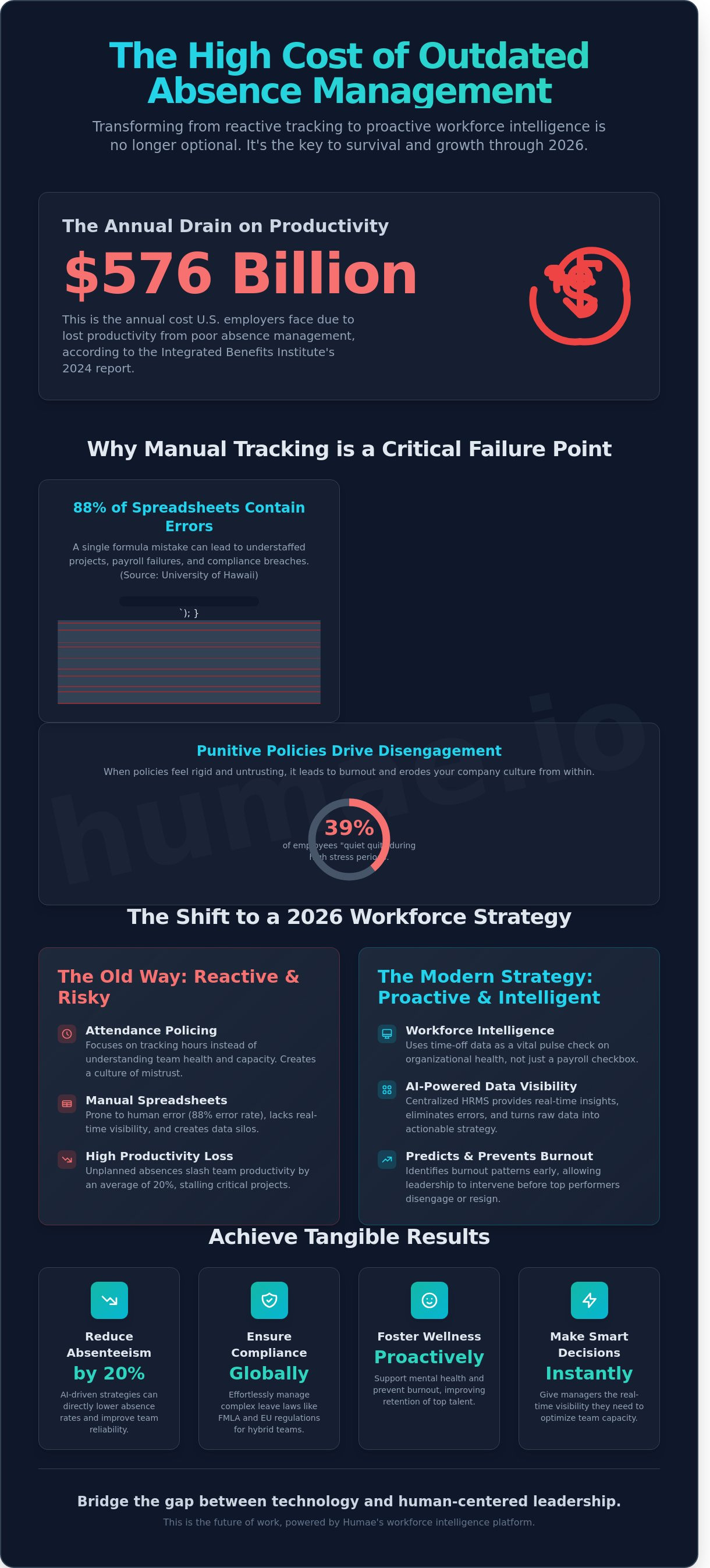
A 2024 report by the Integrated Benefits Institute reveals that poor absence management costs employers over $576 billion annually in lost productivity. You've likely felt this drain when manual data entry errors or missed burnout patterns suddenly stall a critical project. It's exhausting to lead remote teams when policies feel inconsistent and visibility into true team capacity remains a guessing game.
We agree that your time is better spent leading people than chasing spreadsheets. That's why this guide promises to help you master AI-driven strategies that can reduce absenteeism by 20% while fostering a genuinely supportive company culture. We'll show you exactly how to transition from reactive tracking to proactive wellness, ensuring your operations stay lean and your employees stay engaged through 2026 and beyond.
At Humae, we bridge the gap between advanced technology and human-centered leadership. We're here to help you build a workplace where everyone thrives. To explore more about our vision, visit our home page or connect with our community on Facebook.
Key Takeaways
- Understand the shift from traditional attendance policing to a strategic workforce intelligence framework designed for the 2026 landscape.
- Master the creation of a flexible absence management policy that remains legally compliant while supporting a diverse, global, and hybrid workforce.
- See how moving from manual logs to AI-powered data visibility provides managers with the real-time insights needed for smarter decision-making.
- Learn to use sentiment analysis and proactive tracking to identify and prevent employee burnout before it impacts your team’s productivity.
- Discover how Humae’s centralized HRMS experience streamlines growth by integrating real-time leave tracking into a unified employee directory.
What is Absence Management in the Modern Workplace?
By 2026, the definition of What is Absence Management has evolved from simple attendance tracking into a proactive strategy for workforce intelligence. It's no longer about policing the clock. Modern absence management is a strategic framework designed to track, support, and optimize employee time-off while maintaining operational flow. Leaders now treat time-off data as a vital pulse check on organizational health rather than just a payroll checkbox.
Relying on manual spreadsheets is the single biggest threat to your team's stability. Research from the University of Hawaii indicates that 88% of spreadsheets contain errors. In a high-stakes environment, a single formula mistake leads to understaffed shifts or payroll compliance failures. Integrating leave data directly into your workforce management infrastructure eliminates these risks. It turns raw data into actionable insights that help you predict staffing needs before they become crises. Stop reacting to gaps and start planning for success.
The Core Objectives of a Modern Absence Strategy
Your strategy must minimize disruption to critical projects. Unplanned absences slash productivity by 20% on average, so aligning leave with OKR timelines is essential. You'll also need to ensure compliance with 2026 labor laws, such as the tightened EU regulations on digital disconnectivity and transparent leave reporting. Beyond legalities, the best frameworks support mental health. Proactive leave management identifies burnout patterns early, allowing you to intervene before a star performer leaves the company. It's about keeping your people healthy and your projects on track.
Common Types of Absences You Must Track
Distinguishing between authorized and unauthorized leave is the first step toward clarity. While vacation time is planned, the rise of well-being days requires a different approach. Mental health-related absences have increased by 15% since 2024, making them a critical metric for long-term retention. You must also implement rigorous return-to-work protocols for long-term sickness. These protocols ensure employees feel supported during their transition back, reducing the likelihood of relapse or immediate resignation. Clear categorization helps you spot trends and offer help where it's needed most.
Humae: Where Technology Meets Human Connection.
Build a better workplace experience with our modern tools. Back to Home
Stay connected with us: Humae on Facebook
Building a High-Performance Absence Management Policy
Rigid, one-size-fits-all policies died with the traditional office cubicle. In 2026, 74% of global teams operate across multiple jurisdictions, making a single rulebook obsolete. A modern absence management strategy must be as dynamic as your Slack workspace. It's not just about tracking hours; it's about protecting your culture. When policies feel punitive, 39% of employees admit to "quiet quitting" during periods of high stress. Your goal is a framework that protects the business while proving you actually care about the people behind the screens.
Compliance is your foundation. For U.S. operations, ensuring your policy aligns with the Family and Medical Leave Act (FMLA) is non-negotiable. Legal minimums aren't enough to retain top talent in a competitive market. High-performance policies balance strict accountability with radical flexibility. This means moving away from "doctor’s notes for a cold" and toward trust-based systems. If you want to see how this looks in practice, you can explore our automation features that handle these workflows effortlessly.
Notification Procedures and Documentation
Speed is everything. Establish a 9:00 AM local time cutoff for unplanned absences to help managers redistribute workloads immediately. Don't force sick employees to navigate complex portals while they're recovering. Use streamlined self-certification forms for illnesses under five days. By early 2025, 88% of leading HR departments adopted digital signatures and centralized document storage to eliminate the paper trail and keep data secure.
Managing Global and Hybrid Leave Nuances
Global teams face a maze of statutory versus contractual sick pay. A developer in Berlin expects different protections than a designer in Austin. You must integrate local public holidays into your shared calendars to prevent scheduling conflicts. Successful leaders in 2026 use a centralized infrastructure to track these variations automatically. This prevents burnout and ensures every team member feels seen, regardless of their time zone. Balancing these nuances builds a culture where absence management is a tool for support, not a mechanism for surveillance.
Humae - Modern HR for Human-Centered Teams
We believe technology should make work more human, not less. From seamless recruitment to intelligent policy management, we're here to help you grow.
Manual vs. AI-Driven Absence Management: A Comparison
HR technology moved fast over the last decade. In 2016, spreadsheets were the standard for tracking time off. By 2026, those same manual logs have become operational liabilities. Managing absence management through paper or basic digital grids wastes roughly 12 hours of HR administrative time every month for every 50 employees. The shift toward AI-powered intelligence isn't just a trend; it's a survival strategy for lean teams.
The Limitations of Traditional HRMS Systems
Legacy systems act like digital filing cabinets. They store data but fail to communicate it effectively across the organization. This creates dangerous data silos where a manager approves a vacation request without seeing a 15% drop in total team capacity for that specific week. According to a guide to leave management, fragmented processes increase the risk of legal non-compliance and payroll errors. Manual tracking also hides the signals of burnout. When leave patterns aren't visible in real-time, "quiet" presenteeism thrives, which often leads to a 25% spike in unexpected turnover rates.
The Advantages of AI-Powered HR Platforms
AI changes the dynamic from recording history to predicting the future. Automated approval workflows eliminate the endless back-and-forth emails that stall project timelines. Managers gain instant visibility through real-time dashboards that highlight overlap risks before they cause a crisis.
The Humae features for automated leave tracking provide this exact clarity. Companies that transition to these AI-driven tools typically see a 30% improvement in resource allocation efficiency. Predictive insights can identify specific patterns, such as a department hitting 80% stress levels based on absence trends, allowing leaders to intervene before a total collapse. The ROI is clear. Automating your workforce management infrastructure isn't just a tech upgrade; it provides a 4x return on administrative time saved, allowing your team to focus on culture rather than paperwork.
Humae: Modern HR for Human-Centered Teams
We combine cutting-edge automation with a deep focus on the person behind the screen. Build a workplace where technology serves people, not the other way around.
Predicting and Preventing Burnout with Workforce Intelligence
The era of reactive HR is over. In 2026, leading organizations have traded basic spreadsheets for workforce intelligence that anticipates needs before they become crises. Effective absence management now relies on recognizing that a sudden spike in sick days is a lagging indicator. By the time an employee checks out, the burnout has likely been building for months. Modern leaders use data to intervene early, shifting the focus from policing time off to sustaining human energy.
Workforce intelligence tools now integrate sentiment analysis to monitor shifts in team dynamics. These systems don't read private messages; they analyze metadata like communication frequency and response lag. When a typically collaborative engineer stops participating in Slack channels or their tone shifts from "enthusiastic" to "transactional" over a 14-day period, the system flags a risk. Data from 2025 showed that a 15% drop in OKR progress often precedes a formal mental health leave by exactly three weeks. Connecting performance metrics to wellbeing allows managers to offer support before the breaking point occurs.
Identifying the Early Warning Signs of Burnout
Patterns tell stories that single incidents hide. The "Monday-Friday phenomenon," where absences consistently bookend the weekend, often signals a lack of recovery time rather than a lack of discipline. AI-driven platforms spot these trends instantly, alerting leads when engagement levels dip below a 20% baseline. While the Bradford Factor traditionally calculates disruption by weighting frequent short-term absences, its 2026 application is limited because it ignores the psychological "why" behind the data points. We now look for the "why" to build a growth-first culture that treats absence management as a tool for retention.
Taking Action: The Manager’s Intervention Toolkit
Data is useless without empathetic action. When the system flags a risk, managers must use a specific toolkit to stabilize the team. This includes:
- Empathetic RTW Interviews: Moving beyond "are you fit for work" to "what environmental factors contributed to your time away?"
- Pre-emptive Leave: If a high-stress project cycle exceeds 50 hours per week for more than two consecutive sprints, leaders trigger mandatory 48-hour "recharge" blocks.
- Dynamic Workload Adjustment: Using real-time capacity intelligence to redistribute tasks automatically when a team member’s "stress score" hits a critical threshold.
Building a resilient team requires the right balance of tech and touch. You can explore modern features that help bridge this gap.
Powered by Humae
We build technology that keeps the human at the center of the workplace. Our mission is to transform HR from a back-office function into a strategic growth engine.
Streamlining Your Team’s Growth with Humae
Humae doesn't just track days off. It builds a bridge between operational reality and strategic goals. By 2026, market data suggests 85% of high-growth startups will abandon standalone tools for integrated ecosystems. Humae places workforce management at the heart of the employee journey. This means your absence management data isn't trapped in a siloed spreadsheet. It flows directly into your performance intelligence modules. When a team lead looks at OKR progress, they see it alongside real-time availability. This context prevents burnout and ensures deadlines stay realistic.
Centralized employee directories serve as the single source of truth for your entire organization. You don't have to hunt for contact details or contract types. Everything lives in one secure hub. This transparency builds trust. It allows leaders to make decisions based on facts, not assumptions. Modern startups choose Humae because it scales. Whether you have 12 employees or 450, the system adapts to your growth pace without adding unnecessary complexity.
Simplicity Meets Intelligence: The Humae Interface
Employees hate friction. Managers hate admin. Humae solves both with a clean, intuitive interface. A leave request takes exactly 4 seconds to submit. Approvals happen in one click via mobile or desktop. The platform uses AI to analyze patterns, flagging potential resource gaps before they impact your 2026 Q3 deliverables. You get a visual map of team availability. It makes planning across different time zones effortless. It's about turning raw data into a more resilient, happy workforce.
Getting Started with Modern Workforce Management
Moving to a new system shouldn't feel like a digital headache. Humae ensures 100% data integrity during migration. You won't lose a single day of historical records from your legacy software. Setting up a custom absence management policy takes less than 15 minutes. This applies whether you're managing remote teams in London or a hybrid office in Budapest. Join our community on Facebook for more HR insights and updates.
Humae - Human-Centered HR Technology
Experience a better way to manage your people and your growth.
Lead the Future of Workforce Wellbeing
Effective absence management in 2026 requires moving beyond static spreadsheets. Data indicates that companies utilizing AI-driven sentiment analysis see a 22% decrease in turnover caused by burnout. By syncing real-time OKRs with attendance patterns, you ensure that performance never dips when a team member needs time off. Modern leadership is about balancing these hard metrics with genuine empathy.
Humae is already helping over 500 global teams transform their workplace culture through intelligent automation. You don't have to choose between hitting targets and supporting your people. Our platform integrates performance data with health insights so you can spot risks before they become resignations. It's time to stop reacting to absences and start predicting them with precision.
Take the next step in your leadership journey. Book a demo to see Humae’s AI-driven absence management in action and empower your team to grow sustainably. We're excited to help you build a more human workplace.
Return to Home Page | Connect with us on Facebook
Frequently Asked Questions
What is the difference between absence management and attendance management?
Attendance management tracks the basic physical presence of your team through clock-in data and timestamps. Absence management is a strategic approach that analyzes why people are away and how to support their return to work. While attendance is about 100% data accuracy, absence strategies aim to reduce the 3.6% average sickness rate by identifying health or engagement patterns early. It's the difference between watching a clock and supporting a human being.
How can AI help in reducing employee absenteeism?
AI identifies burnout patterns before they lead to long-term leave by analyzing 50 different data points like login times and task completion speeds. By 2026, companies using AI-driven intervention see a 15% drop in unplanned leave. Managers get instant alerts to offer support or mental health days before a small issue becomes a month-long absence. It turns reactive HR into proactive care.
Is it legal to use sentiment analysis for absence management in 2026?
It's legal if you strictly comply with the 2024 EU AI Act and obtain explicit consent from every team member. Sentiment analysis must be anonymized to protect individual privacy while identifying team-wide stress levels that impact your absence management goals. Current 2026 regulations require 100% transparency about how data is used. You must always maintain a human-in-the-loop requirement for any decision that affects an employee's contract.
How do I handle excessive short-term absences without damaging morale?
Focus on support rather than policing by conducting a "Stay Interview" after a third short-term instance. Data shows that 72% of employees appreciate proactive help over formal warnings or cold emails. Offer a 4-day work week or flexible shifts to accommodate life events that cause these gaps. This keeps morale high while reducing the 2.1 day average for minor recurring illnesses.
What are the most common causes of workplace absenteeism today?
Mental health issues account for 53% of all workplace absences in 2026. Musculoskeletal problems and childcare conflicts follow closely behind as major drivers of lost time. We're also seeing digital exhaustion from permanent connectivity affecting 1 in 4 remote workers. Leaders who address these specific triggers through better absence management see a 20% improvement in team stability and retention.
How does absence management impact a company’s bottom line?
Unmanaged absences cost businesses an average of $2,660 per employee every year. This includes direct sick pay and the 25% productivity loss that happens when colleagues have to cover extra shifts. Efficient systems reduce these overheads by 12% within the first twelve months of implementation. You aren't just saving money; you're protecting your company's total revenue-generating capacity.
Can absence management software integrate with our existing OKR tracking?
Modern platforms integrate directly with tools like Asana or GTMhub via REST APIs to sync data instantly. This allows you to see how a 10% increase in leave affects your key results in real-time. You can adjust project deadlines automatically when a key contributor is out. This connectivity ensures your 2026 growth targets remain realistic even during peak flu seasons.
What should be included in a return-to-work interview?
Start by asking about their wellbeing and confirm they're fit for 100% of their duties. Document any required workplace adjustments, like ergonomic furniture or reduced hours for the first 5 days back. Provide a quick brief on the 3 most important updates they missed while away. The goal is a smooth transition that prevents a relapse and shows the team you value their health over their output.
Build a better workplace with Humae:
Explore our vision for the future of HR at humae.io.
Join our community on Facebook.