Training Employees on New HR Software: The 2026 Implementation Strategy
By Humae · 4 July 2026
training employees on new hr software
Why do most HR tech rollouts fail before the first login? It isn't usually a flaw in the code. It is the "tool fatigue" that leaves your team feeling more burdened than empowered. You have likely felt the frustration of investing in a sophisticated platform only to see it ignored or met with a flood of support tickets from non-tech staff. Training employees on new hr software shouldn't feel like an uphill battle against your own culture; it should be the moment your team finally feels supported.
We understand that a successful rollout requires more than a manual. It requires a human-centric strategy that bridges the gap between technical capability and daily reality. This guide provides a definitive 2026 framework for software adoption that turns skeptical staff into enthusiastic power users. You will learn how to reduce administrative friction, achieve 100% platform engagement, and ensure your investment pays off. We will explore how to integrate workflows, leverage AI-driven personalization, and stay compliant with new regulations like California SB 513 to ensure your implementation is both modern and meaningful.
Key Takeaways
- Understand why a strategic rollout prevents "ghost platforms" and significantly reduces the volume of administrative support tickets.
- Master our five-step framework for training employees on new hr software, focusing on pre-launch awareness and the empowerment of internal champions.
- Learn to identify the root causes of technical resistance and shift your team's mindset away from outdated, manual processes.
- Establish clear success KPIs and use AI-driven sentiment analysis to measure long-term adoption and genuine employee satisfaction.
- Explore how Humae Performance Intelligence leverages intuitive design and AI guidance to eliminate the burden of extensive manual training.
Why a Strategic Approach to HR Software Training Matters
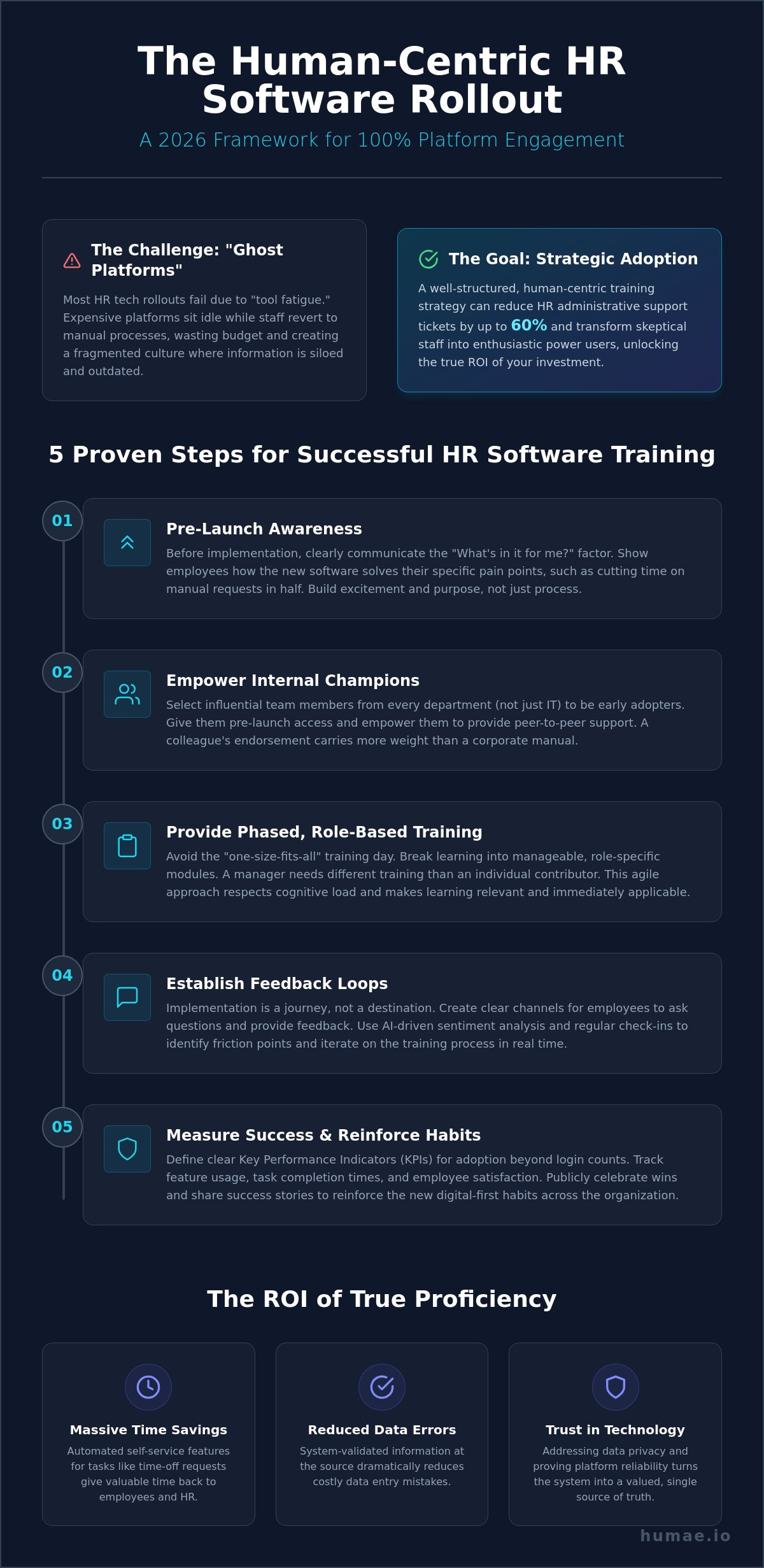
Software is only as powerful as the hands that use it. Many organizations fall into the trap of purchasing high end HRMS solutions only to watch them become "ghost platforms." These are expensive systems that sit idle while employees continue to use fragmented spreadsheets or manual paper trails. This disconnect doesn't just waste budget; it creates a fragmented culture where information is siloed and outdated. When you prioritize training employees on new hr software, you aren't just teaching clicks. You're building a digital-first culture. Industry data suggests that well-structured onboarding can reduce HR administrative support tickets by up to 60 percent, freeing your team to focus on people, not troubleshooting.
The transition from manual processes to a digital-first approach requires empathy and a clear roadmap. If staff feel the software is an obstacle rather than an aid, they will find workarounds. By treating training as a strategic pillar, you bridge the gap between technical capability and daily reality. Proficiency leads to confidence, and confident employees are more likely to engage with the tools you provide, ensuring your investment delivers the expected returns.
The ROI of Proficiency
Workforce management infrastructure serves as the essential backbone of modern operations by providing the stability and data flow required for organizational growth. When employees master the system, the ROI becomes visible through massive time savings. Automated self-service features allow staff to manage their own time off or update personal records without emailing HR. This standardization dramatically reduces data entry errors, as the system validates information at the source. It's about giving time back to your people so they can focus on high-impact work.
Building Trust in New Technology
Trust is the currency of digital transformation. During the first training session, it is vital to address data privacy concerns head-on. Employees need to know their information is secure and that the platform is the "single source of truth" for the company. Understanding the Technology Acceptance Model helps us realize that perceived usefulness and ease of use are the primary drivers of adoption. By establishing this trust early, you transform the platform from a "corporate requirement" into a valued resource. For a deeper look at how this fits into your overall strategy, explore our guide on What is Workforce Management? to see the bigger picture.
5 Proven Steps for Training Employees on New HR Software
Implementing technology in a hybrid workforce requires a shift from traditional classroom styles to agile, human-centered methods. In 2026, successful training employees on new hr software is no longer about a single Go-Live date. It is a phased journey that respects your team's time and cognitive load. By breaking the process into manageable stages, you ensure that the platform becomes a helpful partner rather than a digital hurdle.
Phase one begins with pre-launch awareness. You must clearly communicate the "What is in it for me" factor. If an employee understands that the new HRMS will cut their time spent on manual time-off requests in half, they are already halfway to adoption. Move quickly into phase two by identifying your internal champions. These individuals act as the bridge between technical implementation and daily usage.
Leveraging Internal Champions
Don't just look at the IT department for your champions. Select influential team members from every department who are early adopters or natural problem solvers. Give these champions early access to the HRMS and encourage them to explore features like the employee directory or OKR tracking. Their role is to provide peer-to-peer support, which significantly reduces implementation anxiety. When a colleague explains a feature, it carries more weight than a corporate manual. This organic support structure mirrors effective federal training and development policies that prioritize continuous learning and peer engagement.
The Power of Micro-Learning
The days of mandatory, hour-long webinars are over. In 2026, your team learns best through role-specific micro-learning modules. These are 5-minute video snippets or interactive guides focused on one specific task, such as "How to submit a time-off request." This mobile-first approach allows on-the-go employees to learn in the flow of work. By providing bite-sized information exactly when they need it, you prevent "tool fatigue" and keep engagement high. To see how this looks in practice, you can explore how our intuitive HR features are designed for immediate clarity.
Finally, move into phase four with hands-on sandbox sessions. These risk-free environments allow staff to click around without fear of making permanent errors. Conclude with phase five: continuous feedback loops. Use this data to roll out advanced features like performance intelligence once the core system is mastered. This ensures your training employees on new hr software evolves alongside your team's proficiency.
Overcoming Adoption Barriers and Employee Resistance
Resistance is rarely about the software itself; it is about the fear of the unknown. When you begin training employees on new hr software, you must address the psychological weight of change. Employees often feel overwhelmed by the constant influx of new digital tools. This is known as tool fatigue, and it can kill adoption rates before the first week is over. To combat this, you need a strategy that prioritizes the human experience over technical checklists. Understanding the root cause of resistance, whether it is a fear of incompetence or a perceived loss of control, allows you to tailor your approach.
Experts suggest that Helping Employees Adapt To New Technology requires clear communication and a focus on how the tool solves specific pains. You must actively dismantle the "way we used to do it" mindset by showing, not just telling, the benefits of the new system. Gamification can turn a mandatory chore into an engaging challenge. Use progress bars for profile completion or small digital badges for finishing the first training module. These micro-incentives build momentum and transform the rollout into a shared victory for the team.
Support must be multifaceted. Some employees prefer a quick Slack message, while others need the detailed explanation of an email or the face-to-face reassurance of live office hours. Providing these diverse channels ensures that no one feels left behind during the transition. By being present and responsive, you build the trust necessary for long term adoption.
Addressing Tool Fatigue
The modern workplace is cluttered with too many apps. Consolidating your legacy tools into one centralized HRMS reduces mental friction and streamlines the workday. When you emphasize the reduction of manual paperwork, the value proposition becomes clear to every staff member. A centralized Employee Directory simplifies daily internal communication by putting every contact, role, and department at your team's fingertips instantly. This consolidation proves that the new system is designed to make their lives easier, not harder.
Incentivizing Early Adoption
Reward your pioneers to set the tone for the rest of the organization. Use small, meaningful rewards for those who complete their initial profile setup within the first 48 hours. Publicly recognizing departments with the highest engagement rates in company meetings fosters healthy competition. Most importantly, link software use to personal growth. When employees see that active participation feeds into their Performance Intelligence and OKR tracking, they recognize the platform as a vital tool for their own career advancement.
Measuring Training Effectiveness and Long-Term Adoption
Measuring the success of training employees on new hr software requires looking far beyond basic login statistics. In 2026, we focus on behavioral outcomes and task proficiency. High login frequency can sometimes mask frustration if a user is logging in multiple times just to find a single button. By tracking task completion rates alongside time-spent-on-task, you gain a clearer picture of where the friction actually lies. Are users finishing their profiles on the first try? Are they submitting time-off requests without triggering errors? These are the metrics that define true adoption.
Modern platforms now leverage AI-driven sentiment analysis to gauge how your team feels about the transition. Instead of waiting for a formal complaint, you can see early signs of frustration through the tone of help desk queries or internal feedback tools. Conducting post-training "Pulse Surveys" allows you to catch these issues in real-time. These are short, two-question check-ins that provide immediate data on technical barriers or training gaps. This proactive approach ensures that minor hurdles don't turn into systemic resistance.
Aligning Adoption with OKRs
Software implementation should never happen in a vacuum. Set specific Objectives and Key Results (OKRs) for the rollout phase to ensure the technology serves your broader business goals. For example, a key result might be "90% of employees completing their performance self-assessment within the first month without HR intervention." This connects software usage directly to team productivity and accountability. If you want to dive deeper into how to structure these goals, check out our OKR Meaning Guide for a full framework on modern goal setting.
Utilizing Analytics Dashboards
Visibility is your greatest tool for ensuring long-term success. Use your analytics dashboards to identify "under-utilizers" before they disengage from the company culture completely. These are team members who may have attended the initial sessions but haven't engaged with the platform since. By spotting these patterns, you can offer targeted, empathetic support. Data also reveals which specific features are causing the most confusion, allowing you to iterate on your training employees on new hr software for future hires. Ready to see how data-driven insights can transform your team's performance? Explore the Humae Analytics Dashboard today.
Streamlining Implementation with Humae Performance Intelligence
The final piece of the 2026 implementation puzzle is the platform itself. Even the most robust strategy for training employees on new hr software can struggle if the interface is clunky or outdated. Humae Performance Intelligence is built on the principle that technology should be invisible; it should support the user without demanding constant attention. By focusing on a human-first design, we've created an environment where employees feel at home from their very first login. When the tool is intuitive, the barrier to adoption simply disappears.
Our platform leverages built-in AI intelligence to act as a digital mentor for every staff member. Instead of searching through a 50-page PDF manual, employees receive real-time guidance as they navigate their first tasks. Whether they're setting up an Employee Directory profile or submitting their first request for Time Off Management, the system provides contextual hints that eliminate confusion. This "just-in-time" learning approach significantly reduces the need for extensive manual training sessions and allows your HR team to focus on culture rather than tech support.
The power of Humae lies in its role as a centralized hub. We bring together OKR tracking, performance intelligence, and daily administrative tasks into one seamless experience. This consolidation doesn't just improve efficiency; it fosters a culture of continuous feedback. With real-time analytics dashboards, managers can see progress and offer support instantly, turning the HR platform into a vibrant community space rather than a cold database. By unifying these functions, you eliminate the tool fatigue discussed earlier and provide a single source of truth for the entire organization.
The Humae User Experience
We designed our UI for the modern employee who expects simplicity and speed. The interface is clean, intuitive, and mobile-ready, ensuring that your workforce can engage with company goals from anywhere. We understand that your needs will change as you grow. Humae is built to scale with you, providing the same high-quality experience whether you're a growing startup or a large enterprise. We invite you to see how it works in a live environment to experience the difference for yourself.
Getting Started Today
Transitioning to an AI-powered HR platform is a bold step toward a more efficient future. Our implementation resources are designed to make this move as smooth as possible. You'll have access to dedicated support and a wealth of guides to help you execute your strategy for training employees on new hr software with confidence. It's time to stop fighting with legacy systems and start empowering your people. Explore our Humae features page today to see how we can help you build a better workplace.
Empower Your Team for the Future of Work
Success in 2026 isn't measured by the features you buy, but by the confidence of the people using them. We've explored how a human-centric approach transforms a technical rollout into a cultural victory. By prioritizing micro-learning and empowering internal champions, you move away from the "ghost platforms" of the past. Effective training employees on new hr software ensures that your investment yields high adoption rates and a significant reduction in administrative friction. It's about shifting the focus from technical checklists to genuine user empowerment.
Your team deserves a platform that feels like a partner, not a burden. Transitioning to a modern ecosystem allows you to harness AI-driven performance intelligence and centralized OKR tracking to drive real growth. With real-time analytics dashboards, you can stop guessing and start leading with data-driven empathy. This combination of strategy and technology creates a workplace where everyone has the tools to thrive.
Discover how Humae simplifies workforce management for modern teams and take the first step toward a more engaged, proficient workforce today. The future of HR is here, and it is built around the success of your people.
Frequently Asked Questions
How long should HR software training typically take for a medium-sized team?
Most medium-sized teams require two to four weeks for a full rollout of core functionalities. This timeline allows for initial awareness, role-specific micro-learning, and hands-on sandbox exploration without overwhelming daily operations. Rushing the process often leads to skipped steps and lower long-term adoption rates across the organization.
What is the best way to train remote employees on new software in 2026?
Mobile-first micro-learning is the most effective method for remote teams today. Use short, asynchronous video guides and interactive walkthroughs that employees can access in their own time. This approach respects their workflow and allows them to learn in the environment where they actually perform their daily tasks.
How do I handle employees who are resistant to leaving legacy systems?
Address resistance by highlighting specific efficiency gains rather than just technical features. When training employees on new hr software, show them exactly how the new system eliminates their most tedious manual tasks. Peer-to-peer support from internal champions can also bridge the gap and reduce anxiety better than a corporate manual.
Should we use a phased rollout or a "big bang" approach for new software?
A phased rollout is almost always superior for complex HR systems. Start with core features like the Employee Directory or Time Off Management before moving to performance intelligence. This strategy builds user confidence and allows you to gather feedback and make adjustments before the system becomes fully operational.
What are the most common mistakes companies make during HR software implementation?
The biggest mistake is treating software implementation as a purely technical project rather than a human one. Companies often fail to communicate the "What is in it for me" factor or ignore the user experience during the selection process. Without clear success KPIs and ongoing support, even the best technology will struggle to gain traction.
How can AI help with the employee training and onboarding process?
AI creates personalized learning paths that adapt to an employee's specific role and learning pace. It can provide real-time guidance during tasks and use sentiment analysis to identify when a user is struggling. This technology ensures that training employees on new hr software feels supportive rather than demanding for the end user.
How often should we conduct refresher training for our HRMS?
Schedule light refresher sessions quarterly or whenever significant new features are introduced to the platform. These don't need to be long; a five-minute update on new analytics dashboards or OKR tracking features is usually enough. Continuous, bite-sized updates keep the system relevant and ensure that team proficiency grows alongside the software.