Top HR Analytics Trends for 2026: From Static Reporting to Agentic Intelligence
By Humae · 31 July 2026
hr analytics trends
With the global HR analytics market reaching $5.2 billion in 2026, the real question isn't whether you have data, but whether that data is actually working for your people. You've likely felt the frustration of building complex reports that gather digital dust, or the confusion of seeing high engagement scores while productivity remains stagnant. Staying ahead of the latest hr analytics trends means moving beyond these manual bottlenecks to find a system that breathes with your organization and supports your team in real time.
We're here to help you transform that raw workforce data into a high-impact strategic roadmap that your leadership team will actually value. You'll discover how the shift toward agentic intelligence and automated dashboards can finally prove HR's ROI to the board without the usual manual headache. We will explore the specific tools you need to evolve from a data collector into a performance architect, ensuring your 2026 strategy is driven by meaningful action rather than just observation and static spreadsheets.
Key Takeaways
- Learn how to move beyond descriptive reporting to prescriptive analytics that predict and execute workforce outcomes.
- Understand how hr analytics trends like Agentic AI transform your software into an autonomous partner for complex tasks.
- Solve the "Engagement Trap" by connecting real-time sentiment data with OKR tracking for a holistic performance view.
- Audit your organization's "dark data" silos to create a centralized, AI-powered infrastructure that drives strategic ROI.
- Transition from a manual data analyst to a performance architect, allowing technology to handle reporting while you focus on culture.
The Evolution of HR Analytics: Beyond Descriptive Reporting in 2026
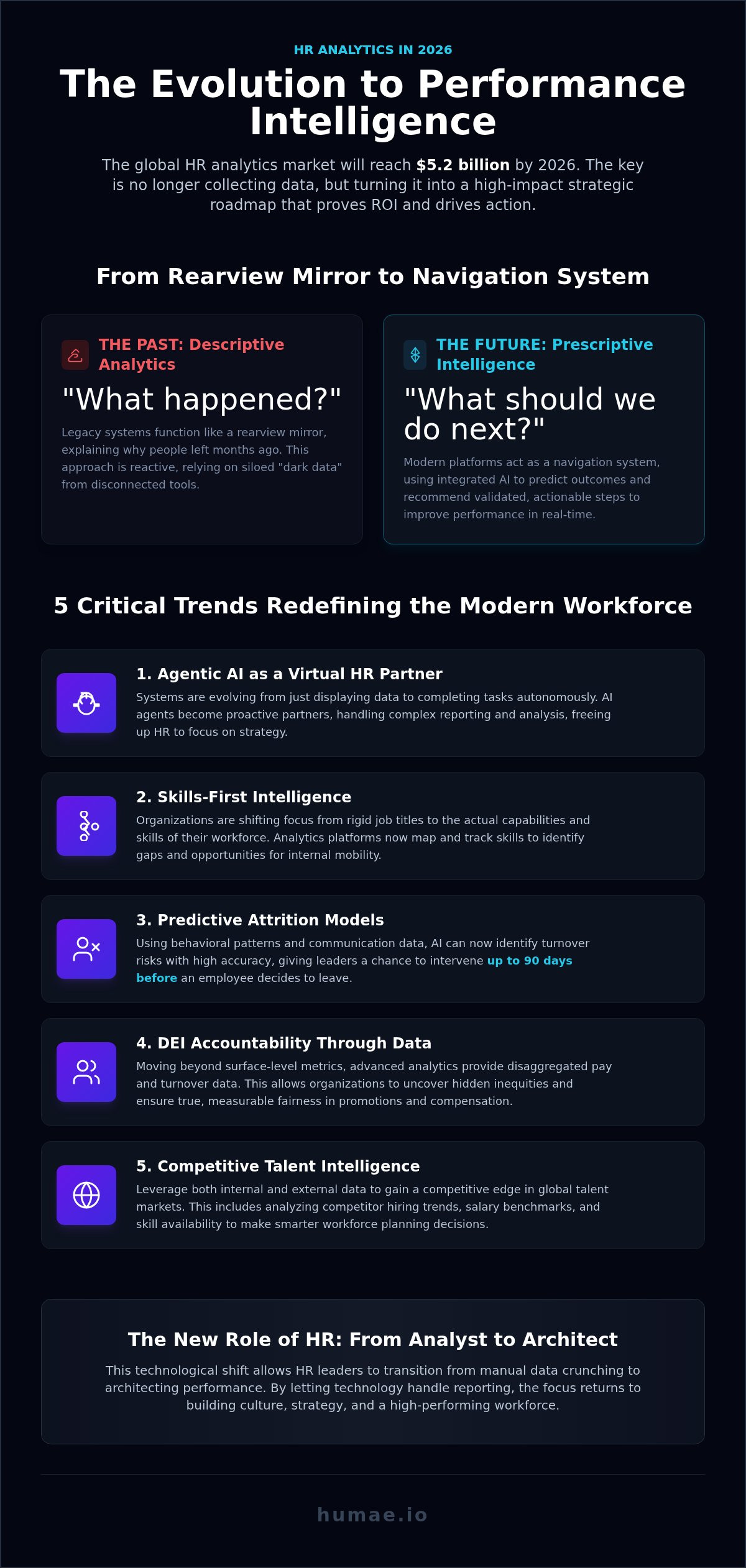
HR analytics in 2026 isn't a rearview mirror. It's a high-definition navigation system. In the past, teams spent weeks gathering data just to explain why people left three months ago. Today, the definition has fundamentally changed. Modern People analytics is the use of integrated AI to predict and execute workforce outcomes in real time. It's the difference between seeing a problem and having a system that's already working on the solution.
The industry is moving away from descriptive analytics, which only tells you what happened. We've entered the era of prescriptive intelligence. This shift answers the most critical question in People Operations: "What should we do next?" This year marks the rise of Decision-Grade Intelligence. This isn't just a collection of charts. It's a strategic layer that provides leaders with validated, actionable steps to improve retention and performance before issues escalate. To make this work, your workforce management infrastructure must centralize fragmented data points into a single, coherent story. Without this foundation, even the most advanced hr analytics trends will fail to deliver value.
Why Traditional HRIS Systems Are Failing Modern Teams
Legacy HR software often functions as a digital filing cabinet. Data stays trapped in silos, separated by walls between hiring, onboarding, and performance reviews. This isolation creates "dark data" that no one can use effectively. Modern platforms solve this by integrating every stage of the employee lifecycle into one continuous stream. If you're still struggling with disconnected tools, check out our modern HRIS guide to understand how to build a better infrastructure. When your data flows together, you stop chasing spreadsheets and start leading with confidence.
The Rise of Real-Time Sentiment Analysis
The annual engagement survey is dead. In a fast-moving market, waiting twelve months for feedback is a recipe for high turnover. 2026 is about continuous feedback loops. AI now interprets employee sentiment across multiple touchpoints to prevent burnout before it actually happens. By analyzing subtle shifts in communication and performance patterns, these tools alert managers to potential disengagement early. This real-time visibility dramatically increases executive decision-making speed, allowing you to protect your culture and your bottom line simultaneously.
5 Critical HR Analytics Trends Redefining the Modern Workforce
The transition from passive data collection to active workforce strategy is happening faster than many expected. Organizations are no longer content with knowing how many people left last month. They want to know who is likely to leave next quarter and what specific intervention will keep them. These hr analytics trends are shifting the focus from historical reporting to real-time execution. To stay competitive, leaders must adopt a "Trend-Ready" mindset that treats data as a living part of the company culture.
Success in 2026 requires mastering five key areas:
- Agentic AI as a Virtual HR Partner: Systems that don't just show data but complete tasks autonomously.
- Skills-First Intelligence: Prioritizing actual capabilities over traditional, rigid job titles.
- Predictive Attrition Models: Using behavioral patterns to identify turnover risks up to 90 days before they happen.
- DEI Accountability: Moving beyond surface-level metrics to analyze disaggregated pay and turnover data for true equity.
- Talent Intelligence: Leveraging internal and external data to gain a competitive edge in global markets.
These shifts align perfectly with the Top CHRO Priorities for 2026, where workforce redesign and AI adoption are the primary drivers of growth.
Agentic AI: From Analysis to Action
The phrase "AI Agent" describes a system capable of reasoning and executing tasks without constant human prompting. In workforce management, this means an agent can autonomously handle time-off approvals based on team capacity or answer complex policy queries instantly. We're moving away from human-led analysis toward AI-assisted execution. This technology doesn't just flag a problem; it initiates the fix, freeing your team to focus on high-value human connections.
The Skills-Based Organization Framework
Job roles are becoming increasingly fluid. In a human-machine era, what a person can do matters more than their official title. Modern hr analytics trends show that the most successful companies map internal skill gaps and find hidden talents already within their ranks. Implementing performance intelligence software allows you to track these skill gains as they happen, ensuring your workforce stays agile. If you want to build a resilient team, you need to see the skills behind the names on your org chart.
Building a future-proof team starts with the right infrastructure. See how Humae can help you turn these trends into your company's reality.
Solving the Measurement Paradox: Engagement vs. Productivity
Many organizations are currently falling into the "Engagement Trap." They celebrate high survey scores and vibrant office cultures, yet they're puzzled when business output remains stagnant. This disconnect is the Measurement Paradox. It's a clear sign that your data isn't telling the whole story. In the context of modern hr analytics trends, simply knowing that your employees are "happy" isn't enough. You need to understand if that happiness is actually fueling progress or if it's masking underlying inefficiencies.
The solution lies in linking sentiment data directly to execution. When you layer real-time feedback over project milestones, you gain a holistic view of performance. This approach is supported by research into the 6 Latest HR Trends, which emphasizes that top-performing companies are those that successfully align worker wellbeing with strategic goals. By using real-time dashboards, you can identify specific friction points in the employee journey, such as a lack of resources or unclear expectations, before they derail your quarterly targets.
Aligning Individual Growth with Company Objectives
Closing the productivity gap starts with clarity. Implementing robust OKR tracking allows every team member to see exactly how their daily tasks contribute to the company's high-level strategy. This visibility builds a sense of purpose that traditional engagement surveys often miss. When people understand their "why," their output naturally increases.
Performance Intelligence in 2026 is the real-time synthesis of employee sentiment, skill growth, and goal attainment to drive sustainable business results.
Measuring What Matters: Impact Metrics
In 2026, volume metrics are losing their relevance. Knowing your "time-to-hire" doesn't help if the new hires aren't contributing to the bottom line. Strategic leaders are moving toward "quality-of-impact" metrics. These data points quantify the actual value an employee or team brings to the organization over time. To prove HR's ROI to the C-suite, you must present an executive-ready dashboard that highlights these outcomes. Focus on how your initiatives reduced turnover costs or accelerated project delivery. This shift from counting activities to measuring results is what defines the most successful hr analytics trends of the decade.
Building the Infrastructure: Implementing Trend-Ready Analytics
Infrastructure readiness is the silent driver of success in 2026. While many organizations focus on the flashy side of AI, the real leaders are those who fix their foundations first. Most companies currently face an "Infrastructure Gap." They have plenty of data, but it's trapped in silos where it can't be used for execution. To truly capitalize on the latest hr analytics trends, you must build a pipeline that moves seamlessly from raw data to strategic action.
Your first step is a comprehensive data audit. Identify your "dark data" silos, the places where information exists but isn't integrated into your main decision-making flow. If your time-off records don't talk to your performance metrics, you're missing the context needed for predictive intelligence. Centralizing these points into one AI-powered workforce infrastructure is the only way to gain a clear, 360-degree view of your team.
Ethics and governance must be at the core of this transition. As AI becomes more autonomous, establishing a model for data privacy is essential for maintaining employee trust. Your team needs to know that their data is being used to support their growth, not just for surveillance. This cultural shift requires training your HR staff to move away from manual data entry. They must become strategic interpreters who can translate dashboard insights into human-centric solutions.
Data Quality and Governance in 2026
A "single source of truth" is the prerequisite for every trend we've discussed. Without it, your analytics will be inconsistent and unreliable. Privacy-first design is no longer optional; it's a competitive necessity. Using automated workforce management tools allows you to maintain high data integrity while protecting individual privacy. This balance ensures your analytics remain both powerful and ethical.
The Pilot Project Framework
Success is built through iteration. Start with a pilot project that targets a specific business outcome, such as reducing turnover in a high-growth department. Map your data points to this problem, test your predictive models, and measure the results. Once you've refined the process, you can scale these successes across the organization using a centralized dashboard. This step-by-step approach minimizes risk while maximizing impact.
Ready to bridge the gap between data and strategy? Explore Humae's centralized platform and build your trend-ready infrastructure today.
From Analyst to Architect: Leading with Performance Intelligence
The role of the HR professional is undergoing its most significant transformation yet. You're no longer just a custodian of records or an analyst of past events. In 2026, the most successful leaders have stepped into the role of the Architect of Human Potential. By leveraging the latest hr analytics trends, you can design environments where talent doesn't just exist but actively thrives. This shift is only possible when you stop fighting with spreadsheets and start leading with performance intelligence.
AI technology has finally reached a point where it can handle the repetitive, time-consuming tasks of data collection and cleaning. This freedom allows your team to return to the heart of the profession: the human element. When you aren't buried in manual reporting, you can focus on building a culture of empathy and growth. You become a visionary partner who uses data to support people, rather than just using people to generate data. This transition marks the end of the HR department as a back-office function and its rise as a central value center for the entire organization.
Embracing the Visionary Partner Role
Moving beyond a compliance mindset into strategic leadership requires an infrastructure built for speed. You need to position your department as a primary driver of the company's bottom line. By utilizing Humae's features, such as integrated sentiment analysis and real-time performance dashboards, you can initiate organizational change based on validated evidence. These tools allow you to prove HR's ROI to the board with clarity and confidence. The future of leadership is about making bold moves backed by Decision-Grade Intelligence.
Your 2026 HR Analytics Roadmap
Staying competitive in the 2026 landscape requires immediate, intentional action. To help you master the most impactful hr analytics trends, we've outlined the essential steps for your journey:
- Audit your data silos: Identify where fragmented information is preventing a clear view of your workforce.
- Implement a centralized platform: Move toward a "single source of truth" that integrates hiring, performance, and OKRs.
- Train for interpretation: Help your team evolve from data entry specialists into strategic consultants.
- Focus on impact: Replace volume-based metrics with quality-of-impact data that shows real business value.
The future of work belongs to those who can turn raw data into a high-impact strategic roadmap. Humae is designed to be your foundational partner in this transformation, providing the AI-powered infrastructure you need to lead with certainty. Visit the official Humae homepage for a complete platform walkthrough and discover how we can help you build a trend-ready organization.
Step Into the Future of People Operations
The transition from manual reporting to agentic intelligence is no longer a distant vision; it's the new standard for 2026. You've seen how the most impactful hr analytics trends focus on closing the gap between employee sentiment and business execution. By moving beyond the "Engagement Trap" and embracing a skills-first approach, you can finally align individual growth with your company's high-level strategy. This evolution requires a shift in your own role, moving from a data analyst to a visionary architect of human potential.
Success starts with the right foundation. You need a centralized workforce management infrastructure that turns fragmented data into clear, actionable insights. With AI-driven performance intelligence and integrated OKR tracking, you can prove HR's value to the board while building a culture that truly thrives. The tools for this transformation are ready when you are. It's time to stop observing the data and start architecting the future of your team.
Ready to transform your data into strategy? Explore Humae's AI-powered HR platform today.
Frequently Asked Questions
What are the most important HR analytics trends for 2026?
Agentic AI, skills-based organizational design, and predictive attrition modeling are leading the way. These hr analytics trends focus on moving from simply observing data to executing autonomous actions that solve business problems. Organizations are now prioritizing talent intelligence as a core competitive advantage. This shift allows leaders to transition from being reactive data analysts to becoming strategic architects of human potential.
How does Agentic AI differ from traditional AI in HR?
Traditional AI analyzes data and provides insights, but Agentic AI actually executes tasks. While a standard system might flag a staffing shortage, an agentic system can autonomously suggest shift changes or initiate a recruitment workflow. It acts as a reasoning partner that reduces the manual burden on your HR team. This technology moves beyond basic automation by making informed decisions based on the context of your organization.
Why is workforce management infrastructure necessary for analytics?
You can't analyze what you can't see. A centralized infrastructure breaks down data silos between hiring, performance, and time-off management. This unified view is the single source of truth required for any predictive model to be accurate. Without it, your analytics will remain fragmented and unreliable. A modern platform ensures that every data point contributes to a coherent story about your workforce's health and productivity.
How can I improve my company's HR analytics maturity level?
Start by auditing your current data quality and identifying dark data that isn't being used. Move from descriptive reporting to prescriptive insights that tell you what to do next. Implementing a platform that integrates OKR tracking and sentiment analysis will help you reach a higher maturity level quickly. This allows your team to focus on interpreting results rather than just entering data into spreadsheets.
What is the measurement paradox in employee engagement?
The paradox occurs when engagement scores are high but productivity remains stagnant. This happens because happiness doesn't always equal impact. To solve this, you must link sentiment data to performance outcomes and OKR progress. This gives you a holistic view of how your culture actually drives results. Understanding this connection helps you identify friction points in the employee journey that might be slowing down your team.
Is predictive analytics in HR ethical and compliant with privacy laws?
Yes, provided you implement a strong governance model and prioritize transparency. Privacy-first analytics ensure that data is used to support employee growth rather than for surveillance. Modern hr analytics trends emphasize disaggregated data that protects individual identities while providing valuable organizational insights. Maintaining this trust is essential for the long-term success of any data-driven initiative. Ethical AI practices are now a prerequisite for success.
How can small startups implement advanced HR analytics?
Startups should focus on a pilot project framework by picking one specific business problem to solve. Use centralized, cloud-based platforms that offer enterprise-level analytics without the need for a massive internal data science team. Focus on high-impact metrics like quality-of-hire and early-stage retention to prove ROI. This allows you to scale your analytics capabilities as your company grows without a massive upfront investment.
What metrics should I include in an HR dashboard for the CEO?
CEOs need impact metrics rather than volume metrics. Focus on quality-of-impact, revenue per employee, and predictive turnover risks. Include data that links HR initiatives to business execution, such as the correlation between leadership development and OKR attainment. This proves HR's role as a strategic value center. A well-designed dashboard should provide the decision-grade intelligence needed to guide the company's long-term workforce strategy and growth.