The Power of Analytics Dashboards: Driving Performance in 2026
By Humae · 15 July 2026
predictive analytics in HR
What if you could spot a retention risk weeks before an employee even considers leaving? It's a question every leader asks as we manage the complexities of 2026. Most HR teams still feel trapped by fragmented data silos and manual reporting that eats up precious hours every single week. You're likely tired of looking in the rearview mirror when you need a clear view of the road ahead to make confident decisions. Modern predictive analytics in HR has evolved from a luxury into a necessity; it's the bridge between raw numbers and genuine human empathy.
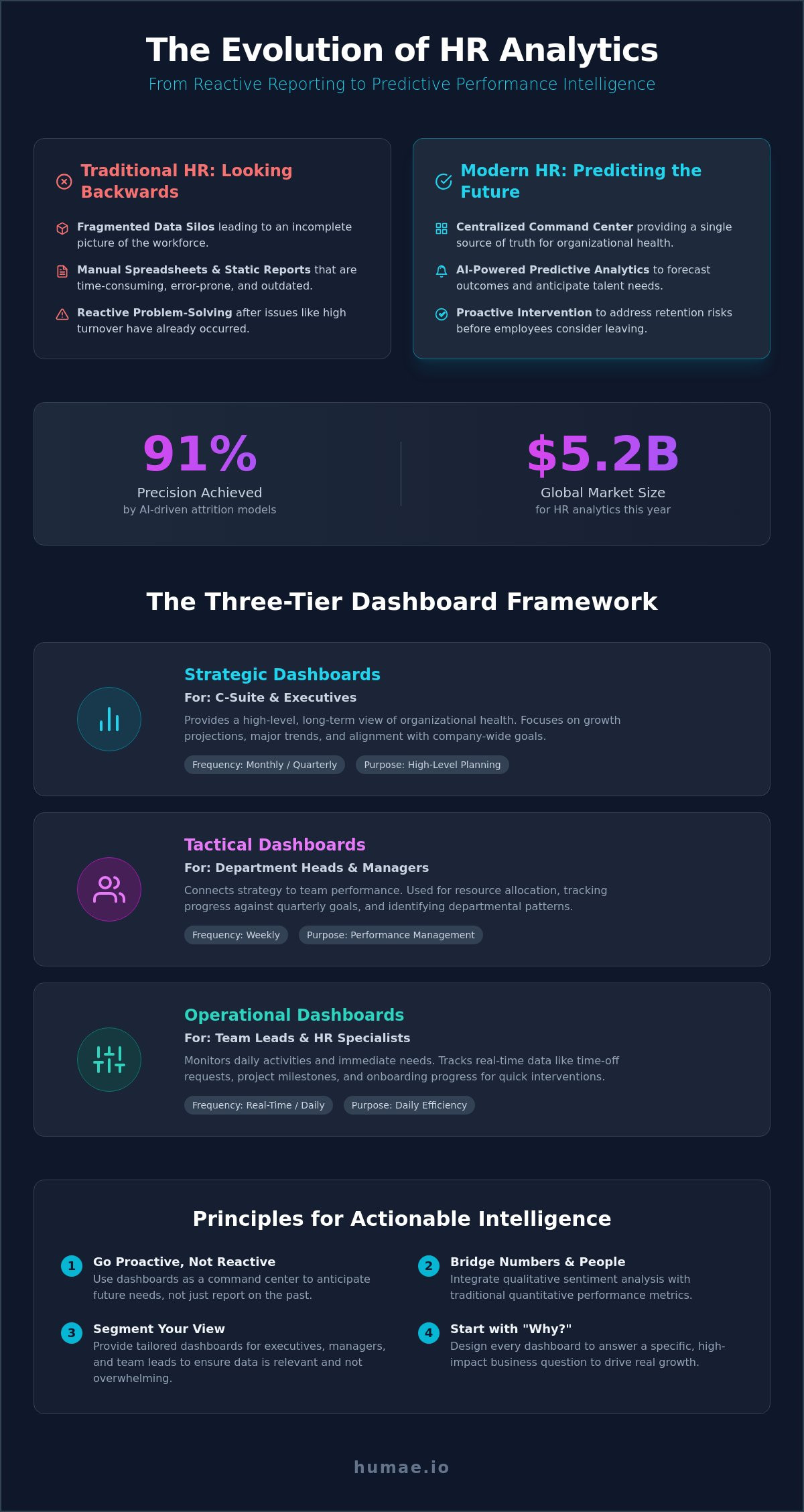
We understand that data is only as good as the decisions it inspires. With AI-powered attrition models now reaching up to 91% precision and the global HR analytics market hitting $5.2 billion this year, the shift toward data-driven talent management is no longer optional. We'll show you how to transform workforce metrics into actionable growth strategies. You'll discover how to centralize your view, automate stakeholder reports, and finally link individual OKRs to your organization's bottom line. By the end of this guide, you'll see how performance intelligence from Humae creates a culture where people and technology thrive together.
Key Takeaways
- Move from reactive reporting to proactive performance intelligence by using dashboards as a centralized command center for organizational health.
- Utilize a three-tier dashboard framework to provide managers and executives with the specific data density they need to lead effectively.
- Implement predictive analytics in HR to transform raw workforce data into a forward-looking engine that anticipates talent needs and retention risks.
- Bridge the gap between numbers and people by integrating qualitative sentiment analysis with traditional performance metrics.
- Build dashboards that drive actual growth by starting every design process with a specific, high-impact business question.
The Evolution of Predictive Analytics in HR for the 2026 Workplace
The HR department has officially shed its reputation as a purely administrative hub. In 2026, it functions as the strategic engine of the organization. This transformation is driven by a fundamental shift in how we handle information. We've moved past the era of looking at what happened and entered the age of anticipating what's next. Predictive analytics uses historical data, statistical algorithms, and machine learning to identify the likelihood of future outcomes. When applied to the workforce, predictive analytics in HR acts as a centralized command center for organizational health.
This isn't just about visualization; it's about proactive performance intelligence. In previous years, HR leaders spent hours piecing together reports to explain high turnover or lagging productivity. Today, AI-powered engines process thousands of data points in the background. They don't just produce static charts; they generate forecasts. With AI-driven attrition models now achieving up to 91% precision, leaders can intervene before a talented employee even decides to look elsewhere. Real-time data is the lifeblood of this system. In a fast-moving global environment, waiting for a month-end summary is a luxury no competitive business can afford.
From Static Reports to Real-Time Intelligence
The days of the monthly PDF report are over. Those documents were snapshots of a past that no longer exists by the time they reach a manager's inbox. Modern teams rely on live, interactive data streams that reflect the current state of the workforce. Cloud-based infrastructure has democratized this access, ensuring that every stakeholder sees the same single source of truth. Similar to how One Health Connect centralizes data for medical professionals through integrated cloud technology, these HR systems allow for rapid pivoting. If a specific team's engagement levels dip on Tuesday, you can address it by Wednesday, rather than discovering the burnout in a quarterly review.
Why Modern HR Needs More Than Just Spreadsheets
Manual spreadsheets are a significant liability for scaling companies. They're prone to human error, they create dangerous data silos, and they drain hours of productivity from HR professionals. Relying on fragmented cells and formulas makes it impossible to see the big picture of your organization's growth. Startups and enterprises alike now require integrated workforce management infrastructure that automates the heavy lifting. By implementing predictive analytics in HR through automated dashboards, you reduce the administrative burden. This allows your team to focus on what matters most: the human experience and high-level strategy.
Three Essential Types of Analytics Dashboards for HR Leaders
One size fits all is a dangerous philosophy in data visualization. To effectively manage a modern workforce, you need to provide the right information to the right person at the right time. This is where a tiered dashboard strategy becomes essential. By segmenting data density based on management levels, you ensure that leaders aren't overwhelmed by noise while managers have the granular details they need to succeed. By leveraging predictive analytics in HR, companies can customize these views to anticipate future needs rather than just reacting to the past. If you need help tailoring your broader software environment to these specific needs, you can discover Wanas Apps for specialized digital transformation support.
The frequency of data refreshes also varies across these tiers. While a CEO might only need a strategic refresh once a month, a department head requires weekly tactical updates, and a team lead needs real-time operational data. This structured approach ensures that every decision, from a daily schedule change to a five year hiring plan, is backed by evidence.
Operational Dashboards for Daily Efficiency
Operational dashboards act as the heartbeat of your daily activities. These tools focus on immediate, high-frequency data that changes by the hour or day. For a team lead, this means having instant visibility into time-off requests, onboarding milestones, and current project allocations. By integrating time-off management directly into your operational view, you can spot potential bottlenecks before they disrupt your workflow. If three senior engineers are scheduled to be away during a critical release week, the dashboard flags the conflict immediately. This level of detail ensures that the day-to-day machine runs smoothly without constant manual check-ins.
Strategic Dashboards for Long-Term Planning
At the executive level, the focus shifts to the big picture. Strategic dashboards prioritize low-frequency, high-impact metrics like annual turnover rates, diversity benchmarks, and long-term labor costs. Executives use these insights to transform business with predictive analytics, making high-stakes decisions about market expansion or organizational restructuring. These views are vital for investor reporting and demonstrating the clear link between employee health and company valuation. When you can prove that your retention strategies are working, you build trust with every stakeholder. If you're ready to see how your data can work harder for you, exploring a centralized analytics dashboard is the first step toward a more transparent culture.
The middle tier, often called tactical dashboards, bridges these two worlds. It allows mid-level managers to track team-wide OKRs and performance trends over weeks or months. This is where predictive analytics in HR identifies patterns in productivity before they become systemic issues. It’s about adjusting the sails mid-journey to stay on course.
Beyond Metrics: The Rise of Performance Intelligence and Sentiment Analysis
Numbers tell you what happened. Performance intelligence tells you how it feels. For years, HR leaders relied on cold KPIs like headcounts and turnover percentages to measure success. While these metrics are useful, they often miss the emotional heartbeat of the organization. In 2026, the most successful companies look beyond the spreadsheet. They understand that qualitative data is now just as critical as quantitative data for building a resilient culture. By using predictive analytics in HR, you can bridge the gap between hard numbers and the human experience.
The challenge for most organizations isn't a lack of data; it's a lack of clarity. Some reports suggest that 41% of organizations struggle to make sense of their large data volumes. This is where performance intelligence shines. It transforms raw information into a narrative about your people. When you can see the "why" behind the "what", you can benefit from workforce analytics by making decisions that actually resonate with your team. It's about moving from a reactive stance to a deeply empathetic, proactive leadership style.
Integrating OKR Tracking for Alignment
Alignment is the fuel for organizational growth. When employees understand how their daily tasks contribute to the big picture, engagement naturally rises. Visualizing OKRs alongside performance data creates a level of transparency that annual reviews simply can't match. This continuous feedback loop provides a psychological boost; people want to see their impact in real time. For a deeper look at how to implement this framework, our OKR meaning guide offers a definitive roadmap for 2026. Seeing progress on a live dashboard replaces the anxiety of the unknown with the confidence of clear direction.
AI-Powered Sentiment Analysis for Proactive Retention
Retention isn't just about salary; it's about sentiment. AI-powered sentiment analysis allows you to interpret human emotion at scale by analyzing feedback from surveys and internal communication. These modern AI-powered HR platforms can identify subtle patterns of burnout or disengagement long before they lead to an exit interview. With AI attrition models now capable of reaching 91% precision, you can intervene with support exactly when it's needed most. This proactive approach shows your team that they aren't just entries in a database, but valued members of a community. Using predictive analytics in HR to protect your culture is the ultimate competitive advantage in a fast moving global market.
How to Design Actionable Analytics Dashboards That Drive Growth
A dashboard that nobody looks at is a waste of resources. To build something truly transformative, you must start with a question, not a data set. Instead of asking "What data do we have?", ask "What decision do we need to make today?". This shift in mindset ensures that your implementation of predictive analytics in HR serves a clear business purpose. Designing for growth means focusing on the human stories hidden behind the percentages. It's about creating a tool that empowers managers to act with confidence and empathy.
The best designs strike a delicate balance between depth and simplicity. If a dashboard is too complex, users will ignore it. If it's too simple, it lacks the insight needed for high-stakes decisions. Growth happens when data is accessible and trustworthy. Follow this checklist for maintaining dashboard hygiene and data integrity:
- Data Integrity: Ensure all sources are synced in real time to avoid conflicting "truths" between departments.
- System Readiness: When migrating or integrating new platforms, follow the Stratoryn data preparation checklist to ensure your ERP data is clean and migration-ready.
- Relevance: Remove any metric that doesn't lead to a specific, identifiable action.
- Accessibility: Design the interface for the non-technical manager who needs quick, clear answers.
- Consistency: Use standard naming conventions so everyone speaks the same organizational language.
Selecting the Right KPIs for Your Organization
Not all metrics are created equal. Vanity metrics, like total headcount or average employee age, might look good in a slide deck, but they don't drive growth. You need actionable indicators that reflect your current stage. For a scaling startup, your "North Star" might be the time-to-productivity for new hires. For an established enterprise, it might be the internal mobility rate of your high performers. Aligning these metrics with your company culture ensures that everyone is pulling in the same direction. When you focus on what truly matters, predictive analytics in HR becomes a powerful catalyst for organizational alignment.
Avoiding Information Overload Through Drill-Down Capabilities
Progressive disclosure is a vital concept in modern UI design. Start with a high-level overview that gives a clear status at a glance. If a manager sees a sudden dip in engagement or a spike in turnover, they should be able to click into that specific chart to see the "why". Drill-down capabilities allow users to investigate specific teams, roles, or regions without cluttering the main view. This intuitive approach makes sophisticated data accessible to everyone in the company. If you're ready to move beyond basic charts and start driving performance, you can explore our analytics dashboards to see how we turn complex data into simple, actionable insights.
Transforming Your Workforce with Humae AI-Powered Analytics
Humae isn't just another software addition to your tech stack; it's the modern infrastructure your organization needs to thrive. We've built a platform that respects your time and your people. By weaving predictive analytics in HR into the very fabric of your daily operations, we turn fragmented data into a clear roadmap for success. You no longer have to jump between tabs to understand why a project is lagging or who is at risk of burnout. Our intuitive interface provides a single source of truth that balances technical precision with a deeply human approach. It's about giving leaders the clarity they deserve without the usual technical headaches.
For companies requiring broader digital transformation beyond the HR department, Shark Matrix Technologies LLC offers expert custom software engineering and digital marketing services to complement these internal systems and drive overall business growth.
Centralizing Workforce Infrastructure in One Interface
The hidden cost of disconnected tools is the loss of organizational context. When your hiring data doesn't talk to your performance metrics, you lose the ability to see the big picture. Humae solves this by centralizing your entire workforce lifecycle. From managing global employee directories to streamlining complex time-off requests and viewing real-time analytics, everything is accessible in one place. This centralized model isn't just about efficiency; it's about creating a better experience for every employee. When onboarding is smooth and information is transparent, trust grows naturally within the team. This unified approach eliminates the administrative clutter that often bogs down HR teams. You can finally focus on strategy instead of data entry. Experience the simplicity for yourself and see how it works across your various departments.
Real-Time Insights for Smarter Decision-Making
Decision fatigue is a real threat to modern leadership. Humae reduces this stress by providing real-time OKR tracking and performance intelligence that actually makes sense. We address the common gap in the market by linking your analytics directly to your company's strategic objectives. This means your predictive analytics in HR don't just exist in a vacuum; they provide the context needed to hit your targets. Our AI-driven sentiment analysis works quietly in the background to flag disengagement before it turns into turnover. This allows you to have meaningful conversations with your team members at the exact moment they need support. Whether you're a startup looking to scale or an enterprise aiming for better alignment, our platform offers the tools to make it happen. It's time to embrace a more proactive way of working. Explore our comprehensive features and start your journey toward a more resilient, data-informed organization today.
Shaping a Resilient Workforce for the Future
The workplace of 2026 demands more than just data collection; it requires a deep understanding of the people behind the numbers. We've explored how transitioning from reactive reporting to proactive performance intelligence allows you to anticipate needs before they become challenges. By implementing a tiered dashboard strategy and focusing on sentiment analysis, you bridge the gap between organizational efficiency and human empathy. Embracing predictive analytics in HR is no longer just a technical upgrade. It's a commitment to a transparent, growth-oriented culture where every employee feels heard and valued. Whether through innovative software or high-performance hardware from Budget Gamer UAE, investing in the right tools is key to empowering your team.
Humae provides the intuitive workforce management infrastructure needed to turn these insights into reality. With real-time OKR tracking for team alignment and AI-driven sentiment analysis for proactive management, you can finally move past data silos. It's time to replace manual spreadsheets with a centralized command center that scales with your ambition. You don't have to navigate this digital transformation alone; for strategic advice on broader tech trends, Alternative Radar offers a definitive 2026 guide to automated media buying and software comparisons.
Optimize your team growth with Humae AI-powered analytics and lead your organization into a new era of performance. Your team is your greatest asset; it's time to empower them with the intelligence they deserve.
Frequently Asked Questions
What is the primary purpose of predictive analytics in HR?
The primary purpose is to identify the likelihood of future outcomes based on historical data and statistical modeling. This allows leaders to move from reactive management to proactive strategy. By using predictive analytics in HR, teams can forecast hiring needs, identify flight risks, and anticipate skill gaps before they impact the bottom line. It's about turning raw workforce data into a strategic roadmap for sustainable organizational growth.
How do analytics dashboards differ from traditional HR reports?
Analytics dashboards provide real-time, interactive data streams, whereas traditional reports are static, historical snapshots often delivered as PDF files. Dashboards allow for immediate visibility and drill-down capabilities to investigate the root cause of a specific trend. This shift ensures that decision-makers are working with current information rather than month-old data that no longer reflects the fast-moving reality of a modern workforce.
What are the most important KPIs to include in a workforce dashboard?
Essential KPIs include retention rates, time-to-productivity for new hires, and internal mobility scores. You should also track real-time OKR progress and employee sentiment scores to gauge organizational health. The most effective dashboards focus on actionable indicators that directly link employee performance to company growth goals. This prevents leaders from getting distracted by vanity metrics like total headcount that don't drive actual performance.
Can small startups benefit from using predictive analytics in HR?
Yes, small startups benefit immensely by building a scalable data infrastructure from day one. Implementing predictive analytics in HR early on helps founders avoid the data debt that comes with fragmented spreadsheets and manual entry. It allows growing teams to make evidence-based hiring decisions and maintain a healthy culture as they scale. Starting with a centralized system ensures that data remains a strategic asset as the company grows.
How does AI-driven sentiment analysis work in a dashboard?
AI-driven sentiment analysis works by using natural language processing to analyze employee feedback from surveys and internal communication tools. The system identifies patterns in human emotion, such as rising frustration or declining engagement, at scale. This proactive intelligence flags potential burnout or turnover risks long before they manifest in a resignation letter. It gives managers the opportunity to provide support at the exact moment it's needed most.
Is data security a concern when using cloud-based HR dashboards?
Data security is a top priority for modern cloud-based HR platforms, which use advanced encryption and comply with global standards like GDPR. Unlike local spreadsheets that are easily shared or lost, centralized cloud infrastructure offers robust access controls and audit trails. This ensures that sensitive workforce data remains protected while still being accessible to authorized stakeholders. It's a much safer alternative to fragmented, manual data management methods.
How often should an HR analytics dashboard be updated?
An HR analytics dashboard should ideally be updated in real time to reflect the current state of the organization. While strategic reviews might happen monthly, operational metrics like time-off requests or onboarding progress require daily or even hourly refreshes. This constant flow of information prevents bottlenecks and allows managers to respond to team needs with speed. Real-time data is the only way to stay competitive in a global business environment.
Do I need a data scientist to build an effective analytics dashboard?
You don't need a dedicated data scientist to build an effective dashboard if you use intuitive platforms like Humae. Modern HRMS tools are designed specifically for non-technical users, providing pre-built models and automated visualizations. These platforms handle the complex backend processing and data cleaning automatically. This allows HR leaders to focus on interpreting the insights and implementing people-centric strategies rather than struggling with complex coding or formulas.