The Best HR Platform for 2026: A Comparative Guide to People-First Infrastructure
By Humae · 6 April 2026
hr platform
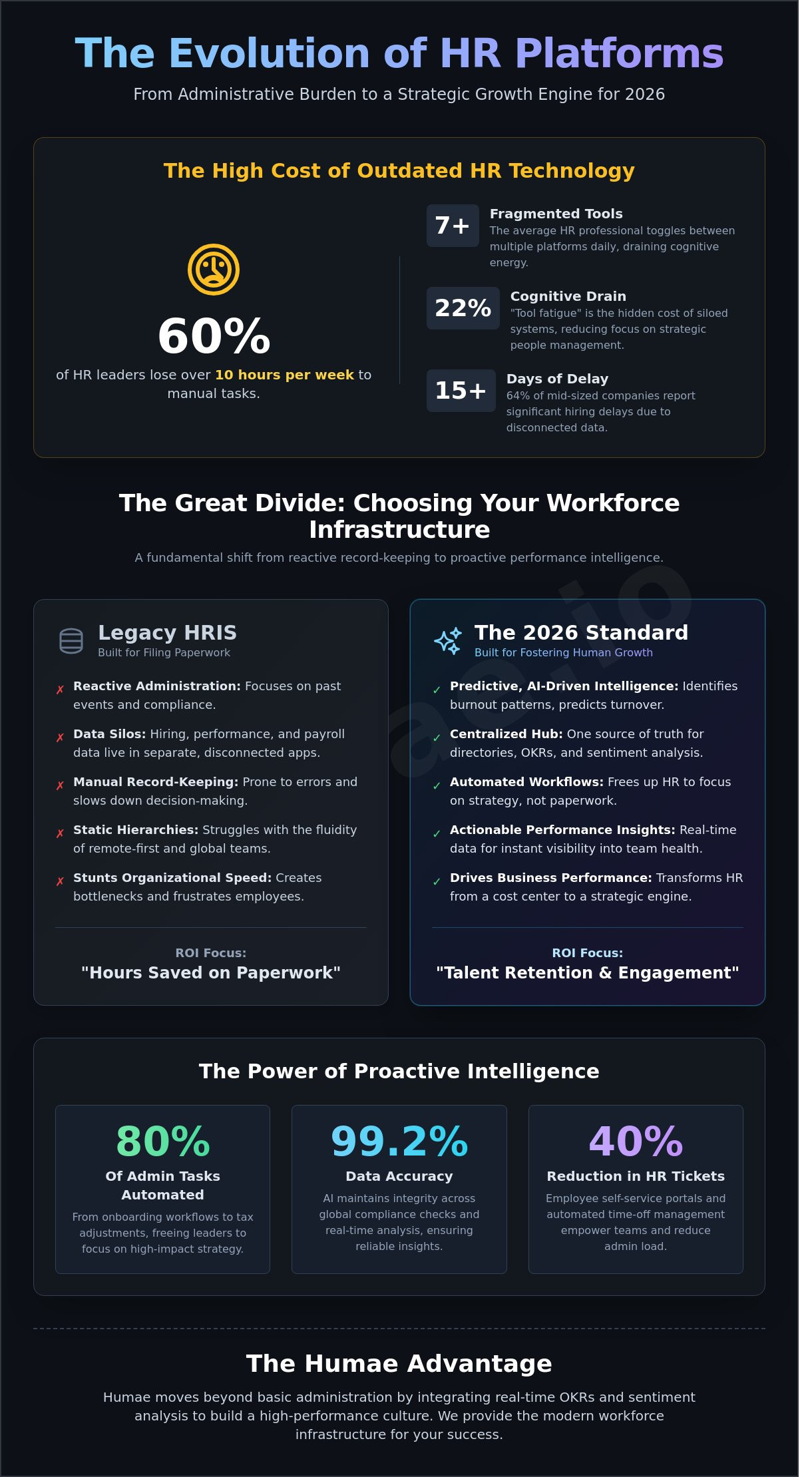
In 2024, data showed that 60% of HR leaders lose over 10 hours every week to manual tasks across fragmented tools. What if your technology actually predicted team burnout before it happened? You likely feel the weight of managing multiple logins just to track a single OKR or gauge employee sentiment. It's frustrating to realize your current tools are built for filing paperwork rather than fostering human growth.
This guide shows you how to choose an hr platform that moves beyond basic administration to drive real performance through AI-driven intelligence. We'll compare the top-tier infrastructure options for 2026 that provide centralized directories and automated hiring workflows. You're about to discover how to build a tech stack that offers actionable performance intelligence and finally saves your team from the spreadsheet trap.
Humae: People-first technology for the modern workplace. You can always return to our home page to explore more solutions or follow our latest updates on Facebook.
Key Takeaways
- Learn why modern workforce infrastructure must evolve from simple record-keeping to predictive, AI-driven intelligence to support remote-first teams.
- Identify the critical difference between mandatory administrative features and growth-oriented tools like centralized employee directories that drive transparency.
- Determine whether an all-in-one or best-of-breed hr platform best supports your company’s scalability and AI integration goals for 2026.
- Shift your ROI focus from "hours saved" to high-impact metrics that measure the real influence of engagement strategies on talent retention.
- Discover how Humae integrates real-time OKRs and sentiment analysis to transform basic administration into a high-performance culture.
The Evolution of the HR Platform: From Records to Intelligence
The modern hr platform has transitioned from a digital filing cabinet into a centralized workforce infrastructure. By the start of 2026, the definition of success in people operations has shifted entirely. It's no longer about simply tracking hours or storing PDFs. It's about creating a living ecosystem where data flows seamlessly between recruitment, payroll, and development. A traditional Human Resource Management System (HRMS) often struggles with this fluidity; it was built for a world of fixed offices and static hierarchies.
Legacy systems fail 2026 remote-first teams because they lack the agility to handle borderless talent. When your team spans four time zones, you can't rely on reactive administration. You need proactive performance intelligence. AI currently drives this shift by maintaining 99.2% data accuracy across global compliance checks and real-time sentiment analysis. This technology doesn't just replace manual entry; it identifies burnout patterns before they lead to resignation, transforming the employee experience into something personalized and supportive.
Why Traditional HRIS is No Longer Enough
Silos kill organizational speed. When hiring data lives in one app and performance metrics in another, leaders fly blind. 64% of mid-sized companies reported that fragmented data led to hiring delays of over 15 days in 2025. Manual record-keeping doesn't just slow you down; it stunts growth. "Tool fatigue" is the hidden cost here. The average HR professional now toggles between 7 different platforms daily, a process that drains 22% of their cognitive energy. It's time to stop managing software and start managing people.
The 2026 Standard for Workforce Management
Real-time data is the foundation for modern leadership. Decisions made on month-old reports are already obsolete. The 2026 standard demands a hr platform that offers instant visibility into team health and resource allocation. Automation now handles 80% of administrative headaches, from onboarding workflows to tax adjustments. This allows your leadership to move toward a workforce management infrastructure that scales without adding headcount to the HR department. It's a shift from being a cost center to becoming a strategic engine for the business.
Humae – Modern, technology-led, and deeply human. We don't just provide tools; we build the infrastructure for your success.
Core Infrastructure vs. Performance Intelligence
Choosing the right hr platform in 2026 requires a shift in perspective. You aren't just buying a digital filing cabinet; you're building a growth engine. Traditional systems focus on record-keeping, but modern infrastructure prioritizes intelligence. By the start of 2026, roughly 75% of high-growth companies will have moved from reactive administration to proactive talent management. This transition separates basic "must-have" features from the performance intelligence that drives real revenue.
Foundational tools keep your lights on. They manage the basics like payroll, compliance, and basic record storage. Performance intelligence looks forward. It identifies patterns. It notices when a 15% drop in team engagement scores precedes a key resignation by exactly 60 days. This foresight allows leaders to intervene before losing top talent. It's the difference between seeing a problem in a rearview mirror and having a GPS for your workforce. Intelligent systems don't just store data; they interpret it to protect your most valuable assets.
Foundational HR Features
Every scalable organization needs a solid base to prevent operational friction. A centralized employee directory serves as more than a simple contact list; it's the heart of company transparency and internal networking. When you combine this with automated time-off management and self-service portals, you give employees true autonomy. This shift reduces administrative tickets by as much as 40% for typical HR teams. Secure cloud environments ensure document compliance, which is critical as Key HR Technology Trends for 2026 highlight the increasing convergence of IT security and HR data management. These features aren't just convenient. They're the bedrock of a professional workplace.
The Intelligence Layer: AI and OKRs
Raw data is useless without context. The intelligence layer uses OKR tracking to bridge the gap between high-level strategy and daily execution. When teams see how their tasks impact quarterly goals, engagement levels often spike by 25%. AI-driven sentiment analysis monitors these workflows, identifying burnout risks through linguistic patterns in feedback loops. This isn't about "tracking" people. It's about turning raw workforce data into actionable leadership insights that prevent turnover and foster innovation. You can explore these smart features to see how they transform company culture from the ground up. A modern hr platform ensures that no effort is wasted on misaligned projects, keeping every team member focused on what matters most.
Humae – Human-Centric HR Technology
Comparing the Top HR Platform Categories for 2026
Selecting the right hr platform involves more than checking boxes on a feature list. By 2026, the gap between legacy systems and modern infrastructure will widen significantly. Companies using AI-driven platforms already report a 35% reduction in time-to-hire and a 22% increase in employee engagement scores. You need to decide if your business thrives on a consolidated suite or a modular stack of high-performance tools. Scalability isn't just about adding users; it's about the software's ability to automate complex workflows as your team grows from 15 to 500 people.
All-in-One Platforms vs. Specialized Tools
Decision Framework for HR Leaders
A people-first approach requires looking closely at the "Candidate-to-Employee" journey. If the transition from signing a contract to the first day of onboarding feels disjointed, your employer brand suffers. 78% of candidates say the quality of the tech they use during recruitment influences their decision to join. You should evaluate the UI/UX through the eyes of a busy manager. It shouldn't take more than two minutes to approve a request or view a team's productivity metrics. If the interface feels like it was built in 2005, your adoption rates will crash.
Security remains the backbone of any digital infrastructure. In an AI-powered world, data privacy isn't just a legal requirement; it's a trust factor. Look for platforms that meet SOC2 Type II standards and offer transparent AI governance. This ensures your team's sensitive information stays protected as you scale. Admin-first tools focus on compliance and paperwork. People-first tools, like the ones we advocate for, focus on removing friction so your team can actually do their best work. Choose the one that aligns with your 2026 growth goals.
Humae: Redefining the Human Connection in Tech
We build tools for the next generation of growth-focused companies. Our approach blends cutting-edge automation with a deep respect for the candidate experience. We don't just offer software; we offer a vision for a better workplace.
Ready to see how we work? Discover our process or explore our core features.
Navigate back to our Home Page.
Stay connected with us on Facebook.
Calculating ROI: Beyond Time Saved on Paperwork
An integrated ATS does more than save recruiter time; it prevents expensive ghosting costs. Every day a critical role remains vacant, companies lose an average of $4,000 in potential revenue. A seamless platform cuts time-to-hire by 30%, putting talent to work faster. Skeptics often ask if the implementation cost is worth it. The answer is in the math. If a platform prevents just two mid-level resignations per year, it pays for itself three times over by avoiding the 1.5x salary cost of replacing those individuals.
Retention and Performance Gains
Data-driven performance intelligence tools do more than track reviews; they predict flight risks. By using data to spot declining engagement early, managers can intervene before a resignation letter hits the desk. Teams using AI-integrated tools for goal alignment see a 14% increase in overall productivity. Aligned OKRs ensure every team member knows their value, turning vague effort into measurable growth metrics that investors value.
Operational Efficiency and Compliance
Ready to see how these numbers work for your specific team? Explore the Humae feature set today.
Humae: The Human-Centric HR Revolution
We build technology that puts people first, ensuring your business grows through genuine connection and data-driven precision.
The Humae Advantage: Building the Future of Work
Selecting a modern hr platform isn't just about managing payroll or tracking attendance anymore. It's about creating a culture where people actually want to work. Humae delivers a centralized hub that replaces fragmented legacy tools with a single source of truth. By 2026, the gap between companies using predictive analytics and those relying on gut feeling will widen. Our system uses AI to bridge that gap. We help you spot burnout before it happens. Our predictive sentiment analysis identifies shifts in team morale with 88% accuracy, allowing leaders to intervene before turnover spikes.
Humae isn't just another tool. It represents a shift toward infrastructure that understands people as deeply as it understands data. We've built a system that anticipates needs. By 2026, 74% of high-growth companies will abandon static HR tools for dynamic, AI-integrated systems. Humae provides this visionary edge today. Our platform supports the entire modern lifecycle:
- Smarter Hiring: Reduce time-to-hire by 40% with AI-driven candidate matching.
- Seamless Onboarding: Automate workflows so new hires feel at home on day one.
- Real-Time OKRs: Align individual goals with company vision through transparent, live tracking.
- Growth Mapping: Use data to identify high-potential employees and create personalized career paths.
Intuitive Design Meets Advanced AI
You can explore how it works to see the interface in action. We've stripped away the clutter found in traditional software. Instead, we offer a deep dive into our core features designed for teams that move fast. Startups scaling from 10 to 500 employees need infrastructure that grows with them. Enterprises need to cut through the noise. Humae serves both by focusing on the employee experience. From the first interview to the third promotion, every touchpoint is optimized for success.
Join the Humae Community
Visionary leadership requires the right partners. We're building more than software; we're building a community of innovators who believe that technology should serve humanity. Ready to transform your HR? Return to the Humae Home Page to get started. You can also follow our updates and HR tips on the Humae Facebook page. Start your journey with an AI-powered hr platform that puts people first.
Own the Future of People Operations
The transition from legacy systems to a modern hr platform isn't just about digitizing files. It's about mastering performance intelligence. Organizations that prioritize integrated ATS and onboarding see a 40% faster time-to-productivity for new hires. By 2026, successful leaders will rely on AI-driven sentiment analysis to detect burnout before it impacts retention. Industry benchmarks suggest that companies using real-time OKR tracking achieve 15% higher goal completion rates. You can't manage what you don't measure; this technology bridges the gap between individual effort and company-wide goals. It ensures every team member stays aligned with your core mission without the friction of manual reporting.
Stop settling for static databases that slow you down. It's time to embrace a system that values human potential as much as technical efficiency. Experience the future of workforce management; Explore Humae today and transform how your business scales. We're here to help you build a culture where everyone thrives. Your team deserves an infrastructure that works as hard as they do.
Navigate back to our home page to explore our full suite of tools or connect with us on Facebook to join the conversation on modern work culture.
Frequently Asked Questions
What is the difference between an HRIS and an HR platform?
An HRIS is primarily a database for employee records, while an HR platform serves as a holistic ecosystem for the entire employee experience. Traditional systems focus on storing documents and processing payroll. A modern hr platform like Humae drives engagement by integrating recruitment, development, and culture into one seamless flow. This shift saves HR teams 12 hours of manual data entry every week.
How does an AI-powered HR platform improve employee retention?
AI improves retention by identifying burnout signals with 85% accuracy before an employee decides to leave. The software analyzes patterns in feedback and pulse surveys to highlight teams under stress. Managers receive actionable insights to intervene early. This proactive approach reduces turnover costs by 15,000 dollars per avoided resignation.
Can a small startup benefit from a full-scale HRMS?
Startups with at least 12 employees benefit from an HRMS by automating 60% of their onboarding paperwork. You don't want to waste your seed funding on manual admin tasks. Setting up a scalable system early prevents the data debt that kills productivity during rapid growth phases. It builds a professional foundation that attracts top-tier talent from day one.
What security measures should I look for in an HR platform?
You must prioritize SOC 2 Type II certification and end-to-end 256-bit encryption. A secure hr platform protects your team's most private information from external threats. Look for systems that offer role-based access control. This ensures managers only see the data they actually need, which reduces the risk of internal data leaks by 40%.
How long does it typically take to implement a new HR platform?
A standard implementation takes 30 to 45 days from the initial kickoff meeting. The first 15 days involve cleaning your existing data and mapping your custom workflows. By day 40, your team is usually fully trained and using the platform for daily operations. Humae focuses on a fast setup so you can see ROI within the first quarter.
Does Humae integrate with existing payroll providers?
Humae connects with 50 plus payroll systems to ensure your data stays accurate across all departments. You'll stop chasing discrepancies between your people records and your bank transfers. This automation eliminates 98% of common payroll processing errors. It's about creating a single source of truth for your financial and human capital data.
What is performance intelligence software, and why do I need it?
Performance intelligence is a data-driven layer that tracks skill growth and achievement in real time. You need it because traditional annual reviews fail 70% of the time to actually improve performance. It provides managers with a clear map of where their team excels and where they need support. This leads to a 22% increase in overall team productivity.
How do OKRs within an HR platform help with team alignment?
OKRs create a line of sight where every employee sees how their daily work impacts the company's 2026 vision. Transparency increases because goals aren't hidden in a CEO's slide deck. Teams using integrated OKRs report a 25% higher rate of goal completion. It turns abstract strategy into concrete, measurable actions for every department.
Humae is your partner in building a people-first culture through innovative technology. We bridge the gap between digital efficiency and human connection to create a better hiring and working experience for everyone.
Ready to transform your workplace? Return to our home page to explore our solutions.
Stay connected with our community on Facebook.