The 9/80 Work Schedule: A Comprehensive Guide to Compressed Workweeks in 2026
By Humae · 4 August 2026
9/80 work schedule
Did you know that 39% of job seekers in 2026 are primarily motivated by flexibility, even as 87% of roles have moved back to the office? You likely feel the tension between maintaining high performance and preventing employee burnout. It's a delicate balance that traditional 40-hour weeks often fail to strike. The 9/80 work schedule offers a strategic way out, giving your team an extra day off every two weeks while keeping your business running at full speed.
We understand that changing how your team works feels daunting, especially when payroll compliance and complex scheduling are involved. You shouldn't have to choose between a happy team and a productive one. This guide promises to help you master the mechanics and benefits of compressed workweeks to boost both satisfaction and output. We'll explore the legal framework, provide a roadmap for cultural fit, and introduce the tools necessary to manage a modern, flexible organization with total confidence. It's time to turn flexibility into your greatest competitive advantage.
Key Takeaways
- Discover how the 9/80 work schedule creates 26 additional three-day weekends per year while keeping your business at 100% capacity.
- Learn the "split-day" payroll concept to ensure total compliance with labor laws and avoid costly overtime errors.
- Identify how to use performance intelligence to monitor team energy levels and prevent fatigue during longer workdays.
- Explore the strategic role of Humae's AI-powered HRMS in managing alternating calendars and predicting staffing needs with precision.
Understanding the 9/80 Work Schedule: A Modern Alternative
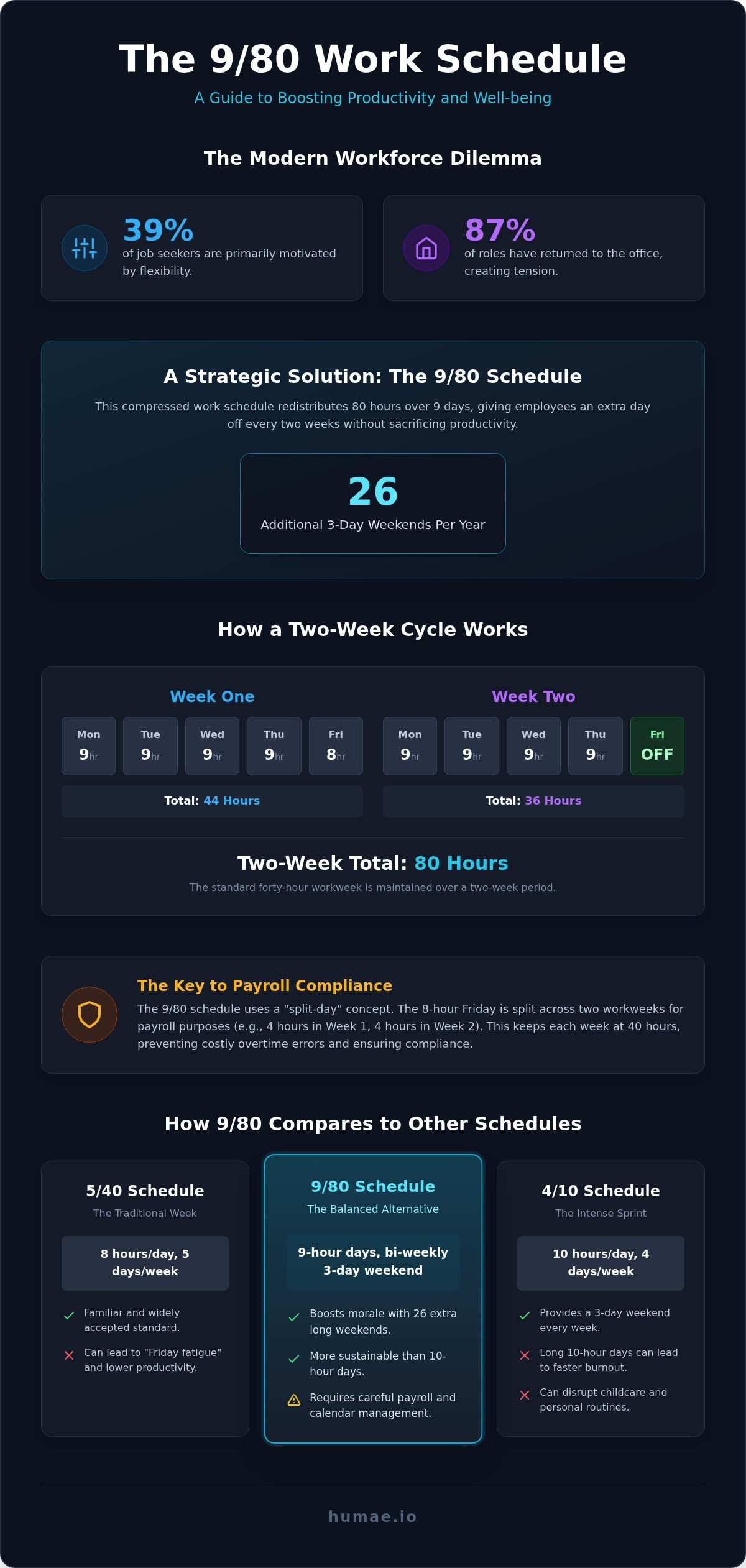
The traditional forty-hour workweek is losing its grip on the modern office. As we move through 2026, the 9/80 work schedule has emerged as a powerhouse strategy for companies that want to retain top talent without sacrificing operational hours. At its core, this arrangement is a popular compressed work schedule that redistributes a standard eighty-hour fortnight into nine working days instead of ten. The result is simple yet transformative. Employees enjoy an extra day off every other week, effectively gaining twenty-six additional three-day weekends per year.
This shift isn't just a trend; it's a direct response to a clear market demand for autonomy. While 87% of roles have returned to the office this year, Gallup research from 2026 shows that 52% of remote-capable employees still maintain a hybrid schedule. People want their time back. The "9/80" name refers specifically to the eighty hours worked over a nine-day period, which aligns perfectly with standard two-week payroll cycles. It provides a structured, predictable rhythm that balances the intensity of the workday with the rejuvenation of a longer break.
How the 9/80 Compressed Workweek Functions
Implementing a 9/80 work schedule requires a specific mathematical breakdown to stay within federal guidelines. During a two-week period, employees typically work eight nine-hour days and one eight-hour day. The tenth day is their scheduled day off. To visualize this, imagine a typical two-week cycle:
- Week One: Four nine-hour days (Monday to Thursday) and one eight-hour day (Friday).
- Week Two: Four nine-hour days (Monday to Thursday) and Friday off.
This alternating pattern ensures the team remains productive while offering that coveted "off-Friday" every second week. It's a rhythmic approach to work that values results over mere attendance, providing a clear framework for both managers and staff.
Comparing 9/80 to Traditional and 4/10 Schedules
Why choose 9/80 over other models? The standard 5/40 schedule often leads to "Friday fatigue," where productivity dips as the weekend approaches. By contrast, the 9/80 model keeps energy levels high by providing a clear reward at the end of the cycle. When compared to the 4/10 schedule, where employees work ten hours a day for four days, the 9/80 is often seen as more sustainable. A nine-hour day is manageable for most people. It doesn't drastically disrupt childcare or evening routines the way a ten-hour shift might. It represents the "Goldilocks" zone of flexibility, offering the benefits of a three-day weekend without the physical and mental exhaustion of extreme daily shifts.
The Mechanics of Implementation: Calendars and Payroll Rules
Transitioning to a 9/80 work schedule is more than a cultural shift; it is a precise recalibration of your payroll engine. Without a clear mechanical framework, you risk unintentional overtime liabilities that can complicate your compliance profile. Success begins with a transparent roadmap and a firm grasp of the "split-day" logic that makes this arrangement possible under federal law.
Clear communication is your first priority. Before you adjust a single timecard, your team needs to understand how their pay remains consistent despite alternating hours. You should outline the schedule at least thirty days in advance, allowing employees to adjust personal commitments like childcare or recurring appointments. In regions with strict labor laws, such as California, implementation requires even more rigor. As of August 2026, California Labor Code § 511 still mandates a formal proposal and a secret ballot election. You must secure a two-thirds majority within a work unit and file those results with the Division of Labor Standards Enforcement to avoid daily overtime penalties.
Mapping the Two-Week Pay Period
The magic of the 9/80 model lies in the way it balances eighty hours across two weeks. In the first week, employees work four nine-hour days and one eight-hour day, totaling forty-four hours. In the second week, they work four nine-hour days and take the Friday off, totaling thirty-six hours. To prevent this from triggering overtime pay for those extra four hours in week one, you must redefine your official workweek. By splitting the eight-hour Friday exactly in the middle, you assign four hours to the first week and four hours to the second. This creates two perfectly balanced forty-hour blocks in the eyes of the law.
Solving the Payroll and Overtime Puzzle
Managing non-standard hours manually is a recipe for error. When a holiday falls on a nine-hour workday, your policy must clearly state that the employee receives nine hours of holiday pay. Similarly, sick leave and vacation time must be tracked based on the length of the scheduled day. If someone takes a Tuesday off, they're using nine hours of PTO, not eight. This level of detail is why a modern workforce management infrastructure is no longer optional; it's a necessity for accuracy.
Automating these calculations ensures that your "split-day" logic is applied consistently across every department. It removes the burden of manual audits from your HR team and provides employees with real-time visibility into their balances. If you're ready to move beyond spreadsheets, you can explore how AI-powered tools simplify complex scheduling while keeping your compliance airtight.
Evaluating the Impact: Benefits and Strategic Advantages
Implementing a 9/80 work schedule isn't just about shuffling hours; it's about reclaiming time. The most immediate impact is the gift of twenty-six additional three-day weekends every year. This isn't a minor perk. It’s a structural change that addresses the modern worker's greatest pain point: the feeling that life is constantly being squeezed into a two-day gap. By offering a dedicated day for "life admin," appointments, or pure rest, you remove the stress that usually leaks into the standard workweek.
Data from May 2026 shows that flexibility is the primary driver of loyalty for 72% of employees. When you offer a compressed schedule, you aren't just giving time; you're building a culture of high-level trust. This is a massive differentiator in a market where 39% of job seekers are specifically looking for more flexibility. You're no longer just competing on salary; you're competing on quality of life.
Boosting Employee Retention and Mental Wellness
Burnout often stems from a lack of recovery time. The 9/80 work schedule provides a predictable, recurring rhythm of rest that helps maintain mental clarity. To truly maximize this, visionary leaders use tools like AI-driven sentiment analysis to monitor team energy. By tracking engagement levels during those longer nine-hour days, you can proactively adjust workloads before fatigue turns into turnover. High job satisfaction scores are rarely an accident; they are the result of an infrastructure that respects the human need for balance.
Operational Productivity and Environmental Gains
Beyond the human element, the 9/80 schedule drives significant operational efficiency. Longer workdays create larger blocks of uninterrupted time, which are essential for reaching a "flow state." In a standard eight-hour day, fragmented by meetings and emails, deep work often gets pushed to the margins. A nine-hour shift provides that extra hour of high-focus output where complex projects actually move forward. You get more done in fewer days.
There are also tangible environmental and facility benefits. Fewer commuting days mean a direct reduction in your organization's carbon footprint. If your team is in the office, closing the facility on alternating Fridays can lead to noticeable savings in energy and operational costs. It's a rare win-win scenario where the planet, your bottom line, and your people all benefit from the same strategic shift. By aligning your operations with modern values, you position your brand as a leader in both sustainability and employee care.
Overcoming the Challenges: Potential Downsides to Manage
While the benefits are clear, the 9/80 work schedule introduces specific logistical hurdles that require proactive management. It's not a one-size-fits-all solution. For some, the ninth hour of the day feels like an uphill battle. This "afternoon slump" can impact cognitive performance if you don't provide the right support. You must address these human factors to ensure the transition doesn't spark resentment among those who prefer a traditional five-day structure.
Childcare is a significant factor to consider. Working until 6:00 PM instead of 5:00 PM can disrupt school pickups or evening family routines. Some employees might find the longer days exhausting, especially if their commute is lengthy. Success depends on your ability to offer flexibility within the flexibility. If a team member struggles with the nine-hour shift, you might need to offer a hybrid option or a slightly adjusted start time to accommodate their personal life.
Managing the Fatigue of Longer Workdays
Maintaining focus for nine hours requires intentionality. You can't expect peak performance without providing the right infrastructure. Encourage your team to take structured breaks and avoid scheduling high-stakes meetings after 3:00 PM. By utilizing performance intelligence, you can monitor output trends and identify if certain departments are hitting a wall. If the data shows a sharp decline in the final hour, it might be time to rethink how tasks are allocated or introduce more frequent "micro-breaks" to keep energy levels high.
Ensuring Coverage and Communication Continuity
A major concern for leadership is the "ghost town" effect on off-Fridays. If your entire support team is away, who handles an urgent client request? The most effective solution is the "Staggered Friday" approach. Split your departments into two groups: Group A and Group B. Group A takes the first Friday off, while Group B takes the second. This keeps your business operational every day of the week without sacrificing the benefits of the 9/80 work schedule. Visibility is paramount here. Modern employee directories allow everyone to see at a glance who is available, preventing communication bottlenecks and ensuring a seamless experience for your customers.
In 2026, the intersection of compressed schedules and hybrid work requires a new level of coordination. If you're ready to bridge these gaps with technology, explore how Humae's AI-powered platform can simplify your workforce management.
Scaling Flexibility with Workforce Management Infrastructure
Managing a 9/80 work schedule on a manual spreadsheet is a recipe for operational chaos. While the logic seems simple on paper, the reality of tracking eighty hours across nine days for a diverse, global team is incredibly complex. Standard payroll systems often choke on the Friday split. Manual tracking leads to errors that frustrate employees and trigger compliance alerts. You need an infrastructure that's as flexible as the culture you're trying to build.
Humae serves as the centralized hub for modern organizations, turning the logistical nightmare of compressed workweeks into a seamless background process. Our AI-powered HRMS doesn't just record hours; it understands the rhythm of your team. It predicts staffing gaps before they happen and ensures that your alternating "off-Fridays" never leave your clients hanging. By moving away from rigid, outdated tools, you create a foundation where flexibility and precision coexist.
Automating Flexible Schedules with AI Platforms
Humae simplifies the 9/80 transition by automating the heavy lifting of payroll calculations. Our system handles the midday Friday split with total precision, ensuring every hour is assigned to the correct workweek. This eliminates the administrative burden that often keeps HR managers stuck in data entry. When an employee requests time off, the system automatically adjusts for nine-hour or eight-hour days. It maintains the integrity of the cycle without manual intervention. It's about giving your leadership team the freedom to focus on people, not paperwork.
Tracking Performance and Sentiment in Real Time
The success of a compressed workweek depends on the well-being of your people. Because we value the human element, Humae integrates AI-driven sentiment analysis to check for signs of fatigue. Longer workdays shouldn't lead to exhaustion. By monitoring engagement trends, you can see exactly how the schedule affects morale and adjust your strategy accordingly. Aligning these schedules with OKR tracking ensures every team member stays focused on high-impact goals, regardless of their specific hours.
Our analytics dashboards provide the proof you need to show the ROI of flexibility. You'll see the correlation between the 9/80 work schedule, high productivity, and decreased turnover. In the fast-paced business environment of 2026, technology is the bridge between a visionary idea and a sustainable reality. Let Humae be the partner that helps you scale your culture with confidence.
Transform Your Culture Through Strategic Flexibility
Adopting a 9/80 work schedule is a bold step toward a more human-centric organization. You've seen how it grants your team twenty-six extra weekends while maintaining operational momentum. By mastering the split-day payroll logic and ensuring business continuity through staggered shifts, you create an environment where talent chooses to stay. You don't have to sacrifice results to provide the balance your people deserve.
Success in this new landscape requires more than just a policy change; it demands the right digital foundation. You can optimize your flexible workforce with Humae to handle the complexities of modern scheduling. Our streamlined workforce management infrastructure, powered by AI-powered performance intelligence and real-time OKR tracking, ensures your goals remain in sight. With built-in sentiment tracking, you'll always know when your team is thriving or if it's time to adjust.
The future of work is flexible, and you're now equipped to lead the way. Let's build a workplace that inspires.
Frequently Asked Questions
Is a 9/80 work schedule considered full-time?
Yes, this arrangement is a full-time schedule because employees still complete eighty hours of work every two weeks. It doesn't reduce the total time spent on the job compared to a traditional forty-hour week. It simply redistributes those hours into nine days instead of ten, ensuring that benefits and full-time status remain completely unchanged for the staff.
How do you calculate holiday pay for a 9/80 schedule?
Holiday pay should match the number of hours the employee was originally scheduled to work on that specific day. If a holiday lands on a nine-hour workday, the employee receives nine hours of pay. If it falls on an eight-hour day, they receive eight. This consistency prevents employees from losing pay or having to use PTO to cover the difference.
Does the 9/80 schedule cause more stress due to longer days?
Most employees report lower overall stress because the benefit of a three-day weekend every fortnight outweighs the extra hour of daily work. While a nine-hour day is longer, it's far more sustainable than the ten-hour shifts found in other compressed models. Success depends on encouraging structured breaks and using performance intelligence to monitor team energy levels throughout the day.
Can 9/80 work for remote or hybrid teams?
The 9/80 work schedule is an excellent fit for remote and hybrid environments where autonomy is already a core value. In 2026, with 52% of remote-capable staff working in hybrid models, digital tools are the key to making this work. Shared calendars and real-time directories ensure that everyone knows who is "on" or "off," maintaining seamless collaboration across different locations.
What happens if a holiday falls on an employee’s off-day?
When a holiday lands on a scheduled day off, companies typically provide an "in-lieu" day or a floating holiday credit. This ensures that all team members receive the same number of paid holidays regardless of their specific rotation. You should clearly define these rules in your company policy to maintain fairness and prevent any confusion during the payroll cycle.
Is the 9/80 schedule legal for non-exempt employees?
Yes, it is legal under the Fair Labor Standards Act as long as the workweek is defined to split the eight-hour Friday into two four-hour blocks. This prevents the employee from technically working more than forty hours in a single workweek. However, you must check local regulations; for example, California requires a formal election process to avoid daily overtime penalties.
How do you handle sick leave on a nine-hour day?
Sick leave is deducted based on the actual scheduled hours for that day. If an employee is absent on a nine-hour day, nine hours are taken from their accrued balance. Using a centralized HRMS simplifies this process by automatically adjusting leave deductions based on the specific calendar day, which removes the risk of manual calculation errors for your HR team.