SMART Goals vs OKRs: Which Framework Drives Growth in 2026?
By Humae · 20 August 2026
smart goals vs okrs
What if the very framework you use to measure success is actually the ceiling on your team's potential? It’s a common frustration to watch carefully planned objectives become obsolete before the quarter even ends. You want deep team alignment and a clear path to scale, yet measuring intangible progress often feels like a guessing game. We know that in a fast-moving environment, rigid systems can stifle the very innovation you’re trying to foster.
In this guide, we explore the critical differences of smart goals vs okrs to help you choose the right strategy for your organizational growth in 2026. You’ll discover how to transition from static tracking to a dynamic, data-driven culture that prioritizes both results and human connection. We’re passionate about building these modern cultures, a topic we share more about on our Facebook page regularly.
We’ll provide a clear framework for scaling and improving employee engagement through better performance intelligence. By the end, you’ll understand how to balance the tactical precision of SMART targets with the strategic velocity of OKRs to drive your team forward with confidence.
Key Takeaways
- Modern business requires faster iteration; learn why traditional annual review cycles no longer support organizational growth in 2026.
- Understand the core differences of smart goals vs okrs to choose between tactical task checklists and ambitious strategic engines.
- Discover the five fundamental shifts in scope and ambition that separate individual performance from cross-functional alignment.
- Learn to implement a hybrid model where SMART criteria refine your Key Results for maximum clarity and execution.
- Explore how AI-powered HRMS tools provide real-time performance intelligence, and follow our Facebook page for more leadership tips.
The Evolution of Goal Setting: Why Traditional Methods Stagnate in 2026
The traditional annual review cycle is a relic. In 2026, market conditions change in days, not months. Relying on a once-a-year conversation creates a dangerous disconnect between leadership vision and daily execution. Hybrid teams specifically feel this friction. Without a shared digital pulse, people work in silos, losing sight of how their efforts move the needle. The "set it and forget it" mentality is the fastest way to ensure your best talent feels ignored and your strategic targets become irrelevant by March. Modern business requires a rhythm that matches the speed of innovation.
The rise of AI in the workplace demands more dynamic and transparent performance metrics. We can no longer afford to hide progress in private spreadsheets. Transparency is the new currency of trust. When everyone sees the impact of their work in real-time, engagement naturally climbs. Choosing between smart goals vs okrs isn't just a technical decision; it's a commitment to how your team breathes and grows in a digital-first environment.
The Problem with Static Goal Frameworks
Static frameworks fail because they don't account for the volatility of modern tech. When a new AI breakthrough occurs, a goal set six months ago might become a waste of resources. We often see individual achievements happening in a vacuum. A team member might hit every personal target, yet the company still misses its growth milestones. This friction occurs because traditional management styles prioritize checking boxes over actual impact. Rigid systems lack the elasticity to pivot when a new competitor emerges or a project scope shifts. Regarding smart goals vs okrs, it is clear that the former often focuses on the "what" without the "why" of organizational alignment. This gap creates a culture of compliance rather than a culture of contribution.
The Shift Toward Performance Intelligence
Performance intelligence is where data meets human potential. It’s not just about tracking numbers; it's about understanding the sentiment and momentum behind them. Real-time feedback has replaced the dreaded quarterly check-in because it allows for immediate course correction. Modern workforce management infrastructure, like the tools we develop at Humae, provides the visibility needed to keep everyone moving in the same direction. This shift isn't just technical; it's deeply human. It empowers managers to act as coaches rather than gatekeepers. By leveraging performance intelligence, organizations can turn abstract data into actionable growth. Stay updated on these cultural shifts by following our Facebook page for the latest leadership insights.
Breaking Down the Frameworks: SMART Goals and OKRs Defined
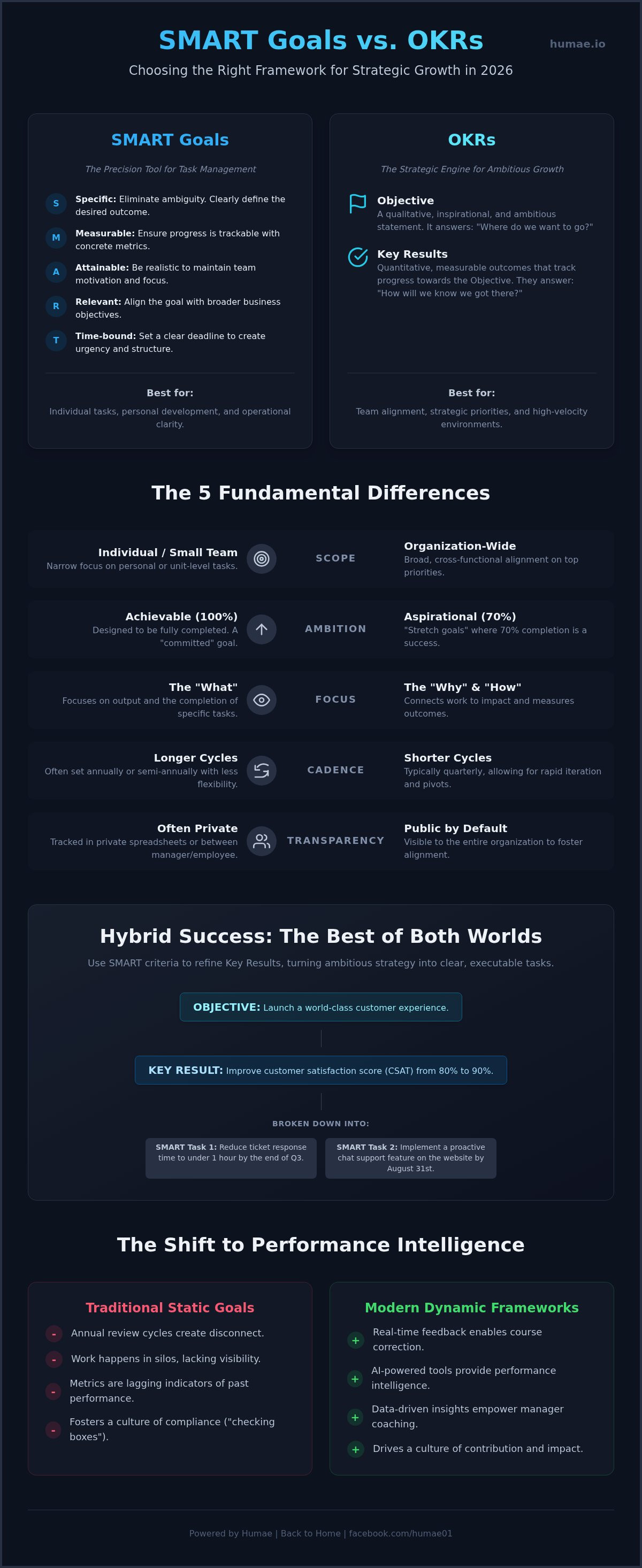
Understanding the landscape of smart goals vs okrs begins with recognizing their distinct roles in a modern organization. OKRs function as a strategic framework designed to ignite ambitious, high-velocity growth across an entire team. In contrast, SMART goals act as a reliable checklist that ensures individual tasks remain clear, feasible, and grounded in reality. While one pushes the boundaries of what's possible, the other provides the tactical structure needed to get the job done without confusion. Both have a place in your toolkit, but they serve different masters: one drives your vision, while the other stabilizes your operations.
The distinction often lies in the balance between inspiration and precision. Objectives in the OKR model are qualitative and directional statements that answer "Where do we want to go?" They are meant to be aspirational, even slightly uncomfortable. Key Results provide the quantitative rigor, answering "How will we know we got there?" with measurable data points. Meanwhile, SMART goals remain the gold standard for personal development and specific task management because they leave no room for misinterpretation. They ensure that every small step is accounted for and achievable.
What Makes a Goal SMART?
A SMART goal is a precision tool for clarity. It starts with being Specific, stripping away ambiguity to define exactly what success looks like. Measurable and Attainable criteria ensure that progress is trackable and that the target is realistic enough to maintain team motivation. Finally, making a goal Relevant and Time-bound ensures it aligns with current priorities and carries a firm deadline. This approach is perfect for stabilizing workflows and managing predictable outcomes where failure isn't an option. It’s about the "how" of execution, ensuring that day-to-day operations run like a well-oiled machine.
The Anatomy of an Effective OKR
OKRs are built for teams that want to disrupt their industry and achieve moonshot results. The Objective is a directional statement that should feel deeply motivating for the entire team. Beneath it, you'll find two to five Key Results. These are measurable outcomes that prove you are moving toward the Objective. Unlike traditional targets, OKRs often incorporate "Stretch Goals." In this high-growth mindset, achieving 70 percent success is often the target. If you're hitting 100 percent of your OKRs every quarter, you probably aren't aiming high enough. Managing these moving parts requires more than a simple document; it requires a dedicated OKR tracking system that connects individual effort to the big picture. You can see how we approach this balance by checking out our latest updates on our Facebook page.
SMART Goals vs OKRs: The Five Fundamental Differences
Choosing between smart goals vs okrs isn't just a matter of semantics; it's a decision about the soul of your operations. While both frameworks aim for success, they operate on different frequencies. SMART goals provide a stabilizing force for individual tasks, ensuring they are realistic and grounded. OKRs, however, act as a strategic engine designed to propel the entire organization forward through collective ambition. Understanding these five pillars helps you decide when to play it safe and when to push for a breakthrough.
- Scope: SMART goals usually focus on individual performance, while OKRs drive cross-functional organizational alignment.
- Ambition: One targets low-risk attainment; the other encourages high-reward moonshots and stretch targets.
- Cadence: SMART often follows fixed annual or project cycles, whereas OKRs thrive on agile quarterly rhythms.
- Transparency: Manager-employee agreements are often private, but OKRs demand company-wide visibility to foster trust.
- Linkage: SMART targets often tie directly to compensation, while OKRs focus on operational excellence and learning.
Scope and Strategic Alignment
The most visible difference in smart goals vs okrs is how they connect to the big picture. SMART goals often focus on the "what," defining a specific task with narrow boundaries. OKRs emphasize the "why" and the "how," creating a cascade effect that connects every employee to the central mission. This ensures that a developer in one department understands how their code impacts the sales target in another. For a deeper dive into how this logic transforms businesses, explore our guide on OKR meaning. We also share real-world examples of this alignment on our Facebook page regularly.
Ambition and the Culture of Failure
If you're hitting 100 percent of your SMART goals, you're doing your job well. If you're hitting 100 percent of your OKRs, you're likely playing it too safe. OKRs require a psychological shift where failure is seen as a data point rather than a defeat. We aim for the "70 percent sweet spot," where targets are intentionally difficult to reach to spark innovation. Managing expectations in this environment means celebrating the effort and the learning gained from missing a moonshot. It’s about building a culture where bravery is rewarded more than simple compliance. This shift in mindset is what separates stagnant companies from high-growth leaders in 2026.
Hybrid Success: How to Use SMART Goals Within an OKR Framework
Stop treating the choice of smart goals vs okrs as a binary decision. Many leaders believe they must pick a side, but the most resilient organizations in 2026 actually layer these frameworks. They use OKRs to define the strategic horizon and SMART goals to manage the tactical execution. This hybrid approach ensures that high-level ambition doesn't lead to daily confusion. By combining these systems, you create a culture that is both visionary and grounded. It’s about using the right tool for the right level of the organization.
Applying SMART criteria to individual contributors supports broader team OKRs without overwhelming your staff. It provides a necessary sense of security. While the company pursues a moonshot, the individual knows exactly what is expected of them by the end of the week. This balance is critical for maintaining employee engagement in high-pressure environments. We often discuss how to strike this balance effectively on our Facebook page, where we share insights for modern leaders.
Step-by-Step: Writing SMART Key Results
Turning a vague aspiration into a trackable result requires discipline. Start with a directional Objective that inspires your team. Then, draft Key Results that meet the SMART criteria to ensure they are actionable. This leaves no room for debate during reviews. For example, if your Objective is to "Enhance market presence," your Key Result should be "Acquire 15 new enterprise clients by the end of Q3." Is it measurable? Yes. Is it time-bound? Yes. This precision prevents Key Results from becoming "wish lists" that lack a clear path to completion. To manage these complex layers efficiently, you need a robust workforce management infrastructure that tracks progress in real-time.
Balancing Individual and Organizational Needs
Individual professional development plans (PDPs) are the perfect home for SMART goals. While an OKR might focus on a collective product launch, a SMART goal can focus on an employee mastering a new software tool to support that launch. Managers act as the vital bridge here. They ensure that personal growth targets don't conflict with the team's mission. When these two systems align, employees feel their career is advancing alongside the company. This creates a powerful sense of community and shared success. A centralized platform helps managers visualize these connections, ensuring that no individual effort is wasted in a silo. It turns abstract strategy into a lived experience for every team member.
Scaling Performance with AI-Powered OKR Tracking
Spreadsheets are where good strategy goes to die. In 2026, relying on manually updated cells is a recipe for organizational stagnation. They're siloed, prone to error, and lack the real-time pulse needed for agile growth. A centralized HRMS replaces these static documents with live data, allowing every team member to see their impact instantly. When discussing smart goals vs okrs, the debate often misses the infrastructure required to make either successful. Without a single source of truth, even the best-written objectives lose their momentum. We've built our platform to be that engine of clarity.
AI-driven sentiment analysis adds a layer of human context that numbers alone can't provide. It's not just about whether a key result is at 60 percent; it's about the team's morale and the hurdles they face. By analyzing feedback patterns, AI helps managers understand the "why" behind the data. Analytics dashboards allow leadership to identify bottlenecks before they derail an entire quarter, offering a birds-eye view of organizational health. This proactive visibility transforms management from a reactive chore into a strategic advantage. You can see how these tools come to life by following our Facebook page for live demos and insights.
The Role of Real-Time Data in Goal Attainment
Proactive adjustments are the hallmark of high-performing teams. Moving away from retrospective reviews means you can pivot when market conditions shift. At Humae, we integrate performance intelligence directly into daily workflows. This ensures that goals stay top-of-mind rather than buried in a tab. An accessible employee directory also plays a crucial role. It allows for seamless cross-functional OKRs, making it easy to find the right expert to help unblock a specific key result. It's about building a connected ecosystem where data flows freely and every connection serves a purpose.
Leveraging AI for Continuous Feedback
Automating the "boring" parts of management frees up time for real leadership. AI check-in reminders and progress updates ensure that no one falls behind due to administrative oversight. Beyond just nudging, AI can suggest refinements for poorly written objectives, ensuring they meet the necessary rigor for clarity. This fosters a culture of growth backed by data-driven insights rather than gut feelings. Developing these leadership skills is essential for anyone navigating the complexities of 2026. By using technology to support human connection, we make the transition from smart goals vs okrs a journey toward shared excellence.
Empowering Your Team for the Strategic Future
Choosing the right path between smart goals vs okrs is the first step toward a more resilient and innovative organizational culture. You now have the framework to balance individual precision with company-wide ambition. By integrating a centralized workforce management infrastructure, you eliminate the friction of silos and outdated tracking methods that hold teams back. It's about creating a transparent environment where every contributor sees their value in real-time.
Real growth happens when data meets empathy. With AI-powered sentiment analysis, you gain deeper team insights that protect your culture while you scale your operations. We invite you to join our growing community of visionary leaders on our Facebook page to stay connected with the latest trends. It's your opportunity to move beyond static planning and embrace a dynamic future.
Ready to transform your performance? Streamline your strategy with Humae OKR Tracking today. Let's build a future where every objective leads to a shared victory and every team member feels inspired to reach their next moonshot.
Frequently Asked Questions
Can I use SMART goals and OKRs at the same time?
Yes, you can and often should use both to maximize performance. While OKRs set the high-level vision and ambitious moonshots, SMART goals provide the tactical structure for individual tasks or professional development plans. This hybrid approach ensures that your big-picture strategy is supported by clear, actionable steps. It is a powerful way to maintain momentum without losing sight of day-to-day execution or team morale.
Which framework is better for a small startup?
OKRs are generally better for startups because they prioritize agility and rapid growth. In a fast-moving environment, you need a system that allows for quarterly pivots and cross-functional alignment. However, you might use SMART goals for specific, low-risk operational tasks that require absolute precision. The flexibility of OKRs helps startups focus on what truly matters during early scaling phases while keeping the team motivated by aspirational objectives.
How often should OKRs be reviewed compared to SMART goals?
OKRs are typically reviewed on a quarterly cycle with weekly or bi-weekly check-ins to track progress. In contrast, SMART goals often follow project timelines or annual review cycles. The faster cadence of OKRs allows for real-time course correction, which is vital in the 2026 business landscape. This frequent rhythm ensures that your team stays aligned and can respond quickly to market shifts or technological breakthroughs without waiting for year-end.
Do OKRs replace individual performance reviews?
No, OKRs should not replace individual performance reviews; instead, they should inform them. OKRs focus on organizational impact and operational excellence, while performance reviews look at personal growth, behaviors, and core competencies. Tying OKRs directly to compensation can discourage the very risk-taking they are meant to inspire. Use your performance intelligence data to have more meaningful, human-centric development conversations rather than just checking boxes or focusing on metrics alone.
What is the most common mistake when transitioning to OKRs?
The most common mistake is setting too many objectives or making them too easy to achieve. When teams treat OKRs like a laundry list of tasks, they lose the strategic focus that makes the framework effective. Another error is keeping the process private. Transparency is key to a successful smart goals vs okrs transition. You can find more tips on avoiding these common leadership pitfalls on our Facebook page.
Is there software that can track both SMART goals and OKRs?
Yes, modern workforce management platforms are designed to handle both frameworks within a single ecosystem. A centralized HRMS allows you to track ambitious OKRs for the company while managing individual SMART targets for professional development. This integration provides a holistic view of performance intelligence, helping leadership see how tactical tasks contribute to the broader mission. It eliminates the need for fragmented spreadsheets and ensures data-driven tracking for every member of your team.