Scaling HR Operations for Growth: The 2026 AI-Powered Framework
By Humae · 9 May 2026
scaling hr operations for growth
What if hiring your 200th employee felt as seamless and culturally aligned as hiring your first? Many leaders assume that scaling hr operations for growth requires a linear increase in HR headcount, but the math simply doesn't work in 2026. With the global HR software market projected to hit $60.52 billion by 2030, the competitive edge isn't found in adding more recruiters. It's found in smarter, AI-driven infrastructure.
It's exhausting to watch manual onboarding swallow your schedule while compliance risks, like the August 2, 2026, EU AI Act enforcement deadline, loom over your global expansion. You've likely felt the frustration of losing cultural touchpoints as remote teams grow, leaving you without the real-time performance data you need to lead effectively. This article transforms that reality. You'll learn how to shift HR from a reactive support role into a strategic growth engine using performance intelligence and automated workflows.
We'll explore a framework that eliminates administrative burdens and uses data to maintain high engagement, ensuring your culture thrives while your operations expand. It's time to build a workforce that's ready for the future.
Experience the future of human-centered technology at Humae. Connect with our community and stay updated on the latest HR innovations via our Facebook page.
Key Takeaways
- Break the "Growth Paradox" by moving from linear hiring to building exponential capacity through smart AI infrastructure.
- Transition to a proactive talent pipeline using an integrated Applicant Tracking System that syncs with your core data.
- Master the art of scaling hr operations for growth by replacing annual reviews with real-time performance intelligence and burnout detection.
- Centralize your workforce data to manage global time-off policies and remote directories through a single source of truth.
- Select HR platforms based on user experience and adoption rates to ensure your technology actually serves your people.
Ready to evolve? Return to Humae or stay connected via our Facebook page.
The Growth Paradox: Why Traditional HR Systems Fail During Expansion
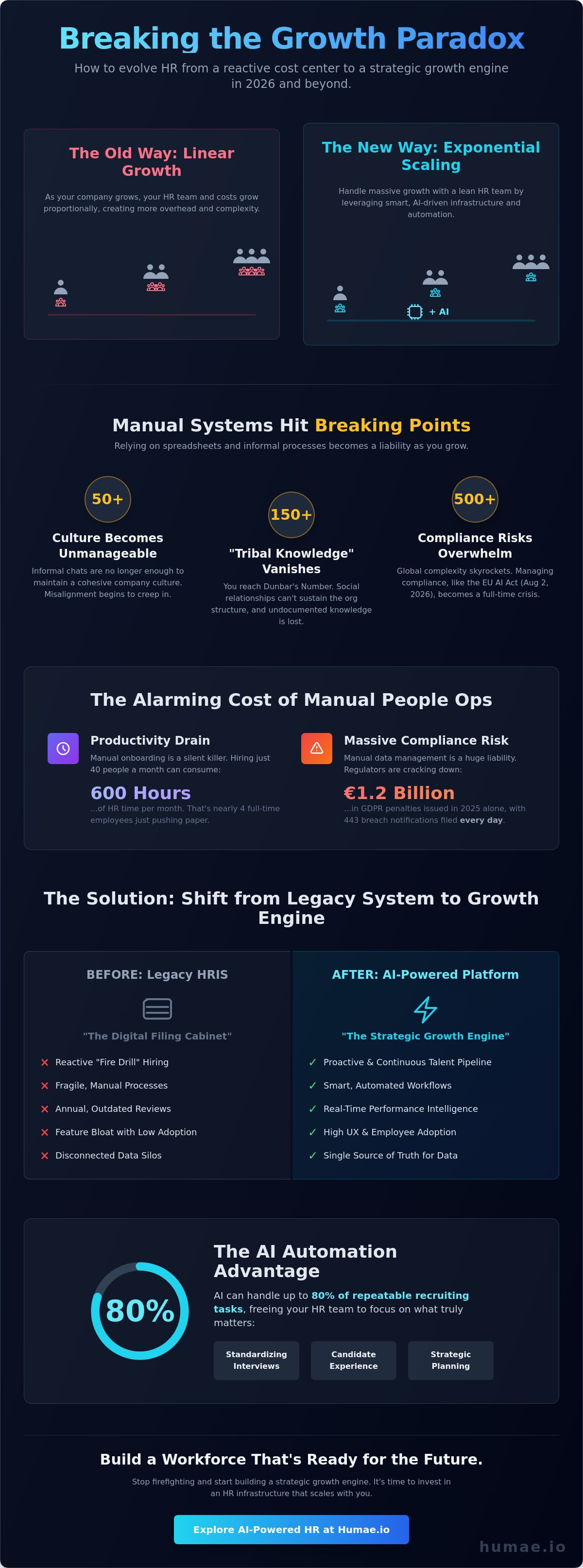
Success has a price. It's the "Growth Paradox," where the very success you've fought for begins to strain your internal people operations to the point of failure. Most leaders confuse growth with scaling, but they're fundamentally different. Growth is a linear increase in revenue and headcount that often carries a proportional increase in costs. Scaling hr operations for growth, however, is about building the capacity to handle a massive influx of talent without a massive influx of administrative overhead. If your HR team's workload doubles every time you hire ten people, you aren't scaling; you're just getting bigger and more expensive.
Manual systems hit "breaking points" at predictable intervals. At 50 employees, you can no longer maintain company culture through informal chats. By 150 employees, you reach Dunbar’s number, where social relationships can't sustain organizational structure and "tribal knowledge" begins to vanish. Once you cross the 500-employee mark, global complexity and compliance risks become overwhelming. Relying on spreadsheets in 2026 is a dangerous game. With European regulators issuing €1.2 billion in GDPR penalties in 2025 alone and data protection authorities receiving 443 breach notifications every day, manual data management is a liability you can't afford.
The Hidden Costs of Manual People Ops
Manual onboarding is a silent productivity killer. If your team spends 15 hours manually processing a single new hire, a rapid growth phase of 40 people per month consumes 600 hours of HR time. That's nearly four full-time employees just pushing paper. Beyond the time-drain, relying on undocumented processes creates a fragile environment. Without Strategic human resource planning, your intellectual property walks out the door with every resignation. Slow HR response times also damage your employer branding, as top-tier candidates in 2026 expect the same speed from an employer that they get from their favorite apps.
Why Your Current HRIS Might Be Holding You Back
Many legacy systems are nothing more than digital filing cabinets. They store records, but they don't provide the performance intelligence needed to lead a remote, high-growth team. You don't need "feature bloat" or complex modules that your employees refuse to use. You need a platform that prioritizes user experience and integrates seamlessly with your talent pipeline. Workforce management infrastructure is the backbone of scalable growth. It's the difference between a team that's constantly firefighting and one that's strategically positioned to win the market.
Scaling Talent Acquisition: From Reactive Hiring to an Automated Engine
Stop treating hiring like a fire drill. Most growing companies fall into the trap of "emergency hiring," where a vacancy opens and everyone scrambles to fill it. This reactive approach is the enemy of scaling hr operations for growth. By the time you've posted the job, you've already lost weeks of productivity. Instead, you need a continuous talent pipeline. This means your Applicant Tracking System (ATS) shouldn't just be a list of resumes; it should be a living database that integrates with your core HR data to predict future needs before they become urgent.
When your hiring engine is automated, you spend less time on screening and more time on the candidate experience. Citing research on Scaling HR Capacity, experts emphasize that AI can now handle up to 80% of repeatable recruiting tasks. This shift allows your team to focus on standardizing the interview process. Standardization ensures every candidate is evaluated against the same cultural and technical benchmarks, which is vital when you're hiring at scale. A robust workforce management infrastructure ensures these new hires aren't just names in a system but are immediately recognized as part of the company's total capacity.
Automating the Onboarding Lifecycle
First impressions are permanent. We recommend the "5-day rule": every new hire should be fully equipped and contributing to their first project by the end of week one. You can't achieve this with manual checklists. Automating these steps is non-negotiable when scaling hr operations for growth, as it prevents the HR team from becoming a bottleneck during hiring surges. Use digital workflows to automate equipment provisioning, software access, and paperwork. Automation doesn't make the process colder; it frees up managers for 1:1 coffee chats and cultural immersion.
Building an Employer Brand That Scales
Your brand isn't what you say in a job post; it's how a candidate feels during the process. In 2026, top talent expects a frictionless digital experience. Use analytics to track which sourcing channels provide the best long-term retention, rather than just the highest volume. If 60% of your top performers come from one specific board, double down there. Create a feedback loop where new hires rate their experience within 30 days. This data helps you refine the engine, ensuring your recruitment experience remains a primary competitive advantage.
Performance Intelligence: Managing High-Output Teams with AI
Annual performance reviews are a liability when you're moving at the speed of 2026. In a high-growth environment, waiting twelve months to tell an employee they're off track is a recipe for turnover and lost revenue. Real-time feedback loops have replaced the traditional appraisal, providing the agility required for scaling hr operations for growth. By integrating a clear OKR meaning and tracking system directly into your daily workflow, you ensure that every team member, whether remote or in-office, understands exactly how their work impacts the company's trajectory.
The Shift to Performance Intelligence
Scaling Culture Through Sentiment Analysis
Rapid expansion often creates "culture silos," where different departments begin to drift apart in values and communication styles. You can prevent this by using anonymous, AI-powered sentiment analysis to track team health during periods of intense change. These tools detect the linguistic markers of burnout or frustration in survey responses long before they lead to resignations. AI preserves empathy by highlighting human needs in the data, ensuring leaders see the person behind the percentage. By identifying these issues early, you maintain the "small company feel" and high engagement levels that made you successful in the first place.
Essential Workforce Infrastructure for Global Scaling
Building a global workforce is impossible without a centralized digital foundation. When you're scaling hr operations for growth, you need a single source of truth that handles the complexity of 2026 regulations. By January 1, 2026, 19 U.S. states have enacted comprehensive data privacy laws, while the EU AI Act enforcement date of August 2, 2026, fast approaches. Managing these moving parts with a fragmented legal team is inefficient and risky. Instead, high-growth companies rely on a modern HRIS to automate compliance and data security at every level.
The Modern Employee Directory
Static PDFs and manual spreadsheets are where organizational clarity goes to die after you pass the 100-employee mark. A modern directory must be a dynamic map of your company. It should integrate organizational charts with real-time project roles, allowing a developer in Berlin to instantly find the right product manager in Austin. Self-service portals are the secret weapon here. By empowering employees to manage their own personal data and documents, you eliminate up to 40% of the routine inquiries that typically clog an HR department's inbox.
Managing Time-Off and Absence at Scale
Handling diverse regional leave policies is a logistical minefield. Automating accruals and approval workflows is the only way to prevent manager bottlenecks as you expand. In 2026, absence management isn't just about counting days. It's about using analytics dashboards to spot trends in absenteeism that might signal deeper cultural issues or burnout. Whether you're dealing with Washington's 180-day job protection rule or varied European holiday requirements, your infrastructure must handle the math for you. This ensures fairness and consistency across your entire global team.
Stop fighting your software and start empowering your people. Explore Humae's workforce infrastructure to see how we simplify global scaling for modern teams.
Selecting an AI-Powered HR Platform for Your Growth Stage
Selecting the right technology is the final, most critical step in scaling hr operations for growth; it's the bridge between a chaotic startup and a mature, high-performing organization. Don't get distracted by flashy features that your team will never actually use. You should evaluate software based on its integration capabilities and how well it fits into your existing ecosystem. A platform that doesn't talk to your other tools creates new data silos, which eventually leads to the very manual work you're trying to escape. You need an "Intelligence First" system that doesn't just store employee records but provides actionable insights to help you lead.
High adoption rates are the only way to realize the value of your investment. If the user experience is clunky or confusing, employees will find workarounds, and your data integrity will crumble. Prioritizing a clean, intuitive interface ensures that self-service tools and performance tracking become a natural part of the workday. Humae's features are designed with this exact balance in mind, combining deep technical power with a human-centric design that people actually enjoy using. When you're scaling hr operations for growth, you need a partner that understands both the data and the human behind it.
The 3-Step Evaluation Framework
Success requires a structured approach to procurement. Follow these steps to find a platform that grows with you:
- Step 1: Audit current manual bottlenecks. Pinpoint where your team loses the most time, whether it's in spreadsheet-based onboarding or fragmented time-off tracking.
- Step 2: Define must-have automations. Focus on the tools that directly drive growth and capacity. Ignore the "nice-to-have" extras that only add complexity.
- Step 3: Test for scalability. Verify how the system handles increased loads. A tool that works for 50 people might struggle when your headcount reaches 500 or more.
Future-Proofing Your HR Tech Stack
The HR landscape in 2026 demands constant flexibility. An API-first infrastructure is non-negotiable because it allows you to plug in new tools as your needs evolve. AI will continue to move beyond basic automation into predictive workforce modeling, helping you anticipate hiring needs months in advance. By choosing a partner that views technology as a way to enhance human connection, you ensure your organization remains agile and empathetic. It's time to stop managing and start scaling. Discover how Humae scales with you and transforms your people operations into a strategic advantage.
Build a Future-Ready Workforce Today
The road to 2030 is paved with data-backed decisions and human-centric design. You've seen how the Growth Paradox breaks traditional systems at 50, 150, and 500 employees. To stay ahead, you must move from reactive hiring to a proactive, automated engine that preserves your unique culture. Successfully scaling hr operations for growth means empowering your team with the right tools before the pressure of expansion becomes unsustainable.
By centralizing your workforce management infrastructure, you eliminate the manual silos that lead to compliance risks and administrative burnout. You can now detect turnover risks through AI-driven sentiment analysis and align every contributor with real-time OKR tracking. This isn't just about efficiency; it's about creating a success-oriented environment where your people can thrive at any scale. It's time to stop fighting legacy systems and start building a modern culture.
Scale your people operations with Humae's AI-powered platform and turn your HR department into a strategic growth engine. We're here to help you build a workplace that's ready for what's next.
Frequently Asked Questions
What is the difference between growing and scaling HR?
Growing means adding resources at the same rate as revenue, while scaling means adding capacity without a proportional increase in costs. When you are scaling hr operations for growth, you use automation to handle a higher volume of hires and data while keeping your internal people team lean and strategic.
When is the right time to implement an AI-powered HR platform?
You should implement these tools before your manual processes reach their breaking point, which typically occurs at 50 or 150 employees. If your team spends more than 15 hours on a single manual onboarding process, or if you're managing teams across multiple jurisdictions, your infrastructure is already behind the curve.
How can AI help maintain company culture during rapid growth?
AI preserves culture by identifying "sentiment silos" through anonymous feedback and linguistic analysis. It ensures that managers spend less time on administrative paperwork and more time on 1:1 human connection. This is vital for maintaining the "small company feel" even when hiring 20 or more people per month.
What are the core components of a scalable HR infrastructure?
A scalable stack includes an Applicant Tracking System (ATS), a centralized HRMS with a dynamic employee directory, and automated time-off management. These tools must use an API-first approach to ensure they can integrate with new software as your organization continues to expand through 2026 and beyond.
How do OKRs help in scaling a company's people operations?
OKRs align individual efforts with high-level company goals, providing a clear map of productivity across remote teams. This framework ensures that even as your headcount doubles, every employee understands their specific impact on the bottom line. It replaces "gut feel" management with objective, data-driven performance intelligence.
Can an HRMS help with compliance when scaling internationally?
Yes, a modern HRMS automates the tracking of regional labor laws and time-off policies. It helps you manage the complexity of global regulations, such as the EU AI Act enforcement or varied U.S. state privacy laws, without requiring a massive legal department for every new market you enter.
How does sentiment analysis prevent turnover in high-growth startups?
Sentiment analysis detects early markers of burnout or frustration in employee communications long before a resignation is submitted. Since 62% of organizations have recently improved their workforce analytics, using these insights allows leadership to intervene early. This proactive approach helps reduce the turnover spikes often associated with rapid organizational changes.
What is the role of an employee directory in a scaling business?
A dynamic employee directory acts as a real-time organizational map that connects distributed teams. It allows employees to find specialized skills and project roles across time zones instantly. This replaces static spreadsheets, which typically fail to provide the necessary transparency once a company grows beyond 100 people.