Scalable HR Software for Mid-Sized Companies: The 2026 Growth Guide
By Humae · 30 June 2026
scalable hr software for mid-sized companies
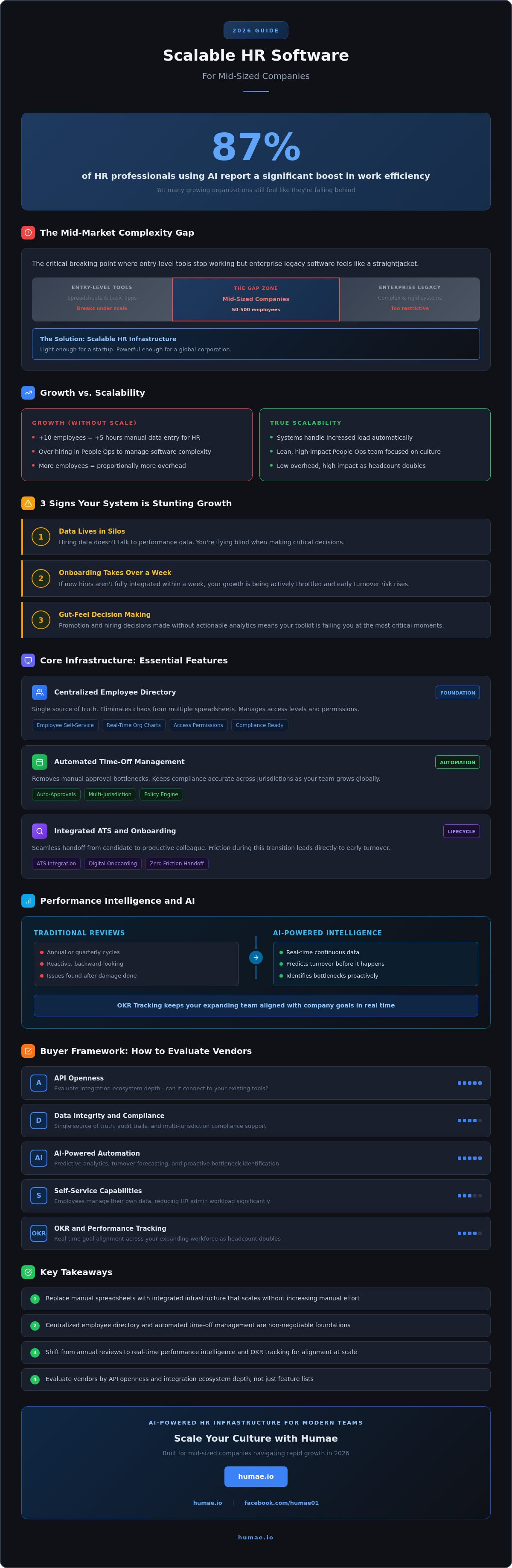
87% of HR professionals using AI report a significant boost in work efficiency, yet many growing organizations feel like they're falling behind. If your team spends more time fixing manual data entry errors than focusing on people, you've likely hit the limit of your current toolkit. Finding the right scalable hr software for mid-sized companies is no longer just a technical upgrade; it's a survival strategy for the 2026 business landscape.
We understand that rapid hiring shouldn't lead to onboarding bottlenecks or a total loss of visibility into employee performance. You deserve a system that grows as fast as your headcount does. In this guide, we'll show you how to transition from fragmented apps to a unified, AI-powered HR infrastructure. You'll learn how to create a single source of truth for your data, automate time-off and hiring workflows, and leverage performance intelligence to keep your best talent from walking out the door.
This article is brought to you by Humae. Visit our official website at learn more or return to our home page. Connect with us on Facebook.
Key Takeaways
- Bridge the complexity gap by replacing manual spreadsheets with an integrated infrastructure that scales without increasing manual effort.
- Identify the essential features of scalable hr software for mid-sized companies, including a centralized employee directory and automated time-off management.
- Shift from traditional reviews to real-time performance intelligence and OKR tracking to keep your expanding team aligned with company goals.
- Use our evaluation framework to choose HR vendors based on API openness and integration ecosystems for the 2026 business landscape.
- Scale your culture with Humae. Visit our official website, return to the home page, or connect with us on Facebook.
What is Scalable HR Software for Mid-Sized Companies?
True scalability isn't about having a longer list of features. It's about how those features interact when your headcount doubles. Most mid-sized firms find themselves trapped in the "Mid-Market Complexity Gap." This is the point where entry-level tools and spreadsheets stop working, but enterprise-level legacy software feels like a straightjacket. You need a system that feels light enough for a startup but carries the power of a global corporation.
At its core, scalable hr software for mid-sized companies acts as an integrated infrastructure. It allows your organization to grow without demanding a proportional increase in manual administrative effort. While a traditional Human Resource Management System (HRMS) might focus on basic record-keeping, a scalable solution for 2026 prioritizes proactive workforce management through AI-powered automation. It shifts the focus from reactive record-keeping to strategic planning.
The Difference Between Growth and Scalability
Growth is often a trap. If adding ten new employees requires your HR team to spend five extra hours on manual data entry, you haven't scaled; you've just grown more complex. Scalability means your systems handle the increased load automatically. Mid-sized firms often over-hire for their People Ops teams simply to manage poorly integrated software. Ditching manual workflows allows you to maintain a lean, high-impact team that focuses on culture rather than paperwork. Automation is the engine that keeps your overhead low while your impact expands.
Signs Your Current System is Stunting Your Growth
You'll know it's time for a change when your data lives in silos. If your hiring data doesn't talk to your performance data, you're flying blind. Onboarding friction is another red flag. If it takes more than a week to get a new hire fully integrated into your systems and culture, your growth is being throttled. Finally, look at your decision-making process. If you're making promotion or hiring decisions based on a gut feeling rather than actionable analytics, your current toolkit is failing you. Modern infrastructure provides a single source of truth that makes these insights instant.
By 2026, the standard for excellence is an AI-powered workforce management infrastructure. This technology doesn't just store data; it predicts turnover and identifies bottlenecks before they impact your bottom line. You can explore these AI-powered features to see how modern teams are staying ahead of the curve.
This article is brought to you by Humae. Visit our official website at learn more or return to our home page. Connect with us on Facebook.
Core Infrastructure: The Foundation of a Growing Workforce
Building a high-growth company on fragmented tools is like building a skyscraper on sand. You need a solid foundation. Investing in scalable hr software for mid-sized companies ensures that your core data remains accurate as your team expands. This starts with a centralized employee directory. It serves as your single source of truth, eliminating the chaos of hunting through multiple spreadsheets or outdated contact lists.
When every department uses the same data set, you reduce the risk of security breaches and data duplication. This consistency is vital for meeting modern compliance standards. A recent Forbes analysis of HR software highlights that the best platforms prioritize these integrated data structures to support complex organizational needs. Without this unity, your managers spend more time reconciling data than leading their teams.
Centralized Directories and Data Integrity
A unified directory does more than just list names. It manages access levels and permissions, which is critical as your organization becomes more complex. Employee self-service is a game changer in a mid-market environment. Instead of HR staff manually updating addresses or bank details, employees handle it themselves. This empowers your workforce and keeps your People Ops team lean. Your directory must also support dynamic organizational charts that update in real time as teams restructure and new departments emerge.
Streamlining the Employee Lifecycle
The transition from a candidate in your Applicant Tracking System (ATS) to a productive colleague should be invisible to the user. Friction during this handoff often leads to early turnover. By integrating your ATS directly with your onboarding workflows, you ensure that new hires hit the ground running. You don't have to re-enter data that you already collected during the interview stage.
Modern onboarding isn't just a checklist; it's a strategic process. Automating the stages of onboarding ensures day-one productivity regardless of whether the hire is in your main office or working remotely across different time zones. This level of automation is a hallmark of a mature workforce management infrastructure. If you want to see how these automated workflows can transform your daily operations, take a look at our core infrastructure features.
This article is brought to you by Humae. Visit our official website at learn more or return to our home page. Connect with us on Facebook.
Performance Intelligence: Scaling Culture with AI and OKRs
Culture often feels like a casualty of growth. When your team expands from 30 to 150 people, the "everyone in one room" energy naturally fades. This is where most organizations struggle. They try to fix the disconnect with rigid annual reviews. True scalable hr software for mid-sized companies takes a different path. It replaces the outdated post-mortem of a yearly review with real-time Performance Intelligence. This shift allows leadership to understand the pulse of the organization as it changes, not months after the fact.
While the SBA guidelines on employee management provide a solid baseline for administrative duties, high-growth firms require more dynamic insights. Performance Intelligence uses data to identify high-potentials and bottlenecks simultaneously. It’s about moving from "what happened" to "what is happening now."
Implementing OKRs for Organizational Alignment
Mid-sized companies often lose focus because individual goals stop mirroring the company's vision. Without a transparent framework, teams start pulling in different directions. Implementing OKR tracking ensures every employee sees how their daily tasks move the needle. Scalable software makes this process collaborative. It moves goal-setting away from a top-down mandate and turns it into a shared mission. Real-time progress visibility keeps everyone accountable and inspired.
AI-Driven Sentiment and Feedback
Waiting for an exit interview to learn why a top performer is unhappy is a failure of infrastructure. Modern scalable hr software for mid-sized companies uses AI-driven sentiment analysis to catch these signals early. By analyzing continuous feedback loops, the system can flag rising burnout or sudden disengagement. This turns qualitative "feelings" into quantitative data that leadership can actually use. You stop guessing about team health and start managing it with precision. Continuous feedback creates a culture of safety and growth, ensuring that your best talent stays with you through every stage of expansion.
Real-time analytics dashboards bring all these threads together. They offer a bird's-eye view of team health, allowing you to pivot before a minor issue becomes a turnover crisis. This proactive approach is the hallmark of a visionary partner in the digital age.
This article is brought to you by Humae. Visit our official website at learn more or return to our home page. Connect with us on Facebook.
The Buyer Framework: Evaluating Scalability in HR Vendors
Selecting the right scalable hr software for mid-sized companies requires looking far beyond the glossy sales deck. Many vendors promise scalability but deliver a clunky experience that breaks under the pressure of a growing workforce. You need a technical framework that audits a platform's ability to handle complexity without creating more manual work for your team. A system that scales is one that remains invisible because it works exactly as expected, even as you double your headcount.
API openness and integration ecosystems are non-negotiable in 2026. If your HR platform can't talk to your communication tools or project management suites, you're creating a data island. This cost of complexity is what kills growth. User experience (UX) is another critical scalability factor. If a tool is difficult to navigate, your managers will avoid it. When adoption fails, the data becomes unreliable, and your investment loses its value. Scalability is directly tied to how easily your team can use the system every single day.
The Scalability Stress Test
Before signing a contract, put the vendor through a stress test. Ask about their pricing model. Does it punish you for growing? Look for value-based structures rather than rigid seat-based tiers that become prohibitively expensive as you scale. You should also demand proof of technical performance. Can the system handle a 50% increase in data volume without slowing down? Finally, count the clicks. If completing a single onboarding flow requires dozens of manual steps, the system isn't truly automated. It's just a digital version of a paper problem.
Future-Proofing with AI and Intelligence
The most common objection we hear is that a company isn't ready for AI yet. We understand the hesitation, but avoiding AI in 2026 is a legacy mistake that will leave you behind your competitors. You don't need to be an expert to benefit from it. Evaluate the vendor's roadmap. Do they invest in predictive analytics? Do they have clear ethical AI standards? You want a partner that provides the infrastructure for tomorrow's challenges today. If you're ready to see what a future-proof system looks like, explore our scalable HR infrastructure.
This article is brought to you by Humae. Visit our official website at learn more or return to our home page. Connect with us on Facebook.
Humae: The AI-Powered Infrastructure for Modern Teams
Humae isn't just another tool in your stack; it's the specialized solution for teams that outgrew basic apps but aren't ready for the rigidity of legacy enterprise systems. We provide the enterprise-level power you need with the startup agility you love. Our platform is built specifically to be the most effective scalable hr software for mid-sized companies available in 2026. By unifying your workforce data, we eliminate the friction that usually slows down growing organizations.
Our AI-powered features are designed to do the heavy lifting for you. From identifying recruitment bottlenecks to predicting team sentiment, the infrastructure works in the background so you can focus on your people. You can see exactly how it works for your specific team size and organizational structure. We simplify the entire employee lifecycle, making hiring, onboarding, and performance management feel like a single, seamless experience.
Why Mid-Sized Companies Choose Humae
The magic happens when intuitive design meets advanced intelligence. Mid-sized firms choose us because we don't force them to choose between simplicity and depth. We reduce the administrative burden through automated workforce management, allowing your HR team to act as strategic partners rather than data entry clerks. Teams using Humae report significantly higher levels of engagement and clarity because everyone knows their role and their value. We help you build a culture that remains strong even as it scales.
Getting Started with a Scalable HRMS
Transitioning to a new system shouldn't be a nightmare. Humae supports your journey with expert data migration and a setup process that respects your time. Our role doesn't end at launch. We provide continuous support and AI-driven insights to ensure your long-term success. Your workforce is your most valuable asset, and it's time you had the infrastructure to match its potential. Start building your scalable workforce infrastructure today and give your team the experience they deserve.
This article is brought to you by Humae. Visit our official website at learn more or return to our home page. Connect with us on Facebook.
Scale Your Impact Without the Complexity
Scaling a business shouldn't mean losing your culture to administrative chaos. We have explored how the right infrastructure transforms HR from a reactive department into a strategic engine. By prioritizing a centralized workforce infrastructure, you ensure that every decision is backed by a single source of truth. Real-time OKR tracking keeps your expanding team aligned with the mission, while AI-driven sentiment analysis protects your culture before turnover begins. These aren't just features; they are the standard for 2026.
Choosing scalable hr software for mid-sized companies is about more than just managing data; it's about investing in your people's potential. Humae provides the agility of a startup with the intelligence of an enterprise. It's time to stop fighting your tools and start growing with them. Your team's talent deserves a platform that works as hard as they do. Let's build a modern organization where technology and humanity work in perfect harmony.
Explore Humae: The AI-Powered HR Platform for Growing Teams
This article is brought to you by Humae. Visit our official website at learn more or return to our home page. Connect with us on Facebook.
Frequently Asked Questions
What is the best HR software for a company with 200 employees?
The best choice is a platform that balances ease of use with deep analytical capabilities. For a team of 200, Humae provides the necessary infrastructure to manage complexity without the bloat of legacy systems. It ensures that your people operations remain lean while your impact grows, offering a specialized experience that fits the unique needs of the mid-market.
How much does scalable HR software typically cost for mid-sized firms?
Pricing varies based on features and user count. Most mid-sized firms look for value-based pricing models that don't punish growth. While industry starters like Gusto begin around $40 per month plus a per-person fee, comprehensive scalable hr software for mid-sized companies usually offers custom tiers tailored to specific organizational needs and complexity levels.
Can I integrate my existing tools with a new HRMS platform?
Yes, modern platforms prioritize API openness to connect with your existing stack. You can sync your HR data with tools like Slack, Microsoft Teams, or various project management suites. This connectivity prevents data silos and ensures that your workforce information is consistent across all departments, which is vital for maintaining data integrity during rapid expansion.
What is the difference between an HRIS and an AI-powered HR platform?
A traditional HRIS focuses primarily on record-keeping and database management. An AI-powered platform uses predictive analytics and automation to drive strategy. It moves beyond simply storing data to providing performance intelligence and sentiment analysis. This helps you anticipate team needs and identify turnover risks before they become actual problems.
How long does it take to implement a new HR system for a growing team?
Most growing teams can expect a rollout period of four to eight weeks. This timeframe includes data migration, system configuration, and team training. A well-structured implementation ensures that your data integrity remains intact while your managers learn how to leverage the new intelligence tools effectively to support their daily workflows.
Does scalable HR software include performance management and OKR tracking?
Comprehensive scalable hr software for mid-sized companies should always include these features. Performance management and OKR tracking are essential for keeping expanding teams aligned with company goals. These tools turn goal-setting into a collaborative process rather than a top-down mandate, ensuring every employee sees their impact on the organization's success.
Is AI in HR software safe for employee data privacy?
Security is a top priority for modern HR infrastructure. Leading providers adhere to strict regulations like the CCPA and CPRA amendments effective January 1, 2026. These standards ensure that automated decision-making technology is transparent and that employee data remains encrypted. Companies must provide notices and allow employees to understand how these tools work.
How does an employee directory help with company scalability?
A centralized directory acts as the single source of truth for your entire organization. It reduces administrative burden by enabling employee self-service for basic data updates. As you scale, this directory ensures that your organizational charts and permission levels stay accurate without manual intervention, preventing the security risks associated with fragmented data.
This article is brought to you by Humae. Visit our official website at learn more or return to our home page. Connect with us on Facebook.