Reducing Time-to-Hire with Software: The 2026 Strategy for High-Growth Teams
By Humae · 16 May 2026
reducing time-to-hire with software
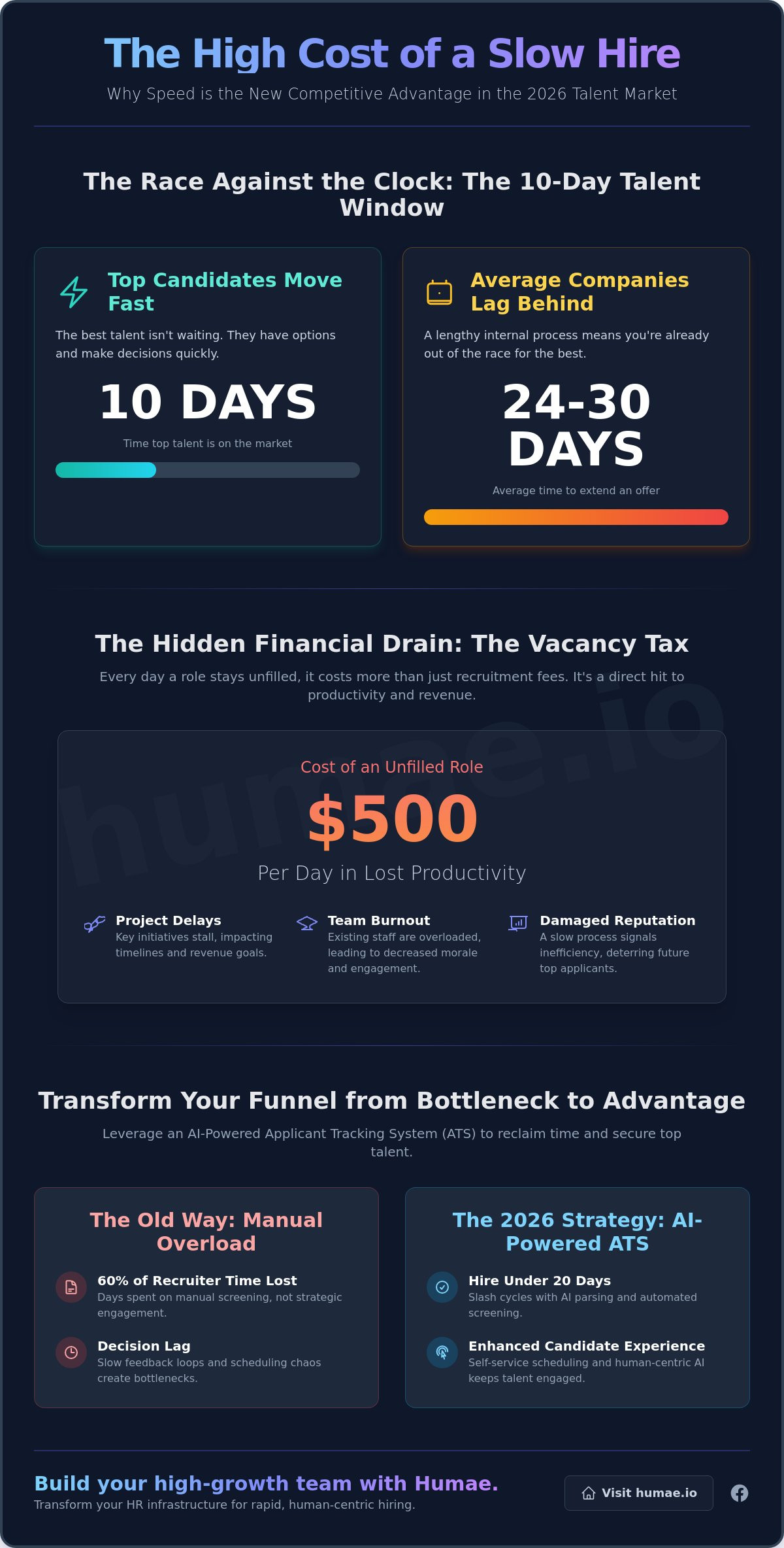
Top candidates are off the market in just 10 days, yet the average company still takes 24 to 30 days to extend an offer. You've likely felt the pressure as unfilled roles cost your business $500 every single day in lost productivity. Start reducing time-to-hire with software to reclaim the 60% of the day your recruiters currently spend on manual screening. You know that a slow process doesn't just lose talent; it hurts your brand's reputation and team morale.
We're here to change that dynamic. You'll discover how to leverage an AI-powered Applicant Tracking System to slash recruitment cycles to under 20 days while improving the candidate experience. This guide previews the 2026 strategy for building a high-growth team where hiring speed and performance intelligence finally work in harmony. It's time to transform your recruitment funnel from a bottleneck into a competitive advantage.
Humae helps teams build better workplaces through innovation. Return to the Humae homepage or follow our latest updates on Facebook.
Key Takeaways
- Understand why the 10-day talent window is the new benchmark for high-growth teams in 2026.
- Start reducing time-to-hire with software to automate the screening tasks that currently drain your productivity.
- Discover how human-centric AI uses sentiment analysis to keep candidates engaged throughout the process.
- Pinpoint Decision Lag in your funnel to consistently move from application to offer in under 20 days.
- Align recruitment with long-term goals by connecting your ATS to performance intelligence and OKR tracking.
Build your high-growth team with Humae. Return to our home page or visit us on Facebook.
The Real Cost of Slow Hiring in 2026
Speed is the new currency in talent acquisition. While many leaders use the terms interchangeably, there's a vital distinction between time-to-fill and time-to-hire. Time-to-fill tracks the entire span from the moment a job is posted until the new hire starts. In contrast, time-to-hire focuses strictly on the speed at which a candidate moves through your internal pipeline once they apply. For high-growth teams, reducing time-to-hire with software is the only way to stay competitive when the average time-to-hire in 2026 has stretched to nearly 30 days.
The Hidden Financial Impact of Unfilled Roles
The direct costs of a slow process are easy to spot in recruiter fees and rising advertising spends. However, the indirect costs are often more damaging. Lost revenue from delayed product launches and decreased morale can cripple a scaling company. We define the "Vacancy Tax" as a critical KPI for 2026, representing the documented $500 per day in lost productivity for every unfilled professional role. Relying on an Applicant Tracking System (ATS) helps mitigate these costs by identifying high-potential candidates before the Vacancy Tax drains your budget.
Candidate Experience as a Competitive Advantage
Modern candidates view your hiring speed as a direct reflection of your company's innovation and operational health. A sluggish process suggests a bureaucratic culture, while a swift, transparent journey signals a tech-forward environment. This perception is directly linked to offer-acceptance rates. If you want to understand how this fits into your broader organizational strategy, exploring what is workforce management can provide the necessary context for building a modern HR infrastructure. By reducing time-to-hire with software, you prove to candidates that you value their time as much as your own.
Core Software Features that Slash Recruitment Cycles
High-growth teams can't afford to let resumes sit in a stagnant inbox while competitors move at lightning speed. The foundation of a modern recruitment strategy is an integrated Applicant Tracking System that centralizes every interaction. By reducing time-to-hire with software, your recruitment team shifts from administrative data entry to high-impact decision making. This transition starts with AI-powered resume parsing. Instead of spending hours on the manual "first look," software extracts relevant experience and skills instantly, highlighting the top 5% of candidates before you even finish your morning coffee.
Friction often occurs in the gaps between stages. Self-service interview scheduling eliminates the exhausting back-and-forth email chains that can delay a process by days. When candidates can pick their own slots based on real-time availability, you maintain the momentum they felt during the initial application. This efficiency is a core part of the strategic role of technology in recruitment, where the goal is to remove mechanical hurdles so human connections can happen faster. Centralized candidate directories also ensure that your hiring managers aren't hunting for feedback in Slack or email; everything stays in one visible dashboard.
Intelligent Screening and Pre-Qualification
Speed shouldn't come at the cost of quality. Knock-out questions allow you to filter for essential certifications or years of experience the moment an application is submitted. This immediate feedback loop ensures your team only reviews qualified profiles. Modern AI-driven skill assessments provide objective data points early in the funnel, which helps in making evidence-based choices. Using these tools also helps reduce unconscious bias by focusing on verified competencies rather than subjective resume formatting.
Automated Communication Workflows
Candidate ghosting is often a reaction to recruiter silence. Automated "Status Triggers" keep applicants informed every time they move through the funnel, which significantly boosts your candidate sentiment scores. You can also deploy automated FAQs to handle routine questions about benefits or office location, freeing up your recruiters for more complex conversations. Explore Humae features to see how these automated workflows can be tailored to your specific team culture. You can explore how a centralized Applicant Tracking System unifies these tools into one seamless experience.
Moving Beyond Automation: AI and Sentiment Analysis
Automation alone isn't enough to win the talent war in 2026. If your process feels cold or detached, the most sought-after professionals will simply look elsewhere. High-growth teams are now moving beyond simple task-switching and embracing "Human-Centric AI." This approach ensures that while you are reducing time-to-hire with software, you aren't sacrificing the emotional connection that defines a great employer brand. Instead of just moving resumes from one stage to another, this technology analyzes the nuances of every candidate interaction to keep the "human" in HR.
Sentiment analysis is a game-changer for maintaining engagement. By evaluating the tone and responsiveness of candidate communications, your software can flag when an applicant’s interest is starting to wane. If a top-tier developer begins giving shorter answers or takes longer to reply to interview invites, the system alerts your recruiter to step in with a personal, supportive touch. Predictive analytics takes this a step further. It identifies historical patterns that lead to drop-outs, allowing you to proactively address concerns before a candidate exits the funnel. This data-driven foresight ensures your pipeline stays healthy and active.
Maintaining the Human Touch in a Digital Process
Technology should amplify empathy, not replace it. Modern tools use dynamic data fields to personalize automated outreach so candidates never feel like a number in a database. AI can also identify "soft skill" markers, such as leadership potential or adaptability, that often remain hidden in traditional resumes. Ensuring your AI-powered HR platform remains empathetic is the key to winning talent in a highly selective market where culture matters as much as compensation.
Data-Driven Decision Making
Objective data is the best antidote to a slow hiring committee. Standardized digital scorecards ensure every interviewer evaluates candidates against the same criteria, removing the "gut feeling" bias that often stalls progress. Real-time collaborative feedback allows hiring managers to see each other's notes instantly, preventing information silos. AI significantly reduces consensus lag in hiring committees by identifying discrepancies in interviewer ratings and prompting immediate resolution discussions to keep the process moving forward.
Optimizing the Funnel: Finding and Fixing Bottlenecks
Scaling a team at pace requires more than just a list of software features. It demands a systematic audit of your entire recruitment pipeline. Most organizations suffer from "Decision Lag," where qualified resumes sit in a digital pile while hiring managers juggle other priorities. By reducing time-to-hire with software, you can set automated reminders and visibility triggers that keep the process moving. If a resume stays unreviewed for more than 48 hours, the system should flag it as a risk. This proactive stance is the only way to stay within the critical 10-day window for top-tier talent.
Optimization is an ongoing experiment. Start by implementing analytics dashboards to visualize your funnel from sourcing to onboarding. Use this data to A/B test your job titles and outreach sequences. Does a "Senior Product Designer" title attract more qualified leads than "Lead UI/UX Expert"? Real-time data will tell you. Eventually, your goal is to transition from reactive hiring to proactive talent pipelining. Maintaining a centralized directory of "silver medalist" candidates allows you to fill roles before they even become a drain on your productivity.
Measuring What Matters
Speed is only one part of the equation. You must balance Time-to-Hire with Quality-of-Hire and Candidate Satisfaction Scores. To justify the investment in new tools, connect your recruitment speed to performance intelligence. When you prove that candidates who move through a streamlined, 20-day funnel have higher 90-day performance scores, you've built an undeniable case for ROI. Reducing time-to-hire with software isn't just about filling seats; it's about finding the right people faster and ensuring they stay productive.
The Bridge to Onboarding
The candidate experience doesn't end with a signature. A common bottleneck occurs when a signed offer letter gets stuck in HR limbo before the first day. Automating the transition from your Applicant Tracking System to the Employee Directory ensures a smooth "day one" experience. This integration is a hallmark of a modern HR infrastructure. If you're looking to unify your entire people operation, exploring what is an HRIS will show you how to connect these dots seamlessly. Optimize your recruitment funnel to ensure your growth isn't slowed by outdated processes.
Humae: The Infrastructure for Rapid, Human-Centric Hiring
Humae represents the evolution of HR technology. It isn't just another tool; it is a unified infrastructure designed to bridge the gap between finding talent and fostering excellence. By reducing time-to-hire with software that integrates an Applicant Tracking System (ATS) directly with an HRMS and Performance Intelligence, you eliminate the friction that usually occurs when a candidate becomes an employee. This seamless interface ensures that every data point gathered during the interview process informs the new hire's development from day one.
Design plays a critical role in this transition. Humae features a Red Dot award-winning UI that prioritizes a "Human First" experience. When software is beautiful and intuitive, adoption rates among hiring managers and employees soar. This reduces the administrative burden on your HR team, allowing them to focus on building relationships rather than troubleshooting complex menus. Rapid growth shouldn't feel like a mechanical process; with the right interface, it feels like a natural extension of your company’s ambition.
A Unified Workforce Management Ecosystem
Data silos are the enemy of efficiency. When your hiring data is disconnected from your performance metrics, you lose the ability to see why certain hires succeed while others struggle. Humae removes these barriers by creating a single source of truth for your entire workforce. Scaling your team at a high pace often puts your culture at risk, but our platform helps you maintain your unique identity through real-time sentiment analysis. This tool provides continuous feedback post-hire, ensuring that new team members feel supported and aligned with your core values long after the onboarding phase is complete.
Getting Started with Humae
Your growth strategy deserves an infrastructure that can keep up. Humae integrates into your existing workflows without the typical implementation headaches associated with legacy systems. We empower your managers with actionable performance dashboards that connect hiring speed to real-world outcomes. By leveraging AI-powered OKR tracking, you can ensure every new hire is aligned with company goals before they even attend their first team meeting. See how Humae works to accelerate your growth and start reducing time-to-hire with software that cares about your people as much as your productivity.
Build Your Future Workforce Today
Winning the race for talent in 2026 requires more than just a faster process; it demands a smarter one. You've seen how identifying decision lag and reducing time-to-hire with software can save your organization thousands in lost productivity. By moving beyond basic automation and embracing human-centric AI, you ensure that every candidate feels valued while your team stays focused on strategic growth. It's about turning the first point of contact into a lasting performance advantage.
Humae provides the infrastructure to turn these strategies into reality. With our Red Dot Design Award-winning interface, your team will actually enjoy the recruitment process. You can leverage AI-powered sentiment analysis to keep engagement high and use integrated OKR tracking to align new hires with your mission instantly. It's time to build a recruitment funnel that works as hard as you do. Start optimizing your workforce with Humae today and watch your high-growth team thrive.
Frequently Asked Questions
How does software actually reduce time-to-hire?
Software automates the repetitive, manual tasks that typically consume 60% of a recruiter's day. By reducing time-to-hire with software, you eliminate bottlenecks like manual resume parsing and back-and-forth interview scheduling. This allows your team to move qualified candidates through the funnel instantly, ensuring you reach top talent before they leave the market.
Can AI-powered hiring tools really maintain a human-centric experience?
Yes, modern AI tools actually enhance the human element by freeing recruiters from administrative drudgery. When software handles status updates and FAQs, recruiters have more time for meaningful, one-on-one conversations. Sentiment analysis also helps identify when a candidate's engagement is dropping, allowing for a timely, personal intervention that feels supportive rather than robotic.
What is the ideal time-to-hire for a modern startup in 2026?
The ideal benchmark for high-growth teams in 2026 is under 20 days. Since the most sought-after candidates are often hired within 10 days, your internal process must be agile enough to extend an offer quickly. Aiming for this window signals to talent that your organization is innovative, decisive, and respects their time.
Is it difficult to integrate a new HRMS with my existing recruitment tools?
Modern HRMS platforms use API-first designs that make integrations straightforward and fast. You can typically connect your Applicant Tracking System to your broader employee directory without complex coding or long downtime. This unified approach ensures that candidate data transitions into employee performance data without any manual entry errors.
How do I identify bottlenecks in my current hiring process?
Start by auditing your time-to-hire at every stage, from the initial application to the signed offer. Use real-time dashboards to pinpoint "Decision Lag," which is the specific point where resumes sit unreviewed for the longest period. Visualizing these delays helps you see exactly which stage is slowing down your growth.
What features should I look for in an ATS for a high-growth team?
Prioritize features like automated screening, self-service interview scheduling, and centralized candidate directories. It's also vital to choose a platform with an intuitive user interface to ensure high adoption rates among hiring managers. Reducing time-to-hire with software only works if your entire team feels comfortable using the tools every day.
Does reducing time-to-hire affect the quality of the candidates?
Speed actually improves candidate quality because high-performers are the least likely to tolerate a slow, bureaucratic process. By moving faster, you increase your chances of securing "A-players" who would otherwise accept competing offers. Using objective digital scorecards ensures that your faster decisions are still based on rigorous, data-driven evaluations.
How much does HR software typically cost for a mid-sized company?
Pricing for HR software varies widely based on your headcount, required features, and the level of integration needed. Most providers offer scalable subscription models that grow alongside your team. You should consult with specific vendors to get a quote that reflects your organization's unique goals and technical requirements.