PTO Accrual Reporting: The 2026 Strategic Guide for HR Leaders
By Humae · 17 June 2026
pto accrual reporting
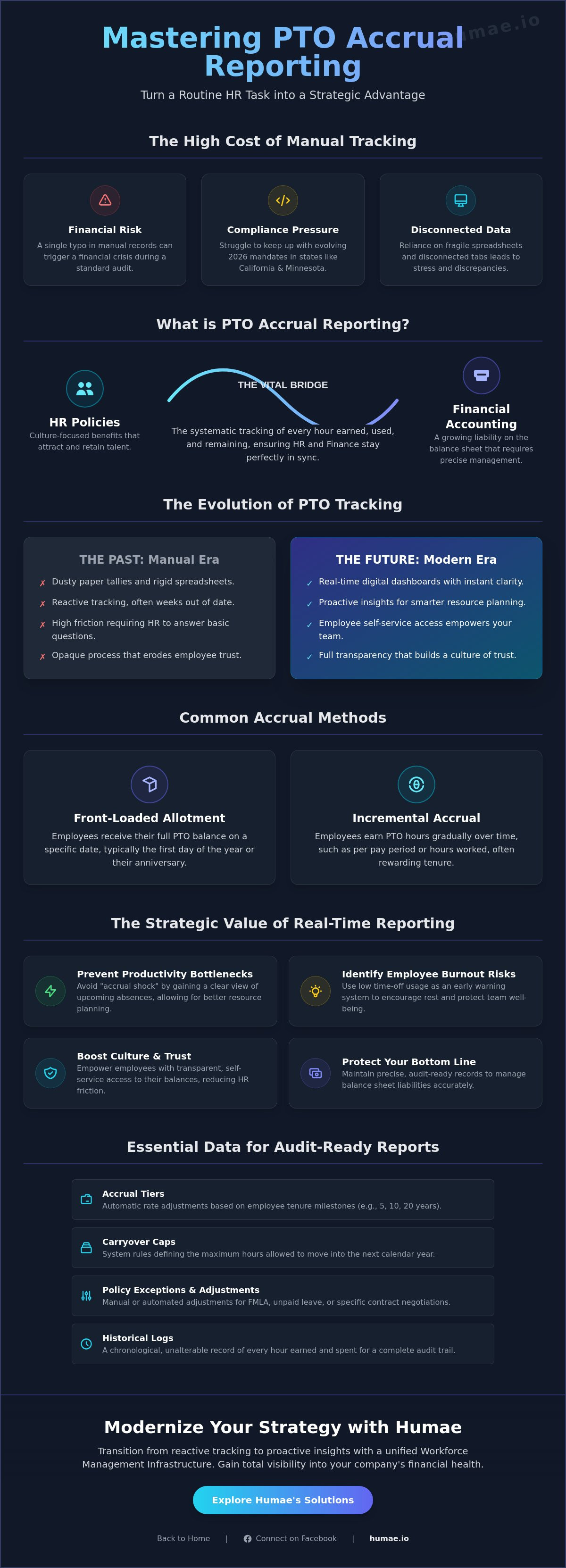
A single typo in your manual records can turn a standard audit into a financial crisis. You've likely felt the pressure of keeping up with evolving 2026 mandates in states like California or Minnesota, where unused time is strictly treated as earned wages. Managing pto accrual reporting shouldn't feel like a high-stakes guessing game played across disconnected tabs and fragile spreadsheets.
It's time to move beyond the stress of payroll discrepancies and gain total visibility into your company's financial health. We'll show you how to master the complexities of accruals to ensure compliance and boost employee well-being through modern data insights. This guide covers everything from automating your workflows to using absence patterns as a tool against burnout. By the end, you'll know how to turn a routine HR task into a strategic advantage that protects your bottom line and supports your team's mental health.
Key Takeaways
- Learn why pto accrual reporting serves as the essential bridge between your culture-focused HR policies and accurate financial accounting.
- Identify how to calculate the true monetary value of unused time off to manage balance sheet liabilities with precision.
- Discover the critical data points needed to eliminate manual spreadsheet errors and ensure compliance across different tenure-based tiers.
- Transition from reactive tracking to proactive insights by using automated reports to identify and address employee burnout trends.
- See how modernizing your strategy with real-time analytics dashboards creates a transparent, high-performance culture for every team.
What is PTO Accrual Reporting?
pto accrual reporting is more than just a ledger of days off. It's the systematic tracking and documentation of every hour earned, used, and remaining within your organization. Think of it as the vital bridge between your culture-focused HR policies and the hard numbers of financial accounting. While HR sees a benefit that keeps talent happy, Finance sees a growing liability on the balance sheet. Effective reporting ensures these two perspectives stay in sync, turning raw data into a shared language of organizational health.
The way we track this data has shifted dramatically. We've moved from dusty paper tallies and rigid annual spreadsheets to real-time digital dashboards that offer instant clarity. This evolution isn't just about speed; it's about trust. When employees have self-service access to their balances through a modern Time Off Management system, they feel empowered. They don't have to email HR to ask how much time they've saved up. This transparency reduces friction and builds a culture of mutual respect where everyone knows exactly where they stand.
Defining PTO Accrual in a Modern Workplace
In 2026, organizations typically choose between front-loaded allotments and incremental accruals. Front-loading gives employees their full balance on day one, while incremental accruals reward tenure by adding hours every pay period. The accrual rate is the engine here; it dictates exactly how many hours land in an employee's bank based on their hours worked or specific tenure milestones. The reporting lifecycle begins the moment an hour is earned and concludes only when that data is verified during a final financial audit.
The Strategic Value of Real-Time Reporting
Waiting until the end of the quarter to check balances is a recipe for "accrual shock." This happens when your entire engineering team realizes they have three weeks to "use or lose" their time in December, leaving your projects stranded. Real-time pto accrual reporting prevents these productivity bottlenecks by giving you a clear view of upcoming absences well in advance. It’s a tool for smarter resource planning and proactive management.
Beyond logistics, this data serves as an early warning system for burnout. By identifying departments where time-off usage is dangerously low, you can step in and encourage rest before your best people hit a wall. Understanding global standards for annual leave helps HR leaders benchmark their policies to remain competitive while maintaining operational stability. High-performing teams don't just track time; they use it as a metric for sustainable success.
Essential Data Points for Accurate PTO Accrual Reports
Precision in pto accrual reporting requires a granular approach to data entry. You can't just track names and numbers; you need a deep look at employee identification tied to specific tenure-based tiers. As of 2026, many organizations have shifted to complex schedules where an employee's accrual rate increases at the 5, 10, or 20-year mark. Without these milestones clearly mapped in your report, you risk under-calculating benefits or over-paying upon termination. Every data point serves as a brick in your compliance foundation.
Accurate reporting also hinges on how you define accrual rates. Whether your team earns time based on hours worked or fixed pay periods, the data must reflect the financial impact of PTO accrual on your balance sheet. This is especially true for adjustments involving FMLA, sick leave, or unpaid time off. If an employee takes an extended leave, your system needs to automatically pause or pro-rate their earnings. This prevents "ghost hours" from inflating your financial liability and keeps your records audit-ready. To maintain a robust report, you should track these essential fields:
- Accrual Tiers: Automatic rate adjustments based on hire dates.
- Carryover Caps: Maximum hours allowed to move into the next calendar year.
- Policy Exceptions: Manual adjustments for specific contract negotiations or leave types.
- Historical Logs: A chronological record of every hour earned and spent.
Tracking Different Accrual Methods
Reporting requirements vary wildly between industries. In retail or manufacturing, hourly accruals are the standard. This means your report must pull directly from timesheet data to remain accurate. For salaried teams, milestone-based increases are more common. You also need to pro-rate balances for part-time staff to ensure fairness and cost control. Using modern HRIS systems allows you to automate these calculations so they happen in the background without manual oversight.
Compliance and Regulatory Reporting Requirements
The legal landscape in 2026 is a patchwork of state-specific rules. In California and Colorado, accrued vacation is considered earned wages. This means "use-it-or-lose-it" policies aren't just unpopular; they're illegal. Your pto accrual reporting must maintain an audit-ready trail for FLSA compliance and state mandates. For example, Minnesota's PFML program going live on January 1, 2026, requires specific documentation for medical and family leave. Historical usage logs provide the context needed to prove your organization is meeting these standards.
Managing these data points manually is a recipe for disaster. If you want to see how automation can simplify your life, take a look at how centralized time-off management handles the heavy lifting for you.
The Financial Impact of PTO Accrual Reporting
Finance departments don't see vacation days as just beach photos and relaxation. They see a growing line item on the balance sheet. In the world of accounting, accrued time off is a liability because it represents a future cash outflow that the company is obligated to pay. Mastering pto accrual reporting is the only way to bridge the gap between these financial realities and your people strategy. Without clear data, your organization is essentially carrying an unquantified debt that can complicate company valuations and year-end audits.
The stakes are even higher in high-turnover industries. When an employee leaves, their accrued hours often must be paid out at their current salary rate, not the rate they had when they first earned the time. This means if a team member receives a promotion or a raise, the "cost" of their unused vacation suddenly increases. Systematic reporting allows your CFO to forecast these payouts with precision, preventing sudden hits to your cash flow during periods of restructuring or seasonal turnover. It turns a "hidden cost" into a predictable, manageable expense.
Managing Unused PTO as a Financial Liability
To calculate the total dollar value of your organization's financial liability, you must multiply the current hourly rate of every employee by their total bank of accrued hours. Organizations often reduce this burden by implementing carryover caps or encouraging mandatory leave during slower quarters. Accurate pto accrual reporting ensures these policies are applied fairly and consistently, providing the transparency required for clean financial audits. By keeping these numbers visible, you can proactively manage your balance sheet rather than reacting to it at year-end.
Identifying Burnout Risks Through Absence Analytics
While finance focuses on the debt, HR can use the same data to protect the team. High accrual balances are often an early warning sign of "leave-stigma," where employees feel they can't take time off without falling behind. By correlating these high balances with low employee sentiment scores, you can spot burnout before it leads to a resignation. Using Analytics Dashboards allows you to see which departments are at risk, turning absence management into a powerful retention tool. Rested employees are more productive, meaning that encouraging time off actually protects your long-term bottom line.
Ready to see how data-driven insights can transform your culture? Explore how Humae helps you balance financial health with employee well-being.
Best Practices for Effective PTO Reporting in 2026
Excellence in reporting isn't a one-time setup; it's a living workflow. To maintain a competitive edge, HR leaders must move beyond simply collecting data and start refining how that data is used. Standardization is your first line of defense. When every department follows the same data entry rules, your pto accrual reporting becomes a reliable source of truth rather than a collection of conflicting notes. Consistency ensures that a senior manager in Sales and a junior designer in Creative are treated with the same level of fairness and transparency.
Self-service is the next pillar of a modern strategy. Employees shouldn't have to wait for an HR response to plan their personal lives. Giving them real-time access to their balances through an intuitive portal reduces administrative tickets and builds cultural trust. However, the most critical practice is the bi-annual logic audit. With state laws in places like Minnesota and Maine shifting rapidly in 2026, your system's underlying rules must be checked twice a year to ensure your accrual calculations remain legally sound. Adopting these habits transforms reporting from a chore into a strategic asset:
- Standardize Entry: Eliminate department-specific "offline" tracking to keep all data in one central system.
- Automate Distribution: Schedule monthly reports so Finance and Department Heads never have to hunt for liability data.
- Verify Compliance: Review your accrual logic every six months to stay ahead of evolving state-level payout mandates.
- Empower Users: Use a platform that provides employees with a clear, real-time view of their earned hours.
Automating the Reporting Lifecycle
Manual spreadsheets are the silent killers of HR efficiency. They're prone to formula errors and quickly become outdated, creating a massive risk factor for your organization. The most effective way to protect your data integrity is by syncing payroll directly with your time-off management software. This ensures that every hour worked is instantly reflected in the employee's balance without human intervention. To build a truly resilient system, you need a robust workforce management infrastructure that handles these updates in the background.
Integrating Time Off Data with Performance Intelligence
In 2026, high-performing organizations are looking for the "why" behind the numbers. By integrating time-off data with your performance management system, you can see how usage patterns correlate with results. For example, understanding the OKR meaning in the context of rest allows you to see if teams that take regular breaks actually achieve their objectives faster. It also helps you ensure that leaders are modeling healthy behavior; if a manager never uses their PTO, their team is unlikely to do so either, leading to long-term productivity declines.
Ready to eliminate manual errors and gain total visibility? See how our Time Off Management platform automates your reporting today.
Modernizing Your Strategy with Humae Workforce Management Infrastructure
Humae transforms your time-off management from a static ledger into a dynamic engine for organizational growth. By centralizing pto accrual reporting within an intuitive interface, we remove the technical barriers that often separate HR from the rest of the company. You're no longer just managing numbers; you're nurturing a culture where data serves the people. Our integrated workforce management infrastructure ensures that every calculation is error-free and every policy is applied with absolute consistency. This level of precision builds a foundation of trust that manual systems simply can't match.
Transparency is the heartbeat of a modern workplace. When your team has real-time access to their own accrual data, the "black box" of HR disappears. Employees can plan their lives with confidence, while managers gain the clarity they need to lead effectively. This isn't just about administrative ease; it's about creating a workspace where everyone feels empowered by the information they have at their fingertips. By eliminating reporting errors, you protect your company from financial liability and give your team the peace of mind they deserve.
AI-Driven Insights for Smarter Time Off Management
While competitors focus on generic streamlining, we look at the human story behind the data. Humae uses sentiment analysis to help you understand how time-off patterns impact team morale. If your reporting shows that a specific department has high accrual balances but low sentiment scores, our system provides an early warning. You'll receive automated alerts when balances reach critical levels, allowing you to intervene before burnout takes hold. Predictive reporting also takes the guesswork out of seasonal planning; you can anticipate upcoming absence surges and adjust your resource allocation months in advance. This proactive approach ensures your team stays rested and your projects stay on track.
Centralizing Workforce Data in One Intuitive Interface
Startups and enterprises alike thrive when they have a single source of truth for their people data. Humae brings hiring, onboarding, and pto accrual reporting together so you never have to toggle between disconnected platforms. This centralization allows you to see the full employee lifecycle in one place, making it easier to spot trends that others might miss. You can explore our AI-powered features to see how we turn raw data into actionable intelligence that drives productivity. When employees have transparent, real-time access to their own accrual data, they feel more secure and valued. It's a modern approach that respects the time of your HR team and the well-being of your entire workforce.
Master Your Organization's Future Through Smarter Reporting
Effective pto accrual reporting has evolved into a high-impact tool for both financial stability and cultural health. You've seen how moving beyond manual tracking eliminates costly errors and ensures your organization stays ahead of shifting 2026 mandates. By integrating real-time analytics dashboards into your daily workflow, you turn static numbers into actionable intelligence that protects your bottom line and simplifies complex audits.
Modern HR leadership is about more than just managing time; it's about fostering a culture of trust and sustainable performance. Utilizing AI-powered sentiment analysis allows you to identify burnout trends early, ensuring your team remains energized and engaged. You have the power to transform administrative tasks into strategic advantages that support every employee's journey while maintaining total compliance. It's time to build a workplace where data and empathy work in perfect harmony.
Ready to lead with precision and empathy? Optimize your workforce with Humae today and experience the future of human resource management. Stay connected by following us on Facebook for the latest industry insights and updates.
Frequently Asked Questions
What is the difference between front-loaded PTO and accrued PTO?
Front-loaded PTO provides an employee's entire annual allotment on a single date, such as January 1st or their work anniversary. Accrued PTO is earned incrementally over time, usually per pay period or hour worked. While front-loading is simpler to track, accrual models often reduce financial liability if an employee leaves early in the year. Choosing between them depends on your cash flow needs and organizational culture.
How do you calculate PTO accrual rates for part-time employees?
You calculate part-time accrual by pro-rating the full-time rate based on the actual hours worked. For example, if a full-time employee earns 4 hours per pay period for 40 hours of work, a part-time employee working 20 hours would earn 2 hours. This ensures fairness across your diverse workforce. Automated pto accrual reporting tools handle these calculations instantly to prevent manual errors and maintain transparency.
Is PTO accrual reporting legally required for all businesses?
There is no federal mandate for PTO in the United States, but state-level regulations make reporting a practical necessity. States like California, Colorado, and New York have specific laws regarding paid sick leave and vacation payouts. Even without a direct legal mandate, accurate reporting is required for GAAP compliance and tax purposes. Failing to track these hours can lead to significant legal and financial penalties during an audit.
What happens to accrued PTO when an employee leaves the company?
Payout requirements at termination vary significantly by state law. In states like California and Colorado, accrued vacation is considered earned wages and must be paid out in full upon departure. Other states allow "use-it-or-lose-it" policies if clearly stated in the employee handbook. Maintaining precise pto accrual reporting ensures you always know the exact dollar amount owed to a departing team member at any given time.
How often should a company run a PTO accrual report for finance?
Running these reports on a monthly basis is the gold standard for modern finance teams. This frequency allows the accounting department to adjust the company's liability on the balance sheet in real-time. Waiting until the end of the year can lead to "accrual shock," where sudden payouts or high balances disrupt cash flow. Regular reporting keeps your financial forecasting accurate and your leadership team informed.
Can AI improve the accuracy of PTO accrual reporting?
AI dramatically improves accuracy by flagging data anomalies that a human might miss. It can identify patterns, such as an employee earning hours at the wrong tier or failing to take mandatory rest. Beyond simple math, AI provides predictive insights into upcoming absence surges. This technology turns a basic administrative task into a strategic asset for resource planning and long-term workforce stability.
How do carryover limits affect PTO accrual reports?
Carryover limits act as a ceiling on the total liability your company carries into a new fiscal year. These limits must be reflected in your reports to show which hours are available for use and which have expired. In states where "use-it-or-lose-it" is illegal, these limits often manifest as accrual caps. Accurate reports ensure that these caps are applied fairly and documented correctly for future financial audits.
What are the risks of manual PTO reporting in spreadsheets?
Manual spreadsheets are the most common source of payroll discrepancies and compliance failures. They lack a secure audit trail, are prone to broken formulas, and often suffer from version control issues between HR and Finance. A single typo can lead to a significant financial miscalculation or a legal dispute. Moving to a centralized system eliminates these risks by automating the data flow and providing a single source of truth.