Performance Goal Tracking Software: The 2026 Guide to Performance Intelligence
By Humae · 20 July 2026
performance goal tracking software
Static goal setting is where high-potential growth goes to die. It's a recurring frustration for leaders: you set ambitious OKRs in January, but by March, those objectives are buried under daily tasks and forgotten spreadsheets. You've likely experienced the painful disconnect when employees lose sight of how their daily work impacts the bigger picture. When your performance goal tracking software feels like a data graveyard rather than an engine for talent, it's time to rethink your organizational infrastructure.
We agree that your team deserves more than manual data entry and outdated annual reviews. You want a centralized system that offers real-time visibility and predictive insights to catch performance issues before they happen. This 2026 guide explores how modern organizations use AI-powered performance intelligence to turn static objectives into actionable growth. We'll show you how to build a culture of continuous feedback where every milestone is visible, measurable, and deeply connected to your company mission.
Key Takeaways
- Shift from static annual reviews to a dynamic model of continuous performance intelligence that keeps goals actionable all year long.
- Discover how AI-driven sentiment analysis helps you identify burnout risks before they've had a chance to impact your team's success.
- Understand the critical criteria for selecting performance goal tracking software that integrates seamlessly with your existing HR stack.
- Master a simple two-phase roadmap for implementing OKR and KPI frameworks that actually drive growth.
- Explore how a centralized HRMS platform like Humae unifies hiring, onboarding, and performance data for a superior user experience.
What is Performance Goal Tracking Software in 2026?
In 2026, the definition of success has shifted from mere output to strategic alignment. Modern performance goal tracking software is no longer just a digital checklist; it's a dynamic platform designed to synchronize individual efforts with organizational objectives using real-time data and predictive intelligence. This technology acts as the connective tissue that bridges the gap between high-level strategy and daily execution. It ensures that every team member understands not just what they're doing, but why it matters to the company's collective vision.
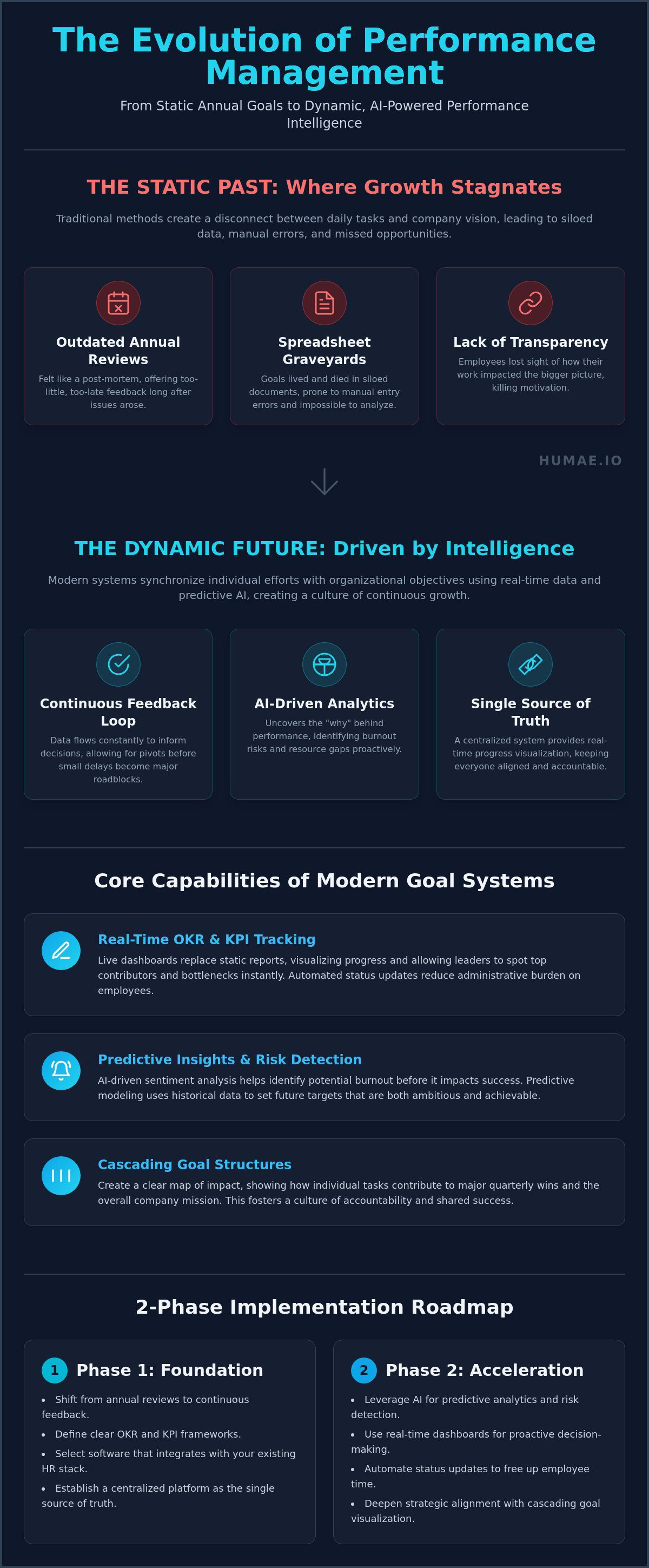
The landscape has evolved significantly. We've moved away from static annual reviews that felt like a post-mortem of the previous year. Today, we embrace continuous performance intelligence. This approach integrates into the broader discipline of Business performance management, where data flows constantly to inform decisions. It's about building a modern infrastructure that supports growth rather than just documenting it. When your goal systems are alive, they provide a pulse for the entire organization, allowing for pivots before small delays become major roadblocks.
Core Functionalities of Modern Goal Systems
A robust system in 2026 prioritizes visibility and automation. Real-time progress visualization allows leaders to see exactly where projects stand without chasing updates via email. Automated status updates reduce the administrative burden on employees, letting them focus on actual work. Perhaps most importantly, cascading goal structures create a clear map of impact. These structures show how a single task completed by an engineer or a marketer feeds into a major quarterly win. By integrating these goals with your employee directory, ownership becomes transparent. Everyone knows who is driving which initiative, fostering a culture of accountability and shared success.
Why Spreadsheets Fail the Modern Workforce
Relying on spreadsheets for goal management is a recipe for stagnation. The high cost of manual data entry isn't just about time; it's about the inevitable human error that leads to outdated or flat-out wrong information. When goals live in a siloed document, they effectively die in that silo. Transparency vanishes, and team members lose the context needed to stay motivated. Leadership also suffers because generating actionable analytics from fragmented files is nearly impossible. Without a centralized system, you're managing by guesswork rather than intelligence. Modern teams need a single source of truth that updates as fast as the business moves.
The Rise of Performance Intelligence and AI Analytics
Modern performance goal tracking software has graduated from passive record-keeping to active intelligence. It's no longer enough to know that a goal was missed; leaders need to understand the underlying causes that led to that outcome. AI-driven insights provide this depth by analyzing work patterns and communication flows in real time. This allows you to distinguish between a lack of resources, a mismatch in skills, or a simple lack of strategic alignment. By focusing on the "why" instead of just the "what," you're empowered to make proactive adjustments that keep your team on the path to success.
High-performing teams rely on analytics dashboards to spot their top contributors instantly. These visual hubs aggregate thousands of data points from across the organization, revealing who consistently exceeds benchmarks and where bottlenecks are forming. Beyond identifying stars, these tools enable sophisticated predictive modeling. By looking at historical completion rates, project complexity, and even seasonal trends, the software helps you set future targets that are ambitious yet achievable. You're no longer guessing at what's possible; you're using concrete data to map your organization's future trajectory with confidence.
Real-Time OKR Tracking Capabilities
Static goals are obsolete the moment they're typed into a document. Modern systems ensure your Objectives and Key Results (OKRs) stay relevant through automatic integrations with the tools your team uses every day. Whether it's a CRM update, a completed code commit, or a closed support ticket, the data flows directly into your performance hub. This creates a single source of truth for every department, eliminating the "your data vs. my data" arguments that often plague executive meetings. By linking these OKRs to your broader workforce management infrastructure, you can allocate talent and resources where they'll have the most significant impact on the bottom line.
AI-Driven Sentiment Analysis
The most advanced platforms recognize that numbers only tell half the story. AI-driven sentiment analysis examines qualitative feedback from check-ins, peer reviews, and internal surveys to gauge team morale. It's a powerful early-warning system for identifying burnout before it leads to missed deadlines or employee turnover. By connecting engagement levels to objective completion rates, you gain a truly holistic view of organizational health. Sentiment analysis serves as the essential bridge between cold performance data and the nuances of the human experience. If you're ready to see the human side of your data, you might want to explore how AI transforms performance tracking.
Evaluating Performance Goal Tracking Software: A Comparison Framework
Choosing the right performance goal tracking software requires a shift in perspective. It's not just about a feature list; it's about how the tool lives within your daily workflows. Leaders must prioritize ease of use to ensure high adoption. If employees find the system intuitive, they'll actually use it, providing the rich data needed for performance intelligence. Integration depth and AI sophistication are the next pillars. You need a platform that doesn't just store data but interprets it to offer meaningful guidance for your team's growth.
The best solutions bridge the gap between recruitment and results. When your goal tracking connects directly to hiring and onboarding, you set clear expectations from day one. New hires shouldn't have to wait months to understand their impact on the company's mission. For modern, remote-first teams, mobile accessibility is non-negotiable. Performance conversations happen in real-time, often on the go, and your software must support that flexibility. Finally, evaluate the total cost of ownership. Look beyond the sticker price of the monthly subscription and consider implementation speed, training requirements, and the hidden costs of managing multiple disconnected tools.
Integration with the Core HRMS
Goal tracking shouldn't exist in a vacuum. It's far more effective when it's not a separate silo from your HRIS. Having performance data alongside time-off records and directory info provides a 360-degree view of employee health. This centralized approach streamlines the transition from a new hire to a high-performing contributor by keeping all relevant information in one place. It reduces friction for managers and HR teams alike, ensuring that data flows seamlessly across the entire employee lifecycle.
Scalability for Startups and Enterprises
Your needs will change as you grow. Startups often prioritize speed and simplicity to get moving quickly. They need tools that require minimal setup and provide immediate value. Enterprises, however, demand advanced security, granular permissions, and complex reporting to manage thousands of employees across different regions. It's vital to choose a partner that offers a workforce management infrastructure capable of growing with you. You don't want to migrate your entire goal history every time your organization hits a new headcount milestone.
How to Implement Goal Tracking That Actually Drives Growth
Implementing performance goal tracking software shouldn't be a hurdle. It's a strategic shift that transforms how your team perceives and achieves success. When you deploy performance goal tracking software, the transition from theory to practice requires a clear roadmap. We've identified four distinct phases that move your organization from initial strategy to a daily habit of high performance.
Phase 1 begins with defining your framework. You might choose OKRs for moonshot thinking or KPIs for operational excellence, but the goal is to create a common language that everyone understands. Many innovative teams now opt for a hybrid model that balances bold ambition with steady-state metrics. Phase 2 involves setting up the digital infrastructure. This is where you import your team directory, establish reporting hierarchies, and connect your existing tech stack to ensure data flows automatically.
Phase 3 focuses on driving adoption through leadership buy-in. If the executive team doesn't update their goals in the system, the rest of the organization won't see the value. Leadership must be the first to adopt the new rhythm to signal its importance. Finally, Phase 4 is about continuous iteration. Use the analytics from your first quarter to see where goals were too easy or impossibly hard. Use these insights to refine the process for the next cycle, ensuring your targets stay realistic yet challenging.
Setting Up the Infrastructure
A strong foundation starts with alignment. You must connect top-level company objectives directly to individual key results so every employee sees their specific contribution. Every goal needs a named owner and a strict deadline to maintain accountability across the board. Utilizing standardized templates across departments ensures that everyone follows the same quality of goal-setting, which prevents confusion and data fragmentation. When the infrastructure is clear, the work becomes focused and meaningful. It's about creating a system where progress is visible to everyone who needs to see it.
Driving Team Adoption
Software alone doesn't change culture; people do. You need to train managers to use the platform as a coaching tool rather than a surveillance device. Shift the focus from annual reviews to a culture of continuous feedback where progress is celebrated in real-time. Modern software reduces the friction of the weekly check-in process by automating data updates and providing instant progress visualizations. This turns an administrative chore into a supportive, value-driven dialogue between managers and their teams. If you're ready to modernize your team's approach, you can see how our platform simplifies implementation and drives immediate results.
Humae: The AI-Powered Infrastructure for High Performance
Humae represents a fundamental shift in how businesses approach human potential. We don't just provide a tool; we offer the centralized infrastructure required to manage every stage of the employee journey. By unifying hiring, onboarding, and performance into a single ecosystem, we eliminate the data silos that typically hinder organizational growth. In 2026, leaders recognize that fragmented systems lead to fragmented results. Humae provides the clarity needed to keep every team member aligned with the company's core mission from their very first day. Data silos die here. Growth becomes predictable.
Choosing the right performance goal tracking software is about more than just checking off key results. It's about empowering your workforce with intelligence that feels supportive rather than intrusive. Our platform stands out because it treats performance as a continuous conversation. We've built an environment where AI doesn't just track progress but actively helps managers identify opportunities for mentorship and development. The power of our platform lies in the seamless integration of OKR tracking and sentiment analysis within one interface. This provides a dual view of both productivity and emotional engagement, ensuring that your team stays both effective and inspired.
Centralized Workforce Management
Managing the full employee lifecycle becomes effortless when everything lives in one place. From a single, intuitive dashboard, you can oversee recruitment, manage the directory, and monitor time-off requests alongside performance metrics. Consolidating these functions reduces the tool fatigue that often drains team productivity and morale. When your data isn't scattered across five different apps, you gain a level of visibility that was previously impossible. You can explore how Humae features simplify these complex HR tasks to create a more cohesive work environment. This unique blend of high-tech analytics and high-touch human connection is why modern organizations trust Humae as their primary performance goal tracking software.
Actionable Performance Intelligence
Humae transforms raw data into strategic decisions. Our AI-driven tools provide a competitive edge by offering real-time insights into team health and goal trajectory. Instead of waiting for a quarterly report, managers receive proactive alerts that highlight potential roadblocks before they impact the bottom line. This level of intelligence allows for faster pivots and more informed resource allocation. It's about moving from reactive management to visionary leadership. You can see how it works and start building a high-performance culture that thrives on transparency and mutual success today.
Lead Your Team Toward a New Era of Performance
The shift from static objectives to continuous intelligence is no longer optional for growth-minded leaders. By embracing a centralized HR infrastructure, you ensure that every individual's effort is visible and valued in real time. Real-time OKR tracking and AI-powered sentiment analysis transform raw data into a supportive coaching environment that fosters long-term success. This approach doesn't just track progress; it protects your most valuable asset: your people.
Choosing the right performance goal tracking software is the first step in building a resilient, high-performing culture that adapts as fast as the market does. When you unify your hiring, onboarding, and goal-setting processes, you remove the friction that slows down innovation. It's about creating a workspace where everyone knows their impact. Your organization's potential is limitless when strategy and execution move in perfect harmony. For high-performing leaders seeking to extend this strategic edge to their asset portfolios, Hummingbird Executive offers private access to exclusive off-market opportunities. We're excited to help you bridge that gap with technology that feels human and acts with precision.
Optimize your team’s growth with Humae today
Humae is your partner in modern workforce management. Connect with us on Facebook, visit our official website, or return to the home page.
Frequently Asked Questions
Is performance goal tracking software different from project management software?
Yes, these tools serve distinct purposes within an organization. Project management software tracks the daily "how" of work, focusing on tasks, deadlines, and specific deliverables. In contrast, performance goal tracking software focuses on the "why" by connecting those daily actions to high-level strategic objectives. It provides a bird's-eye view of organizational impact and individual growth rather than just managing a to-do list.
Can AI really predict employee performance issues?
AI predicts potential issues by analyzing patterns in sentiment and progress data that human managers might overlook. By identifying subtle shifts in communication or a sudden plateau in objective completion, the system flags risks like burnout or disengagement early. This proactive approach allows you to step in with support before a small hurdle becomes a major setback. It turns performance management into a preventive strategy rather than a reactive one.
How much does performance goal tracking software typically cost?
Pricing for these solutions varies based on your organization's size and the sophistication of the features you need. Most platforms offer tiered subscriptions that scale according to your headcount and the depth of AI capabilities required. Factors such as integration complexity and advanced analytics dashboards will influence the final investment. It's best to evaluate your specific workforce needs to find a balance between high-level functionality and your budget.
What is the difference between OKRs and KPIs in goal software?
OKRs (Objectives and Key Results) are designed for ambitious growth and directional change. They push teams to reach for new milestones. KPIs (Key Performance Indicators) measure the ongoing health and stability of your business processes. A robust performance goal tracking software should manage both frameworks simultaneously. OKRs drive your organization forward; KPIs ensure your foundation remains solid while you scale.
How do I ensure my team actually uses the goal tracking tool?
Adoption starts at the top. When leadership uses the tool to share their own progress and celebrate wins, it signals that the system is a genuine priority. Focus on positioning the software as a coaching resource rather than a tool for surveillance. When employees realize the data helps them gain recognition and professional development, they're much more likely to engage with the platform as part of their daily rhythm.
What happens if our company goals change mid-quarter?
Modern software is built for agility and doesn't treat goals as if they're set in stone. If your market or strategy shifts, you can update key results or pivot objectives mid-quarter without losing your historical data. This flexibility ensures your team stays focused on what is currently relevant rather than wasting energy on obsolete targets. It's always better to adjust a goal than to chase an objective that no longer serves the mission.
Can small startups benefit from AI performance intelligence?
Startups often see the greatest impact from AI intelligence because it helps maintain alignment during periods of rapid, chaotic scaling. When roles are fluid, having a data-driven source of truth keeps everyone moving in the same direction. AI insights can also identify high-potential contributors early, allowing you to nurture the talent that will lead your company's future. This structural foundation is critical for companies scaling in competitive markets, where managing internal performance is just as vital as securing high-quality leads for tradespeople UK to maintain momentum and build a high-performance culture from day one.
Is my employee data secure in a cloud-based HR platform?
Cloud-based platforms prioritize security through advanced encryption and strict compliance standards. Leading providers implement rigorous protocols to ensure that sensitive employee information remains protected from unauthorized access. Regular security audits and granular permission controls are standard features in modern systems. You can trust that your organizational data is guarded by the same level of security used by global financial institutions to protect their most sensitive assets.