Mastering OKR and Performance Management: The 2026 Guide to Integrated Strategy
By Humae · 13 July 2026
okr and performance management
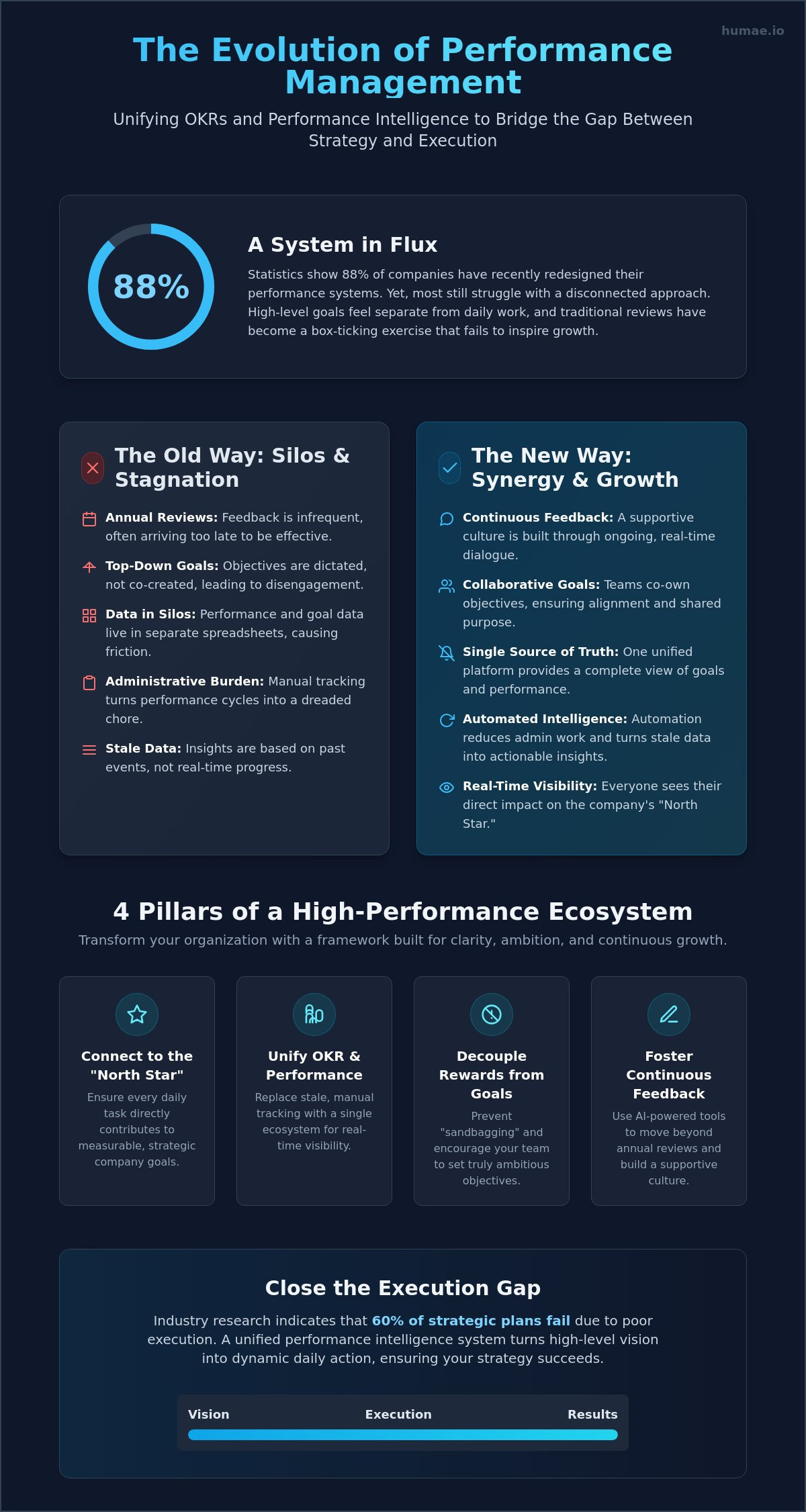
Statistics show that 88% of companies have redesigned their performance systems recently, yet many leaders still feel trapped by a disconnected approach to okr and performance management. It's exhausting when your high-level company goals feel entirely separated from the daily tasks your team actually performs. Most managers agree that traditional performance reviews have become little more than a box-ticking exercise that fails to inspire genuine growth or clarify the path forward.
In the following sections, we'll show you how to bridge that gap by unifying strategic goal-setting with continuous performance intelligence. You'll discover how to create a single, high-performance ecosystem that drives measurable growth and deeper employee engagement. We'll explore the practical steps to build a system that offers real-time visibility into goal health while fostering a culture of radical transparency across your entire organization, turning stale data into actionable insights for everyone involved.
Key Takeaways
- Connect individual daily tasks to the company "North Star" to ensure every effort contributes to measurable strategic growth.
- Unify okr and performance management into a single ecosystem to replace stale manual tracking with real-time visibility.
- Decouple financial rewards from strategic goals to prevent sandbagging and encourage your team to set truly ambitious objectives.
- Use AI-powered sentiment analysis to move beyond annual reviews and establish a continuous, supportive feedback culture.
The Evolution of OKR and Performance Management in 2026
The business world has moved past the era where goals and people were managed in separate spreadsheets. By 2026, the convergence of okr and performance management has become the baseline for any organization serious about scaling. Think of Objectives and Key Results (OKR) as the strategic "What and How" of your company. They define the destination and the concrete milestones. Performance management, on the other hand, focuses on the "Who and How Well." It's the engine of employee growth and professional development.
When these two systems live in isolation, friction is inevitable. Strategy feels like a distant corporate mandate, while growth discussions feel like a disconnected administrative chore. Modern leadership requires a unified approach. We call this Performance Intelligence. It's the evolution of the old annual appraisal, replacing static checkboxes with a living, breathing map of organizational health and individual potential. Research shows that while 95% of companies have a formal performance process, 88% have redesigned their systems recently to meet these shifting demands. They're looking for a way to make work more meaningful and results more visible.
Setting the Stage: OKRs vs. Traditional Reviews
Annual reviews simply can't keep up with a digital-first economy. Waiting twelve months to give feedback is a recipe for stagnation and disengagement. The modern OKR meaning has shifted from a rigid quarterly planning tool to a framework for real-time adaptability. Instead of top-down evaluations that spark anxiety, teams now favor collaborative goal-setting. This shift ensures that every contributor understands their impact instantly. It isn't just about judging past performance; it's about enabling future success through constant alignment.
The Synergy of Goals and Growth
High-trust cultures aren't built on secrets. They're built on radical transparency. When you integrate okr and performance management, you provide the necessary context for every performance discussion. Managers no longer have to guess what an employee has achieved or where they struggled. The data is right there, accessible and objective. This visibility acts as the most effective form of employee recognition. Seeing a key result move from 20% to 80% provides more motivation than a generic "good job" ever could. By centralizing these insights, you create a supportive environment where growth is measurable and success is shared across the entire team.
Strategic Alignment: Why OKRs and Performance Intelligence are Better Together
Strategic alignment isn't just a management buzzword; it's the difference between a team that's busy and a team that's effective. When you unify okr and performance management, you give every employee a clear view of the company's "North Star." This connection ensures that individual contributors don't just complete tasks; they drive the business forward. Without this link, people often work in silos, unaware that their efforts might be drifting away from the core mission. It's about making sure the "work" and the "purpose" are always in the same room.
Friction occurs the moment your goals and performance data live in separate tools. Managers find themselves jumping between tabs, trying to piece together a story from fragmented data. A single source of truth for all people operations eliminates this chaos. By centralizing these insights, organizations can see exactly how team health impacts goal achievement in real-time. This integration isn't just about data; it's about people. When you leverage automated features to sync progress updates, you remove the heavy administrative lifting that often makes performance cycles feel like a burden. It allows leaders to focus on coaching rather than chasing status updates.
Closing the Execution Gap
Industry research indicates that roughly 60 percent of strategic plans fail because of poor execution. The gap between a high-level vision and daily reality is often too wide to bridge with annual planning alone. Real-time tracking turns those static quarterly goals into dynamic daily actions. Instead of a rigid hierarchy, you create a cascading system where goals are transparent and adaptable. This fluidity allows teams to pivot quickly without losing sight of the ultimate objective. It transforms strategy from a dusty document into a living part of the organizational culture.
Data-Driven Performance Conversations
Subjective opinions are the enemy of fair performance reviews. Moving toward objective, metric-based feedback changes the entire dynamic of a 1-on-1 meeting. When managers use OKR progress as a baseline, the conversation naturally shifts toward career development and problem-solving. Microsoft's guidance on OKRs highlights that while these frameworks are distinct, they must work in tandem to identify top talent and future leaders accurately. This intelligence helps you spot high-potential employees who are consistently hitting ambitious targets, allowing for more proactive succession planning.
Ready to see how a unified platform can clarify your strategy? You can explore our approach to performance intelligence to start building a more aligned workforce today.
The Great Debate: Why You Must Separate OKRs from Compensation
Tying a paycheck directly to a stretch goal is the fastest way to kill innovation in a modern company. When an employee knows that missing a target by 10% will result in a smaller bonus, they won't aim for the moon. They'll aim for the ceiling. This psychological trap is exactly why the most successful organizations in 2026 keep their okr and performance management systems connected but distinct. You want your team to be obsessed with impact, not playing it safe to protect their commission. When money is the primary driver for a specific objective, the focus shifts from growth to survival.
This conflict leads to a phenomenon known as "sandbagging." Employees start setting easier goals that they are certain to achieve, rather than the ambitious targets that actually drive the business forward. To avoid this, leaders should use OKR data as a signal rather than a formula. For a deeper dive into how these frameworks interact without compromising motivation, Microsoft's guide to OKRs and performance management provides an excellent blueprint for maintaining this balance. By using OKRs to inform the conversation about an individual's impact, you can reward overall contribution without punishing the risk-taking that leads to breakthroughs.
Preserving the Spirit of Ambition
OKRs are designed for "stretch" goals. In a healthy culture, achieving 70% of a truly difficult objective is often more valuable than hitting 100% of an easy one. Separation encourages your team to take calculated risks and innovate without fear of financial penalty. This approach builds psychological safety, which is the foundation of every high-performing team. When people feel safe to fail, they're much more likely to discover the next big growth lever for your company. It turns the workplace into a laboratory for success rather than a courtroom for evaluation.
A New Model for Rewards in 2026
Modern performance intelligence allows you to assess the "how" just as much as the "what." Instead of a rigid, once-a-year bonus based on a single number, 2026 rewards are built on a holistic view of employee value. This includes peer feedback, alignment with company values, and the consistent behaviors that lead to long-term success. Continuous feedback cycles are far more motivating than a delayed financial reward. By rewarding the overall impact and the growth of the individual, you foster a culture where excellence becomes a habit, not just a scramble for a year-end payout.
Implementing a Continuous Performance Framework
Setting up a sustainable rhythm is what separates high-growth companies from those that just go through the motions. To successfully integrate okr and performance management, you need a framework that feels like a natural part of the workday rather than an extra chore. It isn't about adding more meetings; it's about making the existing ones more meaningful. It starts with five clear steps:
- Step 1: Set quarterly OKRs that are visible to the entire organization. Transparency breeds accountability and helps everyone understand how their piece fits into the bigger picture.
- Step 2: Establish a weekly 15-minute check-in rhythm for every team. This creates a predictable heartbeat for progress and ensures no one is drifting in the wrong direction.
- Step 3: Use real-time analytics dashboards to prepare for reviews. Coming to a meeting with data already in hand saves time, reduces bias, and keeps the focus on coaching.
- Step 4: Conduct monthly alignment sessions. These are critical for adjusting resources and shifting priorities. If a market shift happens in week four, you don't want to wait until week twelve to react.
- Step 5: Hold quarterly retrospectives. Focus these sessions on what the team learned during the cycle. The goal is to improve the process for the next quarter, not to assign blame for missed targets.
The Weekly Check-In: The Heartbeat of Progress
Consistency is the secret sauce. A quick, weekly touchpoint keeps goals top-of-mind and ensures that okr and performance management isn't something people only think about every three months. Focus on blockers and deltas. What changed since last week? What's standing in your way? Keep these meetings under 15 minutes to respect everyone's time. By documenting decisions in a centralized system, you create a trail of intelligence that makes future evaluations effortless. This rhythm turns strategy into a series of manageable, high-impact actions.
Bridging the Gap with Continuous Feedback
The old "Annual Event" mindset is dead. In a modern culture, feedback is "always on." Real-time recognition doesn't just boost morale; it reinforces the specific behaviors that lead to goal achievement. When feedback loops are integrated directly into your goal-tracking process, growth becomes a byproduct of daily work. This continuous flow of information ensures that by the time you reach a formal review, there are zero surprises. It creates a supportive environment where employees feel seen and valued for their daily contributions.
Ready to build your own rhythm? You can start your journey with a modern performance infrastructure that keeps your team moving in sync.
The AI Advantage: Future-Proofing Strategy with Humae
Technology should do more than just store your data; it should actively help you lead. By weaving your okr and performance management efforts into a broader workforce management infrastructure, you move from reactive problem-solving to proactive leadership. Humae doesn't just list your objectives. It connects those goals to your employee directory, feedback loops, and performance intelligence tools. This centralization ensures that when a new hire joins, their onboarding is already aligned with the team's quarterly stretch goals from day one.
The real magic happens when AI steps in to analyze the human element behind the metrics. Most tools tell you that a goal is failing only after the deadline has passed. Predictive intelligence changes the game by identifying at-risk objectives weeks in advance. By monitoring goal velocity and participation rates, the system flags potential issues before they impact your bottom line. It gives managers the foresight they need to offer support exactly when it's required, rather than waiting for a post-mortem meeting. This approach ensures your okr and performance management systems are always working to protect your growth.
AI-Powered Performance Intelligence
AI-driven sentiment analysis provides a pulse check on team health that manual surveys simply can't match. It detects patterns of disengagement or burnout by looking at how teams interact with their work. If goal velocity drops sharply, the platform can send automated nudges to keep teams accountable. This reduces the need for constant manager intervention while maintaining momentum. These tools even summarize months of feedback into actionable leadership insights, helping you understand the "why" behind every success or setback.
The ROI of Integrated People Operations
Fragmented data is expensive. When your hiring, onboarding, and goal execution live in different silos, you lose hours to manual reporting and reconciliation. An integrated platform slashes these costs while improving employee retention. People stay when they see a clear growth path and understand how their work matters. By unifying your strategy and your people data, you create a culture of continuous success where every team member feels empowered to contribute.
Experience the future of performance intelligence with Humae and see how AI can transform your organizational health.
Scaling Strategy with AI-Powered Confidence
Scaling your organization in 2026 requires more than just ambition; it demands a unified infrastructure that connects every individual effort to your strategic North Star. You've seen how separating OKRs from compensation preserves the spirit of innovation, while a continuous check-in rhythm keeps progress visible and actionable. The traditional approach of managing goals and people in isolated silos is no longer enough to stay competitive in a fast-paced economy. Leaders who embrace this shift find that transparency doesn't just improve results; it builds a culture of trust and shared success across every department.
The future of okr and performance management is powered by intelligence that works as hard as your team does. By leveraging AI-driven sentiment analysis and real-time performance analytics, you can spot risks before they become roadblocks. Integrated OKR tracking ensures that your strategy isn't just a document on a shelf, but a living part of your daily operations. It's time to move beyond manual tracking and embrace a system that supports both your business growth and your people's well-being—a goal that can be further enhanced by incorporating natural wellness resources from Mental Compass. You have the tools to turn every challenge into a learning opportunity for your entire workforce.
Start your journey toward AI-powered performance intelligence with Humae and build a more resilient, aligned organization today.
Frequently Asked Questions
How often should we update our OKR tracking software?
You should update your OKR progress at least once a week during your team check-ins. This frequency ensures that your data remains fresh and actionable for real-time decision-making. Stale data leads to organizational disengagement, whereas weekly updates allow you to celebrate small wins and address blockers before they become major issues.
Can OKR and performance management coexist in a small startup?
Yes, okr and performance management are essential for small startups because they provide the focus needed to scale without losing alignment. Startups often struggle with shifting priorities, so a clear framework helps the team stay concentrated on the most impactful tasks. It builds a culture of accountability and transparency from the very beginning of your journey.
What is the best way to introduce OKRs to a team used to traditional reviews?
The best approach is to position OKRs as a supportive tool for empowerment rather than a new way to judge people. Start with a pilot program in one department to demonstrate success and gather internal champions. Emphasize that these goals are about strategic growth and alignment, which feels much more collaborative than a top-down annual review.
Should we use a different tool for OKRs than we use for our employee directory?
No, you should avoid using separate tools because data fragmentation creates administrative friction and leads to stale insights. Keeping your goals, performance intelligence, and employee directory in one centralized platform ensures that strategy is always viewed in the context of the people. This integration provides a single source of truth for your entire organization.
How does AI help managers give better performance feedback?
AI assists managers by providing objective data points and sentiment analysis that remove personal bias from the feedback process. It can summarize feedback trends and highlight patterns of high performance or potential burnout. This intelligence allows managers to have more empathetic and data-backed conversations that focus on long-term career development.
What happens if a team consistently misses their Key Results?
Consistently missing Key Results is usually a signal that your goals are too ambitious or your team lacks the necessary resources. Use these moments as a learning retrospective rather than a blame-shifting exercise. It's an opportunity to recalibrate your strategy and ensure that future objectives are challenging yet realistic for your current capacity.
Is it possible to track OKRs in a spreadsheet in 2026?
While you can technically use a spreadsheet, it's highly inefficient due to the lack of real-time visibility and automated nudges. Manual tracking often results in "zombie goals" that no one looks at until the end of the quarter. Modern platforms offer predictive health features and automated reporting that a static spreadsheet simply cannot match.
How do we ensure OKRs don’t lead to employee burnout?
To prevent burnout, leaders must ensure that OKRs are viewed as "stretch" goals where 70% achievement is considered a success. Use AI-driven sentiment analysis to monitor team stress levels and goal velocity in real-time. When the data shows a team is pushing too hard, managers should proactively adjust priorities and reinforce psychological safety.