Key Metrics for HR Dashboards: 2026 People Analytics Guide
By Humae · 15 August 2026
key metrics for HR dashboards
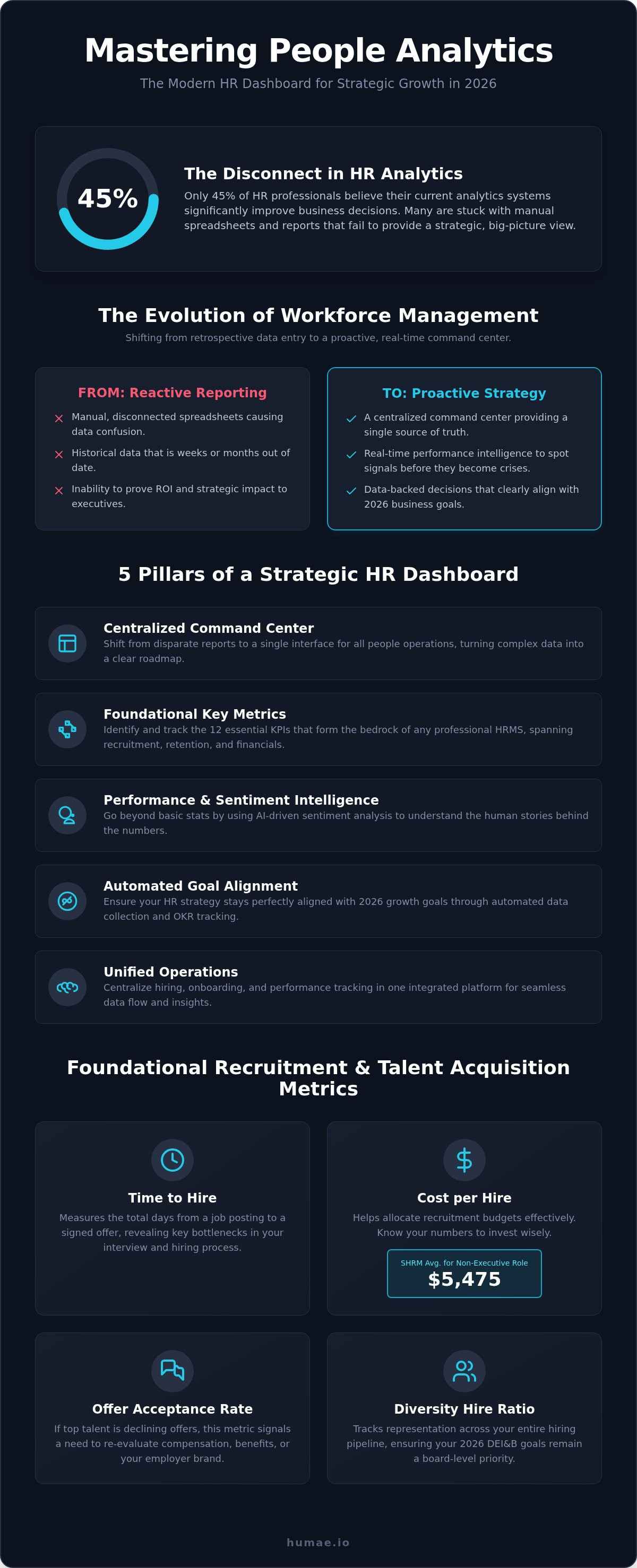
Only 45% of HR professionals believe their analytics systems actually improve business decisions. It's a frustrating reality when you're buried under manual spreadsheets and disconnected reports that fail to show the bigger picture. You know that HR should be a strategic growth engine, yet proving ROI to executives feels like an uphill battle without the right key metrics for HR dashboards. We understand that behind every data point is a person, and your tools should reflect that human element while providing the technical precision you need.
This guide will help you master the essential data points and AI-driven insights required to move beyond retrospective tracking into real-time performance intelligence. We'll provide a clear list of actionable KPIs and show you how to automate your reporting to align perfectly with your organization's 2026 business goals. From predictive flight risk analysis to real-time OKR tracking, you're about to transform your data into a visionary roadmap for success.
Key Takeaways
- Shift from reactive reporting to proactive workforce management by treating your dashboard as a centralized command center for people operations.
- Identify the 12 key metrics for HR dashboards that serve as the foundation for any professional HRMS, spanning recruitment, retention, and financials.
- Go beyond basic stats with Performance Intelligence, using AI-driven sentiment analysis to understand the human stories behind the numbers.
- Master the steps to automate your data collection, ensuring your HR strategy stays perfectly aligned with your organization's 2026 growth goals.
- Centralize hiring, onboarding, and OKR tracking in one interface to turn complex data into a clear, strategic roadmap for success.
Why HR Dashboards are Essential for Modern Workforce Management
Think of your HR dashboard as the centralized command center for your entire organization. It's no longer enough to look back at what happened last month. In 2026, modern leadership requires a proactive stance. You need to see the signals before they become crises. This shift from reactive reporting to a proactive workforce management infrastructure changes everything. It moves you from a state of data confusion, where spreadsheets feel like a maze, to a position of strategic confidence. You aren't just presenting numbers; you're telling the story of your company's growth using a single source of truth. This clarity allows you to focus on the human side of the business while the technology handles the heavy lifting of data aggregation.
HR Metrics vs. HR KPIs: Knowing the Difference
Distinguishing between metrics and KPIs is the first step toward clarity. HR metrics are broad data points. They show you the general state of the department, like total headcount or training hours completed. KPIs are different. They are the high-stakes targets tied to your 2026 business goals. When you track too many metrics, you end up with dashboard fatigue. This happens when the volume of data makes it impossible to see what actually matters. A simple rule for selecting the right key metrics for HR dashboards is to ask: "If this number drops by 10%, what specific action will we take?" If there's no clear answer, keep it as a background metric rather than a primary KPI. This focus ensures your dashboard remains a tool for action rather than just a digital archive.
The Role of Workforce Management Infrastructure in 2026
Integrated platforms have officially replaced the chaos of disconnected spreadsheets. In 2026, a robust workforce management infrastructure is the backbone of any successful people strategy. It provides the real-time visibility that modern leadership demands. You can't lead effectively if your data is two weeks old. This infrastructure connects hiring, onboarding, and performance data into a single, living ecosystem. This connectivity is what allows for predictive insights rather than just historical summaries. When your systems talk to each other, you spend less time cleaning data and more time acting on the insights it provides. By centralizing these key metrics for HR dashboards, you create a transparent environment where every decision is backed by evidence and every employee's progress is visible.
The 12 Essential HR Metrics Every Team Should Track
Data without structure is just noise. To build a high-performing culture in 2026, you need a solid foundation that transforms raw numbers into a clear picture of organizational health. These twelve data points represent the key metrics for HR dashboards that every professional HRMS must prioritize. They provide the "what" of your company's current state, allowing you to identify trends before they become obstacles. Consistency is your greatest asset here; when every team member collects data the same way, your insights become undeniable.
Recruitment and Talent Acquisition Metrics
Your hiring pipeline is the lifeblood of your growth. Efficiency here saves more than just time; it protects your bottom line. Tracking these four metrics ensures your talent engine is humming:
- Time to Hire: This measures the days from a job posting to a signed offer. It reveals bottlenecks in your interview process.
- Cost per Hire: According to SHRM data, the average cost for a non-executive role is $5,475. Knowing your specific number helps you allocate recruitment budgets effectively.
- Offer Acceptance Rate: If top talent is saying "no," it's time to re-evaluate your compensation packages or employer brand.
- Diversity Hire Ratio: This tracks representation across your pipeline, ensuring your 2026 DEI&B goals remain a board-level priority.
Retention and Employee Lifecycle Metrics
Hiring talent is only half the battle. Keeping them is where the real value is created. These metrics help you spot flight risks and cultural shifts early:
- Employee Turnover Rate: With voluntary turnover in knowledge sectors hitting 18-20% recently, monitoring this helps you identify which departments need support.
- Average Tenure: This measures the long-term stability of your workforce. High tenure often correlates with deeper institutional knowledge.
- Absence Rate: Frequent unplanned time off is often a leading indicator of burnout or disengagement.
- Employee Net Promoter Score (eNPS): This simple metric gauges overall sentiment and loyalty, providing a pulse check on your culture.
Financial and Productivity Metrics
HR is a strategic partner, and these numbers prove it. They link people operations directly to business outcomes:
- Revenue per Employee: This is the ultimate productivity check, calculating the direct value created by your human capital.
- HR-to-Employee Ratio: This ensures your people operations team is properly scaled to support the rest of the organization.
- Training ROI: Since 94% of employees stay longer if you invest in their development, proving the financial return on these programs is vital for budget approval.
- Time to Productivity: This tracks how quickly a new hire starts contributing meaningful work, measuring the success of your onboarding process.
These metrics don't exist in a vacuum. A low turnover rate might look positive, but if it's paired with a high absence rate, you likely have a disengaged workforce. Integrating these data points into modern analytics dashboards allows you to see these connections clearly, turning fragmented stats into a cohesive strategy.
Beyond the Basics: Performance Intelligence and Sentiment Metrics
Traditional data tells you what happened in the past, but Performance Intelligence tells you why it happened and what is coming next. This is the new frontier for key metrics for HR dashboards in 2026. We are moving beyond static headcount reports into a world where human signals drive strategy. By layering AI over your standard data, you gain a visionary perspective that protects your culture and accelerates growth. This evolution transforms HR from a cost center into a powerhouse of predictive insight. It allows you to foster a growth mindset across the organization by making progress visible and meaningful for every team member.
Real-Time OKR Tracking for Strategic Alignment
Annual reviews are a relic of the past. In 2026, high-growth organizations rely on continuous monitoring to stay agile. Integrating objectives and key results directly into your daily dashboard ensures that every individual task supports a company-wide goal. This transparency eliminates the "silo effect" where teams work hard but move in different directions. When employees see how their daily contributions move the needle, engagement naturally rises. Understanding the deeper OKR meaning is the first step toward building this alignment. This infrastructure allows leadership to pivot quickly without losing momentum, ensuring that the entire workforce remains synchronized with the board's latest priorities.
AI-Driven Sentiment Analysis and Feedback
Numbers alone can't capture the mood of a workforce. AI now identifies subtle patterns in employee feedback to flag issues like burnout before they lead to turnover. This is critical when you consider that recent studies, such as those by the Institut de Veille Sanitaire, found that 34% of employees suffered from burnout in 2024. By using sentiment scores, you can measure engagement levels in real time rather than waiting for an annual survey. This process relies on "zero-party data," which is information intentionally shared by employees through recognition platforms and feedback loops. It provides a more reliable pulse check on the social climate of your company. Continuous feedback replaces the stress of traditional surveys with a supportive, ongoing conversation. This technical precision, combined with an empathetic approach, ensures you are supporting the humans behind the key metrics for HR dashboards.
When you connect these advanced insights with your foundational data, you create a complete picture of organizational health. You aren't just managing people; you're nurturing a community. This integrated approach ensures that your 2026 strategy is both data-driven and deeply human, providing the strategic confidence needed to lead in a complex business environment.
A Step-by-Step Guide to Building Actionable People Analytics
Identifying your stakeholders is the foundational step of any data strategy. A CEO focuses on revenue per employee and overall headcount growth, while an HR Business Partner needs to see tenure and department-specific turnover. Before you touch a single chart, write down the three most critical questions each leader needs to answer every Monday morning. This intentionality prevents the "cluttered spreadsheet" trap, where a wall of numbers obscures the truth. Your goal is a command center that highlights anomalies and celebrates wins, not a digital filing cabinet. By focusing on the questions first, you ensure your key metrics for HR dashboards serve as a catalyst for discussion rather than just a report.
Selecting Your Analytics Infrastructure
Integrated HRMS platforms have officially replaced the era of fragmented spreadsheets. In 2026, manual data entry is more than just a chore; it's a security risk and a source of constant error. This is likely why only 45% of HR professionals reported that their analytics systems improved talent and business decisions in 2025. To be part of the successful minority, you need specific features that automate data syncing from your ATS, employee directory, and performance tools. This automation ensures your key metrics for HR dashboards are always accurate without requiring hours of manual labor. Robust access control is equally vital, as it protects sensitive people data while ensuring managers have the visibility they need to lead effectively.
Designing for Executive Impact
Designing for executive impact requires a "less is more" philosophy. Leaders need to see trajectory and velocity, not just static snapshots. Use visual cues like color-coding to highlight urgent issues, such as a sudden spike in absenteeism or a drop in offer acceptance rates. This allows a busy executive to spot a potential crisis in seconds. Accessibility is another non-negotiable factor. In a fast-paced environment, your dashboard must be mobile-optimized so leaders can check organizational health between meetings or during travel. When the data is beautiful and easy to access, it becomes a natural part of the leadership's decision-making process.
Finally, establish a rigid review cadence to ensure data translates into results. A dashboard that nobody looks at is a wasted investment. Schedule monthly "People Strategy" sessions where you review your key metrics for HR dashboards and commit to specific interventions. If the data shows a decline in engagement within the engineering team, use that insight to launch a targeted feedback loop immediately. You can start building your automated dashboard today to turn these insights into a permanent competitive advantage for your organization.
Streamlining Your People Operations with Humae Dashboards
Managing a modern workforce shouldn't feel like a technical chore. Humae is an AI-powered platform designed for teams that prioritize both growth and human connection. We've built an infrastructure that centralizes your hiring, onboarding, and performance data into one intuitive command center. This isn't just about showing numbers; it's about providing a higher level of user experience for everyone involved. By removing the friction of manual data entry, you can focus on the strategic decisions that drive your culture forward. Our interface is so intuitive that your team won't need weeks of technical training to start uncovering valuable insights. It's time to move past the rigid, fragmented systems of the past and embrace a solution built for the speed of 2026.
All-in-One Analytics for High-Growth Teams
Fragmentation is the enemy of clarity. Humae solves this by combining your ATS, HRMS, and Analytics Dashboards in a single ecosystem. You don't have to jump between tools to see how your recruitment pipeline affects your long-term retention. Having your OKRs and performance intelligence in a single view allows you to see the direct link between individual effort and company-wide success. You can easily customize your view to highlight the specific key metrics for HR dashboards that matter most to your board. Whether you're tracking real-time sentiment or financial productivity, our platform adapts to your unique organizational needs. This centralized approach ensures that your data is always current, connected, and ready for action.
Getting Started with Humae in 2026
Transitioning from legacy systems often feels daunting, but it doesn't have to be. We've simplified the onboarding process so you can set up your first dashboard in record time. Our support team is a visionary partner for organizations moving away from clunky, traditional software. We understand the technical challenges of 2026 and provide a supportive attitude throughout your digital transformation. You'll never feel like you're just another ticket in a queue. Instead, you'll have a partner helping you turn raw data into a modern organizational vision. If you're ready to see the difference for yourself, you can explore how it works today. It's time to stop fighting your tools and start letting them work for you. Join the community of innovators who are already using key metrics for HR dashboards to build a more human, data-driven future.
Empowering Your 2026 People Strategy
Mastering the key metrics for HR dashboards is the first step toward transforming your people operations into a strategic powerhouse. You've learned how foundational metrics like turnover and training ROI provide the "what," while AI-driven performance intelligence reveals the "why" behind workforce trends. By integrating real-time OKR tracking and sentiment analysis into a single source of truth, you move from reactive guessing to proactive leadership. This clarity isn't just about technical efficiency; it's about building a workplace where every individual feels supported and every business decision is backed by solid evidence.
The future of HR is predictive and deeply human. You don't have to navigate this digital transition alone or remain trapped in manual spreadsheets. Modernizing your workforce infrastructure allows you to automate repetitive reporting and focus on your most valuable asset: your people. It's time to lead with confidence and turn your data into a visionary roadmap for organizational success.
Start building your modern HR dashboard with Humae today and leverage our integrated OKR tracking and real-time analytics designed for modern leaders. We're here to help you build a more connected, data-driven community.
Frequently Asked Questions
What are the most important metrics for a startup HR dashboard?
Startups should prioritize time to hire, cost per hire, and employee net promoter score (eNPS). Since scaling quickly is often the goal, you need to know how efficiently you are attracting talent. However, protecting your culture is equally vital. Tracking eNPS allows you to catch disengagement early before it damages your employer brand or leads to costly turnover during critical growth phases.
How often should HR dashboards be updated for maximum impact?
Real-time updates are the gold standard for 2026 people operations. Waiting for monthly or quarterly reports means you are always looking at the past. By the time you see a spike in absenteeism, the burnout may have already caused a resignation. Automated syncing between your HRMS and analytics tools ensures that leadership always has a live view of organizational health, allowing for immediate interventions.
Can I build an effective HR dashboard without using Excel?
Yes, and moving away from spreadsheets is actually a strategic advantage. Modern platforms automate the collection of key metrics for HR dashboards, which removes the risk of manual data entry errors. These tools provide real-time visibility and interactive visualizations that static Excel files simply cannot match. This transition allows your team to spend less time cleaning data and more time acting on strategic insights.
What is the difference between descriptive and predictive HR analytics?
Descriptive analytics explain what has already happened, such as your turnover rate for the previous quarter. Predictive analytics use AI to forecast future trends, like identifying which departments are at a higher risk of burnout. In 2026, the focus has shifted toward these forward-looking insights. This allows you to intervene early and prevent issues rather than just reporting on them after the damage is done.
How many KPIs should I track on a single HR dashboard?
Focus on 5 to 7 high-impact KPIs to prevent dashboard fatigue. While your system might collect dozens of data points, your primary view should only feature the metrics that directly trigger a business decision. If a number doesn't prompt a specific action when it changes, it should be moved to a secondary report. This keeps your leadership team focused on what truly drives organizational growth.
Is AI-driven sentiment analysis accurate for small teams?
AI-driven sentiment analysis is highly effective for small teams because it provides an objective, anonymous pulse check. In smaller groups, personal biases can sometimes cloud a manager's perception of team morale. AI identifies subtle patterns in written feedback and recognition platforms, helping you understand the human signals within your culture. This ensures you can support your people effectively even in intimate, fast-paced business environments.
How do I ensure data privacy when sharing HR dashboards?
Data privacy is maintained through role-based access control and encryption. You should ensure that executives see high-level trends while managers only access data relevant to their specific teams. Modern analytics platforms are built with these security layers in mind, protecting sensitive information like individual performance scores. This transparency builds trust across the organization while staying compliant with strict 2026 data protection standards.